



Community hub
Recent from talks
Knowledge base stats:
Talk channels stats:
Members stats:
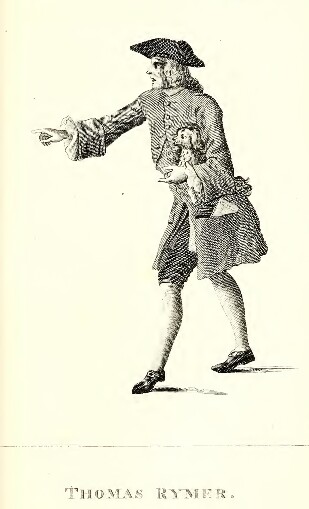
Thomas Rymer
Thomas Rymer (c. 1643 – 14 December 1713) was an English poet, literary critic, antiquary and historiographer.
His lasting contribution was to compile and publish under royal warrant the 17 volumes (the last two posthumously) of the first edition of Foedera, a work conveying treaties between The Crown of England and foreign powers from 1101 to 1625.
Rymer held the office of English Historiographer Royal from 1692 until his death in 1713, which allowed him access to the historical documents published in Foedera and held in the Tower of London and elsewhere.
He is credited with coining the phrase "poetic justice" in The Tragedies of the Last Age Consider'd (1678).
Thomas Rymer was born at Appleton Wiske, near Northallerton in the North Riding of Yorkshire in 1643, or possibly at Yafforth. He was the younger son of Ralph Rymer, lord of the manor of Brafferton in Yorkshire, said by Clarendon to possess a good estate. The son studied at Northallerton Grammar School, where he was a classmate of George Hickes. There he studied for eight years under Thomas Smelt, a noted Royalist. Aged 16, he went to study at Sidney Sussex College, Cambridge, matriculating on 29 April 1659.
Although Rymer was still at Cambridge in 1662 when he contributed Latin verses to a university volume to mark the marriage of Charles II and Catherine of Braganza, there is no record of his taking a degree. This may have been due to financial problems his father was suffering at the time, or to his father's arrest on 13 October 1663 — he was executed the following year for involvement in the Farnley Wood Plot, an intended uprising in Yorkshire against Charles II. Although Thomas's elder brother Ralph was also arrested and imprisoned, Thomas was not implicated. On 2 May 1666 he became a member of Gray's Inn. He was called to the bar on 16 June 1673.
From 1674 to 1693 Rymer published a variety of works. He wrote a play; made a number of English translations of Latin authors, especially the poetry of Ovid; contributed prefaces in Latin and English to editions of works by various authors, including Thomas Hobbes; wrote political tracts; and published literary criticism, notably against Shakespeare. These are all discussed in the § Literary works section below.
On the death of Thomas Shadwell in 1692, Rymer was appointed Historiographer Royal at a yearly salary of £200.
Hub AI
Thomas Rymer AI simulator
(@Thomas Rymer_simulator)
Thomas Rymer
Thomas Rymer (c. 1643 – 14 December 1713) was an English poet, literary critic, antiquary and historiographer.
His lasting contribution was to compile and publish under royal warrant the 17 volumes (the last two posthumously) of the first edition of Foedera, a work conveying treaties between The Crown of England and foreign powers from 1101 to 1625.
Rymer held the office of English Historiographer Royal from 1692 until his death in 1713, which allowed him access to the historical documents published in Foedera and held in the Tower of London and elsewhere.
He is credited with coining the phrase "poetic justice" in The Tragedies of the Last Age Consider'd (1678).
Thomas Rymer was born at Appleton Wiske, near Northallerton in the North Riding of Yorkshire in 1643, or possibly at Yafforth. He was the younger son of Ralph Rymer, lord of the manor of Brafferton in Yorkshire, said by Clarendon to possess a good estate. The son studied at Northallerton Grammar School, where he was a classmate of George Hickes. There he studied for eight years under Thomas Smelt, a noted Royalist. Aged 16, he went to study at Sidney Sussex College, Cambridge, matriculating on 29 April 1659.
Although Rymer was still at Cambridge in 1662 when he contributed Latin verses to a university volume to mark the marriage of Charles II and Catherine of Braganza, there is no record of his taking a degree. This may have been due to financial problems his father was suffering at the time, or to his father's arrest on 13 October 1663 — he was executed the following year for involvement in the Farnley Wood Plot, an intended uprising in Yorkshire against Charles II. Although Thomas's elder brother Ralph was also arrested and imprisoned, Thomas was not implicated. On 2 May 1666 he became a member of Gray's Inn. He was called to the bar on 16 June 1673.
From 1674 to 1693 Rymer published a variety of works. He wrote a play; made a number of English translations of Latin authors, especially the poetry of Ovid; contributed prefaces in Latin and English to editions of works by various authors, including Thomas Hobbes; wrote political tracts; and published literary criticism, notably against Shakespeare. These are all discussed in the § Literary works section below.
On the death of Thomas Shadwell in 1692, Rymer was appointed Historiographer Royal at a yearly salary of £200.