
Recent from talks
Scafell Pike
Knowledge base stats:
Talk channels stats:
Members stats:
Scafell Pike
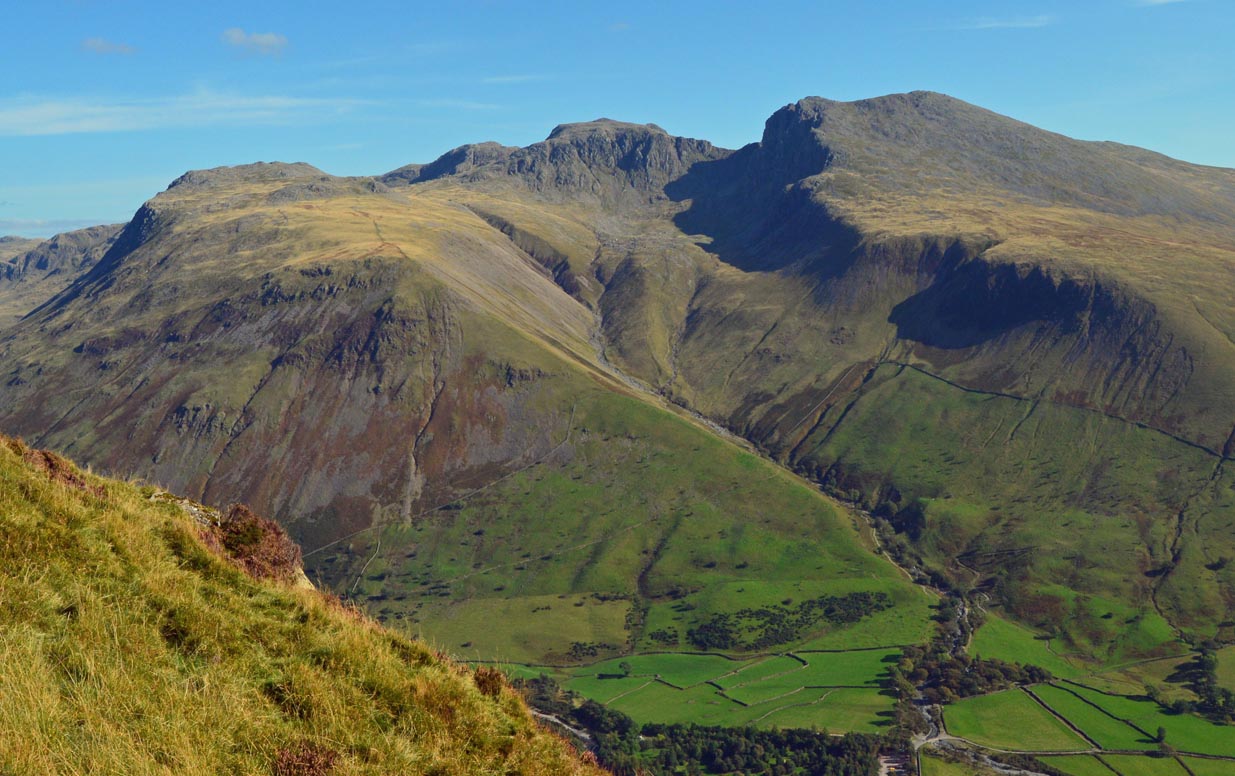
Scafell Pike (/ˈskɔːfɛl/) is a mountain in the Lake District region of Cumbria, England. It has an elevation of 978 metres (3,209 ft) above sea level, making it the highest and the most prominent mountain in England. The mountain is part of the Scafell massif, an extinct volcano, and is one of the Southern Fells.
The name Scafell is believed by some to derive from the Old Norse skalli fjall, meaning either the fell with the shieling or the fell with the bald summit, and is first recorded in 1578 in the corrupted form Skallfield.
Alternatively, Scafell means "the mountain of the scaw (or promontory)". This usage can be compared etymologically with, for example, Skaw, Unst.
The name originally referred to Scafell, which neighbours Scafell Pike. What are now known as Scafell Pike, Ill Crag, and Broad Crag were collectively called either the Pikes (peaks) or the Pikes of Scawfell (see below regarding spelling); from many angles, Scafell seems to be the highest peak, and the others were thus considered subsidiary to it. The name Scawfell Pikes was adopted "by common consent" according to Jonathan Otley, shortly before the publication of the 4th edition of his guidebook in 1830. Up to this point, England's highest mountain (its status as such was not known until the early 1800s) did not have a name of its own; it was labelled Sca-Fell Higher Top by the Ordnance Survey in their initial work in Cumbria in the first decade of the 19th century. The newly developed name reported by Otley first appeared on a published Ordnance Survey map in 1865.
Formerly the name was spelled Scawfell, which better reflects local pronunciation. This spelling has declined due to the Ordnance Survey's use of Scafell on their 1865 map and thereafter.
Scafell Pike is one of a horseshoe of high fells, open to the south, surrounding the head of Eskdale, Cumbria. It stands on the western side of the cirque, with Scafell to the south and Great End to the north. This ridge forms the watershed between Eskdale and Wasdale, which lies to the west.
The narrowest definition of Scafell Pike begins at the col of Mickledore 831.6 m (2,728 ft) in the south, takes in the wide, stony summit area and ends at the next depression, Broad Crag Col, c. 877.6 m (2,879 ft). A more inclusive view takes in two further tops: Broad Crag, 935.3 m (3,069 ft) and Ill Crag, 930.9 m (3,054 ft), the two being separated by Ill Crag Col, 882.3 m (2,895 ft). This is the position taken by most guidebooks. North of Ill Crag is the more definite depression of Calf Cove at 853.4 m (2,800 ft), before the ridge climbs again to Great End, 909.5 m (2,984 ft).
Scafell Pike also has outliers on either side of the ridge. Lingmell 807 m (2,648 ft), to the north west, is invariably regarded as a separate fell, while Pen, 760 metres (2,490 ft), a shapely summit above the Esk, is normally taken as a satellite of the Pike. Middleboot Knotts is a further top lying on the Wasdale slopes of Broad Crag, which is listed as a Nuttall.
Hub AI
Scafell Pike AI simulator
(@Scafell Pike_simulator)
Scafell Pike
Scafell Pike (/ˈskɔːfɛl/) is a mountain in the Lake District region of Cumbria, England. It has an elevation of 978 metres (3,209 ft) above sea level, making it the highest and the most prominent mountain in England. The mountain is part of the Scafell massif, an extinct volcano, and is one of the Southern Fells.
The name Scafell is believed by some to derive from the Old Norse skalli fjall, meaning either the fell with the shieling or the fell with the bald summit, and is first recorded in 1578 in the corrupted form Skallfield.
Alternatively, Scafell means "the mountain of the scaw (or promontory)". This usage can be compared etymologically with, for example, Skaw, Unst.
The name originally referred to Scafell, which neighbours Scafell Pike. What are now known as Scafell Pike, Ill Crag, and Broad Crag were collectively called either the Pikes (peaks) or the Pikes of Scawfell (see below regarding spelling); from many angles, Scafell seems to be the highest peak, and the others were thus considered subsidiary to it. The name Scawfell Pikes was adopted "by common consent" according to Jonathan Otley, shortly before the publication of the 4th edition of his guidebook in 1830. Up to this point, England's highest mountain (its status as such was not known until the early 1800s) did not have a name of its own; it was labelled Sca-Fell Higher Top by the Ordnance Survey in their initial work in Cumbria in the first decade of the 19th century. The newly developed name reported by Otley first appeared on a published Ordnance Survey map in 1865.
Formerly the name was spelled Scawfell, which better reflects local pronunciation. This spelling has declined due to the Ordnance Survey's use of Scafell on their 1865 map and thereafter.
Scafell Pike is one of a horseshoe of high fells, open to the south, surrounding the head of Eskdale, Cumbria. It stands on the western side of the cirque, with Scafell to the south and Great End to the north. This ridge forms the watershed between Eskdale and Wasdale, which lies to the west.
The narrowest definition of Scafell Pike begins at the col of Mickledore 831.6 m (2,728 ft) in the south, takes in the wide, stony summit area and ends at the next depression, Broad Crag Col, c. 877.6 m (2,879 ft). A more inclusive view takes in two further tops: Broad Crag, 935.3 m (3,069 ft) and Ill Crag, 930.9 m (3,054 ft), the two being separated by Ill Crag Col, 882.3 m (2,895 ft). This is the position taken by most guidebooks. North of Ill Crag is the more definite depression of Calf Cove at 853.4 m (2,800 ft), before the ridge climbs again to Great End, 909.5 m (2,984 ft).
Scafell Pike also has outliers on either side of the ridge. Lingmell 807 m (2,648 ft), to the north west, is invariably regarded as a separate fell, while Pen, 760 metres (2,490 ft), a shapely summit above the Esk, is normally taken as a satellite of the Pike. Middleboot Knotts is a further top lying on the Wasdale slopes of Broad Crag, which is listed as a Nuttall.
Recent media