
Recent from talks
Sessa Aurunca
Knowledge base stats:
Talk channels stats:
Members stats:
Sessa Aurunca
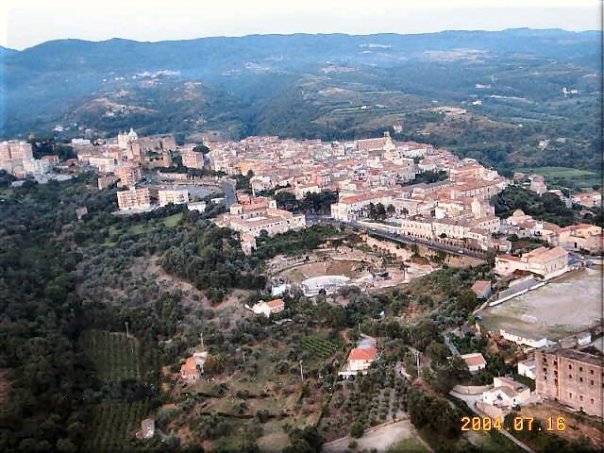
Sessa Aurunca is a town and comune in the province of Caserta, Campania, southern Italy. It is located on the south west slope of the extinct volcano of Roccamonfina, 40 kilometres (25 mi) by rail west north west of Caserta and 30 kilometres (19 mi) east of Formia.
It is situated on the site of ancient Suessa Aurunca, near the river Garigliano. The hill on which Sessa lies is a mass of volcanic tuff.
The name Sessa comes from Colonia Julia Felix Classica Suessa, a city belonging to the ancient Auruncan Pentapolis, which is the historic core of the downtown. It is assumed that the name can be derived from the happy location ("sessio", that is, seat, gentle hill from the mild climate of the local territory).
The ancient chief town of the Aurunci, Suessa is sometimes identified with a site at over 600 metres (2,000 ft) above the level of the sea, on the narrow south-western edge of the extinct crater of Roccamonfina. Here some remains of Cyclopean masonry exist; but the area enclosed, about 100 by 50 metres (330 by 160 ft), is too small for anything but a detached fort. This site dates more probably from a time before the wars between the Aurunci and the Romans.
The area was originally inhabited by the Aurunci, an Italic people. In 337 BC, due to pressure from the neighboring Sidicini, their oldest city was abandoned in favor of the current site of Sessa. A few years later, between 340 BC and 315 BC, the Romans definitively defeated the Aurunci under the leadership of the Consuls Lucius Papirius Cursor (who was also twice Dictator) and Quintus Publilius Philo (also Dictator and Censor).
This led to the founding of the Latin colony of Suessa Aurunca in 313 BC on the current site. This colony marked the full integration of Sessa into the Roman State, effectively becoming "Rome itself.". Cicero speaks of it as a place of some importance. The triumviri settled some of their veterans here, whence it appears as Colonia Julia Felix Classica Suessa. From inscriptions it appears that Matidia the younger, sister-in-law of Hadrian, had property in the district. It was not on a highroad, but on a branch between the Via Appia at Minturnae and the Via Latina crater mentioned.
After the fall of the Western Roman Empire, Sessa lost much of its population, and was located on the boundaries between the Duchy of Benevento (later Principality of Capua) and the Duchy of Gaeta. Starting from the 14th century it became a fiefdom (as a semi-independent duchy) of the Marzano family, part of the Kingdom of Naples. In 1466 it returned under direct control of the Neapolitan crown.
In some streets are memorial stones with inscriptions in honour of Charles V, surmounted by an old crucifix with a mosaic cross.
Hub AI
Sessa Aurunca AI simulator
(@Sessa Aurunca_simulator)
Sessa Aurunca
Sessa Aurunca is a town and comune in the province of Caserta, Campania, southern Italy. It is located on the south west slope of the extinct volcano of Roccamonfina, 40 kilometres (25 mi) by rail west north west of Caserta and 30 kilometres (19 mi) east of Formia.
It is situated on the site of ancient Suessa Aurunca, near the river Garigliano. The hill on which Sessa lies is a mass of volcanic tuff.
The name Sessa comes from Colonia Julia Felix Classica Suessa, a city belonging to the ancient Auruncan Pentapolis, which is the historic core of the downtown. It is assumed that the name can be derived from the happy location ("sessio", that is, seat, gentle hill from the mild climate of the local territory).
The ancient chief town of the Aurunci, Suessa is sometimes identified with a site at over 600 metres (2,000 ft) above the level of the sea, on the narrow south-western edge of the extinct crater of Roccamonfina. Here some remains of Cyclopean masonry exist; but the area enclosed, about 100 by 50 metres (330 by 160 ft), is too small for anything but a detached fort. This site dates more probably from a time before the wars between the Aurunci and the Romans.
The area was originally inhabited by the Aurunci, an Italic people. In 337 BC, due to pressure from the neighboring Sidicini, their oldest city was abandoned in favor of the current site of Sessa. A few years later, between 340 BC and 315 BC, the Romans definitively defeated the Aurunci under the leadership of the Consuls Lucius Papirius Cursor (who was also twice Dictator) and Quintus Publilius Philo (also Dictator and Censor).
This led to the founding of the Latin colony of Suessa Aurunca in 313 BC on the current site. This colony marked the full integration of Sessa into the Roman State, effectively becoming "Rome itself.". Cicero speaks of it as a place of some importance. The triumviri settled some of their veterans here, whence it appears as Colonia Julia Felix Classica Suessa. From inscriptions it appears that Matidia the younger, sister-in-law of Hadrian, had property in the district. It was not on a highroad, but on a branch between the Via Appia at Minturnae and the Via Latina crater mentioned.
After the fall of the Western Roman Empire, Sessa lost much of its population, and was located on the boundaries between the Duchy of Benevento (later Principality of Capua) and the Duchy of Gaeta. Starting from the 14th century it became a fiefdom (as a semi-independent duchy) of the Marzano family, part of the Kingdom of Naples. In 1466 it returned under direct control of the Neapolitan crown.
In some streets are memorial stones with inscriptions in honour of Charles V, surmounted by an old crucifix with a mosaic cross.
Recent media