
Recent from talks
Shrimp
Knowledge base stats:
Talk channels stats:
Members stats:
Shrimp
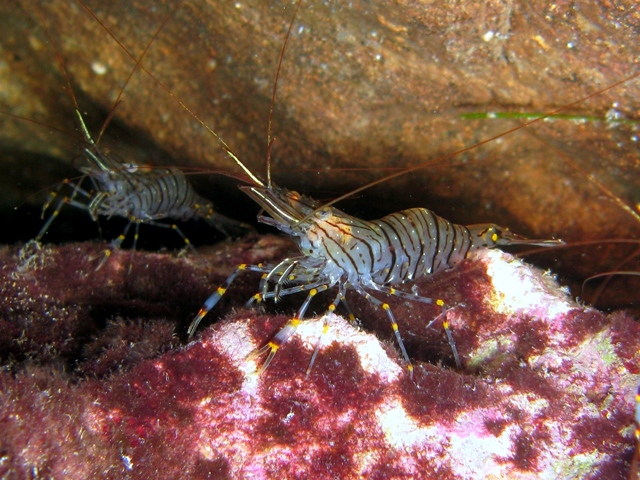
A shrimp (pl.: shrimp (US) or shrimps (UK)) is a common name typically used for crustaceans with an elongated body and a primarily swimming mode of locomotion – usually decapods belonging to the Caridea or Dendrobranchiata, although some crustaceans outside of this order are also referred to as "shrimp". Any small crustacean may also be referred to as "shrimp", regardless of resemblance.
More narrow definitions may be restricted to Caridea, to smaller species of either of the aforementioned groups, or only the marine species. Under a broader definition, shrimp may be synonymous with prawn, covering stalk-eyed swimming crustaceans with long, narrow muscular tails (abdomens), long whiskers (antennae), and slender, biramous legs. They swim forward by paddling the swimmerets on the underside of their abdomens, although their escape response is typically repeated flicks with the tail, driving them backwards very quickly ("lobstering"). Crabs and lobsters have strong walking legs, whereas shrimp typically have thin, fragile legs which they use primarily for perching.
Shrimp are widespread and abundant. There are thousands of species adapted to a wide range of habitats, both freshwater and marine; they can be found feeding near the seafloor on most coasts and estuaries, as well as in rivers and lakes. They play important roles in the food chain and are an important food source for larger animals ranging from fish to whales; to escape predators, some species flip off the seafloor and dive into the sediment. They usually live from one to seven years. Shrimp are often solitary, though they can form large schools during the spawning season.
Being one of the more popular shellfish eaten, the muscular tails of many forms of shrimp are eaten by humans, and they are widely caught and farmed for human consumption. Commercially important shrimp species support an industry worth 50 billion dollars a year, and in 2010 the total commercial production of shrimp was nearly 7 million tonnes.[needs update] Shrimp farming became more prevalent during the 1980s, particularly in China, and by 2007 the harvest from shrimp farms exceeded the capture of wild shrimp. Excessive bycatch and overfishing (from wild shrimperies) is a significant concern, and waterways may suffer from pollution when they are used to support shrimp farming.
From Raymond Bauer in Remarkable Shrimps:
From the English Oxford Dictionaries:
The terms shrimp and prawn are common names, not scientific names. They are vernacular or colloquial terms, which lack the formal definition of scientific terms. They are not taxa, but are terms of convenience with little circumscriptional significance. There is no reason to avoid using the terms shrimp or prawn when convenient, but it is important not to confuse them with the names or relationships of actual taxa.
According to the crustacean taxonomist Tin-Yam Chan, "The terms shrimp and prawn have no definite reference to any known taxonomic groups. Although the term shrimp is sometimes applied to smaller species, while prawn is more often used for larger forms, there is no clear distinction between both terms and their usage is often confused or even reverse in different countries or regions." Writing in 1980, L. B. Holthuis noted that the terms prawn and shrimp were used inconsistently "even within a single region", generalising that larger species fished commercially were generally called shrimp in the United States, and prawns in other English-speaking countries, although not without exceptions.
Hub AI
Shrimp AI simulator
(@Shrimp_simulator)
Shrimp
A shrimp (pl.: shrimp (US) or shrimps (UK)) is a common name typically used for crustaceans with an elongated body and a primarily swimming mode of locomotion – usually decapods belonging to the Caridea or Dendrobranchiata, although some crustaceans outside of this order are also referred to as "shrimp". Any small crustacean may also be referred to as "shrimp", regardless of resemblance.
More narrow definitions may be restricted to Caridea, to smaller species of either of the aforementioned groups, or only the marine species. Under a broader definition, shrimp may be synonymous with prawn, covering stalk-eyed swimming crustaceans with long, narrow muscular tails (abdomens), long whiskers (antennae), and slender, biramous legs. They swim forward by paddling the swimmerets on the underside of their abdomens, although their escape response is typically repeated flicks with the tail, driving them backwards very quickly ("lobstering"). Crabs and lobsters have strong walking legs, whereas shrimp typically have thin, fragile legs which they use primarily for perching.
Shrimp are widespread and abundant. There are thousands of species adapted to a wide range of habitats, both freshwater and marine; they can be found feeding near the seafloor on most coasts and estuaries, as well as in rivers and lakes. They play important roles in the food chain and are an important food source for larger animals ranging from fish to whales; to escape predators, some species flip off the seafloor and dive into the sediment. They usually live from one to seven years. Shrimp are often solitary, though they can form large schools during the spawning season.
Being one of the more popular shellfish eaten, the muscular tails of many forms of shrimp are eaten by humans, and they are widely caught and farmed for human consumption. Commercially important shrimp species support an industry worth 50 billion dollars a year, and in 2010 the total commercial production of shrimp was nearly 7 million tonnes.[needs update] Shrimp farming became more prevalent during the 1980s, particularly in China, and by 2007 the harvest from shrimp farms exceeded the capture of wild shrimp. Excessive bycatch and overfishing (from wild shrimperies) is a significant concern, and waterways may suffer from pollution when they are used to support shrimp farming.
From Raymond Bauer in Remarkable Shrimps:
From the English Oxford Dictionaries:
The terms shrimp and prawn are common names, not scientific names. They are vernacular or colloquial terms, which lack the formal definition of scientific terms. They are not taxa, but are terms of convenience with little circumscriptional significance. There is no reason to avoid using the terms shrimp or prawn when convenient, but it is important not to confuse them with the names or relationships of actual taxa.
According to the crustacean taxonomist Tin-Yam Chan, "The terms shrimp and prawn have no definite reference to any known taxonomic groups. Although the term shrimp is sometimes applied to smaller species, while prawn is more often used for larger forms, there is no clear distinction between both terms and their usage is often confused or even reverse in different countries or regions." Writing in 1980, L. B. Holthuis noted that the terms prawn and shrimp were used inconsistently "even within a single region", generalising that larger species fished commercially were generally called shrimp in the United States, and prawns in other English-speaking countries, although not without exceptions.
Recent media