


.jpg)

Community hub
Sikhs
View on Wikipedia
.svg) | |||||||||||||||||||||||
.jpg) | |||||||||||||||||||||||
| Total population | |||||||||||||||||||||||
|---|---|---|---|---|---|---|---|---|---|---|---|---|---|---|---|---|---|---|---|---|---|---|---|
| c. 25–30 million[9] | |||||||||||||||||||||||
| Founder | |||||||||||||||||||||||
| Guru Nanak | |||||||||||||||||||||||
| Regions with significant populations | |||||||||||||||||||||||
| India | 20,833,116[13] | ||||||||||||||||||||||
| Canada | 771,790[14][15] | ||||||||||||||||||||||
| United Kingdom | 535,517[16][17][18] | ||||||||||||||||||||||
| United States | 500,000[37] | ||||||||||||||||||||||
| Australia | 210,400[49] | ||||||||||||||||||||||
| Italy | 210,000[50] | ||||||||||||||||||||||
| Malaysia | 100,000[51][52][53] | ||||||||||||||||||||||
| Thailand | 100,000[54] | ||||||||||||||||||||||
| United Arab Emirates | 100,000[55] | ||||||||||||||||||||||
| Saudi Arabia | 66,843[56] | ||||||||||||||||||||||
| New Zealand | 53,406[57] | ||||||||||||||||||||||
| Philippines | 50,000[58][59] | ||||||||||||||||||||||
| Germany | 40,000[60] | ||||||||||||||||||||||
| Portugal | 35,000[61] | ||||||||||||||||||||||
| Oman | 33,704[62] | ||||||||||||||||||||||
| France | 30,000[63] | ||||||||||||||||||||||
| Spain | 26,000[64] | ||||||||||||||||||||||
| Greece | 20,000[65] | ||||||||||||||||||||||
| Kuwait | 20,000[66][67] | ||||||||||||||||||||||
| Pakistan | 15,998[68][69] | ||||||||||||||||||||||
| |||||||||||||||||||||||
| Religions | |||||||||||||||||||||||
 Sikhism Sikhism | |||||||||||||||||||||||
| Scriptures | |||||||||||||||||||||||
| Guru Granth Sahib | |||||||||||||||||||||||
| Languages | |||||||||||||||||||||||
| Contemporarily Modern Punjabi • Hindustani • Pashto • English • French • Italian • Spanish • Dutch Historically Punjabi dialects • Khalsa bole • Sant Bhasha (liturgical)[c] | |||||||||||||||||||||||

| Part of a series on |
| Sikhism |
|---|
 |


Sikhs (Gurmukhi: ਸਿੱਖ, romanized: Sikkh, Punjabi pronunciation: [sɪkkʰ])[d] are an ethnoreligious group and nation who adhere to Sikhism, a religion that originated in the late 15th century in the Punjab region of the Indian subcontinent, based on the teachings of Guru Nanak. The term Sikh has its origin in the Sanskrit word śiṣya, meaning 'seeker', 'disciple' or 'student'.[e]
According to Article I of Chapter 1 of the Sikh Rehat Maryada ('code of conduct'), the definition of Sikh is:[95] Any human being who faithfully believes in
- One Immortal Being
- Ten Gurus, from Guru Nanak Sahib to Guru Gobind Singh Sahib
- The Guru Granth Sahib
- The utterances and teachings of the ten Gurus and
- The initiation, known as the Amrit Sanchar, bequeathed by the tenth Guru and who does not owe allegiance to any other religion, is a Sikh.
Male Sikhs generally have Singh ('lion') as their last name, though not all Singhs are necessarily Sikhs; likewise, female Sikhs have Kaur ('princess') as their last name. These unique last names were given by the Gurus to allow Sikhs to stand out and also as an act of defiance to India's caste system, which the Gurus were always against. Sikhs strongly believe in the idea of sarbat da bhala ('welfare of all') and are often seen on the frontline to provide humanitarian aid across the world.[96]
Sikhs who have undergone the Amrit Sanchar ('baptism by Khanda'), an initiation ceremony, are known as Khalsa from the day of their initiation and they must at all times have on their bodies the five Ks:
- kesh, uncut hair usually kept covered by a dastār, also known as a turban;
- kara, an iron or steel bracelet;
- kirpan, a dagger-like sword tucked into a gatra strap or a kamar kasa waistband;
- kachera, a cotton undergarment; and
- kanga, a small wooden comb.

The Punjab region of the Indian subcontinent has been the historic homeland of the Sikhs, having even been ruled by the Sikhs for significant parts of the 18th and 19th centuries. Today, Canada has the largest national Sikh proportion (2.1%) in the world,[14] while the Punjab state in India has the largest Sikh proportion (60%) amongst all administrative divisions in the world. With a population of approximately 25 to 30 million, Sikhs represent about 0.3% to 0.4% of the total world population in 2024.[97] Many countries, such as Canada and the United Kingdom, recognise Sikhs as a designated religion on their censuses[98] and, as of 2020, Sikhs are considered as a separate ethnic group in the United States.[99] The UK also considers Sikhs to be an ethno-religious people, as a direct result of the Mandla v Dowell-Lee case in 1982.[100][101]
History
[edit]
Guru Nanak (1469–1539), the founder of Sikhism, was born in a Hindu Khatri family to Mehta Kalu and Mata Tripta in the village of Talwandi, present-day Nankana Sahib, near Lahore.[102] Throughout his life, Guru Nanak was a religious leader and social reformer. However, Sikh political history may be said to begin in 1606, with the death of the fifth Sikh guru, Guru Arjan Dev.[103] Religious practices were formalised by Guru Gobind Singh on March 30, 1699, when the Guru initiated five people from a variety of social backgrounds known as the Panj Piare ('beloved five'), to form a collective body of initiated Sikhs known as the Khalsa ('pure').[104]
The early followers of Guru Nanak were Khatris, but later a large number of Jats joined the Sikh faith.[105] Khatris and Brahmins opposed "the demand that the Sikhs set aside the distinctive customs of their castes and families, including the older rituals."[106]
Pashaura Singh analysed references made within the 11th ballad of the Varan of Bhai Gurdas to form a picture of the caste-makeup of the early Sikh community.[107] At the time of the writing the Vaar, the early Sikh community was composed of various castes and backgrounds, such as:[107]
- Khatris (particularly the Sehgal, Ohri, Uppal, Julka, Bhalla, Passi, Khullar, Vohra, Vij, Kapur, Chaddha, Behl, Kohli, Marwah, Mehra, Soni, Jhanjhi, Sodhi, Beri, Nanda, Wadhawan, Tulli and Puri gotras)[107]
- Brahmins (such as the Bhardwaj gotra)[107]
- Jats (particularly the Randhawa, Khehra, Dhillon and Pannu gotras)[107]
- Tarkhans ('carpenters')[107]
- Lohars ('blacksmiths')[107]
- Nais ('barbers')[107]
- Chhimbas ('cotton-printers')[107]
- Machhis ('water-carriers')[107]
- Dhobis ('washermen')[107]
- Kumhars ('potters')[107]
- Telis ('oil pressers")[107]
- masons[107]
- goldsmiths[107]
- Outcastes (such as Chandals)[107]
- Muslims[107]
The early Sikhs varied widely in their occupations and position in society's hierarchy: some were rich merchants (Seths and Sarrafs), others were heads of villages (Chowdhury), some were labourers, others were enslaved, whilst others still were artisans, craftsmen, shopkeepers or simple peasants.[107]

During the rule of the Mughal Empire in India, two Sikh gurus were martyred. (Guru Arjan was martyred on suspicion of helping in betrayal of Mughal Emperor Jahangir and Guru Tegh Bahadur was martyred by the Mughal Emperor Aurangzeb)[108] As the Sikh faith grew, the Sikhs subsequently militarised to oppose Mughal rule.[109]


After defeating the Afghans and Mughals, sovereign states called Misls were formed under Jassa Singh Ahluwalia. The Confederacy of these states was unified and transformed into the Sikh Empire under Maharaja Ranjit Singh. This era was characterised by religious tolerance and pluralism, including Christians, Muslims and Hindus in positions of power. Its secular administration implemented military, economic and governmental reforms. The empire is considered the zenith of political Sikhism,[110] encompassing Kashmir, Ladakh and Peshawar. Hari Singh Nalwa, the commander-in-chief of the Sikh Khalsa Army in the North-West Frontier, expanded the confederacy to the Khyber Pass.
British rule in India
[edit]

After the annexation of the Sikh kingdom by the British, the British Army began recruiting significant numbers of Sikhs and Punjabis.[citation needed] During the 1857 Indian mutiny, the Sikhs stayed loyal to the British, resulting in heavy recruitment from Punjab to the British Indian Army for the next 90 years of the British Raj in colonial India.[111] The distinct turban that differentiates a Sikh from other turban wearers is a relic of the rules of the British Indian Army.[112] The British colonial rule saw the emergence of many reform movements in India, including Punjab, such as the formation of the First and Second Singh Sabha in 1873 and 1879 respectively. The Sikh leaders of the Singh Sabha worked to offer a clear definition of Sikh identity and tried to purify Sikh belief and practice.[113]
The later years of British colonial rule saw the emergence of the Akali movement to bring reform in the gurdwaras during the early 1920s. The movement led to the introduction of Sikh Gurdwara Bill in 1925, which placed all the historical Sikh shrines in India under the control of the Shiromani Gurdwara Parbandhak Committee.[114]
Partition and post-Partition
[edit]At the time of the Indian independence movement, the Sikh ruler of the Kapurthala State fought to oppose the partition of India and advocated for a united, secular country.[115] Sikh organisations, including the Chief Khalsa Dewan and Shiromani Akali Dal led by Master Tara Singh, condemned the Lahore Resolution and the movement to create Pakistan, viewing it as inviting possible persecution, with Akali Dal instead favouring an undivided Azad Punjab as an independent Sikh State or Khalistan, having passed the Sikh State Resolution in 1946. The Sikhs therefore strongly fought against the partition of Punjab.[116] The months leading up to the 1947 partition of Punjab were marked by conflict in the Punjab between Sikhs and Muslims.[117] This caused the religious migration of Punjabi Sikhs and Hindus from West Punjab to the east (modern India), mirroring a simultaneous religious migration of Punjabi Muslims from East Punjab to the west (modern Pakistan).[118]
Following partition, the Government of India had begun to redraw states corresponding to demographic and linguistic boundaries. However, this was not effective in the northern part of the country,[119] as the government reconsidered redrawing states in the north.[120] While states across the country were extensively redrawn on linguistic lines at the behest of linguistic groups, the only languages not considered for statehood were Punjabi, Sindhi and Urdu. [121] Leading to the launch of the Punjabi Suba movement and the presentation for a Punjabi Suba as a policy in April 1948 by Master Tara Singh. Also, on January 26, 1950, Sikh representatives refused to sign the Indian constitution. As Sikhs were recognised as Hindus and Sikhs were not provided with scheduled castes concessions given to Hindu scheduled castes.
The Punjab Suba experienced heavy government crackdown with the Congress Government arresting as many as 21,000 people. Attempted negotiations with Congress-led the agitation to be adjourned twice, though Jawaharlal Nehru continued to reject the demand.[122][123] On July 4, 1955, government police forces, led by DIG Ashwini Kumar,[124] forced entry into the Golden Temple premises and heavy-handedly arrested protestors and took them into custody, along with the head granthis of the Akal Takht and Golden Temple, volunteer protestors and even cooks of the temple's langar.[125] The Guru Ram Das Serai and Shiromani Akali Dal offices were also raided and batons used and tear gas and shells were fired to disperse the protestors gathered on the periphery of the temple, damaging the periphery and Sarovar, or pool, of the temple.[125][126] The government stopped volunteers on the way to the Golden Temple and troops were ordered to flag-march through the bazaars and streets surrounding the site.[126] Over 200 protestors were killed, thousands arrested,[126] and thousands, including women and children, were injured.
The Congress government agreed to the Punjab Suba in 1966 after protests and recommendation of the States Reorganisation Commission.[127] The state of East Punjab was later split into the states of Himachal Pradesh, the new state Haryana and current day Punjab.[128] However, there was a growing alienation between Punjabi Sikh and Hindu populations. The latter of which reported Hindi rather than Punjabi as their primary language. The result was that Punjabi-speaking areas were left out of the new state and given to Haryana and Himachal Pradesh[129] resulting in the state of Punjab to be roughly 35,000 square miles smaller than the Punjabi-speaking areas based on pre-1947 census figures. Moreover, the 1966 reorganisation left Sikhs highly dissatisfied, with the capital Chandigarh being made into a shared union territory and the capital of Punjab and Haryana.
In the late 1960s, the Green Revolution in India was first introduced in Punjab as part of a development program issued by international donor agencies and the Government of India.[130] While, Green Revolution in Punjab had several positive impacts, the introduction of the mechanised agricultural techniques led to uneven distribution of wealth. The industrial development was not done at the same pace as agricultural development, the Indian government had been reluctant to set up heavy industries in Punjab due to its status as a high-risk border state with Pakistan.[131] The rapid increase in the higher education opportunities without an adequate rise in the jobs resulted in the increase in the unemployment of educated youth.[127]
In 1973 as a result, of unaddressed grievances and increasing inequality the Akali Dal put forward the Anandpur Sahib Resolution.[132] The resolution included both religious and political issues. It asked for recognising Sikhism as a religion, it also demanded the devolution of power from the Central to state governments.[127] The Anandpur Resolution was rejected by the government as a secessionist document. Thousands of people joined the movement, feeling that it represented a real solution to demands such as a larger share of water for irrigation and the return of Chandigarh to Punjab.[133]
After unsuccessful negotiations the Dharam Yuddh Morcha ('righteous campaign')[134] was launched on August 4, 1982,[citation needed] by the Akali Dal in partnership with Jarnail Singh Bhindranwale, with its stated aim being the fulfillment of a set of devolutionary objectives based on the Anandpur Sahib Resolution.[134] Indian police responded to protestors with high-handed police methods creating state repression affecting a very large segment of Punjab's population. Police brutality resulted in retaliatory violence from a section of the Sikh population, widening the scope of the conflict by the use of violence of the state on its own people.[135] A "state of chaos and repressive police methods" combined to create "a mood of overwhelming anger and resentment in the Sikh masses against the authorities." Leading to Sikh leader Jarnail Singh Bhindranwale gaining prominence and demands of independence gain currency, even amongst moderates and Sikh intellectuals.[135] In 1982 and early 1983, extrajudicial killings by the police of orthodox Sikh youth in rural areas in Punjab provoked reprisals.[136] Over 190 Sikhs had been killed in the first 19 months of the protest movement.[137]
In May 1984, a Grain Roko morcha was planned and to be initiated on June 3[138] with protestors practising civil disobedience by refusing to pay land revenue, water or electricity bills and blocking the flow of grain out of Punjab. Indian Prime minister Indira Gandhi launched Operation Blue Star on June 1 prior to the Grain Roko morcha in order to remove Bhindranwale from the Golden Temple. This subsequently led to Gandhi's assassination by her Sikh bodyguards.[139] Her assassination was followed by government-sponsored pogroms against Sikh communities across India and the killing of thousands of Sikhs throughout India. These events triggered an Insurgency in Punjab which would consume Punjab until the early 1990s.
During the day of Vaisakhi in 1999, Sikhs worldwide celebrated the 300th anniversary of the creation of the Khalsa. Canada Post honoured Sikh Canadians with a commemorative stamp in conjunction with the anniversary. Likewise, on April 9, 1999, Indian president K. R. Narayanan issued a stamp commemorating the 300th anniversary of the Khalsa as well.[140]
Art and culture
[edit]

Sikh art and culture are nearly synonymous with that of Punjab and Sikhs are easily recognised by their distinctive turban (Dastar). Punjab has been called India's melting pot, due to the confluence of invading cultures from the rivers from which the region gets its name. Sikh culture is therefore a synthesis of cultures. Sikhism has forged a unique architecture, which S. S. Bhatti described as "inspired by Guru Nanak's creative mysticism" and "is a mute harbinger of holistic humanism based on pragmatic spirituality."[141] The American non-profit organisation United Sikhs has fought to have Sikh included on the U.S. census as well, arguing that Sikhs "self-identify as an ethnic minority" and believe "that they are more than just a religion."[142]
During the Mughal and Afghan persecution of the Sikhs during the 17th and 18th centuries,[143] the latter were concerned with preserving their religion and gave little thought to art and culture. With the rise of Ranjit Singh and the Sikh Raj in Lahore and Delhi, there was a change in the landscape of art and culture in Punjab; Hindus and Sikhs could build decorated shrines without the fear of destruction or looting.[144]
The Sikh Confederacy was the catalyst for a uniquely Sikh form of expression, with Ranjit Singh commissioning forts, palaces, bungas (residential places) and colleges in a Sikh style. Sikh architecture is characterised by gilded fluted domes, cupolas, kiosks, stone lanterns, ornate balusters and square roofs. A pinnacle of Sikh style is Harmandir Sahib (also known as the Golden Temple) in Amritsar.[145]
Sikh culture is influenced by militaristic motifs (with the Khanda the most obvious) and most Sikh artifacts—except for the relics of the Gurus—have a military theme. This theme is evident in the Sikh festivals of Hola Mohalla and Vaisakhi, which feature marching and displays of valor.[citation needed]
Although the art and culture of the Sikh diaspora have merged with that of other Indo-immigrant groups into categories like "British Asian," "Indo-Canadian" and "Desi-Culture," a minor cultural phenomenon that can be described as "political Sikh" has arisen.[146] The art of diaspora Sikhs like Amarjeet Kaur Nandhra and Amrit and Rabindra Kaur Singh (The Singh Twins)[147] is influenced by their Sikhism and current affairs in Punjab.[citation needed]
Bhangra and Giddha are two forms of Punjabi folk dancing which have been adapted and pioneered by Sikhs. Punjabi Sikhs have championed these forms of expression worldwide, resulting in Sikh culture becoming linked to Bhangra (although "Bhangra is not a Sikh institution but a Punjabi one").[148]
Painting
[edit]
Sikh painting is a direct offshoot of the Kangra school of painting. In 1810, Ranjeet Singh (1780–1839) occupied Kangra Fort and appointed Sardar Desa Singh Majithia his governor of the Punjab hills. In 1813, the Sikh army occupied Guler State and Raja Bhup Singh became a vassal of the Sikhs. With the Sikh kingdom of Lahore becoming the paramount power, some of the Pahari painters from Guler migrated to Lahore for the patronage of Maharaja Ranjeet Singh and his Sardars.[citation needed]
The Sikh school adapted Kangra painting to Sikh needs and ideals. Its main subjects are the ten Sikh gurus and stories from Guru Nanak's Janamsakhis. The tenth Guru, Gobind Singh, left a deep impression on the followers of the new faith because of his courage and sacrifices. Hunting scenes and portraits are also common in Sikh painting.[citation needed]
Shrines
[edit].jpg)
There is an old Sikh shrine called 'Prachin Guru Nanak Math', which lies at a small hill, just next to Bishnumati bridge at Balaju. Guru Nanak is said to have visited Nepal during his third Udasi while returning from Mount Kailash in Tibet. Nanak is said to have stayed at Balaju and Thapathali in Kathmandu. The Nanak Math shrine at Balaju is managed by the Guru-Ji and the Udasin Akardha, a sect developed by Guru Nanak's son, Sri Chandra.[149][150]
Daily routine
[edit]From the Guru Granth Sahib:[151]
One who calls themself a Sikh of the Guru, the True Guru, shall rise in the early morning hours and meditate on the Lord's Name. Upon arising early in the morning, he is to bathe and cleanse himself in the pool of nectar. Following the Instructions of the Guru, he is to chant the Name of the Lord, "Har, Har." All sins, misdeeds, and negativity shall be then erased. Then, at the rising of the sun, he is to sing Gurbani; whether sitting down or standing up, he is to meditate on the Lord's Name. One who meditates on my Lord, Har, Har, with every breath and every morsel of food and – that GurSikh becomes pleasing to the Guru's Mind. That person, unto whom my Lord and Master is kind and compassionate – upon that GurSikh, the Guru's Teachings are bestowed. Servant Nanak begs for the dust of the feet of that GurSikh, who himself chants the Naam, and inspires others to chant it.
— Fourth Mehl (Guru Ram Das), Guru Granth Sahib, p. 305
The Sikh Rahit Maryada (Code of Conduct) clearly states that initiated Amritdhari Khalsa Sikhs must recite or listen to the recitation of Japji Sahib, Jaap Sahib, the 10 Sawayyas, Sodar Rehraas and Sohila.[152][153] Every Sikh is also supposed take the Hukam (divine order) from the Guru Granth Sahib after awakening in the ambrosial hours of the morning (three hours before the dawn) before eating.[154]
In his 52 Hukams, Guru Gobind Singh orders his followers to arise during Amritvela (early morning) and to recite the late evening prayer "Sohila" and the verse "Pavan guru pani pita..." before sleeping.[citation needed]
Five Ks
[edit]


The five Ks (panj kakaar) are five articles of faith which all initiated (Amritdhari) Sikhs are obliged to wear. The symbols represent the ideals of Sikhism: honesty, equality, fidelity, meditating on Waheguru and never bowing to tyranny.[155] The five symbols are:
- Kesh: Uncut hair, usually tied and wrapped in a turban.
- Kanga: A wooden comb, usually worn under a turban to always also keep one's hair clean and well-groomed.
- Kachera: Cotton undergarments, worn by both sexes; the kachera is a symbol of chastity and also a symbol of cleanliness. It is also historically appropriate in battle due to increased mobility and comfort when compared to a dhoti.
- Kara: An iron bracelet, a symbol of eternity, strength and a constant reminder of the strength of will to keep hands away from any kind of unethical practices.
- Kirpan: An iron blade in different sizes. In the UK, Sikhs can wear a small dagger, but in Punjab, they might wear a traditional curved sword from one to three feet in length. Kirpan is only a weapon of defense and religious protection, used to serve humanity and to be used against oppression.
Music and instruments
[edit]
The Sikhs have a number of musical instruments, including the rebab, dilruba, taus, jori and sarinda. Playing the sarangi was encouraged by Guru Hargobind. The rebab was played by Bhai Mardana as he accompanied Guru Nanak on his journeys. The jori and sarinda were introduced to Sikh devotional music by Guru Arjan. The taus (Persian for "peacock") was designed by Guru Hargobind, who supposedly heard a peacock singing and wanted to create an instrument mimicking its sounds. The dilruba was designed by Guru Gobind Singh at the request of his followers, who wanted a smaller instrument than the taus. After Japji Sahib, all of the shabad in the Guru Granth Sahib were composed as raags. This type of singing is known as Gurmat Sangeet.
When they marched into battle, the Sikhs would play a Ranjit nagara ('victory drum') to boost morale. Nagaras (usually two to three feet in diameter, although some were up to five feet in diameter) are played with two sticks. The beat of the large drums and the raising of the Nishan Sahib, meant that the Singhs were on their way.
Khalistan movement
[edit]
The Khalistan movement is a Sikh separatist movement, which seeks to create a separate country called Khalistān ('The Land of the Khalsa') in the Punjab state of India to serve as a homeland for Sikhs.[156] The territorial definition of the proposed country Khalistan consists of the Punjab, India and includes Haryana, Himachal Pradesh, Jammu and Kashmir and Rajasthan.[157][158][159]
Khalistan movement began as an expatriate venture.[160] In 1971, the first explicit call for Khalistan was made in an advertisement published in the New York Times by an expat (Jagjit Singh Chohan).[161] By proclaiming the formation of Khalistan, he was able to collect millions of dollars from the Sikh diaspora.[162] On April 12, 1980, he declared the formation of the "National Council of Khalistan," at Anandpur Sahib.[163] He declared himself as the President of the council and named Balbir Singh Sandhu as its Secretary General. In May 1980, Chohan traveled to London and announced the formation of Khalistan. A similar announcement was made by Balbir Singh Sandhu in Amritsar, where he began releasing stamps and currency of Khalistan. The inaction of the authorities in Amritsar and elsewhere was decried as a political stunt by the Congress(I) party of Indira Gandhi by the Akali Dal, headed by the Sikh leader Harchand Singh Longowal.[164]
The movement flourished in the Indian state of Punjab following Operation Blue Star and the Anti-Sikh Pogroms. As proponents were able to generate funding from a grieving diaspora. In June 1985, Air India Flight 182 was bombed by Babbar Khalsa, a pro-Khalistani terrorist organisation.[165] In January 1986, the Golden Temple was occupied by militants belonging to All India Sikh Students Federation and Damdami Taksal.[166] On January 26, 1986, a gathering known as the Sarbat Khalsa (a de facto parliament) passed a resolution (gurmattā) favouring the creation of Khalistan. Subsequently, a number of rebel militant groups in favour of Khalistan waged a major insurgency against the government of India. Indian security forces suppressed the insurgency in the early 1990s, but Sikh political groups such as the Khalsa Raj Party and SAD (A) continued to pursue an independent Khalistan through non-violent means.[167][168][169] Pro-Khalistan organisations such as Dal Khalsa (International) are also active outside India, supported by a section of the Sikh diaspora.[170]
In the 1990s, the insurgency abated,[171] and the movement failed to reach its objective due to multiple reasons including a heavy police crackdown on separatists, divisions among the Sikhs and loss of support from the Sikh population.[172] However, various pro-Khalistan groups, both political and militant, remain committed to the separatist movement. There are claims of funding from Sikhs outside India to attract young people into militant groups.[173] There have also been multiple claims that the movement is motivated and supported by the Pakistan's external intelligence agency, the ISI.[174][175]
Demographics
[edit].png)
Sikhs number about 26–30 million worldwide, of whom 24–28 million live in India, which thus represents around 90 percent of the total Sikh population.[176][177][178][179][180][181] A 2020 estimate by Charles Preston gives a figure of 29,254,000 of Sikhs worldwide.[182] About 76 percent of all Indian Sikhs live in the northern Indian state of Punjab, forming a majority of about 58 per cent of the state's population, roughly around 16 million.[183][184] Substantial communities of Sikhs live in the Indian states or union territories of Haryana, where they number around 1.2 million and form 4.9 percent of the population, Rajasthan (872,000 or 1.3 percent of the population), Uttar Pradesh (643,000, 0.3 percent), Delhi (570,000, 3.4 percent), Uttarakhand (236,000, 2.3 percent), Jammu and Kashmir (234,000, 1.9 percent), Chandigarh (138,000, 13.1 percent) and Himachal Pradesh (86,000, 1.2 percent).
Canada is home to the largest national Sikh proportion (2.1 percent of the total population) in the world.[14] A substantial community of Sikhs exist in the western province of British Columbia, numbering nearly 300,000 persons and forming approximately 5.9 percent of the total population. This represents the third-largest Sikh proportion amongst all global administrative divisions, behind only Punjab and Chandigarh in India. Furthermore, British Columbia,[185] Manitoba and Yukon hold the distinction of being three of the only four administrative divisions in the world with Sikhism as the second most followed religion among the population.[188]
Whilst Punjab, India has had a majority Sikh population for decades, recent statistics point toward a demographic decline of Sikhs in the state. School data from the Civil Registration System (CRS) shows that Sikh children are now a plurality (49%) at the foundational-level (pre-primary to Class II in the age group of 3–8-years-old). The causes for the demographic decline of Sikhs in Indian Punjab has been attributed to low fertility-rates, outbound migration of Sikhs abroad, and internal migration within India of persons from other states, oftentimes Uttar Pradesh or Bihar, settling in Indian Punjab.[189]
Census data and official statistics
[edit]As a religious minority, Sikhs have fought long and hard to get official status and to be counted in many countries across the world. Through the efforts of Sikh organisations and communities in their respective countries, there is now readily available population data on Sikhs as part of the census or official statistics in the following territories:
| Territory | Latest data | |
|---|---|---|
 India (Punjab) India (Punjab)
|
16,004,754 | 2011[190] |
| India (Rest of India)
|
4,828,362 | |
 Canada Canada
|
771,790 | 2021[191] |
 England England
|
520,092 | 2021[192] |
 Australia Australia
|
210,400 | 2021[193] |
 Malaysia Malaysia
|
130,000 | 2011[194] |
 New Zealand New Zealand
|
53,406 | 2023[57] |
 Singapore Singapore
|
12,051 | 2020[195] |
 Thailand Thailand
|
11,124 | 2010[196] |
 Norway Norway
|
4,318 | 2021[197] |
 Wales Wales
|
4,048 | 2021[192] |
 Fiji Fiji
|
2,577 | 2007[198] |
 Ireland Ireland
|
2,183 | 2022[199] |
 Nepal Nepal
|
1,496 | 2021[200] |
 Northern Ireland Northern Ireland
|
389 | 2021[201] |
 Scotland Scotland
|
10,988 | 2022 |
 Pakistan Pakistan
|
Pending | 2023 |

Note: Official statistics do not count unregistered arrivals or those who have not completed the census or surveys. However, they do provide for a much more accurate depiction of Sikh communities as opposed to estimates from various Sikh organisations whose estimates can vary vastly with no statistically valuable source. Thus, official statistics and census data is highly important and Sikh communities continue to push for census inclusion in many countries where they are still not counted.
Migration
[edit]Sikh migration from British India began in earnest during the second half of the 19th century, when the British completed their annexation of the Punjab, which led to Sikh migration throughout India and the British Empire. During the Raj, semiskilled Sikh artisans were transported from the Punjab to British East Africa to help build railroads. Sikhs emigrated from India after World War II, most going to the United Kingdom but many also to North America. Some Sikhs who had settled in eastern Africa were expelled by Ugandan dictator Idi Amin in 1972.[202] Economics is a major factor in Sikh migration and significant communities exist in the United Kingdom, the United States, Malaysia, East Africa, Australia, Singapore and Thailand.[citation needed]
After the Partition of India in 1947, many Sikhs from what would become the Punjab of Pakistan migrated to India as well as to Afghanistan due to fear of persecution. Afghanistan was home to hundreds of thousands of Sikhs and Hindus as of the 1970s, but due to the wars in Afghanistan in the 2010s, the vast majority of Afghan Sikhs had migrated to India, Pakistan or the west.[203][204][205]
Although the rate of Sikh migration from the Punjab has remained high, traditional patterns of Sikh migration favouring English-speaking countries (particularly the United Kingdom) have changed during the past decade due to stricter immigration laws. Moliner (2006) wrote that as a consequence of Sikh migration to the UK becoming "virtually impossible since the late 1970s," migration patterns evolved to continental Europe.[206] Italy is a rapidly growing destination for Sikh migration,[207] with Reggio Emilia and Vicenza having significant Sikh population clusters.[208] Italian Sikhs are generally involved in agriculture, agricultural processing, the manufacture of machine tools and horticulture.[209]
Growth
[edit]
Johnson and Barrett (2004) estimate that the global Sikh population increases annually by 392,633 (1.7% per year, based on 2004 figures); this percentage includes births, deaths and conversions. Primarily for socio-economic reasons, Indian Sikhs have the lowest adjusted growth rate of any major religious group in India, at 16.9 percent per decade (estimated from 1991 to 2001) and it has further declined to just 8.4 per cent in 2011 census report.[210][211] Sikhs in the world have the lowest fertility rate of 1.6 children per women as per (2019–20) estimation research.[212][213] The Sikh population has the lowest gender balance in India, with only 903 women per 1,000 men according to the 2011 Indian census.[214] The estimated world's Sikh population was over 30 million in 2020 and it will reach 42 million by 2050. It is expected to increase up to 62 million by 2100, given that the anticipated growth rate of 1.7% per year and adding at least 400,000 followers annually.[215][211]
Since the Sikh growth rate dropped from 1.7% (16.9% in 1991 to 2001 estimate) to 0.8% (8.4% in 2001–2011) in 2011 report, hence based on their growth rate, their population in India will increase 196,316 (0.8% based on 2011 figures) per year and will reach 36 million in 2050, it expected to reach 52 million in 2100 given that the anticipated growth rate of 0.8% and adding at least 200,000 followers annually.[216][217]

Sikhism is the fastest growing religion in Canada, Australia and New Zealand. The growth is mainly contributed by the immigration of Indian Sikhs there over the decades. Sikhism is fourth-largest religion in Canada, fifth-largest religion in Australia and New Zealand. The decadal growth of Sikhs is more in those countries as compared to the decadal growth of Sikh population in India, thus making them the fastest-growing religion there.[218][14][219][220] Canada has the highest proportion of Sikhs in the globe, which stands at 2.1% as of 2021, as compared to India which stands at 1.7% as of 2011 respectively.[221][14]
Castes
[edit]Sikhs have remained a relatively homogeneous ethnic group with exceptions. Caste may still be practiced by some Sikhs, despite Guru Nanak's calls for treating everyone equally in Guru Granth Sahib.[222][f]
Along with Guru Nanak, other Sikh gurus had also denounced the hierarchy of the caste system, however, they all belonged to the same caste, the Khatris.[226] Most Sikhs belong to the Jat (Jatt), traditionally Agriculturist class[227] in occupation.[228] Despite being very small in numbers, the Khatri and Arora castes wield considerable influence within the Sikh community. Other common Sikh castes include Ahluwalias (Brewers), Kambojs or Kambos (Rural caste), Ramgarhias (Carpenters), Brahmins (Priestly class), Rajputs (Kshatriyas – Warriors), Sainis, Rai Sikh (Ironsmiths), Labanas (Merchants), Kumhars (Potters), Mazhabi (Cleaners) and the Ramdasia/Ravidasias(Chamar – Tanners).[229]
Some Sikhs, especially those belonging to the landowning dominant castes, have not shed all their prejudices against the Dalit castes such as the Mazhabi and Ravidasia. While Dalits were allowed entry into the village gurdwaras, in some gurdwaras, they were not permitted to cook or serve langar (communal meal). Therefore, wherever they could mobilise resources, the Sikh Dalits of Punjab have tried to construct their own gurdwara and other local level institutions in order to attain a certain degree of cultural autonomy.[222] In 1953, Sikh leader and activist Master Tara Singh succeeded in persuading the Indian government to include Sikh castes of the converted untouchables in the list of scheduled castes.[230] In the Shiromani Gurdwara Prabandhak Committee, 20 of the 140 seats are reserved for low-caste Sikhs.[230]
Other castes (over 1,000 members) include the Arain, Bhatra, Bairagi, Bania, Basith, Bawaria, Bazigar, Bhabra, Chamar, Chhimba (cotton farmers), Darzi, Dhobi, Gujar, Jhinwar, Kahar, Kalal, Kumhar, Lohar, Mahtam, Megh, Mirasi, Mochi, Nai, Ramgharia, Sansi, Sudh, Tarkhan and Kashyap[citation needed]
Karnail Singh Panjoli, member of the Shiromani Gurdwara Prabandhak Committee, says that there are several communities within the term Nanakpanthis too. Apart from Sindhi Hindus, "There are groups like Sikhligarh, Vanjaarey, Nirmaley, Lubaney, Johri, Satnamiye, Udaasiyas, Punjabi Hindus, etc. who call themselves Nanakpanthis despite being Hindus.[231]
Diaspora
[edit]
As Sikhs wear turbans and keep beards, Sikh men in Western countries have been mistaken for Muslim, Arab and/or Afghan since the September 11 attacks and the Iraq War.[232][233] Several days after the 9/11 attacks, Sikh-American gas station owner Balbir Singh Sodhi was murdered in Arizona by a man who took Sodhi to be a member of al-Qaeda, marking the first recorded hate-crime in America motivated by 9/11. CNN would go on to suggest an increase in hate crimes against Sikh men in the US and the UK after the 9/11 attacks.[232][233]
In an attempt to foster Sikh leaders in the Western world, youth initiatives by a number of organisations exist. The Sikh Youth Alliance of North America sponsors an annual Sikh Youth Symposium.[citation needed]
The Sikh diaspora has been most successful in the UK, and UK Sikhs have the highest percentage of home ownership (82%) of any religious community.[234] UK Sikhs are the second-wealthiest religious group in the UK (after the Jewish community), with a median total household wealth of £229,000.[235]
In May 2019, the UK government exempted "Kirpan" from the list of banned knives. The U.K. government passed an amendment by which Sikhs in the country would be allowed to carry kirpans and use them during religious and cultural functions. The bill was amended to ensure that it would not impact the right of the British Sikh community to possess and supply kirpans or religious swords.[236][237] Similarly, the Sikh American Legal Defense and Education Fund overturned a 1925 Oregon law banning the wearing of turbans by teachers and government officials in 2010.[238]
Agriculture
[edit]Historically, most Indians have been farmers and 66 per cent of the Indian population are engaged in agriculture.[239] Indian Sikhs are employed in agriculture to a lesser extent; India's 2001 census found 39 per cent of the working population of the Punjab employed in this sector.[240] According to the Swedish political scientist Ishtiaq Ahmad, a factor in the success of the Indian green revolution was the "Sikh cultivator, often the Jat and Kamboj or Kamboh, whose courage, perseverance, spirit of enterprise and muscle prowess proved crucial."[241] However, Indian physicist Vandana Shiva[242] wrote that the green revolution made the "negative and destructive impacts of science (i.e., the green revolution) on nature and society" invisible and was a catalyst for Punjabi Sikh and Hindu tensions despite a growth in material wealth.[citation needed]
Sikhs in modern history
[edit].jpg)

.jpg)

Manmohan Singh was an Indian economist, academic and politician who served as the 13th Prime Minister of India from 2004 to 2014. The first and only Sikh and non-Hindu in office, Singh was also the first prime minister since Jawaharlal Nehru to be re-elected after completing a full five-year term.
Notable Sikhs in science include nuclear scientist Piara Singh Gill, fibre-optics pioneer Narinder Singh Kapany; and physicist, science writer and broadcaster Simon Singh.
In business, the UK-based clothing retailers New Look and the Thai-based JASPAL[243] were founded by Sikhs. India's largest pharmaceutical company, Ranbaxy Laboratories, is headed by Sikhs.[244] Apollo Tyres is headed by Onkar Singh Kanwar. In Singapore, Kartar Singh Thakral expanded his family's trading business, Thakral Holdings,[245] into assets totalling almost US$1.4 billion and is Singapore's 25th-richest person. Sikh Bob Singh Dhillon is the first Indo-Canadian billionaire. Mastercard's CEO was a Sikh named Ajaypal Singh Banga.
In sports, Sikhs include England cricketer Monty Panesar; former 400-metre runner Milkha Singh; his son, professional golfer Jeev Milkha Singh; Indian wrestler and actor Dara Singh; former Indian hockey team captains Sandeep Singh, Ajitpal Singh and Balbir Singh Sr.; former Indian cricket captain Bishen Singh Bedi; Harbhajan Singh, India's most successful off spin cricket bowler; Yuvraj Singh, World Cup winning allrounder; Maninder Singh, World Cup winning off spinner; and Navjot Singh Sidhu, former Indian cricketer-turned-politician.
Sikhs in Bollywood, in the arts in general, include poet and lyricist Rajkavi Inderjeet Singh Tulsi; Gulzar; Jagjit Singh; Dharmendra; Sunny Deol; Diljit Dosanjh writer Khushwant Singh; actresses Neetu Singh, Simran Judge, Poonam Dhillon, Mahi Gill, Esha Deol, Parminder Nagra, Gul Panag, Mona Singh, Namrata Singh Gujral; and directors Gurinder Chadha and Parminder Gill.
Sikhs in Punjabi Music industry include Sidhu Moosewala, Diljit Dosanjh, Babu Singh Maan, Surjit Bindrakhia, Ammy Virk, Karan Aujla, Jazzy B, Sukha, Shubh, Miss Pooja.
In December 2022, the U.S. Marine Corps was compelled by a court order to allow two Sikhs to wear the turban and grow beards. This was a milestone for religious freedom and in the prevention of employment discrimination against Sikhs.[246]
In the Indian and British armies
[edit]According to a 1994 estimate, Punjabi Sikhs and Hindus comprised 10 to 15% of all ranks in the Indian Army. The Indian government does not release religious or ethnic origins of a military personnel, but a 1991 report by Tim McGirk estimated that 20% of Indian Army officers were Sikhs.[247] Together with the Gurkhas recruited from Nepal, the Maratha Light Infantry from Maharashtra and the Jat Regiment, the Sikhs are one of the few communities to have exclusive regiments in the Indian Army.[247] The Sikh Regiment is one of the most-decorated regiments in the army, with 73 Battle Honours, 14 Victoria Crosses,[248] 21 first-class Indian Orders of Merit (equivalent to the Victoria Cross),[249] 15 Theatre Honours, 5 COAS Unit Citations, two Param Vir Chakras, 14 Maha Vir Chakras, 5 Kirti Chakras, 67 Vir Chakras and 1,596 other awards. The highest-ranking general in the history of the Indian Air Force is a Punjabi Sikh, Marshal of the Air Force Arjan Singh.[250] Plans by the United Kingdom Ministry of Defence for a Sikh infantry regiment were scrapped in June 2007.[251]
Sikhs supported the British during the Indian Rebellion of 1857.[252] By the beginning of World War I, Sikhs in the British Indian Army totaled over 100,000 (20 per cent of the force). Until 1945, fourteen Victoria Crosses (VC) were awarded to Sikhs, a per-capita regimental record.[248] In 2002, the names of all Sikh VC and George Cross recipients were inscribed on the monument of the Memorial Gates[253] on Constitution Hill, next to Buckingham Palace.[254] Chanan Singh Dhillon was instrumental in campaigning for the memorial.
During World War I, Sikh battalions fought in Egypt, Palestine, Mesopotamia, Gallipoli and France. Six battalions of the Sikh Regiment were raised during World War II, serving in the Second Battle of El Alamein, the Burma and Italian campaigns and in Iraq, receiving 27 battle honours. Around the world, Sikhs are commemorated in Commonwealth cemeteries.[255]
-
 Sikhs in the First World War, marching with their scripture, Guru Granth Sahib
 -
 French postcard depicting the arrival of the 15th Sikh Regiment in France during World War I. The bilingual postcard reads, "Gentlemen of India marching to chasten the German hooligans."
 -
 Indian Sikh soldiers in the Italian campaign
 -
 Sikh soldier with captured Swastika flag of Nazi Germany
 -
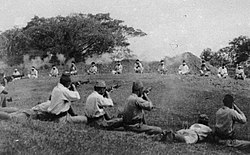 Japanese soldiers shooting blindfolded Sikh prisoners in World War II


See also
[edit]Notes
[edit]- ^ Sikhs comprise 1.7% (23,786,052) of India's total population of 1,399,179,585 per 2023 estimate by the World Factbook.[10]
- ^ Majority of Sikhs speak Punjabi or its various dialects as their mother tongue. Guru Gobind Singh wrote letters to Aurangzeb—Zafarnama and the Hikaaitaan—written in the Persian alphabet; Sikh coins were minted in Gurmukhi and Persian during misls and Sikh Empire.
- ^ [b][81][82][83][84][85]
- ^ /sɪk/ SIK or /siːk/ SEEK
- ^ [86][87][88][89][90][91][92][93][94]
- ^ Guru Nanak has mentioned in his first composition of Jap Ji Sahib, which is recited daily by all practicing Sikhs that all souls are to be treated with care and respect as Waheguru is the Giver of all souls.
"The Guru has given me this one understanding: there is only the One, the Giver of all souls. May I never forget Him!", Guru Granth Sahib, 2[223]
Guru Nanak said that blessings are rained down when the lowly person, regardless of any background are cared for.
"In that place where the lowly are cared for-there, the Blessings of Your Glance of Grace rain down.", Guru Granth Sahib, 15[224]
Guru Nanak had spoken we need to prize humility above all and thus caste is not an issue.
"One who takes pride in wealth and lands is a fool, blind and ignorant.
One whose heart is mercifully blessed with abiding humility,
O Nanak, is liberated here, and obtains peace hereafter." Granth Sahib, 278.[225]
References
[edit]Citations
[edit]- ^ "National Profiles". www.thearda.com.
- ^ "April 2022: Sikh Awareness and Appreciation Month". State of Michigan Office of the Governor. Retrieved 28 March 2023.
there are more than 30 million Sikhs worldwide
- ^ "US Sikhs tirelessly travel their communities to feed hungry Americans". CNN. 9 July 2020. Retrieved 28 March 2023.
Founded some 500 years ago in the Punjab region of India, the faith has some 30 million adherents, making it the fifth largest religion worldwide.
- ^ "A Brief Introduction to Sikhism". WTTW. 5 May 2021. Retrieved 28 March 2023.
"Sikhism is the world's fifth-largest religion, with 25–30 million adherents around the globe
- ^ "Sikhs in America". Retrieved 28 March 2023.
There are nearly 30 million Sikhs around the world today, and a vast majority of them live in the Indian state of Punjab.
- ^ "Guru Nanak Religious Society". Retrieved 28 March 2023.
There are over 30 million Sikhs worldwide.
- ^ "Sikhism". Encyclopædia Britannica. Retrieved 6 October 2022.
In the early 21st century there were nearly 25 million Sikhs worldwide, the great majority of them living in the Indian state of Punjab.
- ^ "Sidhu wrongly quotes Sikh population as 14 crores". The Times of India. 11 November 2019.
- ^ [2][3][4][5][6][7][8]
- ^ a b "India People and Society". The World Factbook. Retrieved 15 February 2023.
- ^ "Sikh Population in World | Sikh Population in India 2023". 22 December 2021.
- ^ "Sikh Religion Census 2011". Retrieved 21 March 2023.
- ^ [10][a][11][12]
- ^ a b c d e f Government of Canada, Statistics Canada (26 October 2022). "Religion by visible minority and generation status: Canada, provinces and territories, census metropolitan areas and census agglomerations with parts". www12.statcan.gc.ca. Retrieved 1 December 2022.
- ^ Government of Canada, Statistics Canada (26 October 2022). "The Daily – The Canadian census: A rich portrait of the country's religious and ethnocultural diversity". www150.statcan.gc.ca. Retrieved 26 October 2022.
- ^ "Religion, England and Wales – Office for National Statistics". www.ons.gov.uk.
- ^ "Religion (detailed): All people" (PDF). National Records of Scotland. Retrieved 8 April 2017.
- ^ "Religion – Full Detail: QS218NI". Northern Ireland Statistics and Research Agency. Archived from the original on 16 September 2017. Retrieved 8 April 2017.
- ^ "Does the Census Bureau have data for religion?". United States Census Bureau. Retrieved 18 March 2023.
- ^ "Asian Indian Was The Largest Asian Alone Population Group in 2020". United States Census Bureau. Retrieved 23 September 2023.
- ^ "Census Profile, 2021 Census of Population". Statistics Canada. 9 February 2022. Retrieved 23 September 2023.
- ^ a b "Statistical Abstract of the United States: 2012 – Section 1: Population – Table 75: Self-Described Religious Identification of Adult Population: 1990, 2001, and 2008 (page 61)" (PDF). United States Census Bureau. Retrieved 14 April 2023.
- ^ a b "How Many U.S. Sikhs?". Pew Research Center. 6 August 2012. Retrieved 18 March 2023.
- ^ "About Sikhs". Sikh Coalition. Retrieved 14 April 2023.
- ^ "H. RES. 275–118th Congress (2023–2024)". United States Congress. 10 April 2023. Retrieved 14 April 2023.
- ^ "Sikhism Reporter's Guide". Sikh Coalition. Archived from the original on 23 July 2023. Retrieved 23 July 2023.
- ^ "The Sikh Community Today". Harvard University. Retrieved 28 March 2023.
Today there are well over 500,000 Sikhs in the United States.
- ^ "American Sikhs are targets of bigotry, often due to cultural ignorance". Religion News Service. 10 August 2022. Retrieved 28 March 2023.
Scholars and government officials estimate the Sikh American population to number around 500,000.
- ^ "Sikhs in America:A History of Hate". ProPublica. Retrieved 28 March 2023.
There are an estimated 500,000 Sikhs living in the U.S., many in New York and California.
- ^ "April 2022: Sikh Awareness and Appreciation Month". State of Michigan Office of the Governor. Retrieved 28 March 2023.
Sikhism is the fifth largest religion in the world, and, today, there are more than 30 million Sikhs worldwide and an estimated 500,000 Sikh Americans;
- ^ "Want to know about Sikhism?". WUWM. 23 May 2022. Retrieved 28 March 2023.
There are more than 500,000 Sikhs in the United States.
- ^ "A Brief Introduction to Sikhism". WTTW. 5 May 2021. Retrieved 28 March 2023.
Despite its relatively recent arrival in Chicago, Sikhism is the world's fifth-largest religion, with 25 to 30 million adherents around the globe and an estimated 500,000 in America today.
- ^ [27][28][29][30][31][32]
- ^ "Asian Americans: A Mosaic of Faiths". Pew Research Center. 19 July 2012. Retrieved 14 April 2023.
- ^ "2020 National Sikh American Survey: Key Findings". Sikh American Legal Defense and Education Fund. 23 October 2020. Archived from the original on 14 April 2023. Retrieved 14 April 2023.
- ^ "DP05ACS Demographic and Housing Estimates". United States Census Bureau. Retrieved 14 April 2023.
- ^ While the U.S. Census does not ask about religion,[19] 70,697 Americans (or 0.02% of the total population) declared Sikh as their ethnicity in the 2020 census.[20] In the 2021 Canadian census, 194,640 Canadians declared Sikh as their ethnicity while 771,790 Canadians declared Sikh as their religion, indicating that the Sikh American population may be around 280,329, or 0.08% of the total population.[21] The U.S. Census Bureau estimated the adult Sikh American population at 78,000 in 2008.[22] The Pew Research Center estimated the Sikh American adult population to be 140,000 and the total population at 200,000 in 2012 while the World Religion Database at Boston University estimated the American Sikh population to be at 280,000 in 2012.[22][23] Sikh organizations like the Sikh Coalition and American Sikh Congressional Caucus estimate the Sikh American population to be as high as 1,000,000, but do not provide any sources for these figures;[24][25][23] 500,000 nevertheless remains the most cited Sikh American population size in news media.[26][33] With 1% of Asian Americans being Sikh, and 90.7% of Sikh Americans being Asian American, the American Sikh population can be estimated around 280,000–500,000 in 2021.[34][35][36]
- ^ a b "Over 40,000 Sikhs vote in secessionist Referendum in Italy". Geo News.
it had chosen the city of Brixia because Italy had over 200,000 Sikhs living in the county with a majority in Brescia.
- ^ a b "Around 45,000 Sikhs vote in Referendum in Italy". Daily Pakistan.
That it had chosen the city of Brixia because Italy had over 200,000 Sikhs living in it with a majority in Brescia
- ^ a b "Sikhs vote in referendum in Rome". Pakistan Today.
About 200,000 Sikhs live in different cities of Italy.
- ^ a b "Thousands of Sikhs attend parade in Italy". Bol News.
Italy has over 200,000 Sikhs who are active members of the Italian population, which is why this city was chosen
- ^ a b "The Continuing Struggle for Religious Freedom by Italy's Sikh Community". The Wire.
It is estimated that there are around 220,000 Sikh migrants in Italy. The community, however, has been largely invisible to native Italians. The majority of Sikhs are dairy workers, living far from the cities, and settled mainly in the farms of north and central Italy.
- ^ a b "How the recent Punjabi migration to Spain & Italy is a departure for the diaspora". The Economic Times. 29 July 2018.
The total number of Indians in Italy has now crossed 200,000, making it the largest Indian diaspora in continental Europe and far greater than the 30,000 estimated in Spain. This Indian contingent is mainly made up of Punjabi Jat Sikhs.
- ^ a b "How Sikhs saved the Italian cheese industry". Global Indian.
Today, Italy has the largest Sikh population in Europe, only second to the United Kingdom, with an estimated number of 220,000
- ^ a b Bertolani, Barbara (2013). "The Sikhs in Italy: A Growing Heterogeneous and Plural Presence". Globalizing Belief, Localizing Gods. Brill Publishers. p. 75. ISBN 9789004254756.
According to Gallo (2013), by contrast, the Sikhs would number at least 100,000. Barbara Bertolani estimates in 2013 "My own data gathered within the Sikh community in Italy show Sikh people constituting about 70% of all the Indians present, i.e., at least 84,000 residents
- ^ a b "Why the Indian government must help Italian Sikhs". Hindustan Times.
Up to 150,000 Sikhs now live there, making it the largest Sikh Community in Europe after the one in Britain
- ^ a b "The Sikhs Spearheading The Italian Parmesan Cheese Industry". Homegrown.
Despite the estimated 220,000 Sikh immigrants who inhabit the Po Valley, there seems to a whiff of change in the air
- ^ a b Tebano, Elena. "Prayer at dawn, zero crime: this is how Sikhs live in Italy, after the sentence of the Cassation". Corriere Della Sera.
The vegan diet, the cult, the traditions. Customs and symbols of the 150,000 faithful of the religion born in India who now live in the Bel Paese
- ^ [38][39][40][41][42][43][44][45][46][47][48]
- ^ [38][39][41][42][43][44][45][46][47][40][48]
- ^ "Gobind Singh Deo is Malaysia's first Sikh minister". The Economic Times.
Malaysia has nearly 100,000 Sikh population.
- ^ "Malaysia gets first Sikh minister". WION.
Miri Indian Association president, Councillor Karambir Singh was quoted as saying by the Borneo Post. Malaysia has nearly 100,000 Sikh population
- ^ "On the Gurdwara Trail in Malaysia: A Spiritual Experience". SikhNet. 20 January 2023.
The Malaysian Sikh community is the fourth largest ethnic group of Malaysian Indians. It is estimated that over 100,000 Sikhs reside in Malaysia. The Sikh population is the largest here among Southeast and East Asia.
- ^ "Thailand". U.S. Department of State.
- ^ Dennehy, John. "From Sikh to Hindu, new book profiles ten diverse faiths of the UAE". The National. Retrieved 7 July 2025.
- ^ "2021 Report on International Religious Freedom: Saudi Arabia". U.S. Department of State. 2 June 2022.
- ^ a b "Stats NZ Aotearoa Data Explorer".
- ^ "Punjabi Community Involved in Money Lending in Philippines Braces for 'Crackdown' by New President". 18 May 2016.
- ^ "2011 Gurdwara Philippines: Sikh Population of the Philippines". Archived from the original on 1 December 2011. Retrieved 11 June 2011.
- ^ "Mitgliederzahlen: Sonstige – REMID – Religionswissenschaftlicher Medien- und Informationsdienst e.V." remid.de (in German). Retrieved 16 August 2017.
Sikhs, 25,000 (2020)....The "German Information Center for Sikh Religion, Sikh History, Culture and Science (DISR)" estimates the number of Sikhs in Germany at 18,000 for 2017
- ^ "Portugal Fact Sheet". Embassy of India (Lisbon, Portugal).
Sikhs (35,000), In recent years, the number of Indians (especially from Punjab/Haryana) has increased significantly owing to the easing of immigration norms by Portugal. However, since many of them do not have valid residency documents, official figures are not available.
- ^ "National Profiles".
- ^ "France's Sikh Minority Looks Set to Vote Against Marine Le Pen". The Wire. 6 May 2017.
- ^ Garha, Nachatter Singh (6 February 2020). "Masculinity in the Sikh Community in Italy and Spain: Expectations and Challenges". Religions. 11 (2): 76. doi:10.3390/rel11020076. hdl:2183/38589. ISSN 2077-1444.
- ^ Lavin, Talia (26 April 2015). "Vibrant Vaisakhi Celebrates Sikh Life In Greece". Huffington Post.
The Sikh community in Greece, numbered at around 20,000 according to a 2012 report, joined together to mark the holy day
- ^ "Kuwait To Seek Closure Of "Illegal" Sikh Temple". Outlook India. 3 February 2022. Archived from the original on 27 May 2023.
- ^ "Sikh Gurdwara discovered by 'intrepid' local reporter". timeskuwait.com/. 14 August 2019. Retrieved 7 December 2022.
- ^ "Sikh population in Pakistan". Archived from the original on 19 January 2023. Retrieved 19 January 2023.
- ^ "Pakistan's Religious Minorities Say They Were Undercounted in Census". VOA. July 2021.
- ^ Lawrence, Mary (22 May 2022). "Het licht van God zien in de ander, daar gaat het om bij de sikhs" [Seeing the light of God in the other, that's what the Sikhs are all about]. Trouw. Archived from the original on 24 May 2022. Retrieved 2 June 2023.
In Nederland wonen zo'n 15.000 sikhs, die hier sinds de jaren zestig vanuit Afghanistan, Pakistan en India kwamen, op zoek naar werk of op de vlucht voor de Sovjets, de Taliban of de geradicaliseerde aanhangers van Indira Gandhi, nadat zij in 1984 door haar sikhlijfwacht was vermoord. Ons land telt inmiddels negen gurdwara's. [Some 15,000 Sikhs live in the Netherlands, who have come here from Afghanistan, Pakistan and India since the 1960s, looking for work or fleeing the Soviets, the Taliban or the radicalized followers of Indira Gandhi, after they were killed in 1984. her Sikh bodyguard had been killed. Our country now has nine gurdwaras.]
- ^ "Hong Kong stories: Getting to know the city's Sikh community". Young Post. 31 July 2019.
- ^ "Orang-orang Sikh di Indonesia". kumparan (in Indonesian).
- ^ Kaur, Arunajeet (6 December 2008). "The Evolution of the Sikh Identity in Singapore". Religious Diversity in Singapore. ISEAS–Yusof Ishak Institute. pp. 275–297. ISBN 9789812307552 – via Cambridge University Press.
- ^ Montes, Enrico Castro; Goddeeris, Idesbald (2020). "Hinduism in Belgium". Handbook of Hinduism in Europe (2 vols). Brill. pp. 849–863. doi:10.1163/9789004432284_031. ISBN 9789004432284. S2CID 236835206 – via brill.com.
- ^ "Why Sikhism as registered religion in Austria matters". The Times of India.
- ^ Adam, Michel (1 September 2013). "A diversity with several levels: Kenyan politics of integration and the Kenyan minorities of Indian origin". Les Cahiers d'Afrique de l'Est / The East African Review (47): 23–32. doi:10.4000/eastafrica.402. ISSN 2071-7245. S2CID 199837942. Retrieved 4 September 2020.
- ^ Singh, Pashaura (18 April 2019), "Northern Europe, Sikhs in", A Dictionary of Sikh Studies, Oxford University Press, doi:10.1093/acref/9780191831874.001.0001/acref-9780191831874-e-251;jsessionid=2ffc28cc5d913137a12d40b346f6cfe2, ISBN 978-0-19-183187-4, retrieved 2 June 2023
- ^ "2020-12-08". ssb.no. 8 December 2020.
- ^ "Religiös symbol knivig fråga för DO" [Religious symbol sharp question for DO]. 4 May 2002 – via Svenska Dagbladet.
- ^ "Cyprus" (PDF). acninternational.org. Archived from the original (PDF) on 22 February 2023.
- ^ "UK Government Web Archive". webarchive.nationalarchives.gov.uk.
- ^ "Sikh Reht Maryada, The Definition of Sikh, Sikh Conduct & Conventions, Sikh Religion Living, India". old.sgpc.net.
- ^ "Sikh Reht Maryada, The Definition of Sikh, Sikh Conduct & Conventions, Sikh Religion Living, India". old.sgpc.net.
- ^ Pashaura Singh; Louis E. Fenech (2014). The Oxford Handbook of Sikh Studies. Oxford Handbooks. OUP Oxford. p. 380. ISBN 9780191004117.
- ^ Mann, Gurinder Singh (2001). The Making of Sikh scripture. Oxford: Oxford University Press. p. 5. ISBN 9780195130249.
- ^ "Institute of Sikh Studies, Chandigarh". sikhinstitute.org. Archived from the original on 20 October 2023. Retrieved 16 October 2023.
- ^ Nikky-Guninder Kaur Singh (2011). Sikhism: An Introduction. I.B. Tauris. pp. 61–. ISBN 978-0-85773-549-2.
- ^ Barwiński, Marek; Musiaka, Łukasz (30 December 2019). "The Sikhs – religion and nation. Chosen political and social determinants of functioning". Studia z Geografii Politycznej i Historycznej. 8: 167–182. doi:10.18778/2300-0562.08.09. hdl:11089/38783. ISSN 2450-0127.
- ^ Rustamova, Flora (16 January 2023). "Rethinking religion and nationalism: The case of the Sikhs - Religion and Global Society". Religion and Global Society - Understanding religion and its relevance in world affairs. Retrieved 28 July 2025.
- ^ Milne, Andrew (1 December 2022). "Sikhs: A Stateless Nation, a Powerful Cohesive Diaspora and a Mistaken Identity". Observatoire de la société britannique (29): 135–153. doi:10.4000/osb.5894. ISSN 1775-4135.
- ^ Crawford, S. Cromwell; Singh, Harbans (July 1971). "Guru Nanak and Origins of the Sikh Faith". Philosophy East and West. 21 (3): 348. doi:10.2307/1398373. ISSN 0031-8221. JSTOR 1398373.
- ^ Singh, Khushwant (2006). The Illustrated History of the Sikhs. India: Oxford University Press. p. 15. ISBN 0-19-567747-1.
- ^ Nabha, Kahan Singh (1930). ਗੁਰ ਸ਼ਬਦ ਰਤਨਾਕਰ ਮਹਾਨ ਕੋਸ਼ [Gur Shabad Ratnakar Mahan Kosh] (in Punjabi). p. 720. Archived from the original on 18 March 2005. Retrieved 29 May 2006.
- ^ carolyn (17 March 2022). "Sikh Nationalism: From a Dominant Minority to an Ethno-Religious Diaspora | By Gurharpal Singh and Giorgio Shani". Pacific Affairs (UBC Journal). Retrieved 9 January 2023.
- ^ "Sikh Reht Maryada: Sikh Code of Conduct and Conventions". Shiromani Gurdwara Parbandhak Committee. Archived from the original on 10 October 2008. Retrieved 6 November 2008.
- ^ "Athens. Dedication of Soldiers Honoring Generals, 111/0 B.C.?". Supplementum Epigraphicum Graecum. doi:10.1163/1874-6772_seg_a40_177. Retrieved 14 September 2024.
- ^ Nadeem, Reem (21 December 2022). "Key Findings From the Global Religious Futures Project". Pew Research Center. Retrieved 16 May 2024.
- ^ ONS (11 December 2012). "Religion in England and Wales 2011". Office for National Statistics. UK Statistics Authority. Retrieved 24 November 2018.
- ^ Press Trust of India (15 January 2020). "Sikhs to be counted as separate ethnic group in 2020 US Census; community hails recognition of distinct language, culture". Firstpost.
- ^ "Anti-Discrimination (Amendment) Bill – 11/05/1994 – 2R COMM – NSW Parliament". Parliament.nsw.gov.au. 11 May 1994. Archived from the original on 4 June 2011. Retrieved 27 April 2015.
- ^ "'Religion or belief': Identifying issues and priorities (Linda Woodhead with the assistance of Rebecca Catto) AHRC/ESRC Religion and Society Programme, Lancaster University". Archived from the original on 16 January 2010. Retrieved 10 February 2010.
- ^ Singh, Khushwant (2006). The Illustrated History of the Sikhs. India: Oxford University Press. pp. 12–13. ISBN 0-19-567747-1.
- ^ "The Khalsa | History of Sikhism | Sikhism". BBC Religion & Ethics. BBC. 29 August 2003. Retrieved 4 April 2008.
- ^ Singh, Patwant (2000). The Sikhs. New York: Knopf. p. 14. ISBN 978-0-375-40728-4 – via Internet Archive.
- ^ Richard M. Eaton (2019). India in the Persianate Age: 1000–1765. Penguin. pp. 168–169. ISBN 9780141966557.
The Sikh community grew rapidly in the sixteenth century. Nanak's earliest followers had been fellow Khatris engaged in petty trade, shopkeeping, or lower level civil service in the Lodi or Mughal bureaucracies. But as the movement grew, it experienced a significant influx of Jat cultivators.
- ^ Dhavan, Purnima (2011). When Sparrows Became Hawks: The Making of the Sikh Warrior Tradition, 1699–1799. Oxford University Press. pp. 42, 47, 184. ISBN 978-0-19987-717-1.
- ^ a b c d e f g h i j k l m n o p q r Singh, Pashaura (2006). Life and Work of Guru Arjan: History, Memory, and Biography in the Sikh Tradition. Oxford University Press. ISBN 9780199087808.
The 11th var of Bhai Gurdas is extremely useful for assessing the social constituency of the early Panth. Apart from this, there is no other contemporary source which can be used to determine the actual numbers and proportions of various groups within the constitution of the Panth in the period of the early Gurus. Identifying the castes, a general profile of the Panth's leadership may be reconstructed with the help of the 11th var of Bhai Gurdas. In fact, 11 stanzas of this ballad (Var 11:18–28) exclusively provide lists of the actual names and places of prominent followers of Guru Arjan. The Khatri caste (e.g. Sehgal, Ohri, Uppal, Julka, Bhalla, Passi, Khullar, Vohra, Vij, Kapur, Chaddha, Behl, Kohli, Marwah, Mehra, Soni, Jhanjhi, Sodhi, Beri, Nanda, Wadhawan, Tulli, and Puri sub-castes) was particularly prominent among the trading communities, and this was the caste to which all the Gurus belonged. There were certainly some Brahmins (Tiwari Pandit, Wissa, Gopi, and Tulsia of Bhardwaj sub-caste, and Jagna Brahmin from Agra) among the Sikhs, and some outcastes – for instance, the name of Paira Chandal appears in the list of prominent Sikhs. There was a preponderance of Jats (e.g. Randhawa, Khehra, Dhillon, and Pannu sub-castes) among the cultivators, who were followed by members of the artisan castes, notably Tarkhans ('carpenters') and Lohars ('blacksmiths'). In addition, there were Nais ('barbers'), Chhimbas ('cotton-printers'), Machhis ('water-carriers'), Dhobis ('washermen'), Kumhars ('potters'), Telis ('oil pressers'), masons and goldsmiths. The name of a Muslim, Mian Jamal, figures prominently in the list of close associates (hazuri sikhs) of Guru Arjan. It should, however, be emphasized that Bhai Gurdas deals only with the more notable members of the Panth. These leaders will have had their own families, friends, and followers in large numbers from their particular areas, who collectively made up the general constituency of the Panth. On the one hand, there were rich merchants (like Seths and Sarrafs) in cities and towns and Chaudaris ('headmen') in villages; on the other, there were labourers and slaves, with artisans and craftsmen, petty shopkeepers and peasants in between. Not surprisingly, in terms of the social background and the economic means of its members, the Panth was far from homogenous. Nevertheless, the cultural patterns of different sections of Puniabi society played a significant role in the evolution of the Sikh Panth.
- ^ McLeod, Hew (1987). "Sikhs and Muslims in the Punjab". South Asia: Journal of South Asian Studies. 22 (s1): 155–165. doi:10.1080/00856408708723379.
- ^ "The Sikh-Mughal Wars". dvnetwork.org. Archived from the original on 24 March 2025. Retrieved 3 June 2025.
- ^ Lafont, Jean-Marie (16 May 2002). Maharaja Ranjit Singh: Lord of the Five Rivers (French Sources of Indian History Sources). New York: Oxford University Press. pp. 23–29. ISBN 0-19-566111-7.
- ^ Ballantyne, Tony (2006). Between Colonialism and Diaspora: Sikh Cultural Formations in an Imperial World. United states: Duke University Press. p. 66. ISBN 0822388111. Retrieved 21 January 2015.
- ^ Cohn, Bernard S (1996). Colonialism and Its Forms of Knowledge: The British in India. Princeton, NJ: Princeton University Press. pp. 107–109. ISBN 0691000433. Retrieved 26 January 2015.
- ^ Oberoi, Harjot (1994). The Construction of Religious Boundaries: Culture, Identity, and Diversity in the Sikh Tradition. Chicago: University of Chicago Press. p. 494. ISBN 9780226615929. Retrieved 18 September 2013.
- ^ Nesbitt, Eleanor (2005). Sikhism: A Very Short Introduction. Very Short Introductions. Oxford: Oxford University Press. ISBN 0-19-280601-7. Retrieved 14 January 2016 – via Google Books.
- ^ "An undivided India?". NDTV. 29 August 2009. Retrieved 19 October 2020.
- ^ Kudaisya, Gyanesh; Yong, Tan Tai (2004). The Aftermath of Partition in South Asia. Abingdon-on-Thames, England: Routledge. p. 100. ISBN 978-1-134-44048-1.
No sooner was it made public than the Sikhs launched a virulent campaign against the Lahore Resolution. Pakistan was portrayed as a possible return to an unhappy past when Sikhs were persecuted and Muslims the persecutor. Public speeches by various Sikh political leaders on the subject of Pakistan invariably raised images of atrocities committed by Muslims on Sikhs and of the martyrdom of their gurus and heroes. Reactions to the Lahore Resolution were uniformly negative and Sikh leaders of all political persuasions made it clear that Pakistan would be "wholeheartedly resisted". The Shiromani Akali Dal, the party with a substantial following amongst the rural Sikhs, organized several well-attended conferences in Lahore to condemn the Muslim League. Master Tara Singh, leader of the Akali Dal, declared that his party would fight Pakistan "tooth and nail". Not be outdone, other Sikh political organizations, rivals to the Akali Dal, namely the Central Khalsa Young Men Union and the moderate and loyalist Chief Khalsa Dewan, declared in equally strong language their unequivocal opposition to the Pakistan scheme.
- ^ Abid, Abdul Majeed (29 December 2014). "The forgotten massacre". The Nation.
On the same dates, Muslim League-led mobs fell with determination and full preparations on the helpless Hindus and Sikhs scattered in the villages of Multan, Rawalpindi, Campbellpur, Jhelum and Sargodha. The murderous mobs were well supplied with arms, such as daggers, swords, spears, and firearms. (A former civil servant mentioned in his autobiography that weapon supplies had been sent from NWFP and money was supplied by Delhi-based politicians.) They had bands of stabbers and their auxiliaries, who covered the assailant, ambushed the victim and if necessary disposed of his body. These bands were subsidized monetarily by the Muslim League, and cash payments were made to individual assassins based on the numbers of Hindus and Sikhs killed. There were also regular patrolling parties in jeeps that went about sniping and picking off any stray Hindu or Sikh. ... Thousands of non-combatants including women and children were killed or injured by mobs, supported by the All India Muslim League.
- ^ Dutt, Amitava; Devgun, Surinder (23 September 1977). "Diffusion of Sikhism and recent migration patterns of Sikhs in India". GeoJournal. 1 (5): 81–89. doi:10.1007/BF00704966. ISSN 1572-9893. S2CID 189881872. [dead link]
- ^ Doad 1997, p. 392.
- ^ Grewal 1998, p. 186.
- ^ Deol 2000, p. 93.
- ^ Deol 2000, p. 96.
- ^ Grewal 1998, p. 188.
- ^ Dhillon, Kirpal S. (2006). Identity and Survival: Sikh Militancy in India, 1978–1993. London, United Kingdom: Penguin Books. p. 60. ISBN 9780143100362.
- ^ a b Bal 1985, p. 426.
- ^ a b c Grewal 1998, p. 189.
- ^ a b c Ray, Jayanta Kumar (2007), Aspects of India's International Relations, 1700 to 2000: South Asia and the World, Pearson Education India, p. 484, ISBN 978-81-317-0834-7
- ^ Singh, Atamjit. "The Language Divide in Punjab". South Asian Graduate Research Journal. 4 (1, Spring 1997). Apna. Retrieved 4 April 2013.
- ^ Grewal 1998, p. 205.
- ^ Dutta, Swarup (June 2012). "Green Revolution Revisited: The Contemporary Agrarian Situation in Punjab, India". Social Change. 42 (2): 229–247. doi:10.1177/004908571204200205. ISSN 0049-0857. S2CID 55847236.
- ^ Sumit Ganguly; Larry Diamond; Marc F. Plattner (2007). The State of India's Democracy. JHU Press. p. 56. ISBN 978-0-8018-8791-8. Retrieved 18 August 2013.
- ^ Karim 1991, p. 30.
- ^ Akshayakumar Ramanlal Desai (1991). Expanding Governmental Lawlessness and Organized Struggles. Popular Prakashan. pp. 64–66. ISBN 978-81-7154-529-2.
- ^ a b Bakke 2015, p. 143.
- ^ a b Karim 1991, pp. 32–33.
- ^ Pettigrew, Joyce (1987). "In Search of a New Kingdom of Lahore". Pacific Affairs. 60 (1): 24. doi:10.2307/2758827. JSTOR 2758827.
- ^ Dhillon, Gurdarshan Singh (1996). Truth about Punjab: SGPC White Paper (1st ed.). Amritsar, Punjab: Shiromani Gurdwara Parbandhak Committee. p. 198. ISBN 978-0836456547.
- ^ Grewal 1998, p. 226.
- ^ Pace, Eric (1 November 1984). "Assassination in India: Sikhs at the centre of the drama; Sikh separation dates back to '47". The New York Times. p. 24.
- ^ "Canada Post to honour Sikh Canadians with a commemorative stamp". Tribune India. The Tribune. Archived from the original on 29 January 2021. Retrieved 26 March 2013.
- ^ "The Magnificence of Sikh Architecture". Archived from the original on 14 December 2007. Retrieved 4 April 2008.
- ^ "Memorandum Regarding the Tabulation of Sikh Ethnicity in the United States Census" (PDF). Archived from the original (PDF) on 24 February 2014. Retrieved 20 November 2014.
- ^ Sian, Katy (2013). Unsettling Sikh and Muslim Conflict: Mistaken Identities, Forced Conversions, and Postcolonial Formations. Rowman & Littlefield. p. 32. ISBN 9780739178744.
- ^ Srivastava, R. P. (1983). Punjab Painting: Study in Art and Culture. Abhinav Publications. p. 13. ISBN 9788170171744.
- ^ "Golden Temple (Sri Harmandir Sahib) | EBSCO Research Starters". www.ebsco.com. Retrieved 22 June 2025.
- ^ "Art and Culture of the Diaspora". Retrieved 4 April 2008.
- ^ "Singh Twins Art Launches Liverpool Fest". Retrieved 4 April 2008.
- ^ "Bhangra & Sikhi by Harjinder Singh". Retrieved 4 April 2008.
- ^ "Guru Nanak Math On Verge Of Vanishing". New Spotlight Magazine. Nepal. Retrieved 19 March 2022.
- ^ "Gurudwara Guru Nanak Math, Kathmandu". World Gurudwaras. Retrieved 19 March 2022.
- ^ "Sri Guru Granth Sahib Translation". Sikhs.org. p. 305. Retrieved 29 January 2016.
- ^ "Sikh Reht Maryada, the Definition of Sikh, Sikh Conduct & Conventions, Sikh Religion Living, India".
- ^ "Sikh Reht Maryada, The Definition of Sikh, Sikh Conduct & Conventions, Sikh Religion Living, India". old.sgpc.net. Archived from the original on 6 January 2024. Retrieved 5 April 2022.
- ^ "Sikh Reht Maryada, The Definition of Sikh, Sikh Conduct & Conventions, Sikh Religion Living, India". old.sgpc.net.
- ^ Nesbitt, Eleanor (2005). Sikhism: A Very Short Introduction. Oxford University Press. pp. 40–43. ISBN 978-0-19-280601-7.
- ^ Kinnvall, Catarina (2007). Globalization and Religious Nationalism in India. Routledge. ISBN 9781134135707.
- ^ Crenshaw, Martha (1995). Terrorism in Context. Pennsylvania State University. p. 364. ISBN 978-0-271-01015-1.
- ^ The foreign policy of Pakistan: ethnic impacts on diplomacy, 1971–1994 ISBN 1-86064-169-5 – Mehtab Ali Shah "Such is the political, psychological and religious attachment of the Sikhs to that city that a Khalistan without Lahore would be like a Germany without Berlin."
- ^ Amritsar to Lahore: A Journey Across the India-Pakistan Border – Stephen Alter ISBN 0-8122-1743-8 "Ever since the separatist movement gathered force in the 1980s, Pakistan has sided with the Sikhs, the territorial ambitions of Khalistan have at times included Chandigarh, sections of the Indian Punjab, including whole North India and some parts of western states of India."
- ^ Pruthi, Raj (2004). Sikhism and Indian Civilization. Discovery Publishing House. p. 169. ISBN 9788171418794. Retrieved 25 October 2018.
- ^ Van Dyke 2009, p. 976.
- ^ Haresh Pandya (11 April 2007). "Jagjit Singh Chauhan, Sikh Militant Leader in India, Dies at 80". The New York Times. Retrieved 28 August 2008.
- ^ Nayar, Kuldip; Kushwant Singh (1985). Tragedy of Punjab. Vision Books. p. 51. ISBN 1-85127-069-8.
- ^ Singh, Satinder (1982). Khalistan: An Academic Analysis. Delhi & Punjab: Amar Prakashan. p. 114.
- ^ "Jagmeet Singh Now Rejects Glorification of Air India Bombing mastermind". CBC News. 15 March 2018. Retrieved 30 April 2018.
The 18-month long Air India inquiry, led by former Supreme Court justice John Major, pointed to Parmar as the chief terrorist behind the bombing. A separate inquiry, carried out by former Ontario NDP premier and Liberal MP Bob Rae, also fingered Parmar as the architect of the 1985 bombing that left 329 people dead 268 of them Canadians.
- ^ Sikh Temple Sit-In Is a Challenge for Punjab, The New York Times 2 February 1986
- ^ "Amnesty International report on Punjab". Amnesty International. 20 January 2003. Archived from the original on 3 December 2006. Retrieved 11 January 2010.
- ^ "The Tribune, Chandigarh, India – Punjab". Tribuneindia.com. Archived from the original on 5 June 2011. Retrieved 27 September 2015.
- ^ "SAD (A) to Contest the Coming SGPC Elections on Khalistan Issue: Mann". PunjabNewsline.com. 14 January 2010. Archived from the original on 15 July 2011. Retrieved 22 January 2010.
- ^ Punj, Balbair (16 June 2005). "The Ghost of Khalistan". Sikh Times. Retrieved 11 January 2010.
- ^ "India gives Trudeau list of suspected Sikh separatists in Canada". Reuters, The Sikh insurgency petered out in the 1990s. He told state leaders his country would not support anyone trying to reignite the movement for an independent Sikh homeland called Khalistan. 22 February 2018. Retrieved 22 May 2018.
- ^ "New brand of Sikh militancy: Suave, tech-savvy pro-Khalistan youth radicalised on social media". Hindustan Times. Retrieved 27 April 2018.
- ^ "Sikh separatists 'funded from UK'". BBC. 4 March 2008. Retrieved 28 August 2008.
- ^ "ISI trying to revive Khalistan movement, says government". The Indian Express. 27 December 2017. Retrieved 23 March 2023.
- ^ Singh, Dalip (15 May 2022). "Pakistan ISI tapping into J&K terror network to fuel pro-Khalistan sentiments: Sources". www.thehindubusinessline.com. Retrieved 23 March 2023.
- ^ "Sikh Population in World | Sikh Population in India 2023". 22 December 2021.
- ^ "Sikhism | History, Doctrines, Practice, & Literature". 30 November 2023.
- ^ "Why Sikhism as registered religion in Austria matters". The Times of India.
- ^ "The source state: Out of approximately 30 million Sikhs in the world, the majority of them, 22 million, live in India". Times of India. 23 November 2019.
- ^ "Why Sikhism As Registered Religion in Austria Matters". Indian Express. 10 November 2019.
- ^ "Why Sikhism as registered religion in Austria matters". The Times of India.
- ^ Preston, Charles (2 July 2024). "List of religious populations: Populations of world religions in 2020". Britannica. Retrieved 15 August 2025.
- ^ "Nearly 10 million Sikhs have lost their religion because of this organisation". 12 May 2016.
- ^ "Pak invites Sikh community to invest in commercial projects along Nankana-Kartarpur Corridor". Business Standard India. 13 January 2019. [permanent dead link]
- ^ "B.C. breaks records when it comes to religion and the lack thereof". vancouversun.
- ^ "Population by religion community – 2011". The Registrar General & Census Commissioner, India. Archived from the original on 23 September 2015.
- ^ "Census of India 2011 – Chandigarh" (PDF). Archived (PDF) from the original on 21 August 2017. Retrieved 28 July 2017.
- ^ Per the 2021 Canadian census, Sikhism is the second-largest religion in British Columbia, Manitoba, and Yukon.[14] Per the 2011 Indian census, Sikhism is the largest religion in Punjab and second in Chandigarh. These are the only two Indian states/UTs where Sikhism is one of the two most common religions.[186][187]
- ^ Singh, I. P. (5 March 2025). "Impact of emigration in Punjab: School data shows shift in demography". Times of India. Retrieved 19 October 2025.
- ^ "Census of India Website : Office of the Registrar General & Census Commissioner, India". censusindia.gov.in. Archived from the original on 1 April 2022.
- ^ Government of Canada, Statistics Canada (26 October 2022). "Religion by visible minority and generation status: Canada, provinces and territories, census metropolitan areas and census agglomerations with parts". www12.statcan.gc.ca. Retrieved 26 October 2022.
- ^ a b "Religion, England and Wales – Office for National Statistics". www.ons.gov.uk. Retrieved 29 November 2022.
- ^ "Australian Bureau of Statistics : 2021 Census of Population and Housing : General Community Profile" (XLSX). Abs.gov.au. Retrieved 2 July 2022.
- ^ "Religion by Ethnic in Malaysia 2011".
- ^ "Religion by Ethnic in Singapore 2020". Archived from the original on 17 June 2021. Retrieved 18 June 2021.
- ^ "Population by religion, region and area, 2010" (PDF). NSO. Retrieved 10 January 2018.
- ^ "06326: Members of congregations in religious and philosophical communities outside the Church of Norway, by religion/philosophy 2006–2023. Statbank Norway". SSB. Retrieved 19 July 2023.
- ^ "Religion – Fiji Bureau of Statistics". www.statsfiji.gov.fj. Archived from the original on 17 April 2018. Retrieved 20 July 2023.
- ^ "Irish census". Irish census. Retrieved 31 May 2023.
- ^ "Table − 1: Population by Religion and sex, NPHC 2021". censusnepal.cbs.gov.np.
- ^ "MS-B21: Religion – full detail". Northern Ireland Statistics and Research Agency.
- ^ "Sikhism". Encyclopædia Britannica. 2007. http://www.britannica.com/eb/article-253167/Sikhism.
- ^ "Afghan Sikhs are targeted by the Taliban and unable to even bury their dead". The Week. 12 November 2019.
- ^ "Nearly 99% Of Hindus, Sikhs Left Afghanistan in Last Three decades". TOLOnews. 20 June 2016.
- ^ "Little reason to migrate to India, say Afghan Sikhs". AA. 17 December 2019.
- ^ Moliner, Christine (2006). "Sikhs in France". Migration Patterns – Workshop on Indian Migration. Ecole des Hautes Etudes en Sciences Sociales (EHESS): Laboratoire d'Anthropologie Urbaine/CNRS. abstract. Archived from the original on 17 November 2006.
- ^ Ciprani, Ralph (14 May 2006). "Sikh Storia e immigrazione – The Sikhs: History and Immigration". International Sociology. 21 (3): 474–476. doi:10.1177/026858090602100331. S2CID 144768462.
- ^ IANS (15 September 2004). "Now, Sikhs Do a Canada in Italy". NRIinternet. Retrieved 4 April 2008.
- ^ Singh, Kulwinder (11 August 2007). "Italy may open VISA office in Chandigarh very soon". NRIinternet. Retrieved 4 April 2008.
- ^ "We need to worry about the decline in Sikh numbers". Dailyo.in. 27 August 2015. Retrieved 25 May 2022.
- ^ a b "Proportion and growth rate of population by religious communities, India, 1961–2001" (PDF). Office of the Registrar General, India. CensusIndia. 6 September 2004. Archived from the original (PDF) on 27 September 2007. Retrieved 4 April 2008.
- ^ "India witnesses decline in population growth rate and fertility across religious groups". The News Minute. 4 October 2021. Retrieved 25 May 2022.
- ^ Krishna Veera Vanamali (18 May 2022). "India's fertility rate dips below replacement level: What does it mean? | Business Standard News". Business Standard India. Wap.business-standard.com. Retrieved 25 May 2022. [permanent dead link]
- ^ Tandon, Aditi (27 August 2015). "Census shocker: Sikhs report lowest sex ratio". Tribune India. Archived from the original on 21 February 2017. Retrieved 5 May 2017.
- ^ Singh, Rupinder Mohan (28 January 2016). "There could be more Sikhs in the future – maybe". American Turban.
- ^ "Behind the decline". frontline.thehindu.com. 16 September 2015.
- ^ "We need to worry about the decline in Sikh numbers". www.dailyo.in.
- ^ Government of Canada, Statistics Canada (23 January 2019). "2011 National Household Survey: Data tables Religion (108), Immigrant Status and Period of Immigration (11), Age Groups (10) and Sex (3) for the Population in Private Households of Canada, Provinces, Territories, Census Metropolitan Areas and Census Agglomerations, 2011 National Household Survey". www12.statcan.gc.ca. Retrieved 8 September 2022.
- ^ "What is the Fastest Growing Religion in Australia?". Worldatlas. 10 June 2020.
- ^ "Sikhs fastest-growing minority in NZ: Census".
- ^ "Why Sikhs ought to be happy, not worried : The Tribune India".
- ^ a b Jodhka, Surinder S (11–17 May 2002). "Caste and Untouchability in Rural Punjab". Economic and Political Weekly. 37 (19): 1822. JSTOR 4412102.
- ^ Singh Khalsa, Sant. "Sri Guru Granth Sahib Translation, p. 2". Srigranth.org. Retrieved 10 January 2017.
- ^ Singh Khalsa, Sant. "Sri Guru Granth Sahib Translation, p. 15". Srigranth.org. Retrieved 10 January 2017.
- ^ Singh Khalsa, Sant. "Sri Guru Granth Sahib Translation, p. 278". Srigranth.org. Retrieved 10 January 2017.
- ^ Oberoi, Harjot (1994). The Construction of Religious Boundaries: Culture, Identity, and Diversity in the Sikh Tradition. Chicago: Oxford. p. 109. ISBN 978-0226615936. Retrieved 15 January 2017.id
- ^ Khanna, Sunil K. (2004). "Jat". In Ember, Carol R.; Ember, Melvin (eds.). Encyclopedia of Medical Anthropology: Health and Illness in the World's Cultures. Vol. 2. Kluwer Academic/Plenum Publishers. p. 777. ISBN 978-0-306-47754-6.
Notwithstanding social, linguistic, and religious diversity, the Jats are one of the major landowning agriculturalist communities in South Asia.
- ^ Don (2015). South Asian Politics and Religion. Princeton University Press. p. 155.
- ^ "Sikhism | History, Doctrines, Practice, & Literature". Encyclopædia Britannica. Retrieved 26 December 2017.
- ^ a b Puri, Harish K. (2003). "The Scheduled Castes in the Sikh Community: A Historical Perspective". Economic & Political Weekly 38(26):2693–2701. JSTOR 4413731. Republished in Dalits in Regional Context (2004). ISBN 978-81-7033-871-0.
- ^ "Explained: Who are Nanak Naam Lewa, and why Kartarpur Corridor can't be limited to Sikhs". 10 November 2019.
- ^ a b "Hate crime reports up in wake of terrorist attacks". US News. CNN. 17 September 2001. Archived from the original on 15 April 2008. Retrieved 4 April 2008.
- ^ a b "Sikhs Urging Action on Faith Hate". UK News. BBC News. 5 November 2006. Retrieved 4 April 2008.
- ^ ONS (11 October 2004). "Housing: Sikhs most likely to own their own homes | Religion". Office for National Statistics. UK Statistics Authority. Archived from the original on 26 February 2008. Retrieved 4 April 2008.
- ^ "An Anatomy of Economic Inequality in the UK" (PDF). Report of the National Equality Panel. The London School of Economics – The Centre for Analysis of Social Exclusion. 29 January 2010. Retrieved 1 February 2010.
- ^ "U.K. gets a new law, secures rights of Sikhs to carry kirpans". newstracklive.com. 19 May 2019. Retrieved 21 May 2019.
- ^ "UK gets new weapons act, secures Sikh right to carry kirpans". The Economic Times. 18 May 2019. Retrieved 21 May 2019.
- ^ Sikh Teachers Are Now Able to Teach in Oregon Public Schools « SALDEF. Saldef.org (2 April 2010). Retrieved 6 October 2011.
- ^ "World Bank Loan for India Farmers". BBC News. 27 June 2007. Retrieved 4 April 2008.
- ^ Government of Punjab. "Agriculture and Allied Sector | Economy and Infrastructure". Government of Punjab. Archived from the original on 10 March 2008. Retrieved 4 April 2008.
- ^ Ishtiaq, Ahmad (8 February 2005). "West and East Punjab Agriculture: A Comparison | Comment". Daily Times. Archived from the original on 3 February 2008. Retrieved 4 April 2008.
- ^ Guus Geurts Studentnummer (5 March 2001). "The cause and effects of the Green Revolution in Punjab (India) – critical analysis of "The Violence of the Green Revolution" by Vandana Shiva (1991)". Katholieke Universiteit Nijmegen. Archived from the original (MS Word) on 26 March 2009. Retrieved 12 September 2007.
- ^ JASPAL Group (2011). "About JASPAL Group". JASPAL Group. Archived from the original on 17 April 2020. Retrieved 15 April 2020.
- ^ "India's Richest: #24 Malvinder & Shivinder Singh". Forbes. 16 November 2006. Archived from the original on 5 May 2008. Retrieved 4 April 2008.
- ^ "Singapore's 40 Richest: #25 Kartar Singh Thakral". Forbes. 24 August 2006. Retrieved 4 April 2008.
- ^ U.S. Marine Corps compelled to allow Sikh Americans to begin basic training with turbans, beards in PBS' Nation, Jan. 6, 2023
- ^ a b Kundu, Apurba (Spring 1994). "The Indian Armed Forces' Sikh and Non-Sikh Officers' Opinions of Operation Blue Star". Pacific Affairs. 67 (1): 48–49. doi:10.2307/2760119. JSTOR 2760119.
- ^ a b TNN. "The success story that UK's 4 lakh Sikhs are". NRI Internet (excerpts from talk by British High Commissioner Michael Arthur). Retrieved 4 April 2008.
- ^ "History of Sikh Gallantry". The Daily Telegraph. London. 24 June 2007. Archived from the original on 27 February 2008. Retrieved 4 April 2008.
- ^ Pillarisetti, Jagan. "Marshal of the Air Force Arjan Singh". Bharat Rakshak. Archived from the original on 27 March 2008. Retrieved 4 April 2008.
- ^ Rayment, Sean (24 June 2007). "Sikh Regiment Dumped over 'Racism' Fears". The Telegraph. London. Archived from the original on 18 November 2007.
- ^ Kennedy Trevaskis, Hugh (1928). The Land of Five Rivers: An Economic History of the Punjab from Earliest Times to the Year of Grace 1890. London: Oxford University Press. pp. 216–217.
- ^ "Memorial Gates Official Website". Retrieved 4 April 2008.
- ^ "UK Government Report on the memorial". Archived from the original on 6 December 2008. Retrieved 4 April 2008.
- ^ "India's High Commission in London 'Sikhs Pioneered Britain's Multi-Cultural Society". Archived from the original on 13 December 2007. Retrieved 4 April 2008.
General and cited sources
[edit]- Fair, C. Christine (2005). "Diaspora Involvement in Insurgencies: Insights from the Khalistan and Tamil Eelam Movements". Nationalism and Ethnic Politics. 11: 125–156. doi:10.1080/13537110590927845. S2CID 145552863.
- Van Dyke, Virginia (2009). "The Khalistan Movement in Punjab, India, and the Post-Militancy Era: Structural Change and New Political Compulsions". Asian Survey. 49 (6): 975–997. doi:10.1525/as.2009.49.6.975.
Further reading
[edit]- The Sikhs in History: A Millennium Study by Sangat Singh, Noel Quinton King. New York, 1995. ISBN 81-900650-2-5.
- A History of the Sikhs: Volume 1: 1469–1838 by Khushwant Singh. Oxford India Paperbacks (2005). ISBN 0-19-567308-5.
- The Sikhs by Patwant Singh. Image (2001). ISBN 0-385-50206-0
- The Sikhs of the Punjab by J. S. Grewal. Published by Cambridge University Press (1998). ISBN 0-521-63764-3.
- The Sikhs: History, Religion, and Society by W. H. McLeod. Published by Columbia University Press (1989). ISBN 0-231-06815-8
- The Sikh Diaspora: Tradition and Change in an Immigrant Community (Asian Americans – Reconceptualising Culture, History, Politics) by Michael Angelo. Published by Routledge (1997). ISBN 0-8153-2985-7.
- Glory of Sikhism by R. M. Chopra, Sanbun Publishers, 2001, OCLC 499896556, Glory of Sikhism at Google Books.
- The Philosophical and Religious Thought of Sikhism by R. M. Chopra, 2014, Sparrow Publication, Kolkata, ISBN 978-81-89140-99-1.
- The Construction of Religious Boundaries: Culture, Identity, and Diversity in the Sikh Tradition – H Oberoi – 1994 University of Chicago Press, ISBN 0-226-61592-8.
- Architectural Heritage of a Sikh State: Faridkot by Subhash Parihar, Delhi: Aryan Books International, 2009, ISBN 978-81-7305-386-3.
- A Study of Religions by R. M. Chopra, Anuradha Prakashan, New Delhi, 2015. ISBN 978-93-82339-94-6.
External links
[edit]

- Sikhism at the BBC
- "Sikhs". Merriam-Webster.com Dictionary. Merriam-Webster.


Sikhs
View on GrokipediaOrigins and Religious Foundations
Founding by Guru Nanak and Early Development
Guru Nanak, the founder of Sikhism, was born in 1469 in the village of Talwandi in the Punjab region, then part of the Delhi Sultanate and now known as Nankana Sahib in Pakistan.[9] He was born into a Hindu Khatri family, with his father Mehta Kalu serving as a local patwari (accountant) and his mother named Mata Tripta.[10] From an early age, Nanak displayed disinterest in formal religious rituals and caste-based practices prevalent in Hindu and Muslim communities, instead seeking deeper spiritual understanding through meditation and discourse.[11] At around age 30, Nanak experienced a transformative spiritual enlightenment during a bath in the Bein River near Sultanpur, where he disappeared for three days and emerged proclaiming the oneness of God and the equality of all humanity, rejecting divisions of Hindu and Muslim.[12] This event marked the beginning of his mission to propagate monotheism—emphasizing Ik Onkar (one universal creator)—and ethical living through honest work (kirat karna), sharing with others (vand chakna), and remembrance of the divine (naam japna).[13] He composed hymns in Punjabi using the Gurmukhi script, critiquing idolatry, ritualism, and social hierarchies, which formed the core of Sikh scripture. To disseminate his teachings, Nanak undertook extensive travels known as udasis, covering regions across South Asia, the Middle East, and possibly beyond, from approximately 1500 to the 1520s, often accompanied by Bhai Mardana, a Muslim musician who played the rabab.[14] These journeys involved debates with religious scholars, including Siddhs and Islamic pirs, where he advocated universal brotherhood and the futility of caste and creed-based superiority.[12] A key innovation was the establishment of langar, the community kitchen, starting during his travels and formalized in Kartarpur around 1522, where meals were served equally to all regardless of background, directly challenging the caste system's dining restrictions.[15] In his later years, Nanak settled in Kartarpur, establishing the first Sikh sangat (congregation) as a model community centered on egalitarian worship, collective recitation of hymns (kirtan), and communal labor.[16] This settlement, located in present-day Pakistan, attracted followers from diverse castes and faiths, laying the institutional foundation for Sikhism as a distinct path emphasizing direct connection to the formless divine over priestly intermediaries. Nanak appointed Bhai Lehna (later Guru Angad) as his successor before his death in 1539, ensuring continuity of his vision amid the syncretic religious landscape of 16th-century Punjab.[10]Succession of the Ten Gurus
The Guruship in Sikhism was transmitted through a lineage of ten human figures, each regarded as the embodiment of the same divine essence or light (Jyot), passed via the preceding Guru's explicit nomination to a successor deemed spiritually worthy. This method emphasized devotion, merit, and alignment with Sikh principles over automatic hereditary succession or primogeniture, allowing selections of disciples, in-laws, younger siblings, grandsons, or uncles rather than eldest sons.[17] Such choices sometimes sparked familial disputes, as rivals questioned the nominations, but Sikh tradition upholds them as divinely guided to preserve the faith's integrity.[18] The succession unfolded over 239 years, from Guru Nanak's founding era to Guru Gobind Singh's militarization of the community amid Mughal persecution, with each Guru contributing scriptural compositions, institutional reforms, or defensive preparations. The table below summarizes the Gurus, their lifespans, tenures, and key succession details:| No. | Name | Lifespan | Guruship Period | Notable Succession Aspect |
|---|---|---|---|---|
| 1 | Guru Nanak Dev | 1469–1539 | 1469–1539 | Founder; nominated devoted disciple Bhai Lehna (renamed Angad) over his own sons.[19] |
| 2 | Guru Angad Dev | 1504–1552 | 1539–1552 | Nominated elderly devotee Amar Das as successor.[20] |
| 3 | Guru Amar Das | 1479–1574 | 1552–1574 | Nominated son-in-law Jetha (renamed Ram Das).[20] |
| 4 | Guru Ram Das | 1534–1581 | 1574–1581 | Selected youngest son Arjan after testing heirs; eldest son Prithi Chand contested and schemed against it.[21][22] |
| 5 | Guru Arjan Dev | 1563–1606 | 1581–1606 | Nominated only son Hargobind.[20] |
| 6 | Guru Hargobind | 1595–1644 | 1606–1644 | Chose grandson Har Rai (aged 14), as his son Gurditta had predeceased him and other sons were deemed unfit.[23][20] |
| 7 | Guru Har Rai | 1630–1661 | 1644–1661 | Nominated youngest son Har Krishan (aged 5); disowned elder son Ram Rai for altering scripture to appease Mughal emperor Aurangzeb.[20] |
| 8 | Guru Har Krishan | 1656–1664 | 1661–1664 | On deathbed at age 8, uttered "Baba Bakala" to indicate uncle Tegh Bahadur (residing in Bakala) as successor, bypassing elder candidates.[20] |
| 9 | Guru Tegh Bahadur | 1621–1675 | 1665–1675 | Nominated sole son Gobind Rai (later Gobind Singh).[20] |
| 10 | Guru Gobind Singh | 1666–1708 | 1675–1708 | No human successor named; in 1708, declared the Adi Granth (later Guru Granth Sahib) as eternal Guru, ending personal Guruship.[24] |
Establishment of the Guru Granth Sahib as Eternal Guru
In 1708, Guru Gobind Singh, the tenth and final human Guru of the Sikhs, formally declared the Guru Granth Sahib—the compilation of sacred hymns and teachings from the Sikh Gurus and select Hindu and Muslim saints—as the eternal, living Guru to succeed him, thereby terminating the line of personal Guruship.[26] This decision stemmed from the Guru's recognition that human successors could introduce division or corruption into the faith's leadership, especially amid ongoing Mughal persecutions that had already claimed the lives of his four sons, leaving no direct heir.[27] By elevating the scripture, he ensured doctrinal continuity through an immutable text embodying the collective wisdom of his predecessors, particularly Guru Nanak's foundational revelations. The Guru Granth Sahib itself originated from earlier compilations: the Adi Granth was first assembled by the fifth Guru, Arjan Dev, in 1604 at Amritsar, containing 5,894 hymns primarily from the first five Gurus, Bhakta poet-saints, and Muslim Sufi Sheikh Farid.[28] Guru Gobind Singh later authenticated and expanded it during his stay at Damdama Sahib in Bathinda between October 1705 and mid-1706, incorporating 116 of his own compositions (such as Japji Sahib variants and Swayyas) while excluding his full Dasam Granth to maintain focus on devotional bani over martial or philosophical extensions.[26] The Damdama granth—a 1,430-page volume in Gurmukhi script—became the canonical version installed as Guru, with its text structured by ragas (musical modes) for recitation rather than chronological or authorial order. The installation ceremony occurred in October 1708 at Nanded, shortly before Guru Gobind Singh's death from wounds inflicted by an assassin on September 17 (per traditional Sikh dating).[27] Addressing assembled Sikhs who urged him to name a human successor, he pronounced the hukamnama: "Sabh Sikhan kau hukam hai, Guru manyo Granth" ("It is the command to all Sikhs to accept the Granth as Guru"), followed by personally prostrating before the volume, touching his forehead to it, and circumambulating it five times in reverence.[26][27] He further emphasized its sovereignty by stating that the Guru Granth Sahib and the Guru Khalsa Panth (the collective baptized Sikh community) would interpret and apply its teachings, though the Granth holds primacy as the unchanging source of Gurmat (Guru's wisdom).[29] This establishment profoundly shaped Sikh governance and practice, rendering the Guru Granth Sahib the ultimate arbiter in gurdwaras worldwide, where it is enthroned on a raised platform (takht) under a canopy, opened daily with ritual (prakash) and closed at night (sukhasan).[27] Historical Sikh texts, such as those by contemporary chronicler Kesar Singh Chhibber, corroborate the event's occurrence amid pleas from followers for a living Guru, underscoring Gobind Singh's intent to forestall factionalism by vesting authority in a text verifiable against original bani.[30] The move reinforced Sikhism's emphasis on direct scriptural access over priestly mediation, with the Granth's 15,575 verses—totaling about 5,894 compositions—serving as the sole infallible guide for ethics, worship, and social order.[29]Historical Evolution
Mughal Persecutions and Sikh Resistance
The martyrdom of Guru Arjan Dev in 1606 marked the onset of systematic Mughal persecution against the Sikh community. Emperor Jahangir ordered the arrest of the fifth Sikh Guru in Lahore, subjecting him to torture over five days, including exposure to extreme heat on iron plates and immersion in boiling water, culminating in his death on May 30, 1606.[31] [32] Guru Arjan refused demands to convert to Islam or excise verses from the Adi Granth deemed offensive to Muslim sensibilities, viewing such alterations as a compromise of Sikh scriptural integrity.[33] Jahangir's memoirs explicitly reference the Guru's execution, framing it as punishment for ostensibly spiritual pretensions masking political influence.[32] In response, Guru Hargobind, Arjan's successor, militarized the Sikh Panth to defend against further aggression, adopting the symbols of miri (temporal power) and piri (spiritual authority) by wearing two swords and maintaining a standing army.[34] He fought five defensive battles against Mughal forces under Jahangir and Shah Jahan between 1609 and 1634, emerging victorious in each, including the Battle of Amritsar on June 5, 1628, where approximately 5,000 Sikhs repelled a Mughal detachment led by Abdul Khan.[35] [36] These engagements, such as those at Gurusar and Kartarpur, arose from Mughal attempts to suppress growing Sikh autonomy and confiscate weapons, compelling Hargobind to relocate communities to fortified sites like Kiratpur for protection.[37] Shah Jahan's reign saw intensified pressure, with four major confrontations reflecting broader imperial efforts to enforce Islamic orthodoxy and curb non-conformist groups.[37] Persecutions escalated under Aurangzeb, whose policies of reimposing the jizya tax and mandating conversions targeted religious minorities. Guru Tegh Bahadur, the ninth Guru, intervened on behalf of Kashmiri Pandits facing forced Islamization in 1675, traveling to Delhi where he was arrested and publicly beheaded on November 11 after defying demands to convert as a demonstration of resolve.[38] [39] His execution in Chandni Chowk, alongside companions tortured for refusing submission, underscored Aurangzeb's causal link between religious defiance and imperial retribution, galvanizing Sikh commitment to armed self-preservation.[38] These events, rooted in Mughal enforcement of conformity amid Sikh emphasis on universal spiritual equality, forged a tradition of resistance blending faith with martial readiness.Formation of the Khalsa and Key Martyrdoms
In response to escalating Mughal persecution following the martyrdom of his father, Guru Gobind Singh, the tenth Sikh Guru, established the Khalsa on Vaisakhi day in 1699 at Anandpur Sahib.[40] Standing before an assembly of thousands of Sikhs, he called for five volunteers willing to sacrifice their heads, symbolizing complete devotion and readiness to resist tyranny.[41] Five Sikhs from diverse backgrounds—Daya Singh (a Kshatriya from Lahore), Dharam Singh (a Jat from Hastinapur), Himmat Singh (a water-carrier from Jagannath), Mohkam Singh (a Muslim washerman from Dwarka), and Sahib Singh (a barber from Bidar)—responded, entering a tent one by one where the Guru performed a symbolic act of sacrifice.[42] These Panj Pyare (Five Beloved Ones) were then initiated through the Amrit Sanchar ceremony, in which the Guru prepared amrit (nectar) by stirring water sweetened with patasa (sugar crystals) in an iron bowl using a double-edged khanda sword, reciting prayers from the Sikh scriptures.[43] The Guru himself received amrit from the Panj Pyare, establishing the principle of collective authority among initiated Sikhs, and all Khalsa members were thereafter to adopt the surnames Singh (for males) and Kaur (for females), forsaking caste distinctions to foster equality and unity.[41] The Khalsa was militarized as a disciplined order of saint-soldiers (sant-sipahi), baptized Sikhs committed to defending the oppressed regardless of faith, with mandates to carry arms (kirpan), maintain uncut hair (kesh), and adhere to ethical conduct amid religious intolerance.[44] This formation directly countered the forced conversions and executions under Emperor Aurangzeb, transforming Sikhism from a devotional community into a sovereign martial fraternity capable of organized resistance.[42] The event galvanized Sikh identity, emphasizing self-reliance and dharma yudh (righteous warfare) against injustice, with the Khalsa's initiation rite becoming a core practice replicated in subsequent ceremonies.[43] Pivotal to the Khalsa's ethos were the martyrdoms (shaheedis) of preceding Sikh figures, which underscored the necessity of armed defense. Guru Teg Bahadur, the ninth Guru and father of Guru Gobind Singh, was publicly executed by beheading on November 11, 1675, in Delhi's Chandni Chowk under Aurangzeb's orders after refusing to convert to Islam and intervening to protect Kashmiri Pandits from religious coercion.[45] Accompanying him to the scaffold were three devoted Sikhs—Bhai Mati Das (sawn in half), Bhai Sati Das (burned alive), and Bhai Dayala (scalded in boiling oil)—who endured torture without recanting, their deaths witnessed by the young Gobind Rai (later Guru Gobind Singh) and reinforcing Sikh resolve against assimilation.[46] Further martyrdoms during Guru Gobind Singh's era cemented the Khalsa's sacrificial spirit. After the Battle of Chamkaur in December 1704, where his elder sons Ajit Singh (18) and Jujhar Singh (14) fought to the death against overwhelming Mughal forces, the younger Sahibzade—Zorawar Singh (aged 9) and Fateh Singh (aged 7)—were captured with their grandmother Mata Gujri.[47] In December 1705, Sirhind's governor Wazir Khan ordered the boys bricked alive in a wall for refusing conversion to Islam, an act Mata Gujri also met with death from grief shortly after.[48] These events, commemorated annually as Shaheedi Jor Mela, exemplified the Khalsa's foundational commitment to faith over survival, inspiring ongoing Sikh militarization and veneration of martyrdom as a catalyst for communal strength.[47]Rise of Sikh Misls and the Sikh Empire
The Sikh Misls emerged amid the weakening of Mughal authority in Punjab during the mid-18th century, as Sikh jathas—mobile warrior bands—consolidated to counter persistent Afghan invasions under rulers like Ahmad Shah Abdali. In 1748, 65 such jathas merged into 12 sovereign confederacies known as Misls, formalized under the Dal Khalsa at Amritsar and initially led by Nawab Kapur Singh, enabling coordinated military operations with cavalry forces numbering in the thousands per Misl.[49][50] These Misls, including the Ahluwalia (led by Jassa Singh Ahluwalia, who seized Lahore in 1762), Bhangi, Kanhaiya, Ramgarhia, and Sukerchakia, extracted tribute from local rulers, fortified villages, and repelled invasions, gradually asserting dominance over Punjab territories by 1769 despite internal skirmishes.[49] The structure preserved autonomy for each sardar-led Misl while allowing collective Dal Khalsa assemblies for major decisions, filling the governance vacuum left by Mughal decline through decentralized martial governance.[50] By the late 18th century, inter-Misl rivalries eroded unified strength, creating opportunities for consolidation under emerging leaders. Ranjit Singh, who inherited command of the Sukerchakia Misl at age 12 in 1792, defeated Afghan forces in 1797 and captured Lahore in 1799, leveraging diplomacy with figures like Sada Kaur of the Kanhaiya Misl to neutralize rivals.[51][49] On April 12, 1801, Ranjit Singh was proclaimed Maharaja of the Punjab, inaugurating the Sikh Empire through systematic absorption of remaining Misls via alliances, marriages, and conquests, transforming fragmented confederacies into a centralized sovereign state.[52] The empire subsequently expanded westward, annexing Multan in 1818 and Kashmir in 1819, while incorporating European military expertise to professionalize the Khalsa army and administer a multi-ethnic domain from Lahore.[51][52]British Colonial Integration and Reforms
Following the Second Anglo-Sikh War, the British East India Company annexed the Punjab region on March 29, 1849, dissolving the Sikh Empire and incorporating its territories into British India.[53] This annexation marked the end of Sikh sovereignty and initiated a period of administrative integration, where British officials implemented land tenure settlements to stabilize revenue collection, often favoring Sikh jagirdars and cultivators in Punjab's canal colonies.[54] Sikhs, recently defeated but militarily respected, were rapidly recruited into the British Indian Army, with their warrior ethos aligning with emerging colonial policies.[55] During the Indian Rebellion of 1857, Sikh troops demonstrated loyalty to the British, aiding in the suppression of the mutiny by recapturing Delhi and other key sites, motivated by recent grievances against Mughal restoration prospects and economic incentives from British service.[56] This fidelity reinforced the British classification of Sikhs as a "martial race," a post-rebellion doctrine prioritizing recruitment from groups perceived as inherently disciplined and loyal, leading to Sikhs comprising up to 20% of the army by World War I despite being a small demographic minority.[57] Military service provided Sikhs with pensions, land grants, and social elevation, particularly for lower-caste Mazhabi Sikhs, fostering deeper colonial integration while preserving distinct martial traditions.[56] The Singh Sabha movement, originating with the Amritsar Singh Sabha founded on October 1, 1873, emerged as a Sikh-led reform effort to counteract Christian missionary activities and Hindu revivalist influences like Arya Samaj, emphasizing scriptural purity, rejection of idol worship, and promotion of Khalsa identity through education and publications.[58] By the 1880s, the Lahore Singh Sabha collaborated to establish Khalsa College in Amritsar in 1892, blending Western education with Sikh teachings to modernize the community without diluting religious distinctiveness.[59] These initiatives, supported by urban Sikh elites and British administrators sympathetic to minority preservation, standardized practices such as Anand Karaj marriage rites and countered syncretic tendencies from the colonial era's udasi mahants who controlled gurdwaras.[58] Colonial oversight of Sikh institutions initially perpetuated mahant control, often marked by corruption and ritual deviations, prompting the early 20th-century Akali movement's non-violent protests, including jathas occupying key gurdwaras like Nankana Sahib in 1921.[60] In response to escalating agitations that risked unrest, the British government enacted the Sikh Gurdwaras Act on July 28, 1925, transferring management of historic gurdwaras to elected Sikh bodies like the Shiromani Gurdwara Parbandhak Committee (SGPC), legally defining Sikh identity and ending hereditary custodianship.[61] This legislation, while conceding to Sikh demands, maintained British supervisory powers until independence, representing a pragmatic reform to secure loyalty amid growing nationalism.[60]Partition of 1947 and Demographic Shifts
The partition of British India, effective August 15, 1947, bifurcated the Punjab province between Pakistan and India via the Radcliffe Line, which disregarded Sikh demographic concentrations and sacred sites, awarding cities like Lahore and key canal colonies—home to substantial Sikh populations—to Pakistan despite Sikh protests for a contiguous homeland.[62] Sikhs, numbering approximately 4.2 million or 14.9% of undivided Punjab's 1941 population of 28.4 million, were dispersed across both sides but faced immediate peril in the Muslim-majority west, where pre-partition riots like the March 1947 Rawalpindi massacres targeted Sikh and Hindu villages, killing thousands and displacing tens of thousands eastward.[63][64] Communal violence escalated post-announcement, prompting a reciprocal exodus: roughly 2 million Sikhs migrated from West Punjab (now Pakistan) to East Punjab (India) between August and December 1947, part of the broader Punjab exchange involving over 8 million people, with Sikhs comprising a significant portion of the non-Muslim refugees fleeing arson, abductions, and killings estimated to have caused 200,000 to 500,000 deaths in Punjab alone.[65][66] Mortality rates among migrating Hindus and Sikhs reached about 15.6%, reflecting unrecovered "missing" persons due to slaughter, disease, and exposure during treks under armed convoys.[67] Sikh jathas (armed bands) provided self-defense but also participated in retaliatory attacks on Muslims in East Punjab, exacerbating the cycle amid British administrative collapse.[64] This upheaval transformed Sikh demographics: pre-partition Sikhs in West Punjab, around 1.5-2 million or 7-10% locally, dwindled to negligible numbers (under 1% by 1951) as nearly the entire community evacuated, while East Punjab's Sikh share rose from about 20% to 32.8% in the 1951 census, concentrating over 90% of India's 6.2 million Sikhs in the region and fueling long-term irredentist sentiments for territorial adjustments.[66][68] The influx of literate, landowning Sikh refugees from irrigated western estates boosted East Punjab's agricultural productivity but strained resources, with population losses from migration and excess mortality exceeding 2.7 million adults province-wide between 1941 and 1951.[69] These shifts homogenized religious majorities—Muslims fell to 1.9% in East Punjab—yet left Sikhs as a vulnerable minority in secular India, setting the stage for future autonomy demands.[70]Post-Independence Conflicts and State Formation
Following the 1947 Partition of India, which displaced over 2.5 million Sikhs from West Punjab to the Indian side, the Sikh community concentrated in East Punjab amid fears of cultural and linguistic assimilation into a Hindi-dominant framework.[71] The Akali Dal, representing Sikh political interests, campaigned for a Punjabi-speaking state (Punjabi Suba) to safeguard the Punjabi language and Sikh-majority areas, viewing the post-independence linguistic reorganization as diluting Sikh identity.[72] Agitations intensified from 1955, including fasts and marches led by Master Tara Singh, culminating in violent clashes with authorities; police fired on protesters in 1959, killing dozens.[73] The States Reorganisation Act of 1956 initially rejected the demand, prompting renewed non-violent protests, such as Sant Fateh Singh's 1961 fast-unto-death, which pressured the central government.[74] On November 1, 1966, Punjab was bifurcated under the Punjab Reorganisation Act: the Punjabi-speaking region became the new Punjab state with a Sikh majority (about 60% of the population), while Hindi-speaking areas formed Haryana, and parts went to Himachal Pradesh.[75] However, key grievances persisted—Chandigarh remained a union territory serving as shared capital, and disputes over river waters (Sutlej-Yamuna Link canal) fueled resentment, as Sikhs perceived these as encroachments on Punjab's resources by the center.[76] In 1973, the Shiromani Akali Dal adopted the Anandpur Sahib Resolution, demanding greater federalism: full transfer of Chandigarh to Punjab, Punjab's control over headworks and river waters, decentralization of power to states, and safeguards against central economic exploitation of Punjab's agriculture.[77] While framed as autonomy within India, critics in New Delhi interpreted it as semi-secessionist, exacerbating tensions amid economic strains like the Green Revolution's uneven benefits and youth unemployment.[78] This set the stage for radicalization, with preachers like Jarnail Singh Bhindranwale gaining support by framing Sikh grievances as existential threats, leading to fortified occupation of the Golden Temple complex by armed militants by 1983.[79] Militancy escalated into the Khalistan separatist campaign, involving bombings, assassinations, and rural guerrilla warfare; by 1984, over 300 deaths were recorded in Punjab from such violence.[80] On June 3-8, 1984, Operation Blue Star saw the Indian Army assault the Harmandir Sahib (Golden Temple) to dislodge militants, resulting in official figures of 492 civilian and militant deaths alongside 83 soldiers killed, though independent estimates suggest 2,000-5,000 pilgrims perished due to the timing during a major religious gathering.[80] [81] The operation damaged the Akal Takht and alienated Sikhs nationwide, viewed by many as a desecration of their holiest site. Indira Gandhi's assassination by Sikh bodyguards on October 31, 1984, triggered organized anti-Sikh pogroms, primarily in Delhi, where mobs—often abetted by Congress Party affiliates—killed approximately 2,146 Sikhs per official records, with estimates reaching 8,000 nationwide; women faced widespread rape, and properties were systematically looted.[82] [83] Insurgency peaked in the late 1980s, with militants controlling swathes of Punjab countryside; total deaths from 1984-1995 exceeded 20,000, including civilians, security forces, and insurgents, before state counterinsurgency—employing police under K.P.S. Gill—crushed the movement by 1993 through intelligence-led operations and village self-defense groups.[84] Punjab's state formation thus solidified a Sikh-majority entity, but at the cost of prolonged conflict rooted in perceived central overreach and unaddressed autonomist claims, with lingering distrust evidenced by low conviction rates in riot cases (under 10% for key perpetrators).[85]Core Beliefs and Practices
Philosophical Tenets and Rejection of Superstition
Sikh philosophy, as articulated in the Guru Granth Sahib, posits a singular, formless, eternal God known as Ik Onkar, the one supreme reality who created and sustains the universe without division or incarnation.[86] This monotheistic framework rejects polytheism and anthropomorphic depictions, viewing God as both transcendent and immanent, accessible through constant remembrance (Naam Simran) rather than ritual intermediaries.[87] The human soul's purpose is to reunite with this divine essence by conquering haumai—ego or self-centeredness—which Sikh ethics identifies as the origin of moral corruption, injustice, and separation from truth.[88] Ethical living forms the practical expression of this philosophy, encapsulated in three pillars: meditating on the divine name, earning livelihood through honest work (Kirat Karni), and sharing earnings with the needy (Vand Chakna).[87] Central to Sikh tenets is the assertion of human equality, denying any innate hierarchy based on birth, as all individuals are deemed equal manifestations of the divine spark.[89] This egalitarianism extends to virtues like truth (Sat), compassion (Daya), contentment (Santokh), humility (Nimrata), and selfless love, which counter ego-driven vices such as lust, anger, greed, attachment, and pride—the "five thieves" that obscure spiritual clarity.[90] The Guru Granth Sahib portrays the material world as inherently real and purposeful, not illusory, urging righteous action within it to realize divine will rather than ascetic withdrawal or fatalistic detachment.[91] Guru Nanak's foundational teachings emphasize direct personal devotion over priestly authority, fostering a rational, experiential approach to faith grounded in ethical conduct and inner transformation.[92] Sikhism systematically rejects superstition, viewing it as a distortion that perpetuates ignorance and ego.[93] Guru Nanak condemned blind rituals, such as mechanical pilgrimages, fasting without devotion, or thread ceremonies (Janeu), as futile without accompanying moral integrity and remembrance of God.[94] Idolatry is dismissed as a barrier to perceiving the formless divine, with teachings urging worship of the abstract creator over physical icons or demi-gods.[95] Practices like astrology, omens, amulets, magic, and ancestor rites (Sharadhs) are prohibited, as they imply manipulable supernatural forces antithetical to submission to divine will.[96] The faith's code explicitly bans such elements, promoting instead discernment and truthful living to align with causal reality, where outcomes stem from actions rather than charms or horoscopes.[97] This stance, evident in Guru Nanak's critiques of prevailing customs during his travels, prioritizes empirical ethical discipline over unverifiable mysticism, though some cultural accretions have occasionally persisted among adherents despite scriptural injunctions.[98]Rehat Maryada: Code of Conduct
The Rehat Maryada, or Sikh Code of Conduct and Conventions, serves as the authoritative guideline for Sikh personal, communal, and ethical practices, emphasizing alignment with core Sikh tenets of monotheism, honest labor, sharing, and divine remembrance. Drafted by a subcommittee of the Shiromani Gurdwara Parbandhak Committee (SGPC) starting in 1931, it received subcommittee approval on August 1, 1936, and SGPC ratification on October 12, 1936, with final amendments and endorsement on February 3, 1945, following review by an advisory committee.[99][100] The document codifies practices derived from Sikh scriptures and traditions, aiming to unify observance among baptized (Amritdhari) Sikhs while providing flexible directives for the broader community. A Sikh is defined therein as one who affirms belief in the One Immortal Being (Ik Onkar), the ten Sikh Gurus from Guru Nanak to Guru Gobind Singh, the Guru Granth Sahib as eternal Guru, the necessity of Amrit initiation for full initiation into the Khalsa, and adherence to this code; non-baptized Sikhs (Sahajdhari) are encouraged to progress toward these commitments.[100] The code structures guidance across chapters on personal discipline, ceremonies, Gurdwara etiquette, and prohibitions, promoting a disciplined life free from superstition and ritualism. Daily personal conduct requires rising in the ambrosial hours (approximately three hours before dawn), bathing, and reciting scriptural prayers such as Japji Sahib, Jaap Sahib, Tav Prasad Savaiye, and Chaupai Sahib, with meditation on the divine name (Naam Simran) for 2.5 to six hours, followed by ethical earning and family support.[100] Baptized Sikhs must maintain the Five Ks (Panj Kakke) as articles of faith: kesh (uncut hair symbolizing acceptance of divine will), kangha (wooden comb for cleanliness), kara (iron bracelet for restraint and reminder of righteousness), kachera (short cotton undergarment for modesty and readiness), and kirpan (strap-on dagger for self-defense and dharma). Moral imperatives include truthful speech, humility, charity (dasvandh of 10% earnings), opposition to caste distinctions, and resolution of disputes via Sikh arbitration rather than courts.[100] Prohibitions explicitly bar intoxicants (alcohol, tobacco, hemp, opium, and drugs), halal or kosher meat (kutha), illicit relations, dowry demands, female infanticide, and superstitious acts like idol worship, astrology, or pilgrimage to non-Sikh sites; hair removal or dyeing is forbidden, as is association with cults deviating from Sikh orthodoxy.[100] Family life stresses monogamous Anand Karaj marriage (circumambulating the Guru Granth Sahib), with divorce permissible only via mutual consent or Hukamnama from Akal Takht; child naming draws from a random hukam (command) opened in the scripture, appending "Singh" for males and "Kaur" for females. Death rites mandate cremation, collective prayer (Ardas), and rejection of excessive mourning or Hindu-style rituals.[100] Gurdwara practices center on reverence for the Guru Granth Sahib—treated as living Guru with ceremonial installation (Prakash) and closure (Sukhasan)—congregational hymn-singing (kirtan) by trained musicians, egalitarian community meals (langar) prepared via voluntary service (seva), and prohibitions on political discussions or non-Sikh worship within premises.[100] Violations of the code, such as grave moral lapses, require atonement through tankhah (disciplinary action) by Panj Pyare (five initiated Sikhs), potentially including expulsion (bhatta) until repentance. While binding for SGPC-affiliated institutions, the code has faced interpretive debates, such as over Ragmala recitation, reflecting ongoing efforts to balance scriptural fidelity with practical uniformity.[99][100]The Five Ks and Symbols of Faith
The Five Ks, known as Panj Kakke in Punjabi, are five obligatory articles of faith for initiated Sikhs, or members of the Khalsa, established by Guru Gobind Singh on April 13, 1699, during the founding of the Khalsa at Anandpur Sahib.[101] These items serve as external identifiers of commitment to Sikh principles, including spiritual discipline, equality, and readiness for righteous action, and are mandated by the Sikh Rehat Maryada, the official code of conduct approved by the Shiromani Gurdwara Parbandhak Committee (SGPC) in 1945.[100] Only Amritdhari Sikhs, those who have undergone the Amrit Sanchar initiation ceremony, are required to maintain all five, though non-initiated Sikhs may adopt some voluntarily.[102] The Five Ks are:- Kesh: Uncut hair on the head and body, symbolizing acceptance of God's natural form and rejection of vanity; it is typically kept covered by a turban (dastar) for men and a headscarf for women.[103]
- Kangha: A small wooden comb, representing hygiene, self-discipline, and orderly living as a reminder to keep thoughts and actions aligned with Sikh ethics.[102]
- Kara: A circular iron or steel bracelet worn on the dominant hand, signifying restraint from wrongdoing, unity with the divine, and a constant reminder of moral conduct.[103]
- Kachera (or Kachh): A specific style of cotton undergarment, promoting modesty, mobility for action, and control over base instincts.[101]
- Kirpan: A strapped ceremonial dagger, embodying the duty to defend the weak and uphold justice, derived from the Sikh principle of dharam yudh (righteous warfare), with blade lengths varying but typically 3-9 inches for daily wear.[103]
Gurdwara Worship, Langar, and Seva
The Gurdwara functions as the primary Sikh place of assembly and worship, etymologically denoting the "gateway to the Guru," with the Guru Granth Sahib installed as the focal scripture treated with utmost reverence.[107] Worship centers on congregational diwan services, featuring kirtan—the musical rendition of shabads (hymns) from the Guru Granth Sahib—accompanied by instruments such as the rabab, dilruba, and modern harmonium.[108] According to the Sikh Rehat Maryada, a standard service commences with the ceremonial opening of the Guru Granth Sahib, proceeds through kirtan and scriptural exposition (katha), includes recitation of Anand Sahib, culminates in ardas (formal prayer), and concludes with hukamnama—a randomly selected verse for daily guidance.[109] Morning services often incorporate Asa di Var, a specific hymn composition, while evening ones feature Rehras Sahib; akhand path, a non-stop 48-hour reading of the scripture, marks significant events like memorials or commencements.[99] Participants sit cross-legged on the floor in the sangat (holy congregation), adhering to principles of equality without distinctions of caste, creed, gender, or status, and head coverings are mandatory for both men and women.[99] Idols, images, or ritualistic displays are absent, emphasizing direct engagement with Gurbani over superstition.[108] Langar, the communal kitchen and free meal tradition, embodies Sikh egalitarianism and was initiated by Guru Nanak Dev Ji around 1499 during his travels, when he redirected mercantile funds to feed mendicants and locals, prioritizing service over commerce.[110] Guru Amar Das Ji, the third Guru, institutionalized it in the mid-16th century by mandating that all visitors, including Mughal Emperor Akbar in 1560, partake seated together on the floor, irrespective of social hierarchy, to dismantle caste barriers.[111] Every Gurdwara maintains a langar offering simple vegetarian fare—typically dal, roti, and sabzi—prepared and distributed gratis to thousands daily, as at the Golden Temple where over 100,000 meals are served on peak days like Vaisakhi.[109] Diners consume from shared steel plates (thali) while seated in rows (pangat) on the ground, reinforcing humility and unity; only Amritdhari Sikhs may share plates among themselves, but service extends universally without discrimination.[99] Seva, denoting voluntary, selfless labor without anticipation of recompense, constitutes a core Sikh practice intertwined with Gurdwara activities, viewed as authentic worship that eradicates ego (haumai) and fosters proximity to the divine.[112] Physical (tan) seva encompasses tasks like scrubbing floors, washing utensils, cooking in langar, polishing devotees' shoes, and distributing water or prasad, often performed by sevadars in organized shifts.[112] Mental (man) seva involves meditative focus on Naam and prayers for communal welfare, while dhan seva entails monetary donations for Gurdwara upkeep or aid.[112] Historical exemplars include Guru Nanak's foundational acts and Guru Amar Das's personal service to Guru Angad; today, global initiatives like disaster relief—such as langar distribution post-1984 anti-Sikh riots or during COVID-19—extend seva beyond precincts, serving millions annually through organizations like Khalsa Aid.[112] The Rehat Maryada prescribes such service as obligatory for initiated Sikhs, promoting holistic welfare sans ritual formalism.[99]Social Organization
Persistence of Jat Dominance Despite Anti-Caste Ideology
Sikhism's foundational texts, including the Guru Granth Sahib, explicitly reject caste distinctions, with Guru Nanak emphasizing spiritual equality across social divisions and Guru Gobind Singh formalizing the Khalsa in 1699 as a casteless brotherhood open to all.[113] Despite this, caste identities have persisted within the Sikh community, particularly in Punjab, where Jat Sikhs—descended from Indo-Scythian pastoralists who transitioned to settled agriculture—emerged as the dominant group through mass conversions beginning in the late 17th century.[114] These conversions accelerated during the Sikh Misls' resistance against Mughal rule, as Jats' martial traditions aligned with the Khalsa's warrior ethos, elevating their socioeconomic status from perceived Shudra origins under Hindu norms to influential landowners and fighters.[114] Demographically, Jat Sikhs constitute approximately 21-25% of Punjab's total population but form at least half of the state's Sikh population, a proportion rooted in historical conversions that made them the numerical backbone of the faith in rural heartlands.[114] In the 1931 Census of undivided Punjab, Jat Sikhs accounted for 52% of the total Sikh populace, underscoring their early consolidation as the faith's primary carriers amid partitions and migrations.[115] This dominance stems from land ownership—Jats control a disproportionate share of arable acreage in Punjab's Green Revolution-fueled economy—enabling economic leverage that reinforces endogamous marriage practices and social hierarchies, even as Sikh doctrine mandates inter-caste unions.[113] Empirical studies confirm high rates of caste-based matrimony among Sikhs, with Jats rarely intermarrying outside their group, perpetuating clan-based networks over egalitarian ideals.[116] Institutionally, Jat Sikhs have maintained control over key Sikh bodies like the Shiromani Gurdwara Parbandhak Committee (SGPC), which manages major gurdwaras and reflects their rural electoral base, as Jats form the largest Sikh subgroup influencing leadership selections.[117] Politically, Punjab's chief ministers have overwhelmingly been Jat Sikhs since 1947, with exceptions like Giani Zail Singh (a Ramgarhia) and Charanjit Singh Channi (a Dalit), highlighting how landholding clout and demographic weight translate to hegemony despite anti-caste rhetoric from Akali Dal parties.[115] This persistence arises from causal factors beyond ideology: Jats' historical role in forging the Sikh Empire under Maharaja Ranjit Singh (a Sandhawalia Jat) fused ethnic identity with religious loyalty, while post-1947 land reforms favored incumbent Jat proprietors, entrenching disparities with lower-caste Sikhs like Mazhabis, who comprise significant Scheduled Caste converts but remain marginalized in power structures.[113][118] Critics attribute this dominance to a failure of Sikh institutions to enforce Rehat Maryada's equality provisions, allowing tribal affiliations to override scriptural mandates, as evidenced by segregated gurdwaras and caste-specific dera movements among non-Jat Sikhs seeking alternative spiritual outlets.[119] In diasporic communities, such as in Canada and the UK, Jat Sikhs replicate this pattern through kinship networks in trucking and real estate, further insulating caste norms from dilution.[120] While some reformist voices advocate surname-neutrality (e.g., adopting "Singh" universally), empirical resistance—rooted in Jats' self-perception as the faith's custodians—demonstrates how socioeconomic realism trumps ideological purity in practice.[121]Family Structures, Marriage Customs, and Gender Roles
Sikh family structures traditionally emphasize the joint or extended family system, rooted in Punjabi kinship networks where multiple generations, particularly patrilineal relatives, reside and cooperate under one household, sharing resources, labor, and decision-making.[122][123] This arrangement fosters collective support but reinforces patriarchal authority, with elder males typically holding primary influence over family affairs, despite Sikh doctrinal emphasis on spiritual equality.[122] In contemporary settings, urbanization and migration have led to a shift toward nuclear families among diaspora Sikhs, though joint systems persist in rural Punjab.[124] Marriage customs center on the Anand Karaj ceremony, formalized in the early 20th century as the prescribed Sikh rite, conducted in a gurdwara where the couple circumambulates the Guru Granth Sahib four times while verses from the Lavan hymns are recited, symbolizing union in faith and mutual commitment.[125][126] Arranged marriages remain prevalent, often facilitated by parents or intermediaries who match partners based on shared caste, clan (got), and socioeconomic compatibility, with the couple's consent required but individual choice secondary to family approval; monogamy is doctrinally mandated, and premarital relations are prohibited.[126][127] While Sikhism rejects dowry and caste endogamy, practical adherence varies, with Jat Sikhs frequently prioritizing intra-caste unions that perpetuate social hierarchies.[128][129] Gender roles in Sikh society exhibit a tension between scriptural ideals of equality—where women are affirmed as spiritually equivalent to men, eligible for initiation (amrit) and leadership, and granted rights to inheritance and divorce—and entrenched cultural patriarchy derived from Punjabi agrarian traditions.[130][131] In practice, women often assume domestic primacy, with limited public authority in family or community decisions; empirical studies in Punjab reveal persistent disparities, such as male preference in resource allocation and lower female participation in gurdwara seva roles like granthi service, despite doctrinal parity.[132][133] Arranged marriages and joint family dynamics further subordinate women to patrilineal structures, though post-1980s reforms and education have boosted female literacy to 76.7% in Punjab by 2011, narrowing some gaps while female feticide rates highlighted skewed sex ratios at 894 females per 1,000 males in 2011.[134][135] Sikh texts critique such imbalances as deviations from gurus' teachings, yet cultural inertia sustains them, particularly among dominant Jat communities.[133]Education, Literacy Rates, and Social Mobility
Sikhs in India exhibit literacy rates slightly above the national average, with the 2011 census recording an overall rate of 75.4% among Sikhs compared to 73% for the general population.[136] This figure reflects male literacy at approximately 80.4% and female literacy at 70.2%, indicating progress from the 2001 census (69.4% overall for Sikhs) but persistent gender disparities, particularly in rural Punjab where most Sikhs reside.[137] In Punjab, home to over 75% of India's Sikhs, the state literacy rate stood at 75.8% in 2011, driven by agricultural prosperity enabling school access, though Sikh-specific data within the state aligns closely with this, tempered by lower female enrollment in higher education due to cultural preferences for early marriage and family labor.[137] Higher education attainment among Sikhs remains moderate, with enrollment in colleges and universities in Punjab benefiting from state investments post-Green Revolution, yet Sikhs lag behind urban Hindus and Jains nationally; for instance, only about 10-15% of Sikh youth pursue tertiary education compared to 20% nationally, constrained by rural demographics and migration outflows.[138] Social mobility for Sikhs in India has historically been facilitated by military service—Sikhs comprise over 20% of the Indian Army despite being 1.7% of the population—and entrepreneurial ventures in transport and small manufacturing, leading to higher per capita incomes in Punjab (around 1.5 times the national average in the 2010s).[139] However, recent stagnation in Punjab's economy, including agrarian distress and drug issues, has slowed intergenerational mobility, with many turning to emigration for advancement.[138] In the Sikh diaspora, literacy approaches 100% due to host-country standards, with second- and third-generation Sikhs achieving high educational outcomes; in Canada, where Sikhs number about 771,800 (2.1% of population as of 2021), over 60% of Sikh adults hold post-secondary qualifications, exceeding the national average, enabling shifts from initial low-skilled labor (e.g., farming in the early 20th century) to professions in engineering, medicine, and business.[140] Similarly, in the UK (Sikhs ~535,000 or 0.8% of population), diaspora Sikhs demonstrate strong upward mobility through home ownership rates above 70% and overrepresentation in self-employment, though underrepresentation in academia (0.3% of academics) highlights concentrations in vocational rather than elite intellectual paths.[141] Migration patterns underscore causal drivers of mobility: economic opportunities abroad, combined with community networks (e.g., gurdwaras funding scholarships), have propelled Sikhs from Partition-era refugees to affluent professionals, with remittances bolstering Punjab's rural education infrastructure.[142] This contrasts with limited mobility for lower-caste converts to Sikhism, where Jat Sikh dominance perpetuates informal hierarchies despite doctrinal egalitarianism.[143]Demographics and Population Dynamics
Global Distribution and Census Data
The global Sikh population is estimated at 25 to 30 million individuals as of 2024, representing approximately 0.3% to 0.4% of the world's total population.[7] Around 90% of Sikhs reside in India, where they numbered 20,833,116 according to the 2011 national census, comprising 1.72% of India's population.[144] Within India, Sikhs are overwhelmingly concentrated in Punjab, where they constituted 16,004,754 individuals or 57.7% of the state's 27,743,338 residents in 2011.[145] Smaller but notable populations exist in neighboring states like Haryana (1,243,752 Sikhs) and Rajasthan (872,930 Sikhs) per the same census.[146] Outside India, Sikh diaspora communities have formed through migration, primarily to Western countries since the mid-20th century. Canada hosts the largest such population, with 771,790 Sikhs reported in the 2021 census, accounting for 2.1% of the national total and concentrated in provinces like Ontario and British Columbia.[147] In the United Kingdom, 524,140 individuals identified as Sikh in England and Wales according to the 2021 census, with additional smaller numbers in Scotland and Northern Ireland bringing the UK total to around 535,000; this represents about 0.9% of the UK's population, mainly in the West Midlands and London.[148] Australia reported approximately 210,400 Sikhs, or 0.8% of its population, based on recent estimates derived from census data.[7] In the United States, where no direct religious census question exists, estimates of the Sikh population vary due to undercounting in surveys; Sikh advocacy groups assert over 500,000 adherents as of 2023, with concentrations in California, New York, and New Jersey.[149] Other countries with sizable Sikh minorities include New Zealand (around 1% of the population per 2023 census data) and Italy (approximately 220,000).[150] The following table summarizes key census and estimate data for major Sikh populations:| Country | Sikh Population | Percentage of National Population | Year |
|---|---|---|---|
| India | 20,833,116 | 1.72% | 2011 |
| Punjab (India) | 16,004,754 | 57.7% | 2011 |
| Canada | 771,790 | 2.1% | 2021 |
| United Kingdom | 524,140 (England & Wales) | ~0.9% | 2021 |
| Australia | 210,400 | 0.8% | Recent est. |
| United States | >500,000 (est.) | N/A | 2023 est. |
Growth Trends, Declines in Punjab, and Fertility Factors
The global Sikh population, estimated at 25 to 30 million as of 2024, has grown from approximately 7 million in 1951 to nearly 21 million in India by 2011, reflecting a historical expansion driven by natural increase and migration. [151] [152] However, growth rates have slowed significantly, with India's Sikh decadal growth rate halving to 8.4% between 2001 and 2011 compared to prior decades. [153] Diaspora communities have shown stronger relative gains, such as in Canada where the Sikh population rose to 771,790 by 2021, and in England and Wales from 430,020 in 2011 to 524,865 in 2021, fueled by immigration and higher retention rates abroad. [147] [154] In Punjab, the Sikh share of the population stood at 57.7% in the 2011 census, down from higher proportions in earlier decades, amid projections of further erosion toward minority status. [155] This decline stems primarily from Punjab's overall stagnant population growth, with the state's decadal rate dropping below national averages, compounded by net out-migration of young Sikhs to urban centers and abroad. [138] Influx of non-Sikh migrants from other Indian states for labor opportunities has also diluted the demographic proportion, as evidenced by school enrollment shifts showing reduced Sikh student shares in rural areas. [138] Socio-economic pressures, including agrarian distress and limited local job prospects, accelerate this outward flow, with remittances sustaining families but reducing on-ground population retention. [156] Fertility rates among Sikhs have fallen below replacement levels, with a total fertility rate (TFR) of 1.6 children per woman as per recent estimates, lower than the national average and contributing to subdued natural growth. [157] National Family Health Survey data from 2019-2021 indicate Sikh TFR convergence with other groups but remaining among the lowest, influenced by high education levels, urbanization, and access to family planning in Punjab's relatively prosperous households. [158] Unlike higher-TFR groups like Muslims (around 2.6), Sikh fertility decline aligns with broader trends in educated, land-owning communities prioritizing smaller families for economic mobility, though this exacerbates aging demographics and dependency ratios in Punjab. [159] Emigration further depresses effective fertility by removing reproductive-age individuals, creating a feedback loop of demographic contraction in the homeland despite global dispersion. [156]Patterns of Internal and International Migration
The partition of India in 1947 prompted massive internal migration, with approximately five million Hindus and Sikhs, including around two million Sikhs, relocating from Pakistan to India, primarily concentrating in Punjab and adjacent regions.[160] This influx solidified Punjab as the demographic core of Sikhism, though subsequent internal movements dispersed communities to urban centers like Delhi, where 570,581 Sikhs resided as of the 2011 census, alongside 643,500 in Uttar Pradesh, driven by employment opportunities and historical ties.[161] Internal migration among Sikhs remains modest compared to international flows, with Punjab experiencing net inward labor migration from other Indian states—totaling about 3.9 million migrants by 2016—while native Sikh youth show limited relocation within India, favoring overseas prospects amid local economic stagnation.[162] Sikh international migration patterns originated in the late 19th century with small groups arriving in North America for agricultural work, but surged post-1947 due to economic aspirations and political factors.[163] Key waves included labor migration to the United Kingdom in the 1950s–1960s, family reunification and skilled entry to Canada from the 1960s onward, and asylum-seeking in the 1980s–1990s amid Punjab's militancy and counterinsurgency operations.[164] Recent trends emphasize student visas and temporary work pathways, particularly to Canada and Australia, fueled by Punjab's agrarian debt, youth unemployment exceeding 20% in rural areas, and perceptions of superior opportunities abroad.[165] Approximately 100,000 Punjabis, predominantly Sikhs, emigrate annually, with 13.34% of rural Punjab households maintaining at least one member overseas, chiefly in Canada, the UK, and the US.[166][162] Major diaspora hubs reflect these patterns: Canada holds the largest non-Indian Sikh population at around 772,000 (2025 estimate), followed by the UK with 520,000, the US with approximately 500,000, and Australia with 210,000.[7] This outward movement, combined with below-replacement fertility rates, has accelerated Punjab's Sikh demographic decline, reducing their statewide share from 63% in 2001 to 57.7% in 2011, with school enrollment data indicating further erosion as families sponsor relatives abroad.[138] While remittances bolster local economies—exceeding $5 billion annually for Punjab—these patterns underscore causal pressures from internal resource competition, policy failures in agriculture, and global labor demand over domestic retention strategies.[162]Cultural and Artistic Traditions
Sacred Literature and Hymns
The Guru Granth Sahib serves as the central sacred scripture of Sikhism, declared the eternal Guru by Guru Gobind Singh on October 20, 1708, following the compilation of its core text, the Adi Granth, by Guru Arjan in 1604 at Amritsar.[167][168] This text comprises 1,430 angs (pages) in Gurmukhi script and contains 5,894 shabads (hymns or poetic compositions), arranged primarily according to 31 ragas (musical modes) to evoke specific devotional moods, with some sources noting up to 60 ragas including compound forms.[169][170] The hymns emphasize monotheism, ethical living, rejection of ritualism, and social equality, drawing from first-hand spiritual experiences of the contributors rather than abstract philosophy.[168] The compositions originate from six Sikh Gurus and fifteen bhagats (saint-poets) from diverse backgrounds, including Hindu, Muslim, and lower-caste figures, totaling contributions from 36 authors when including bhaats (bards) and others.[167] Guru Nanak authored 974 shabads, Guru Angad 62, Guru Amar Das 907, Guru Ram Das 679, Guru Arjan 2,218, and Guru Tegh Bahadur 116, added posthumously by Guru Gobind Singh around 1698-1705; the remaining 922 shabads come from bhagats, with Kabir contributing the most at 541.[169] This inclusion reflects a deliberate curation to transcend sectarian boundaries, prioritizing devotional authenticity over communal affiliation, as evidenced by the absence of authorship-based segregation in the text's structure.[168] Key hymns, known as banis, form the basis of Sikh liturgy and daily recitation, such as the Japji Sahib by Guru Nanak, which outlines core cosmology and opens the scripture, recited at dawn.[167] Other prominent banis include the Jaap Sahib (meditation on divine attributes), Tav Prasad Savaiye (ethical exhortations), and Chaupai Sahib (protective prayer), though the latter two are sourced from the Dasam Granth, a secondary compilation attributed to Guru Gobind Singh containing poetic works like the Bachitar Natak autobiography and Zafarnama letter to Mughal Emperor Aurangzeb in 1705.[171] The Dasam Granth's authenticity remains contested, with debates centering on stylistic inconsistencies, interpolations, and sections like Charitropakhyan (tales of feminine wiles) that some scholars argue undermine its uniformity, leading to varied acceptance among Sikh groups despite historical endorsements by bodies like the Akal Takht.[172] In practice, only the Guru Granth Sahib holds canonical status for hymns, recited in gurdwaras via kirtan (devotional singing) to preserve oral-aural transmission fidelity.[170]Folk Music, Instruments, and Festivals
Sikh folk music draws heavily from Punjabi traditions, blending rhythmic percussion, melodic strings, and vocal improvisations to express agrarian joy, communal bonds, and historical narratives. Central forms include bhangra, a vigorous male dance originating among Punjabi farmers to celebrate the spring harvest, characterized by energetic jumps, shoulder shrugs, and heaves mimicking sickle swings, accompanied by upbeat rhythms and boliyan (short lyrical couplets) recounting tales of valor and romance.[173][174] Giddha, performed by women in circles with handclaps and footwork, complements bhangra by conveying themes of daily life, love, and social commentary through expressive gestures and folk songs, often during weddings and village gatherings.[175] These secular traditions, while predating Sikhism, became intertwined with Sikh cultural identity through their performance at religious harvest festivals, distinguishing them from the devotional Gurbani kirtan sung in gurdwaras. Key instruments in Sikh folk music emphasize percussion and simple melodies suited to outdoor performances. The dhol, a large double-headed barrel drum played with curved sticks and a beater, provides the pulsating backbone for bhangra rhythms, its deep bass tones driving group synchronization during harvest celebrations.[176] The tumbi, a single-stringed plucked lute, delivers high-pitched twangs for melodic hooks in folk songs, while the algoza, a pair of reed pipes played in duet, adds pastoral double-reed harmonies evoking rural landscapes. Supporting elements include the chimta (tongs with metal rings for rhythmic clanging) and dhadd (frame drum), enhancing communal energy without overshadowing vocals. Although Sikh Gurus innovated stringed instruments like the dilruba—a bowed fiddle with sympathetic strings for resonant tones—these have influenced folk adaptations, bridging sacred and secular repertoires.[177][176] Folk music animates Sikh festivals, particularly Baisakhi (Vaisakhi), observed on April 13 or 14 to commemorate the 1699 founding of the Khalsa by Guru Gobind Singh, blending harvest thanksgiving with martial processions. In Punjab, celebrations feature bhangra troupes and giddha performers in vibrant attire, singing folk ballads of Sikh heroism and agricultural bounty, often with dhol processions drawing thousands to gurdwaras like the Golden Temple in Amritsar.[178] Hola Mohalla, held in March at Anandpur Sahib since Guru Gobind Singh's time, incorporates mock battles with folk drumming and competitive displays, evolving from warrior training into festivals showcasing rhythmic martial music. Other observances, such as Gurpurabs marking Gurus' births or martyrdoms, occasionally integrate folk elements like community ragi groups blending traditional tunes with hymns, though purists prioritize unaccompanied vocals in worship settings. These events sustain folk traditions amid modernization, with diaspora communities adapting them for global stages while preserving Punjab's oral heritage.[179][180]Gurdwara Architecture and Iconography
Gurdwaras embody Sikh principles of equality and accessibility through architectural features such as entrances on all four sides, symbolizing openness to people from all directions and backgrounds without discrimination.[181][182] This design rejects hierarchical temple layouts common in contemporaneous Hindu and Islamic structures, instead promoting the Sikh doctrine of universal brotherhood as articulated in the Guru Granth Sahib.[183] The central prayer hall, known as the diwan asthan, houses the Guru Granth Sahib on a raised platform or throne (takht) beneath a richly decorated canopy (chanani), with the scripture treated as the living Guru following its installation as eternal guide in 1708 by Guru Gobind Singh.[184] Architectural styles vary regionally but often incorporate domed roofs, typically white or brass-outlined, drawing from 16th-century construction techniques using brick and lime mortar, evolving with later influences like marble inlay and frescoes during the Sikh Empire under Maharaja Ranjit Singh (r. 1801–1839).[185][186] Many gurdwaras feature a surrounding sarovar, a sacred pool for ritual bathing before worship, as seen in historic sites like the Harmandir Sahib, constructed between 1588 and 1604 under the fifth Guru, Arjan, with expansions adding its distinctive gold-leafed upper dome in the early 19th century.[182] Adjoining facilities include the langar hall for communal meals, reinforcing the practice of selfless service (seva) and egalitarian dining (pangat).[187] Iconography in gurdwaras remains austere, eschewing idols or anthropomorphic depictions of the divine to align with Sikh rejection of image worship, focusing instead on scriptural centrality and abstract symbols.[188] The Khanda emblem, comprising a central double-edged khanda sword representing divine knowledge and justice, flanked by two curved kirpans denoting miri (temporal power) and piri (spiritual authority), and encircled by a chakkar symbolizing God's infinite unity and eternity, adorns flags, entrances, and interiors.[189][190] The Nishan Sahib, a saffron triangular flag bearing the Khanda, flies from a tall pole outside every gurdwara, replaced annually on Baisakhi (April 13 or 14) to signify Sikh sovereignty and communal identity, a tradition instituted during the Khalsa's formation in 1699.[191] Calligraphy of Gurbani verses and the primal mantra "Ik Onkar" (One God) often graces walls and archways, emphasizing monotheism and the formless absolute.[189] While some modern or diaspora gurdwaras include portraits of the Gurus for veneration, orthodox practice limits visuals to these non-idolatrous elements to prevent ritual deviation from Guru Nanak's (1469–1539) emphasis on direct devotion over mediation.[192]Economic Contributions
Agricultural Innovations and Punjab's Green Revolution
Sikh farmers, particularly from the Jat and Ramgarhia communities in Punjab, drove the adoption of key agricultural technologies during India's Green Revolution, which accelerated from 1966 onward with the introduction of high-yielding variety (HYV) seeds for wheat—including varieties like PV 18 and Kalyansona developed by Dilbagh Singh Athwal, a Sikh geneticist at Punjab Agricultural University known as the father of the wheat revolution—and expanded irrigation infrastructure. These farmers transitioned from traditional methods reliant on canal systems—established under British colonial rule—to intensive mechanized practices, including widespread installation of electric and diesel tube wells for groundwater extraction and tractors for tillage and harvesting. This shift enabled reliable irrigation independent of seasonal canal schedules, facilitating the wheat-rice cropping cycle that doubled land productivity.[193][194][195] By 1970-71, tube wells irrigated 44.1% of Punjab's cultivated area, up from negligible coverage pre-Green Revolution, while tractor ownership proliferated among mid-sized holdings typical of Sikh-owned farms, reducing labor dependency and enabling timely planting. Wheat yields in Punjab rose annually by an average of 2.6% from 1968 to 1985, with total production increasing from 1.9 million tons to 5.6 million tons in the early phases, averting widespread famine risks through surplus output. Rice production followed suit after HYV varieties like IR-8 were introduced in the late 1960s, supported by Punjab's assured minimum support prices and credit access, which incentivized risk-taking by land-owning cultivators.[194][196][194] Artisanal Ramgarhia Sikhs, skilled in metalwork and engineering, innovated locally by customizing and repairing tube well pumps, tractor engines, and harvesters in village workshops, ensuring rapid scalability of mechanization without heavy reliance on distant imports. Cropping intensity climbed from 126% in 1960-61 to nearly 195% by recent decades, reflecting adaptations like summer paddy cultivation made viable by tube well density exceeding 1 million units. Rural Sikhs, forming the core of Punjab's 82% agricultural land utilization, comprised a disproportionate share of cultivators—over 30% of working Sikhs nationally, but far higher in Punjab's agrarian districts—leveraging community networks for cooperative input procurement and technology diffusion.[197][198][199][200] This technological embrace positioned Punjab as India's breadbasket, contributing 49% of national wheat and 24% of rice to central procurement pools as of 2025, with Sikh-led farms accounting for the bulk of output in fertile doabs. However, early successes stemmed from empirical incentives like secure tenure post-land reforms and market guarantees, rather than top-down mandates, highlighting causal factors in voluntary innovation over coerced uniformity seen in other regions.[201][202]Diaspora Entrepreneurship and Wealth Accumulation
Sikh diaspora communities have demonstrated notable entrepreneurial activity, particularly in Canada, the United Kingdom, the United States, and Australia, where they have established niches in transportation, hospitality, retail, and real estate sectors. This pattern stems from early 20th-century migration waves, initially driven by labor demands in agriculture and industry, followed by post-World War II and 1980s influxes seeking economic opportunities amid Punjab's socio-political instability. Family-based business models, leveraging kinship networks for capital pooling and labor, have facilitated entry into low-barrier industries requiring diligence and adaptability rather than advanced credentials.[203] In Canada, Sikhs, comprising about 2.1% of the population as of the 2021 census, exert outsized influence in the trucking industry, with Punjabi Sikhs controlling over 60% of operations as of 2016, capitalizing on chronic driver shortages and cross-border trade growth. This sector dominance, built on immigrant willingness to endure long hauls and invest in fleets, has generated substantial wealth, with many transitioning from owner-operators to logistics firms. Complementary ventures in gas stations, motels, and restaurants further diversify holdings, often clustered in provinces like British Columbia and Ontario where Sikh populations concentrate.[204][205] The United Kingdom's Sikh population, numbering around 520,000 per the 2021 census, shows high self-employment rates, with approximately one in three families owning a business, exceeding national averages and concentrated in manufacturing, transport, and professional services. Home ownership stands at 77.7% among Sikhs, compared to 62.7% for the overall England and Wales population, reflecting accumulated equity from intergenerational business transfers and conservative saving habits. Unemployment remains low at under half the UK rate, with over two-thirds of households earning above the £40,000 pre-tax median as of recent surveys.[206][154][207] In the United States, Sikhs parallel Canadian patterns in trucking, comprising an estimated 20% of drivers by 2023, drawn by the industry's scalability and alignment with values of self-reliance. Wealth accumulation here mirrors broader Indian immigrant trends but is amplified by Sikh emphasis on vocational training and community mutual aid, enabling upward mobility from farm labor in California to commercial enterprises. Across diasporas, causal factors include cultural premiums on hard work, risk tolerance honed by historical agrarian entrepreneurship in Punjab, and avoidance of welfare dependency, though uneven outcomes persist due to initial capital constraints and discrimination barriers.[208][209]Military Pensions, Remittances, and Broader Impacts
Military pensions represent a significant economic inflow for Punjab, sustained by the disproportionate Sikh participation in the Indian armed forces. As of 2023, the state is home to approximately 400,000 retired military veterans and their dependents, many of whom are Sikhs receiving regular pensions that provide reliable household income amid rural economic challenges.[210] These pensions, often supplemented by additional state aids such as Rs 2,000 monthly for war widows since 2015, support consumption, small-scale investments, and family welfare in veteran-heavy districts like those in Punjab's Doaba and Malwa regions.[211] Remittances from the Sikh diaspora amplify this financial stability, channeling substantial foreign earnings back to Punjab. Annual inflows to the state are estimated at $2 to $3 billion, equivalent to 12-18% of Punjab's GDP, with Sikh migrants in Canada, the UK, and the US forming a primary source due to their high emigration rates and professional success.[212] In fiscal year 2020-2021, Punjab captured about 3% of India's total remittances, ranking ninth nationally and fueling rural economies through household transfers for agriculture, housing, and education.[213] Collectively, these resources have broader effects on Punjab's socio-economic landscape, elevating rural family incomes and contributing to the state's above-average per capita GDP despite agricultural slowdowns and limited industrialization.[214] Pensions and remittances have enabled investments in real estate and human capital, historically linked to military service's role in literacy gains during colonial recruitment eras, though recent trends show declining military enlistment from Punjab due to migration and social issues, potentially straining future inflows.[215] This reliance on external earnings has sustained consumption-driven growth but also correlates with reduced local diversification, as funds often prioritize immediate needs over entrepreneurial ventures.[214]Martial Heritage and Military Service
Doctrinal Emphasis on the Sant-Sipahi Ideal
The sant-sipahi ideal, translating to "saint-soldier," constitutes a foundational doctrinal principle in Sikhism, mandating the fusion of spiritual enlightenment with martial prowess to safeguard righteousness and the vulnerable. This concept embodies the Sikh ethos of balancing miri (temporal authority) and piri (spiritual authority), ensuring that devotion to Waheguru informs ethical use of force against tyranny.[216] The doctrine rejects pacifism in favor of active defense, positing that true sanctity requires courage to combat injustice without personal enmity or aggression.[217] Doctrinally rooted in the sixth Guru Hargobind's response to Mughal oppression, the ideal emerged in 1606 when, after Guru Arjan's execution on May 30, 1606, he donned two swords symbolizing miri for worldly power and piri for spiritual guidance. This innovation transformed Sikh practice from meditative withdrawal to organized resistance, training followers in both gurbani recitation and weaponry to form a community capable of self-defense. Guru Hargobind's establishment of the Akal Takht in 1608 further institutionalized miri-piri, serving as the seat for temporal decisions alongside the Harmandir Sahib's spiritual focus.[218] Guru Gobind Singh crystallized the sant-sipahi archetype on April 13, 1699, by inaugurating the Khalsa at Anandpur Sahib, initiating 5 Sikhs (Panj Pyare) into a disciplined order baptized with amrit and adorned with the Five Ks, including the kirpan (dagger) as a perpetual emblem of readiness for dharam yudh (just war). In his address, he declared, "We want you to be saints and soldiers. Soldiers to protect the meek and the righteousness, so that you can sacrifice," emphasizing selfless combat guided by divine will. The Dasam Granth, attributed to him, elaborates this through compositions like Chandi di Var, glorifying the divine warrior archetype while insisting on inner purity and detachment from victory or defeat.[217] Sikh scriptures, particularly the Guru Granth Sahib, underpin the ideal with injunctions to fearlessness, as in the verse: "One who does not frighten anyone, and who is not afraid of anyone else," promoting a state of equipoise (sahaj) where martial action stems from spiritual conviction rather than ego. This doctrine mandates daily nitnem (scriptural recitations) alongside physical training, fostering Sikhs as custodians of justice who wield power responsibly to prevent its abuse by despots. Historically, this emphasis enabled Sikhs to withstand persecution, evolving into a resilient identity that prioritizes causal efficacy—spiritual discipline yielding temporal strength—over abstract moralism.[219][220]Contributions to British Indian Army and World Wars
Following the annexation of Punjab by the British in 1849, Sikhs were heavily recruited into the British Indian Army due to their established warrior traditions and demonstrated loyalty during the 1857 Indian Rebellion, in which Sikh units largely refrained from joining the mutiny.[55] This policy aligned with the British "martial races" theory, which prioritized ethnic groups perceived as inherently warlike for military service, leading to Sikhs comprising a disproportionate share of the army relative to their population size of about 1-2% of British India.[221] By the early 20th century, multiple Sikh regiments, such as the 14th, 15th, and 47th Sikhs, formed core infantry units known for discipline and combat effectiveness.[222] In World War I, an estimated 100,000 to 130,000 Sikhs enlisted, accounting for roughly 20% of the British Indian Army's strength, which expanded to about 1.5 million troops overall.[223] [224] Sikh soldiers, often dubbed the "Black Lions" for their ferocity, deployed to the Western Front in 1914 as part of the Indian Corps and engaged in major battles including Neuve Chapelle (10-13 March 1915), where they helped breach German lines amid heavy artillery fire; the Second Battle of Ypres (April 1915), countering the first large-scale gas attack; Festubert, Loos, and the Somme offensive in 1916.[225] [226] Additional theaters included Gallipoli, Mesopotamia, and East Africa, with Sikh pioneers excelling in trench warfare and engineering tasks under grueling conditions.[227] During World War II, Sikhs contributed approximately 250,000-300,000 personnel to the expanded British Indian Army of 2.5 million volunteers, serving across multiple fronts despite initial recruitment pauses due to political tensions.[228] [229] They fought in North Africa, Italy—capturing Monte Cassino in May 1944—and crucially in the Burma Campaign (1942-1945), where units like the 1/11th Sikh Regiment advanced against Japanese forces in dense jungle terrain, aiding the Allied reconquest of Southeast Asia under General Slim's Fourteenth Army.[230] [231] Acts of exceptional gallantry earned multiple Victoria Crosses, including to Naik Nand Singh of the 11th Sikhs for leading assaults near Maungdaw in March 1944, and Naik Gian Singh for capturing positions in Burma.[232] [233] Across both world wars, Sikh troops endured severe losses, with 83,005 killed and 109,045 wounded, reflecting their frontline roles and the intensity of engagements.[234] Their service bolstered British imperial defenses and Allied victories, though post-war, it fueled demands for Indian self-rule amid unfulfilled promises of autonomy.[235]Role in Indian Armed Forces and Valor Awards
Sikhs constitute approximately 8% of the Indian Army's personnel, a figure disproportionate to their 1.7-1.9% share of India's population, reflecting continued recruitment from Punjab and emphasis on martial traditions post-independence.[210] [236] The Sikh Regiment, raised in 1846 and integrated into the Indian Army after 1947, remains one of its most elite infantry units, participating in key conflicts including the 1947-1948 Indo-Pakistani War, 1962 Sino-Indian War, 1965 and 1971 Indo-Pakistani Wars, and operations like Siachen.[210] This regiment alone has amassed over 1,650 gallantry awards, underscoring Sikh soldiers' combat effectiveness and discipline in diverse theaters.[237] Post-independence valor is exemplified by recipients of India's highest military honors. Four Sikh soldiers have been awarded the Param Vir Chakra (PVC), the nation's top gallantry decoration for wartime valor: Lance Naik Karam Singh for holding a position against overwhelming odds in the 1947-1948 war; Naib Subedar Bana Singh for capturing a Pakistani post on the Siachen Glacier in 1987; and others including those from subsequent operations.[238] In peacetime, Havildar Bachittar Singh earned the first Ashoka Chakra in 1952 for eliminating dacoits in dense forests, displaying exceptional courage and marksmanship.[239] Additional Ashoka Chakras, such as to Havildar Joginder Singh in counter-insurgency actions, highlight sustained contributions to internal security.[237]| Award | Sikh Recipients | Key Actions |
|---|---|---|
| Param Vir Chakra | Karam Singh (1947), Bana Singh (1987), and two others | Defense in Jammu & Kashmir; Siachen conquest |
| Ashoka Chakra | Bachittar Singh (1952), Joginder Singh (posthumous) | Anti-dacoit operations; Counter-insurgency |