



Community hub
Community hub
Recent from talks
Knowledge base stats:
Talk channels stats:
Members stats:
Skagway, Alaska
The Municipality and Borough of Skagway (Tlingit: Shg̱agwei) is a borough in Alaska on the Alaska Panhandle. As of the 2020 census, the population was 1,240, up from 968 in 2010. The population doubles in the summer tourist season in order to deal with the large number of summer tourists each year. Incorporated as a borough on June 25, 2007, it was previously a city (urban Skagway located at 59°27′30″N 135°18′50″W / 59.45833°N 135.31389°W) in the Skagway-Yakutat-Angoon Census Area (now the Hoonah–Angoon Census Area, Alaska). The most populated community is the census-designated place of Skagway.
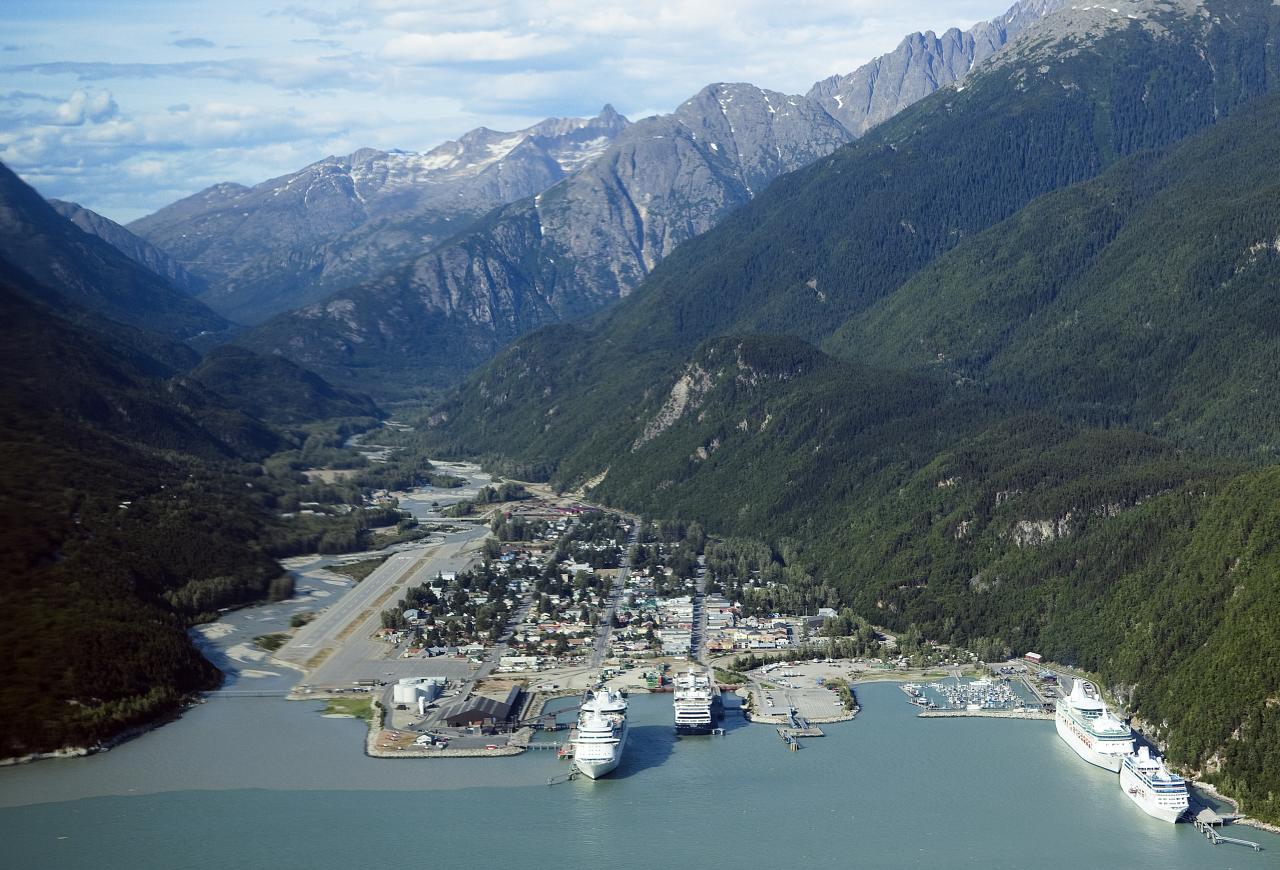
Skagway, on the Taiya Inlet, was an important saltwater port during the Klondike Gold Rush. The White Pass and Yukon Route narrow gauge railroad, part of the area's mining past, now in operation purely for the tourist trade and running throughout the summer months, has its starting point at the port of Skagway. Skagway is a popular stop for cruise ships, and the tourist trade is a big part of the business of Skagway.
Skagway is also the setting for part of Jack London's book The Call of the Wild, Will Hobbs's book Jason's Gold, and Joe Haldeman's novel, Guardian. The John Wayne film North to Alaska (1960) was filmed nearby.
The name Skagway (historically also spelled Skaguay) is the English divergent of sha-ka-ԍéi, a Tlingit idiom which figuratively refers to rough seas in the Taiya Inlet, which are caused by strong north winds. (See, "Etymology and the Mythical Stone Woman", below.)
Skagway is the English adaptation of sha-ka-ԍéi, a Tlingit idiom which figuratively refers to rough seas in the Taiya Inlet, that are caused by strong north winds. Literally, sha-ka-ԍéi is a verbal noun which means pretty woman. The verbal noun was derived from the Tlingit finite verb theme -sha-ka-li-ԍéi, which means, in the case of a woman, to be pretty.
The story behind the name is that Sha-ka-ԍéi or Skagway ["Pretty Woman"] was the nickname of Kanagoo, a mythical woman who transformed herself into stone at Skagway Bay and who (according to the story) now causes the strong, channeled winds which blow toward Haines, Alaska. The rough seas caused by these winds have therefore been referred to figuratively by using Kanagoo's nickname, Sha-ka-ԍéi or Skagway.
The Kanagoo stone formation is now known as Face Mountain, which is seen from Skagway Bay. The Tlingit name for Face Mountain is Kanagoo Yahaayí [Kanagoo's Image/Soul].
One prominent resident of early Skagway was William "Billy" Moore, a former steamboat captain. As a member of an 1887 boundary survey expedition, he had made the first recorded investigation of the pass over the Coast Mountains, which later became known as White Pass. He believed that gold lay in the Klondike because it had been found in similar mountain ranges in South America, Mexico, California, and British Columbia. In 1887, he and his son, J. Bernard "Ben" Moore, claimed a 160-acre (650,000 m2) homestead at the mouth of the Skagway River in Alaska. Moore settled in this area because he believed it provided the most direct route to the potential goldfields. They built a log cabin, a sawmill, and a wharf in anticipation of future gold prospectors passing through.[citation needed]
Hub AI
Skagway, Alaska AI simulator
(@Skagway, Alaska_simulator)
Skagway, Alaska
The Municipality and Borough of Skagway (Tlingit: Shg̱agwei) is a borough in Alaska on the Alaska Panhandle. As of the 2020 census, the population was 1,240, up from 968 in 2010. The population doubles in the summer tourist season in order to deal with the large number of summer tourists each year. Incorporated as a borough on June 25, 2007, it was previously a city (urban Skagway located at 59°27′30″N 135°18′50″W / 59.45833°N 135.31389°W) in the Skagway-Yakutat-Angoon Census Area (now the Hoonah–Angoon Census Area, Alaska). The most populated community is the census-designated place of Skagway.
Skagway, on the Taiya Inlet, was an important saltwater port during the Klondike Gold Rush. The White Pass and Yukon Route narrow gauge railroad, part of the area's mining past, now in operation purely for the tourist trade and running throughout the summer months, has its starting point at the port of Skagway. Skagway is a popular stop for cruise ships, and the tourist trade is a big part of the business of Skagway.
Skagway is also the setting for part of Jack London's book The Call of the Wild, Will Hobbs's book Jason's Gold, and Joe Haldeman's novel, Guardian. The John Wayne film North to Alaska (1960) was filmed nearby.
The name Skagway (historically also spelled Skaguay) is the English divergent of sha-ka-ԍéi, a Tlingit idiom which figuratively refers to rough seas in the Taiya Inlet, which are caused by strong north winds. (See, "Etymology and the Mythical Stone Woman", below.)
Skagway is the English adaptation of sha-ka-ԍéi, a Tlingit idiom which figuratively refers to rough seas in the Taiya Inlet, that are caused by strong north winds. Literally, sha-ka-ԍéi is a verbal noun which means pretty woman. The verbal noun was derived from the Tlingit finite verb theme -sha-ka-li-ԍéi, which means, in the case of a woman, to be pretty.
The story behind the name is that Sha-ka-ԍéi or Skagway ["Pretty Woman"] was the nickname of Kanagoo, a mythical woman who transformed herself into stone at Skagway Bay and who (according to the story) now causes the strong, channeled winds which blow toward Haines, Alaska. The rough seas caused by these winds have therefore been referred to figuratively by using Kanagoo's nickname, Sha-ka-ԍéi or Skagway.
The Kanagoo stone formation is now known as Face Mountain, which is seen from Skagway Bay. The Tlingit name for Face Mountain is Kanagoo Yahaayí [Kanagoo's Image/Soul].
One prominent resident of early Skagway was William "Billy" Moore, a former steamboat captain. As a member of an 1887 boundary survey expedition, he had made the first recorded investigation of the pass over the Coast Mountains, which later became known as White Pass. He believed that gold lay in the Klondike because it had been found in similar mountain ranges in South America, Mexico, California, and British Columbia. In 1887, he and his son, J. Bernard "Ben" Moore, claimed a 160-acre (650,000 m2) homestead at the mouth of the Skagway River in Alaska. Moore settled in this area because he believed it provided the most direct route to the potential goldfields. They built a log cabin, a sawmill, and a wharf in anticipation of future gold prospectors passing through.[citation needed]