


Community hub
Smart Fortwo
View on Wikipedia
| Smart Fortwo | |
|---|---|
 | |
| Overview | |
| Manufacturer | Daimler-Benz (1998) DaimlerChrysler (1998–2007) Daimler AG (2007–2022) Mercedes-Benz Group (2022–2024) |
| Also called | Smart City-Coupé (1998–2002) Smart car (colloquially) |
| Production | 1998–2007 (MkI) 2006–2014 (MkII) 2014–2024 (MkIII) |
| Assembly | France: Hambach (Smartville) |
| Body and chassis | |
| Class | City car Microcar[1] |
| Body style | 3-door hatchback 2-door convertible |
| Layout | Rear-engine, rear-wheel-drive Rear-motor, rear-wheel-drive (electric version) |
| Related | Smart Roadster Smart Forfour |
| Chronology | |
| Successor | Smart #2 |
The Smart Fortwo (stylized as "smart fortwo") is a two-seater city car manufactured and marketed by the Smart division of the Mercedes-Benz Group for model years 1998–2024, across three generations — each using a rear-engine, rear-wheel-drive layout and a one-box design.
The first generation was internally designated as the W450, launched at the 1998 Paris Motor Show. The second generation W451-build series was launched at the 2006 Bologna Motor Show.[2] The third generation Fortwo (2014–2024) was internally designated as the C453 build series,[3][4] and debuted globally on July 16, 2014,[5] at the Tempodrom in Berlin[6] along with a closely related four-door version, the Smart Forfour, co-developed and sharing the same platform and engines with the third-generation Renault Twingo.
Marketed in 46[7] countries worldwide, Fortwo production had surpassed 1.7 million units by early 2015.[8][9][3] The brand name Smart supposedly derives from its early history as a cooperative venture between Swatch and Mercedes: Swatch Mercedes ART.[10] The Fortwo nameplate derives from its two-person seating capacity.[1] Until 2002, the Fortwo had been marketed as the smart City-Coupé.
History
[edit]Development of what ultimately became the Smart Fortwo started before 1993, originally as the Swatch car, developed by Nicolas Hayek in co-operation with Volkswagen. With a design focused on a modern microcar with an electric or hybrid drive, VW vacillated, disputes with Hayek ensued, and Hayek turned to Mercedes.
The company MCC (Micro Compact Car AG) was founded in 1994 by Hayek in Biel as a joint subsidiary of Daimler-Benz and SMH SA (Société Suisse de Microélectronique et d'Horlogerie). When MCC abandoned the original concept and the planned electric or hybrid drive, both Hayek and senior development team members left the project. "Today's gasoline-powered Smart is a product from Daimler-Benz and has not much in common with the plans of the former Swatch team."[11]
Design
[edit]
The Fortwo is noted for its 2.5–2.69-metre (8.2–8.8 ft) overall length, high H-point seating, offset passenger and driver seats (in the first and second generation, the passenger seat is 15 centimetres further rearward than the driver's),[12] automated manual transmission (1st and 2nd generation), De Dion tube rear suspension, low CO2 emissions (119 grams per kilometre, North America, 1.0 Liter),[13] two-part rear hatch, interchangeable plastic body panels and prominent steel hemispherical safety-cell, which is marketed as the Tridion cell and can be ordered in a contrasting color to the vehicle's body panels.

Fortwo models are manufactured at Smartville—a dedicated Daimler assembly plant in Hambach, France—in Coupé (i.e., hatchback) and Cabrio (i.e., convertible) body styles, each in a mono-box configuration.
Smartville underwent a 200 million euro upgrade beginning in mid-2013 for the third generation.[citation needed]
With the second generation, Smart introduced a version with automatic start-stop, marketed as the MHD, or Micro-Hybrid Drive—offered only in certain markets. A sport model, marketed as the Brabus model, has been available in both generations, and Daimler introduced the Smart electric drive, an all-electric version, in 2007.[14][15] The Fortwo forms the basis for Daimler's Car2go fleet, the largest car-sharing enterprise worldwide.[8]
In 2002, the New York Museum of Modern Art (MoMa) introduced a first generation ForTwo into its permanent collection (the only vehicle to be included into the collection while still in series production),[16] and in 2014 the Fortwo was voted the Best Microcar for the fifth year in a row by readers of the Chinese edition of Auto, Motor und Sport.[17] At the time of its commercial launch, the Smart Fortwo diesel-engined variant, the Cdi, had the lowest carbon dioxide emissions for an internal combustion engine, at 88 g/km rated NEDC cycle.[18]

Auto, Motor und Sport cites a drag coefficient (Cd) of 0.35 and Alles Auto cites a Cd of 0.345 for the second generation W451 series[19][20]
Transmissions
[edit]The first and second-generation Fortwo models employ an automated manual transmission, designed and manufactured by Getrag, where the clutch is computer-controlled via electrohydraulics, eliminating the need for a clutch pedal. The first generation used a six-speed version, and the second generation uses a five-speed version, model 5AMT130. Input from floor-mounted shifter or optional steering-wheel-mounted paddles controls a servo-operated clutch and an automated manual gearbox. The vehicle may be driven in automatic mode (early models had the option of fully automatic mode or standard "soft-tip" which was manual mode indicated by no button on the gearshift) or in semi-automatic (half-automatic) mode via paddle-shifters, where the operator controls the shift points but cannot feather or adjust the speed of the clutch.
From 2009, revised transmission software enabled smoother and faster gear changes. The software, available via an ECU upgrade, was also made available for 2008 second generation cars, with a new battery as required.[21][22]
Third-generation models receive a five-speed manual transmission or six speed dual-clutch automatic transmission.
Parking
[edit]With an overall length (first generation: 2.5 m (98.4 in) approximately equal to the width of regular parking space, a Smart Fortwo can park perpendicularly in spaces typically designed for parallel parking, allowing two Smarts to park in one space—a manner of parking not permissible in many jurisdictions worldwide (e.g. Austria, New Zealand and California[23]).
First generation (450 series; 1998)
[edit]| First generation | |
|---|---|
 | |
| Overview | |
| Model code | C 450 (Coupé) A 450 (Cabrio) R 450 (Crossblade)[24] |
| Also called | smart City-Coupé (1998–2002) smart cabrio (2000–2002)[25] smart fortwo (facelift) smart K (kei)[26] smart coupé[26] |
| Production | 1998–2007 |
| Designer | Gerhard Steinle (Chief Designer)[27] |
| Body and chassis | |
| Body style | 3-door hatchback |
| Powertrain | |
| Engine | |
| Transmission | 6-speed automated manual |
| Dimensions | |
| Wheelbase | 1,810 mm (71.3 in) |
| Length | 2,500 mm (98.4 in) |
| Width | 1,510 mm (59.4 in) K: 1,470 mm (57.9 in) |
| Height | 1,500 mm (59.1 in) |
| Kerb weight | 730 kg (1,609 lb) |
The first-generation, build series MC01 debuted in 1998 and received a facelift in 2002.
Engine
[edit]The engines are turbocharged with three cylinders. Originally the basic petrol engine was 599 cc, and came in three versions—33, 38 and 45 kW (45, 51 and 61 hp) (45 kW). The engine displacement was increased to 698 cc with the facelift in 2002, in 37 and 45 kW (50 and 61 hp) variants. The turbo-diesel engine had 799 cc displacement giving 30 kW (41 hp).
Models
[edit]The Fortwo is available as a coupe or cabriolet, originally called the "City-Coupé" & "cabrio", now the "fortwo" & "fortwo Cabrio", introduced in 2000 and restyled in 2002. Trim levels include the Pure, Pulse, and Passion. Pure models are fitted with the standard audio system but nothing else; Pulse models are fitted with alloy wheels, panoramic glass roof, and paddle-shifters on the steering wheel (2004+); and finally, the Passion models are fitted with air-conditioning and ability to select between fully automatic and sequential gearbox.
- Limited 1: The first limited edition of which 7500 were made, all left-hand drive. It was released at the original launch in 1998. It had a black Tridion cell and white body panels. It also had alloy wheels, a Limited 1 insignia, and a blue interior with beige leather finishings. It was supplied with a certificate showing which numbers out of the 7500, and a plaque with this number below the windshield on the inside.
- SE: This was the second limited edition that smart made; it was sold in mid-2001 (Mk5) and all were left-hand-drive. They were all Pulse specification with a redesigned steering wheel, soft-touch, air conditioning, CD Multi-changer, and drinks holder as standard. The engine power was upped to 61BHP from the standard 55BHP normally applied to the Pulse in the 600cc G1 cars. It was designated by a SE badge on the boot and was sold in Bay Grey with grey interior and dark blue twist fabric.
- Cdi: has the world's smallest production common-rail direct injection diesel engine. With a consumption of 3.3 litres (NEDC) per 100 kilometres (71.2 mpg) and CO2 emissions of just 88 grams per kilometre, it has the lowest current production car CO2 emissions worldwide, since Audi and Volkswagen retired its 3-cylinder cars, the A2 1.2 TDI and the Lupo 1.2 TDI respectively.[28]
- Crossblade: a 2002 limited-edition variant of the City Cabrio, a roadster without a windshield, roof, or conventional doors. 2000 were produced.[29] Its weight was still 740 kilograms (1,630 lb). The Brabus-tuned engine developed 52 kW (71 PS) from its 599 cc engine. After Robbie Williams purchased Crossblade number 008, Smart began a marketing association with him, using him to promote the brand and the new Forfour.
- Crosstown: a convertible with a foldable windshield based on the Fortwo, was presented at IAA Frankfurt in 2005. No plans have been announced to bring this model to market.
- Smart Fortwo Brabus Edition Red: - 35 Coupé and 15 Cabrio models.
Between 2006 and 2007 Brabus produced and sold 50 Smart Fortwo Edition Red cars for the UK market. All of these vehicles were originally produced with a black Tridion safety cell and black plastic panels, the car was then later repainted at Brabus in (EB6 colour code) Intense Red. The car was built with the usual Brabus additions to the exterior, these being Brabus front grill (with fog lights), Brabus front splitter, Brabus side skirts, black plastic Brabus rear exhaust panel and 16 inch Brabus Monoblock alloy wheels. These vehicles were always rumoured to be Brabus Nightrun Fortwo's that were later reworked.
The interior was bespoke to this limited run of vehicles. The interior is half leather and half alcantara with red stitching. The seats use the smaller, non sport foams. This is unusual as all other Brabus 450 Fortwo's use the wider sports style seat foams. The door card inserts are alcantara with leather door pockets with the dash board finished in alcantara with an aluminium Brabus plaque displayed in the centre. None of these vehicles had heated seats or electric wing mirrors. All Brabus Edition Red Fortwo's are equipped with a 3-spoke steering wheel, bespoke floor mats, air conditioning, CD player, Brabus clock and rev counter, Brabus speedo displaying 120 mph and all of the removable interior plastics (including door handles and steering wheel trim) repainted in Intense Red to match the exterior.
Designed on the base of the Fortwo Brabus, this limited edition example is powered by a 55 kW 3-cylinder turbo charged engine although all of the upgraded hardware is from the 60 kW motor with a different tune. Brabus upgrades over a standard 698cc Smart Fortwo include a 60 kW camshaft, 60 kW yellow Bosch injectors, 60 kW turbo charger, 60 kW turbo to intercooler pipe (TIK), Brabus branded central twin outlet exhaust with chrome tips, aluminium Brabus intake manifold name plaque and the gearbox from a Smart Roadster (different gear ratios compared with a standard Smart Fortwo).
- Nightrun: includes instrument panels, steering wheel, paddles, shifter, Monoblock VI alloy wheels, leather seats, and engine upgrade from Brabus. Edition Nightrun is only available with the Fortwo coupé/Cabrio.
- Truestyle: painted in metallic ruby red, available in pure trim.
- i-move: a special edition run of 70 Fortwo Cabrio, based on the Passion Cabrio specs with Brabus Monobloc VI wheels, leather interior trim, Lite White panels, an iPod cradle with special edition 20Gb 3G iPod, and an aluminum nameplate on the dash confirmed its special edition status.
- Forfun2 Concept: an off-road version of the Fortwo introduced at the 2005 Athens Motor Show by Greek 4x4 Rally Champion Stefan Attart. It combines the body of a Fortwo with the chassis and drivetrain of a Unimog. It sports monster truck-like 26-inch (66 cm) wheels wrapped in 1.4-metre (4.6 ft) diameter tires and winding keys where the Fortwo's rear wheels are supposed to be.[30][31]
- Brabus: In 2003 Smart and Brabus introduced the jointly developed version of the Fortwo with the 698cc engine. It had 75 PS (55 kW; 74 hp) of power and 110 Nm of torque. It was available in both coupe and convertible versions. It also featured wider wheels, revised front spoiler and grille, and a revised rear exhaust.
- K: launched in October 2001, exclusively for the Japanese market, it was designed to fit the Japanese kei car regulations. Using specially modified suspension that narrowed the track width, altered tire dimensions, and narrower rear fenders, the vehicle width was reduced to 1.47 m. The engine displacement remained unchanged at 598 cc, as Kei-car standards specify a maximum of under 660 cc (40.3 cu in). Safety features include ESP (Electronic Stability Program) and BAS (Brake Assist System) as standard. The Smart K also facilitates the starting procedure with the Hill Start Assist that makes a starts on slopes easier.[32] The Smart K was discontinued in November 2004.[citation needed] [33][34]
- Fortwo Edition Limited One: Featured special metallic grey body panels; silver Tridion cell; brown leather for the seating, steering wheel, and shift lever—along with matching floor mats. The model marked the launch of the W451 build series.
Overall, due to poor sales, Daimler lost an estimated €4,470 per first-generation Fortwo produced.[35]
Smart Crossblade
[edit]
In 2002, a version of the Smart Fortwo without a roof, doors or a proper windshield was created, called the Smart Crossblade. Only 2,000 were built.
Safety
[edit]

Gallery
[edit]-
 One of four BRABUS Canada 1 cdi cars in Canada
 -
 Coupe
Coupe -
 Convertible
 -
 Tachometer generation 450 and clock
 -
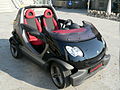 Smart Crossblade
 -
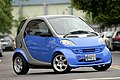 2002 Smart Fortwo BRABUS
 -
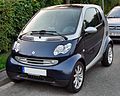 2002 facelift
 -
 2002 facelift
 -
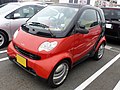 Japanese market Smart K


Second generation (451 series; 2007)
[edit]| Second generation | |
|---|---|
 | |
| Overview | |
| Model code | C 451 (fortwo) A 451 (fortwo cabrio) |
| Production | November 2006–2014 |
| Body and chassis | |
| Body style | 3-door hatchback |
| Powertrain | |
| Engine | 0.8 L diesel (turbo) I3 (OM660) 1.0 L petrol I3 (3B21) 1.0 L petrol (turbo) I3 (3B21T) |
| Transmission | 5-speed automated manual |
| Dimensions | |
| Wheelbase | 1,867 mm (73.5 in) |
| Length | 2,695 mm (106.1 in) |
| Width | 1,559 mm (61.4 in) |
| Height | 1,542 mm (60.7 in) |
| Kerb weight | 750–795 kg (1,653–1,753 lb) (coupe) 780–820 kg (1,720–1,808 lb) (cabrio) |
The second generation, build series 451 (internally: C451, Coupé – A451, Cabrio), was introduced on November 1, 2006—its length increased by 200 mm to 2,690 mm (106.1 in) and offering improved crash performance. The second generation retained the interchangeable plastic body panels as well as the prominent exposed, rigid steel safety cell, which is 50% high-strength steel, hot-dip galvanized and powder-coated—and marketed as Tridion.
The range received a minor interior facelift for the 2011 model year with standard knee airbags, new instrument cluster, more extensive cloth trimming for the top of the instrument panel, circular rather than rectangular outboard dash vents, optional multimedia system with a 6.5" display, and optional surround-sound audio system. For the 2013 model year, all Fortwos received a minor exterior facelift with revised lower facias, front and rear, and a relocated brand emblem located inside rather than above the front grille.[37]
The second generation Fortwo remained the lightest production car on sale in Europe.[38]
Engine and fuel economy
[edit]The 999 cc I3 Mitsubishi 3B2 engine (2007 onwards) is offered in naturally aspirated and turbo versions. German tuner company Brabus, in a joint venture with Smart, has developed a high powered version of the 1.0-litre turbo, producing 102 PS (75 kW; 101 bhp), originally available only in Europe, but now available elsewhere. A small 0.8-litre three-cylinder turbo diesel common rail engine made by Mercedes was available in most European markets.
EU fuel consumption testing for the combined cycle rates the 1.0-litre mhd at 65.7 mpg‑imp (4.30 L/100 km; 54.7 mpg‑US), the turbo at 57.6 mpg‑imp (4.90 L/100 km; 48.0 mpg‑US) and 85.6 mpg‑imp (3.30 L/100 km; 71.3 mpg‑US) for the diesel.[39] The U.S. Environmental Protection Agency (EPA) rates the 1.0-litre at 36 mpg‑US (6.5 L/100 km; 43 mpg‑imp) combined (the EPA does not offer a rating for the diesel engine).[40]
At the 2007 Frankfurt Motor Show, Smart debuted the "micro hybrid drive" (MHD) version of the Fortwo, which was subsequently launched in the UK in 2008. The technology features an automated start-stop system, and a belt-driven starter-generator, which replaces both the starter and alternator. The system generates electricity to charge the battery when the driver is braking, and automatically cuts the engine when the speed drops below 5 mph (8 km/h).[41] Smart claims a fuel efficiency improvement of eight percent from 50 miles per US gallon (4.7 L/100 km; 60 mpg‑imp) to almost 55 miles per US gallon (4.3 L/100 km; 66 mpg‑imp) on the slow NEDC drive cycle—with a reduction in Carbon dioxide emissions from 112 to 103 g/km.[28] This was further improved to 97 g/km in 2010. The mhd version of the Fortwo is not available in the United States or Canada.
| Engine | Capacity | Power | Torque | Emissions CO2 | Top Speed | 0-100 km/h (62 mph) |
|---|---|---|---|---|---|---|
| 0.8 cdi (diesel) | 799 cm3 | 54 PS (40 kW; 53 bhp) | 130 N⋅m (96 lb⋅ft) | 86 g/km | 84 mph (135 km/h) | 16.8 s |
| 1.0 mhd (petrol) | 999 cm3 | 71 PS (52 kW; 70 bhp) | 92 N⋅m (68 lb⋅ft) | 97 g/km (130 g/km in NA) | 90 mph (145 km/h) | 10.7 s |
| 1.0 turbo (petrol) | 999 cm3 | 84 PS (62 kW; 83 bhp) | 120 N⋅m (89 lb⋅ft) | 115 g/km | 90 mph (145 km/h) | 9.9 s |
| 1.0 Brabus (petrol) | 999 cm3 | 102 PS (75 kW; 101 bhp) | 147 N⋅m (108 lb⋅ft) | 119 g/km | 96 mph (154 km/h) | 8.9 s |

Safety
[edit]At introduction, the second generation featured front airbags as well as seat-mounted combination head/thorax side airbags along with the Tridion cell, seat belt tensioners, anti-lock brakes, brake force distribution and electronic stability control. In the United States from model year 2012 onward, the Fortwo featured a total of eight dual-stage airbags in the Coupe—front, knee, side (thorax/pelvis) and window curtain—and a total of six dual-stage airbags in the Cabrio model—front, knee, side (thorax/head) dual-stage airbags. As a part of the vehicle's Tridion cell and crash management system, the front crumple zone is maximized by the rear-mounted engine location.
In Insurance Institute for Highway Safety (IIHS) tests, the 2008 Smart Fortwo earned the top overall rating of "Good" in both the front and side crash tests. The Fortwo received the "Good" score in 8 of 11 measured injury categories.[42] Its seat/head restraints earned the second-highest rating of "Acceptable" for protection against whiplash in rear impacts. The IIHS did an offset crash test with a Smart Fortwo and Mercedes-Benz C-Class, which is 40% of one car's driver's side head-on with 40% of another car's driver's side, and the Smart received a "Poor" rating due to the occupants' heads slamming into the steering wheel. Also, there was too much intrusion into the footwell of the Smart Fortwo. The dummy movement was not well controlled. The Smart Fortwo spun 450 degrees in the air upon impact.[43]
-
 The Fortwo in its stand-alone IIHS crash test
 -
 The Fortwo, crashed into a Mercedes-Benz C-Class


U.S. National Highway Traffic Safety Administration (NHTSA) crash test results for the 2008 Smart Fortwo:[44]
- Frontal Driver:


- Frontal Passenger:
- Side Driver: *The driver door unlatched and opened during the side impact crash which increases the likelihood of occupant ejection.
- Rollover:
- Adult Occupant:
- Pedestrian:
Smart electric drive
[edit]
An all-electric version of the Fortwo, the Smart Fortwo electric drive, began development in 2006.[46][47] Field testing began in London with 100 units in 2007, and the second generation, with a total of 2,000 units, was introduced in 2009 and available in 18 markets around the world for leasing or through the Car2Go carsharing service in San Diego and Amsterdam.[14][15][48][49] Production of the second-generation Smart Fortwo electric drive began in November 2009 in Hambach, France. The Smart EDs have a lithium-ion battery provided by Tesla Motors with capacity of 14 kilowatt-hours (50 MJ) initially, 17.6 kilowatt-hours (63 MJ) later. The range of a fully charged battery is up to 135 kilometres (84 miles) under the New European Driving Cycle (NEDC) cycle.[50][51] The U.S. Environmental Protection Agency's official all-electric range is 63 miles (101 km) and rated the Smart ED with a combined fuel economy of 87 miles per gallon gasoline equivalent (mpg-e) (2.7 L gasoline equivalent/100 km; 104 mpg-imp gasoline equivalent).[52]
The third-generation Smart electric drive was scheduled to be launched in the U.S. and Europe by the second quarter of 2013 and Daimler AG plans to mass-produce the electric car with availability in 30 markets worldwide.[15][53] The third-generation Smart electric drive was unveiled at the September 2011 Frankfurt Motor Show.[54] Key differences with the second-generation model include a more powerful electric motor, which improves acceleration and top speed, a new lithium-ion battery pack that will allow to increase the range to 140 kilometres (87 mi), and an option for quick-charge will be available.[15][54]
Brabus
[edit]
Brabus (styled BRABUS) is a sport package that include a sport exhaust with dual center tips, sport suspension, 16- front and 17-inch rear wheels, power steering and various Brabus visual cues. An originally planned turbocharged engine was not included.[55] The Brabus package is available in cabriolet or coupe body styles, the latter equipped with a panoramic roof (made of glass for the first generation and polycarbonate for the second), and available in metallic silver or deep black.
Safety
[edit]Gallery
[edit]-
 Cabrio
 -
 Interior
.jpg)

Third generation (453 series; 2014)
[edit]| Smart Fortwo | |
|---|---|
_%E2%80%93_Frontansicht,_16._Juni_2015,_D%C3%BCsseldorf.jpg) | |
| Overview | |
| Model code | C 453 (fortwo) A 453 (fortwo cabrio) |
| Also called | smart EQ fortwo (2017–2024) |
| Production | 2014–2019 2017–2024 (EQ Fortwo) |
| Designer | Emiel Burki and Michael Gebhardt under Kai Sieber |
| Body and chassis | |
| Body style | 3-door hatchback 2-door cabriolet |
| Related | |
| Powertrain | |
| Engine | |
| Transmission | 5-speed manual 6-speed DCT Single-speed direct drive |
| Dimensions | |
| Wheelbase | 1,873 mm (73.7 in) |
| Length | 2,695 mm (106.1 in) |
| Width | 1,663 mm (65.5 in) |
| Height | 1,555 mm (61.2 in) |
| Kerb weight | 880 kg (1,940 lb) |
_%E2%80%93_Heckansicht,_16._Juni_2015,_D%C3%BCsseldorf.jpg)
Designed under the direction of Kai Sieber with designer Michael Gebhardt, the third generation launched on July 16, 2014,[5] having been jointly developed with Renault. The third generation was available as the 3-door 2-seater (internally designated as the C453)[3] and 5-door 4-seater (internally designated the W453), marketed as the Fortwo and Forfour, respectively. Motor Trend reported prior to its introduction that the third generation ForFour was to share approximately 70% of its parts with the third generation Renault Twingo, itself only offered as a four-door, four-seater.
The third generation Fortwo was powered by either of two 3-cylinder engines: a 1.0-litre engine producing 76 bhp and 70 lb ft of torque, or a turbocharged 0.9-litre (898 cc) 89 bhp engine with 100 lb ft of torque. A lower-powered 59 bhp engine will follow later. All versions came with either a manual five-speed gearbox or "twinamic" dual-clutch automatic transmission instead of the previous 'Softouch' system.[57] During development, Daimler had consulted with Ford to learn about their Ecoboost 1.0-litre turbo-charged inline 3-cylinder engine, in turn sharing information about its own Euro6 stratified lean-burn gasoline engines.[58]
Prior to its debut, Smart CEO Annette Winkler reported the C453 would share its 2.69 metre length with the current W451[59] as well as its trademark hemispherical steel safety cell, marketed as the Tridion cell.[60] The ForTwo continued to be assembled at Smartville, and the ForFour was manufactured alongside the Renault Twingo 3 in Novo Mesto, Slovenia.[61]
Smartville, where the W450 and W451 have been manufactured, underwent a 200 million euro upgrade beginning in mid-2013, in preparation for the C453 Fortwo, and was ultimately sold to Ineos.[62]
Cabriolet (A453) (2016–2024)
[edit]_%E2%80%93_Heckansicht,_19._September_2015,_Frankfurt.jpg)
In 2015, Smart announced a cabriolet version of the Smart Fortwo at the 2015 Frankfurt Motor Show. The smart fortwo cabrio launched globally in 2016. Cabrio models received additional safety cell reinforcements to compensate for the roof openings, including torsional bulkheads beneath the car, a crossbar behind the passenger seats (sometimes referred to as a basket handle), and additional reinforcement of the A-pillars. Smart claims the standard power soft top will open or close in 12 seconds, and can be operated at any speed. At market launch, 5 soft top colors were offered; black, red, grey, beige and brown. Grey, beige and brown tops were marketed as BRABUS tailor made soft tops.[63]
The smart fortwo cabrio featured removable roof bars that stow into an integrated storage space in the fortwo's rear tailgate. When removed, these roof bars allowed for an open-air driving experience. The fortwo's roof bars were not integrated into the safety structure of the car, and only housed the guide rails for the soft top to close.[64]
Smart EQ rebrand (2018–2024)
[edit]Smart announced in March 2018 that electric versions of the smart fortwo would be branded as the smart EQ fortwo. This change was to further align with the upcoming Mercedes EQ brand in which all Mercedes-Benz produced electric vehicles would receive EQ branding. The rebranding occurred for global March 2018 production, or Model Year 2018.5 in the United States & Canada. Both the coupe and cabrio electric drive models lost the electric drive badges front and rear and received smart EQ fortwo badges in their place, and received updated graphics in the optional smart Media-System.[65]
Facelift (2019–2024)
[edit]In autumn 2019, a facelift model was announced to be available with electric drive beginning in 2020. Tech specs remained the same.


Gallery
[edit]-
 Interior
 -
 Smart EQ Fortwo at Geneva International Motor Show 2018
 -
 Fortwo Cabrio Electric Drive (now Smart EQ Fortwo Cabrio)
 -
 Smart Fortwo cabrio Brabus
 -
 Smart EQ Fortwo at IAA 2019
 -
 Smart EQ Fortwo Cabrio at IAA 2019
 -
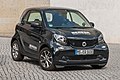 Smart EQ Fortwo
.jpg)
.jpg)
.jpg)
.jpg)

_at_IAA_2019_IMG_0676.jpg)

International markets
[edit]
The smart was initially available only in left-hand-drive form, as the floorpan allowed only for a left-hand-drive version. Smart subsequently designed a floorpan for right-hand-drive models. The Fortwo is now marketed in 37 countries worldwide.
Australia: The Smart Fortwo was marketed through select Mercedes-Benz dealers in Australia from 2003 to 2015 in only the middle 'Pulse' range, and with the petrol engine. In 2007, the base price for the Fortwo coupé was A$19,900, and the Fortwo cabriolet was $22,900. Mercedes-Benz stopped selling the Smart brand in Australia in 2015 due to declining sales.[66]
Brazil
[edit]The smart Fortwo was officially marketed through select Mercedes-Benz dealers in Brazil only from 2009 to 2015 (exclusively in its second generation), only with petrol engines. It was offered with the "micro-hybrid drive" natural aspirated engine (mhd) in standard configuration with a special edition named "Brazilian Edition" which was offered only in yellow (in reference to the Brazilian Flag) with a Brazilian flag sticker on both sides, and turbocharged versions named "standard" (no name), Tritop, and Passion. The mhd were offered only in "coupé" configuration with no sunroof, and turbocharged versions were offered in both coupé (with sunroof) and cabrio variants.
A few units of the fortwo Brabus were also offered in Brazil in the year 2010.
In 2016, Mercedes-Benz decided to discontinue offer of the fortwo in Brazilian market, hence Brazilian customers never had the option of the 453.
There are also a few W450s in Brazil, although they weren't officially imported by Mercedes-Benz and have no official support.
China: In April 2008, Smart premiered at the 2008 Beijing Auto Show. In October 2008, the Smart "vending machine" road show had the first stop in Shenyang and began the Fortwo's pre-order period.
Japan: The Fortwo is one of few non-Japanese cars ever to fulfil the regulations for Kei cars.[citation needed] There was a Japan-only variant of the first generation Smart Fortwo which met the kei regulations, with slightly narrower fenders and skinnier tires, called the Smart K.
Canada
[edit] | This section needs additional citations for verification. (April 2014) |

The smart fortwo was introduced in Canada in September 2004 and sold through Mercedes-Benz dealers. Only the turbo-diesel powerplant was offered for the 450 coupé and 450 convertible models because the fuel vapour recovery system for the gasoline-powered car would have had to be redesigned to meet Transport Canada standards. Diesels do not require such a system because the fuel is not volatile, so the cdi was certified instead. Demand was initially heavy, with up to six-month waiting lists in major urban areas in the spring of 2005. 10,242 cdi cars were imported in model years 2005 and 2006.[citation needed][67] Two or three of these were used in Transport Canada crash testing.
Canada received three special versions of the 450 cdi: the grandstyle—only available in dark green with silver, and beige leather—of which 200 were imported in coupé and cabriolet forms, the BRABUS Nightrun—equipped with BRABUS accessories at the Hambach factory, which only came as a black on black (with blue-grey leather) coupé, and 50 of those were delivered, and finally the BRABUS Tailor Made Canada 1 models, of which only four were produced, three red on red and one white on white, all with highest equipment levels and all BRABUS accessories, high-quality dyed-through leather and Alcantara interiors. The white car is a cabriolet, as are two of the red ones. The sole Canada 1 coupé has a fixed glass roof.
In 2008, Canada received only the gasoline 451 model because the diesel version did not meet 2007 Canadian emission standards. The 451 fortwo carries a 1.0-litre engine that delivers up to 70 horsepower (52 kW) and a re-engineered automated-manual 5-speed transmission with a slightly larger body. This engine has been the sole powertrain for Canada since the 451 was introduced—even the BRABUS models only have 70 HP. The 451 has sold very well in Canada: over 12,600 were registered between the start of 2008 and the end of 2012. The lack of a diesel option has hindered 451 sales to some owners of the diesel 450s.
Canada received several special versions of the 451 as well: the limited 1, the limited 3, the highstyle, the greystyle, the edit10n BRABUS Tailor Made (ten coupés), one all orange "Ultimate" BRABUS Tailor Made, the sharpred, among others.
Smart Canada released ten tenth anniversary edition smart Fortwo cars in February 2009. Each car started life as a Canadian BRABUS model before being converted into tenth anniversary editions by BRABUS in Germany. All examples feature arctic grey metallic paint with brown and alcantara leather interiors and black BRABUS Monoblock 7 wheels. The cars carry a number plate on the dash to signify its production number out of ten.
Smart Canada also commissioned Busch Automodelle GmbH to produce 1:87 scale versions (with a black tridion), of which 10,000 were made.
United States
[edit]
In June 2002, a Smart Fortwo was exhibited in the U.S. at the Museum of Modern Art (MoMA) affiliate P.S. 1 in Queens, New York.
In January 2005, DaimlerChrysler showed the Smart brand at the North American International Auto Show in Detroit, Michigan. Smart Forfour, Smart Roadster, Smart Fortwo Coupé and Smart Fortwo Cabrio models were shown.[68]
In September 2006, Daimler AG announced that Smart USA, a division of Penske Auto Group[69] would officially distribute Smart in the United States and Puerto Rico. Subsequently, the second generation Smart Fortwo (Model 451) became available in January 2008, but the ForFour and the Roadster were never available in this market.[70]
The 2009 model year US version of the Smart Fortwo was available in three trims: Pure (base trim), Passion, and Passion cabriolet. Pure has an MSRP of US$11,990, Passion has an MSRP of $13,990, and the Passion Cabriolet has an MSRP $16,990.[71] A reservation program was launched by Smart USA in March 2007.[72][73] This program allowed interested parties to place a $99 refundable deposit on the new Fortwo in preparation for the product's launch. After the product's launch, sales have surpassed production and the reservation program continued as a "wait list" program.[74][75] The average wait was 12 to 18 months for delivery; although due to economic conditions at the time, many buyers could not purchase the vehicles when they were ready for delivery and many were available on dealer lots.[citation needed]
The Fortwo was rated as the most fuel efficient two-seater car in the United States Environmental Protection Agency's (EPA) 2008 Fuel Economy Guide, with fuel efficiency ratings of 33 mpg‑US (7.1 L/100 km; 40 mpg‑imp) city and 41 mpg‑US (5.7 L/100 km; 49 mpg‑imp) highway.[76] The 2008 Smart Fortwo coupe was given an EPA fuel efficiency rating of 36 mpg‑US (6.5 L/100 km; 43 mpg‑imp) combined.[77]
On May 14, 2008, the Insurance Institute for Highway Safety released crash test results for the Fortwo. The IIHS gave the Fortwo top ratings in protecting passengers in front and side crashes.[78] However, the U.S. National Highway Traffic Safety Administration (NHTSA) cited a Safety Concern on their tests of a 2008 Fortwo, stating "during the side impact test, the driver door unlatched and opened. A door opening during a side impact crash increases the likelihood of occupant ejection."[79]
For model years 2012 and later, the U.S. Fortwo Coupe featured eight airbags (front, knee, side and window curtain), while the Cabrio model featured six airbags (front, knee and side-mounted combination head/thorax).
In early 2006, prior to formal importation to the United States, a specialty firm—G and K Auto conversions of Santa Ana, California—received DOT, NHTSA, and EPA approval to market a modified European specification Smart Fortwo in the US. Modifications for the grey market vehicles included DOT certified headlights, front and rear side marker lights, reinforced doors for additional side impact protection, an odometer in miles rather than kilometres, and soft padding on the interior pillars and ceiling. Approximately 1,000 model year 2004, 2005, and 2006 cars were imported.
In September 2015, the third generation Smart Fortwo Coupe (C453) launched in the United States for the 2016 model year. US variants are offered in four trim levels: Pure, Passion, Prime and Proxy. Significant upgrades, including power steering, eight airbags, alarm, Bluetooth capability and crosswind assist technology were made standard. The 2016 Smart Fortwo also received a new engine, the 0.9 liter 3-cylinder turbocharged unit making 89 horsepower and 100 pound-feet of torque as standard. Both a 5-speed manual transmission and a 6-speed dual-clutch automatic transmission are offered.[80]
In August 2016, the redesigned 2017 Smart Fortwo Cabrio (A453) joined the smart USA lineup, offered in three trim levels; Passion, Prime and Proxy. The Cabrio model makes use of the same gasoline engine and transmissions as the C453 Fortwo Coupe.[81] A BRABUS Sport Package was also added for 2017 for Fortwo Coupe and Cabrio models, adding unique front and rear body styling, wheels, interior appointments and a retuned sport suspension.[82]
The fourth generation Smart Fortwo Electric Drive made its debut at the 2016 Paris Motor Show.[83] The newest generation, built on the C453 chassis, features a new 17.6 kWh lithium-ion battery and an air-cooled electric motor which produce 81 horsepower and 118 lb.-ft. of torque. A new 7.2 kW onboard charger was added, and Smart advertised a charging time of 2.5 hours at a 240 V electrical outlet. EPA estimated range was 58 miles, and the vehicle was rated at 124 MPGe City, making it the most efficient 2 seat vehicle on sale in the USA.[84] The 2017 Smart Fortwo electric drive is offered in both Coupe and Cabrio versions in all 50 states, and qualifies for a $7,500 federal tax incentive.[85]
In February 2017, Smart USA announced the brand would discontinue gasoline vehicle sales after the 2017 model year and focus purely on battery electric vehicles.[86] The Smart Fortwo Electric Drive arrived as a 2017 model in the summer of 2017, and the transition to electric-only occurred for the 2018 model year.[87]
The year 2018 marked 10 years of Smart Fortwo sales in the United States, and the brand offered a special tenth anniversary edition specific to the United States market to celebrate. The edition was available for Passion and Prime lines of the Fortwo Coupe, and consisted of:
- Exclusive Sapphire Blue Metallic body panels, mirror caps, tridion cell, and grille
- 16-Inch BRABUS Monoblock VII Wheels in Matte Anthracite Grey
- Sport Package
- BRABUS-created edition exterior badging in place of the line badge
- Custom-stitched '10th anniversary' BRABUS floor mats
- Tenth anniversary BRABUS shift knob[88]
In April 2019, sales were terminated in the U.S. and Canada. The vehicle never met sales goals.[89]
South Africa
[edit]The smart fortwo was officially marketed through select Mercedes-Benz dealers in South-Africa only with petrol engines.
Chinese copy controversy
[edit]_front_quarter.jpg)
In 2007, Chinese manufacturer Shuanghuan Auto released the Shuanghuan Noble (also known as the Martin Motors Bubble), designed similarly to the Fortwo and prompting Daimler AG to sue Shuanghuan for copyright infringement.[90] The German manufacturer persuaded the Italian court to prohibit the Noble from being exhibited at the Bologna Motor Show, but importer Martin Motors violated that injunction and put the car on display.[91]
In May 2009, a Greek judge ruled against Daimler, allowing the Noble to be sold in Greece. The judge cited that "if a vehicle varies in its technical specification, then any external similarities are irrelevant." This was in reference to the Noble being a front-engine, front-wheel-drive car, while the Fortwo is a similar sized rear-engine and rear-wheel-drive car.[92]
References
[edit]- ^ a b Farenc, Jacques (1998), Norris, Ian (ed.), "European Industry: Mergers and Acquisitions", Automobile Year, 46 (1998–99), Lausanne, Switzerland: Editions JR, J.-R. Piccard: 44–45, ISBN 978-2-88324-054-4
- ^ "Geneva Motor Show 2007 – Highlights". Car Design News, March 7, 2007. Archived from the original on March 6, 2014.
- ^ a b c Lowney, Damon (2013-07-18). "Smart celebrates 1.5 million Fortwo models built, prepares to upgrade factory". Autoblog.
- ^ "The Smart rehearsing the Snow Waltz (in German)". Autobild. March 17, 2014.
- ^ a b "World premiere for the new smart fortwo and smart forfour". Daimler. July 2014. Archived from the original on 2014-07-10.
- ^ "World premiere of the new smart fortwo and forfour on 16 July in Berlin". Daimler AG. Archived from the original on 2014-07-20. Retrieved 2014-07-15.
- ^ "Celebrating 20 Years of History: smart Hambach Plant Writes Next Chapter of its Success Story". Daimler Press, via AutoChannel.com.
- ^ a b "New Vehicle Generation Provides Foundation for Growth 2015". Daimler.com, January 5, 2015. Archived from the original on July 3, 2015. Retrieved January 6, 2015.
- ^ Horrell, Paul (August 28, 2014). "Smart CEO Annette Winkler: The World Needs This Car". Motor Trend.
- ^ "SMART". Acronyms.thefreedictionary.com. Retrieved 2009-03-12.
- ^ "So Smart". Brand Eins Online (in German). October 2001. Archived from the original on 2012-03-07.
- ^ "New Smart fortwo: design story". Carbodydesign.com, 14 November 2006.
- ^ Loveday, Eric (2010-07-22). "Daimler updates Smart Fortwo line, lowers CO2 emissions". Green.autoblog.com.
- ^ a b Ross, Jeffrey N. (2012-10-03). "Smart Fortwo Electric Drive will be cheapest EV at $25,000*". Autoblog.com. Retrieved 2012-10-10.
- ^ a b c d "Third-generation smart Fortwo electric drive to launch worldwide in spring 2012; first use of battery packs from Daimler JV Deutsche Accumotive and motor from JV EM-motive". Green Car Congress. 2011-08-16. Retrieved 2012-10-10.
- ^ Stigh, Daniela (2012-04-06). "Five for Friday (Plus One)". MoMA's Car Collection. The Museum of Modern Art.
- ^ Oagana, Alex (2014-03-07). "Oddly, The smart fortwo is Best Car of 2014 in China". Autoevolution.
- ^ Martin, Jack (2008-09-04). "Happy tenth birthday to the smart fortwo". Gizmag.
- ^ "Leichtbau ist nicht das Wichtigste". Auto, Motor und Sport (in German).
Da der Smart aufgrund seiner großen Frontfläche von 2,06 m2 einen hohen cW-Wert von 0,35 hat, verbraucht er im Vergleich zum niedrigen Gewicht vergleichsweise viel.
- ^ "Smart fortwo mhd passion". Alles Auto. Archived from the original on 2014-03-18.
Luftwiderstandsbeiwert cw 0,345, Stirnfläche A 2,06 m2, Luftwiderstandsindex A x cw 0,71.
- ^ "SMART FOURTWO". Houndgear. 13 July 2010. Archived from the original on December 28, 2010. Retrieved 10 September 2010.
- ^ tampasmart (4 November 2009). "Do you need smart 2.0 upgrade?". Smart Car of America Forums. Retrieved 10 September 2010.
- ^ "Section 22502 – Curb Parking". California Vehicle Code. California DMV. Archived from the original on 20 April 2014. Retrieved 16 August 2011.
- ^ "Smart Diagnostic Smart Tool". DevCom. Retrieved 2023-12-07.
- ^ "Smart Cabrio Prospekt 2000 2001 9/00 D brochure brosjyre catalogus Katalog". eBay (in German). Retrieved 2023-12-07.
- ^ a b "smart スマート クーペ/スマートK/スマート カ...". Yahoo!オークション (in Japanese). Retrieved 2023-12-07.
- ^ "What this couple loves about their Smart car, the Mercedes-Benz of tiny cars". eu.heraldtimesonline.com. Retrieved 20 September 2024.
- ^ a b Abuelsamid, Sam (2007-09-11). "Frankfurt 2007: Smart Fortwo micro hybrid launched". AutoblogGreen. Retrieved 2010-10-17.
- ^ Silvestro, Brian (July 2016). "You Can Buy This Ridiculous and Rare Smart Crossblade Right Now". Road and track. Retrieved 7 August 2022.
- ^ "Smart forfun2: The combination of two vehicles with cult status". Seriouswheels.com. Retrieved 2010-10-17.
- ^ "Video from Fifth Gear television program reviewing the forfun 2". YouTube. 24 January 2008. Archived from the original on 2021-12-22. Retrieved 2010-10-17.
- ^ "The 37th Tokyo Motor Show". Tokyo-motorshow.com. Retrieved 2009-12-18.
- ^ "Smart Fortwo 1st Gen (1998-07)".
- ^ "Pathological Hate: Smart Fortwo (First generation brief history)". 15 June 2018.
- ^ "Zoom, sputter, aagghhh!!". The Economist. 2013-09-25. ISSN 0013-0613. Retrieved 2021-11-29.
- ^ "ANCAP results for Smart City 2 door coupe". ancap.com.au. 2003.
- ^ "Geneva motor show 2012: Facelifted Smart Fortwo". Autocar. Retrieved 23 October 2013.
- ^ "Europe's 15 lightest cars". Green Autoblog. 25 March 2009. Retrieved 23 October 2013.
- ^ "smart – engines". Smart. Archived from the original on 7 October 2013. Retrieved 20 October 2013.
- ^ 2009 smart Fortwo coupe Archived November 11, 2016, at the Wayback Machine Environmental Protection Agency. Retrieved March 10, 2009.
- ^ "Smart Fortwo MHD micro-hybrid (2008) CAR review". Car. 16 July 2008. Retrieved 23 October 2013.
- ^ "IIHS-HLDI: Smart Fortwo". Iihs.org. Archived from the original on 2009-02-13. Retrieved 2009-05-01.
- ^ "New crash tests demonstrate the influence of vehicle size and weight on safety in crashes; results are relevant to fuel economy policies". Iihs.org. 2009-04-19.
- ^ "Safercar.gov". Safercar.gov. Retrieved 2009-05-01. [dead link]
- ^ "For safer cars | Smart Fortwo". Euro NCAP. Retrieved 2009-05-01.
- ^ "smart.com". smart.com. Archived from the original on 2011-04-01. Retrieved 2010-10-17.
- ^ "smart ed". Smart.com. Archived from the original on 2008-03-15. Retrieved 2010-10-17.
- ^ "smart Fortwo electric drive Debuts in the US". Green Car Congress. 2010-06-09. Retrieved 2010-06-09.
- ^ Austin, Michael (June 2010). "2011 Smart Fortwo Electric Drive – First Drive Review". Car and Driver. Archived from the original on 2010-06-12. Retrieved 2010-06-10.
- ^ Blanco, Sebastian (2010-06-10). "250 Smart EDs coming to U.S. this fall with $599/month leases attached". Autoblog Green. Retrieved 2010-06-10.
- ^ "smart goes into series production with second-generation electric drive". Daimler AG. 20 August 2009. Archived from the original on 18 September 2009. Retrieved 22 August 2009.
- ^ U.S. Environmental Protection Agency and U.S. Department of Energy. "2011 smart Fortwo electric drive cabriolet". Fueleconomy.gov. Retrieved 2011-04-19. Select Model Year 2011 and Electric Vehicles, then click on any of the two trims for Smart Fortwo electric drive.
- ^ Sanchez, Karla (2012-10-04). "Smarter Car: 2013 Smart Fortwo Electric Drive Starts at $25,750 – Photos Galore". Motor Trend. Retrieved 2012-10-10.
- ^ a b Loveday, Eric (2011-08-16). "2012 Smart Fortwo Electric Drive hits 75 mph, whizzes to 60 in 13 seconds". AutoblogGreen. Retrieved 2011-08-17.
- ^ Korzeniewski, Jeremy (2008-10-23). "smart Fortwo BRABUS coming to America". Autoblog.com. Retrieved 2010-10-17.
- ^ "ANCAP results for Smart Fortwo variant(s) as tested". ancap.com.au. 2008.
- ^ Holder, Jim (16 July 2014). "2015 Smart Fortwo revealed". What Car?. Archived from the original on 28 September 2014.
- ^ Gibbs, Nick (2013-05-24). "Daimler consults Ford on turbo three-cylinder engine development". Automotive News. Archived from the original on 2014-03-24.
- ^ King, Justin (2014-03-18). "Renault Twingo to share majority of parts with Smart Fortwo". Left Lane News.
- ^ Eckl-Dorna, Wilfried (2013-11-18). "Das ist keine Geheimniskrämerei" (in German). Manager Magazin.
- ^ Holloway, Hilton. "New Renault Twingo spotted". Autocar.
- ^ "Ineos Grenadier".
- ^ Tate, James (2016-09-30). "2017 Smart Fortwo Cabriolet U.S. Spec". Car and Driver. Archived from the original on 2016-11-28.
- ^ Blanco, Sebastian (2017-12-21). "Smart Had to Redo Tridion Safety Cell for Cabrio Version". Forbes.
- ^ Ewing, Steven (2018-03-05). "Smart Electric Drive gets 'EQ' rebrand". CNET. Archived from the original on 2022-12-25.
- ^ Dowling, Joshua (2015-03-05). "Smart car brand axed in Australia". Archived from the original on 2017-07-29.
- ^ Williams, Greg (2008-08-01). "Calgary Herald, Smart Car celebrates its 10th anniversary". Greg Williams. Archived from the original on 2016-03-04.
- ^ "2005 Smart Roadster, ForTwo, ForFour, ForMore – 2005 NAIAS Detroit Auto Show Coverage". Automobile. 2004-12-23. Archived from the original on 2016-10-03. Retrieved 2016-09-30.
- ^ BLOOMFIELD HILLS, MI (April 2, 2007) – Smart USA, a subsidiary of United Auto Group, Inc, (NYSE:UAG), has launched its Smart Fortwo reservation system. The Smart Fortwo is expected to go on sale in the United States in the first quarter 2008 through a dealership network being developed by Smart USA, the exclusive distributor of the Smart Fortwo in the United States and Puerto Rico.
- ^ McCausland, Evan (2009-01-28). "Smart Roadster Somehow For Sale in California". Automobile. TEN: A Discovery Communications Company. Archived from the original on 2017-12-15.
- ^ "2009 Smart Fortwo". Automotive.com. Retrieved 2010-10-17.
- ^ "SmartUSA website". Smartusa.com. Retrieved 2010-10-17.
- ^ "Reserve your Smart Fortwo for $99". Egmcartech.com. 2007-02-05. Retrieved 2010-10-17.
- ^ "How smart is the Smart car?". Kare11.com. Archived from the original on 2013-01-08. Retrieved 2010-10-17.
- ^ "Smart Fortwo Car Rolls Into KC". Kmbc.com. 2008-01-22. Archived from the original on 2011-07-19. Retrieved 2010-10-17.
- ^ Fuel Economy Guide, Model Year 2008 (PDF) (Report). United States Environmental Protection Agency. 2007. Retrieved 4 November 2025.
- ^ "Model 1 Vehicle Characteristics". Fueleconomy.gov. 2006-09-10. Archived from the original on 2011-06-14. Retrieved 2010-10-17.
- ^ "IIHS news release". Iihs.org. 2008-05-14. Retrieved 2010-10-17.
- ^ "NHTSA Website". Safercar.gov. Retrieved 2010-10-17.
- ^ "2016 Smart Fortwo Second Drive - Motor Trend". 15 October 2015. Archived from the original on 2016-10-03. Retrieved 2016-09-30.
- ^ "2017 Smart ForTwo Cabrio First Review | Kelley Blue Book". Archived from the original on 2016-11-13. Retrieved 2016-09-30.
- ^ "New BRABUS Sport Package now available on smart fortwo coupe and cabrio" (Press release). Archived from the original on 2016-10-03. Retrieved 2016-09-30.
- ^ "2017 Smart ForTwo Electric Drive Preview". Cars.com.
- ^ "2017 smart fortwo electric drive coupe".
- ^ "2017 smart fortwo Electric Drive: First Drive Review – Autotrader". Autotrader.
- ^ "Daimler to focus Smart brand on electric cars in U.S., Canada". Reuters. 14 February 2017.
- ^ smartusa. "mini electric cars and micro urban cars – smart USA". smartUSA.com.
- ^ "Smart ForTwo EV tenth Anniversary Edition Launched | Kelley Blue Book".
- ^ Korosec, Kirsten (2019-04-29). "Daimler pulls the plug on electric smart car sales in US, Canada". TechCrunch. Retrieved 2022-06-26.
- ^ Ramsey, Jonathon (2009-01-06). "Mercedes Tries to Burst Shuanghuan's Tiny Bubble, Gives Up". Autoblog.com. Retrieved 2012-01-14.
- ^ Blanco, Sebastian (2007-12-11). "Good Idea? Smart Clone Importers Violate Court Injunction at Bologna Motor Show". Green.autoblog.com. Retrieved 2012-01-14.
- ^ Gauthier, Michael (2009-05-27). "Daimler loses - Greek court rules in favor of Chinese smart fortwo clone". Motorsport Network. Retrieved 2019-09-06.
External links
[edit]- Smart (official site)
- Smart USA (official USA site)
- Smart (official UK community site)
- Origins of the Fortwo
- Smart exhibition at the MoMA
A marque of the Mercedes-Benz Group | ||
| Current vehicles |  | |
| Historic vehicles | ||
| Concept vehicles | ||


Smart Fortwo
View on GrokipediaHistory
Origins and development
The Smart Fortwo originated from a vision conceived in the early 1990s by Nicolas Hayek, the founder of the Swatch watch company, who sought to apply principles of modular design, affordability, and miniaturization from watchmaking to create an ultra-compact urban vehicle often dubbed the "Swatchmobile."[5][6] Hayek aimed for a two-seater microcar that would revolutionize city mobility by being smaller and more efficient than existing small cars, initially envisioning electric or hybrid propulsion to emphasize environmental sustainability.[7] This idea gained traction after Hayek's unsuccessful early discussions with Volkswagen, which were abandoned in 1993 under the direction of Ferdinand Piëch due to strategic differences.[6] In 1994, Hayek partnered with Daimler-Benz to advance the project, forming Micro Compact Car AG (MCC) as a joint venture with Daimler holding a 51% stake and Hayek's Swatch Group (SMH) owning 49%.[5][7] The collaboration leveraged Daimler's engineering expertise while incorporating Swatch's innovative manufacturing techniques, though tensions arose over powertrain choices—Hayek favored electric motors, while Daimler pushed for conventional engines.[6] Swatch eventually withdrew from the venture in the late 1990s amid slower-than-expected progress and market challenges, leaving MCC as a wholly owned subsidiary of Daimler (later DaimlerChrysler).[5] The "smart" name emerged as an acronym for Swatch Mercedes Art, symbolizing the fusion of creativity and automotive engineering.[1] Core design goals centered on achieving an ultra-compact footprint under 3 meters in length to facilitate easy urban parking and maneuverability, paired with an automated manual transmission for simplicity and efficiency, and lightweight plastic body panels over a rigid steel safety cell to minimize weight while enhancing crash protection.[6][7] Development from 1994 to 1998 involved extensive prototyping and testing, including early concepts like the Eco-Speedster and Eco-Sprinter unveiled in 1994, which explored electric and hybrid variants.[6] The eco2000 concept, revealed in 1996 at events such as the Atlanta and Paris motor shows, showcased the envisioned eco-friendly city car with modular components and a focus on sustainability, though safety testing—such as a dramatic 1997 moose avoidance rollover—necessitated redesigns to meet European standards.[6] Initial production was established at the purpose-built Smartville facility in Hambach, France, selected in 1994 for its logistical advantages and incentives; the plant opened in 1997 with a capacity for 200,000 units annually, and full-scale manufacturing of the Smart City-Coupé (later renamed Fortwo) commenced in 1998.[7][1] This setup marked the transition from concept to reality, with the first vehicles rolling off the line on October 27, 1997, ahead of public sales later that year.[6]Production timeline
Production of the Smart Fortwo began in 1998 at the dedicated Hambach plant (Smartville) in France, which was designed with an annual capacity of 200,000 units.[8] The facility, spanning 68 hectares and incorporating a "factory within a factory" concept with on-site suppliers, enabled efficient modular assembly from the outset.[9] The first generation (450 series) ran until 2007, with approximately 770,000 units produced during its nearly decade-long run.[10] Production transitioned to the second generation (451 series) in 2007, featuring updated assembly lines to accommodate refined manufacturing processes and increased model variants, including initial limited electric drive models starting in 2009.[11] In 2014, manufacturing shifted to the third generation (453 series) at the same Hambach facility, with production of the fully electric smart EQ fortwo commencing in 2017 following expansions to support battery integration and higher electrification volumes.[12] The plant underwent further adaptations, including a 2020 acquisition by INEOS Automotive, under which Smart continued contract manufacturing until the Fortwo's discontinuation.[13] By the end of production on March 28, 2024, the Hambach plant had assembled over 2.5 million Smart Fortwo units across all generations, though actual output averaged less than 100,000 annually due to fluctuating demand.[2] Following the cessation, Smart's 50/50 joint venture with Geely has confirmed the smart #2, a two-seater electric city car successor to the Fortwo, for launch in late 2026 in selected global markets including China and Europe.[4]Design and engineering
Body and chassis
The Smart Fortwo's body and chassis are centered around the innovative Tridion safety cell, a high-strength steel skeleton that forms the structural core of the vehicle, providing exceptional crash protection while enabling a lightweight design with curb weights ranging from about 730 kg in early models to around 940 kg in later gasoline variants. This cell, composed of up to 75% high-strength and ultra-high-strength steel, absorbs impact forces in collisions and maintains occupant space integrity, equivalent to that of larger vehicles despite the Fortwo's compact size. The outer body panels, made from dent-resistant thermoplastic polyolefin (TPO) plastic, attach to the Tridion frame, contributing to the car's low weight, corrosion resistance, and ease of repair by allowing panels to be replaced individually without affecting the underlying structure.[14][15][16] Dimensional characteristics emphasize the Fortwo's urban-oriented compactness, with the first generation (450 series) measuring 2.50 meters in length, 1.515 meters in width, and 1.549 meters in height. Subsequent generations maintained a similar profile but grew slightly for improved stability: the second generation (451 series) extended to 2.695 meters in length, 1.559 meters in width, and 1.542 meters in height, while later models like the 2017 version refined to 2.695 meters long, 1.663 meters wide, and 1.554 meters tall. These proportions, combined with a short wheelbase of around 1.87 meters, facilitate tight turning radii under 8 meters, ideal for city navigation.[17][18][14] The rear-engine, rear-wheel-drive layout positions the powertrain over the rear axle, achieving near 50/50 weight distribution for enhanced traction and handling balance, particularly in varied urban conditions. Over generations, chassis rigidity evolved through reinforcements to the Tridion cell and body integration, while suspension tuning—featuring MacPherson struts up front and a De Dion axle at the rear—prioritized agile response and nimble cornering, with updates in the second generation focusing on balanced interaction between chassis, suspension, and steering for superior city driving dynamics.[19][20]Powertrain and transmissions
The Smart Fortwo employs a rear-engine, rear-wheel-drive layout, which contributes to its compact footprint and agile handling in urban environments. This configuration positions the powertrain components at the rear, freeing up interior space while delivering power directly to the rear wheels for efficient traction.[3] Power comes from compact three-cylinder engines co-developed with Mercedes-Benz, primarily petrol variants with displacements ranging from 0.6 L to 1.0 L, alongside diesel options in select markets and electric motors in later iterations. These engines feature electronic multi-point fuel injection for petrol models and common-rail direct injection for diesels, ensuring precise fuel delivery and combustion efficiency. For instance, the 1.0 L turbocharged petrol unit uses an aluminum-alloy block with a 10.5:1 compression ratio and dual overhead camshafts with four valves per cylinder.[21][3] The design emphasizes low-end torque delivery, aided by turbocharging in many variants, to provide responsive acceleration from standstill—ideal for stop-and-go city traffic—without relying on high-revving performance.[21] Transmission options center on automated manual systems to simplify operation in a pedal-free cabin. Introduced with the first generation in 1998, the Softouch automated manual transmission is a sequential gearbox (initially six-speed) controlled by electro-hydraulic actuators for clutch engagement and gear selection, allowing drivers to choose fully automatic shifting or manual paddle/lever inputs without a clutch pedal. This single-clutch dry-plate setup evolved in subsequent models to a five-speed version for smoother urban operation, and later to the twinamic six-speed dual-clutch automatic in the third generation, which eliminates torque interruption during shifts for more seamless power delivery.[22][21] The drivetrain remains rear-wheel drive across all variants, promoting balanced weight distribution with the engine over the rear axle. In the second generation, a micro-hybrid drive (MHD) system was introduced as an option, integrating a belt-driven starter-generator for start-stop functionality and energy recuperation, enhancing fuel efficiency in low-speed scenarios without full electrification.[3] Emissions compliance progressed with model updates, meeting Euro 4 standards from the mid-2000s (e.g., in the cdi diesel variant with low CO2 output) and advancing to Euro 5 and 6 in later petrol and diesel engines through refined injection and catalytic converter technologies. Electric variants achieve zero tailpipe emissions.[23][3]Safety features
The Smart Fortwo's core safety engineering centers on the Tridion safety cell, a rigid structure made of high-strength steel that encases the passenger compartment and distributes crash impact energy across its entire width to minimize intrusion and protect occupants.[24][25] This design acts like the hard shell of a nut, channeling forces away from the cabin while deformable plastic and composite body panels absorb initial energy in collisions.[26] The first-generation Fortwo (450 series) earned a four-star overall rating in the 2000 Euro NCAP crash tests, reflecting the Tridion cell's effectiveness in frontal and side impacts. Similarly, the second-generation Fortwo (451 series) received a four-star Euro NCAP rating in 2007, with strong adult occupant protection scores due to the cell's stability in offset deformable barrier and side barrier tests. The third-generation Fortwo (453 series) also received a four-star Euro NCAP rating in 2014.[27][28] The Fortwo's airbag systems evolved across generations to enhance occupant restraint. The first generation featured standard dual front airbags for driver and passenger protection in frontal crashes. In the second generation, side airbags were added for thoracic protection in lateral impacts, while knee airbags for both driver and passenger were introduced to reduce lower-leg injuries by limiting femur and pelvis movement during deceleration.[29] Later models in the 451 series also incorporated window curtain airbags to mitigate head injuries in rollovers and side collisions.[30] Active safety technologies were integrated starting with the second generation to improve vehicle control. Anti-lock braking system (ABS) prevents wheel lockup during emergency stops, maintaining steering responsiveness on varied surfaces.[31] Electronic stability program (ESP), also introduced in the 451 series, uses sensors to detect skidding and selectively applies brakes to individual wheels while adjusting engine power to help prevent loss of traction.[32] For external safety, the Fortwo complies with pedestrian impact regulations through a deformable front-end design that reduces injury risk in low-speed collisions. The bonnet and bumper incorporate energy-absorbing materials to cushion head and leg strikes, though Euro NCAP assessments noted marginal protection for adult pedestrians in some areas.[33] A reinforced underbody, utilizing high-strength and ultra-high-strength steel at over 50 strategic points, further bolsters structural integrity against ground impacts and enhances overall crash energy management.[34] Independent crash test results from U.S. agencies underscore the Fortwo's protective capabilities relative to its size. The National Highway Traffic Safety Administration (NHTSA) awarded the 2013 Fortwo Electric Drive four stars overall, with four stars in frontal crash and rollover tests but three stars in the side pole impact.[35] The Insurance Institute for Highway Safety (IIHS) gave the 2008 Fortwo its highest "Good" rating for moderate overlap frontal and side crashworthiness, highlighting low risk of head and chest injuries.[36] These ratings demonstrate effective occupant protection despite the vehicle's compact dimensions.[37]Maneuverability and parking
The Smart Fortwo's maneuverability is a defining characteristic, optimized for congested urban settings through its diminutive footprint and agile handling dynamics. Across generations, the vehicle's turning circle has been exceptionally tight, measuring 8.75 meters kerb-to-kerb in the first and second generations, which facilitates sharp turns and easy navigation in narrow alleys. The third generation further refined this to 6.95 meters (22.8 feet curb-to-curb), establishing a benchmark for production cars and enabling U-turns in spaces as small as a standard parking bay.[38][39][40] This design emphasis extends to parking, where the Fortwo's overall length of approximately 2.69 meters allows it to occupy minimal space, often fitting into parallel spots intended for larger vehicles with straightforward forward or minimal reverse maneuvers. The quick steering ratio, around 22:1 in early models, supports precise control for aligning the vehicle at acute angles during entry, reducing the need for multiple adjustments. Some early electric prototypes incorporated rear-wheel steering to enhance low-speed agility for such tasks, though this remained experimental and absent from production variants.[41][42] Advanced driver aids further bolster parking ease, particularly in later iterations. Ultrasonic parking sensors became standard on models like the 2017 Fortwo, alerting drivers to obstacles during reverse maneuvers, while optional rearview cameras provided direct visibility. The third generation introduced more comprehensive systems, including enhanced camera integration for better spatial awareness in confined areas. Additionally, the Fortwo's low center of gravity—achieved via the rear-engine layout and, in electric models, a floor-mounted battery—ensures stability during tight turns and parking, minimizing body roll for confident handling.[43][44][45]First generation (450 series; 1998–2007)
Engines and performance
The first-generation Smart Fortwo (450 series) was equipped with a range of compact three-cylinder engines developed by Mercedes-Benz, emphasizing efficiency and low-end torque suitable for urban driving. These included naturally aspirated and turbocharged petrol variants, as well as a diesel option, all rear-mounted and driving the rear wheels via a five-speed automated manual transmission. Power outputs ranged from 41 to 75 hp (including the Brabus tuned variant), with torque between 70 and 110 Nm delivered primarily at low rpm for responsive acceleration in city conditions.[46] Petrol engines consisted of a 0.6-liter (599 cc) naturally aspirated unit producing 45 hp at 5,250 rpm and 70 Nm at 3,000 rpm, offering basic performance with a 0-100 km/h time of approximately 16.5 seconds and a top speed of 135 km/h. A more refined 0.7-liter (698 cc) naturally aspirated version followed, delivering 50 hp at 5,250 rpm and 80 Nm from 1,800 rpm, achieving 0-100 km/h in 18.3 seconds while maintaining the same top speed. The turbocharged 0.7-liter variant, also 698 cc, boosted output to 61 hp at 5,250 rpm and 95 Nm from 2,000 rpm, improving acceleration to 15.5 seconds for 0-100 km/h without exceeding 135 km/h top speed. The Brabus tuned version of the 0.7-liter turbo increased power to 75 hp at 5,250 rpm and 110 Nm from 2,000 rpm, with 0-100 km/h in 13.3 seconds and the same top speed. Fuel economy across these petrol engines averaged 4.6–4.7 L/100 km combined, contributing to their appeal for fuel-conscious urban commuters.[47][48][49][50][51] The diesel engine, a 0.8-liter (799 cc) turbocharged CDI unit, provided 41 hp at 4,200 rpm and a strong 100 Nm from 1,800 rpm, prioritizing torque for effortless low-speed maneuvers with a 0-100 km/h time of 19.8 seconds and top speed of 135 km/h. It achieved superior fuel economy of 3.8 L/100 km combined, making it particularly popular in Europe where diesel incentives were common. Emissions varied by market and tuning; for instance, the petrol turbo model emitted around 113 g/km CO₂, while the diesel was lower at 90 g/km, aligning with early Euro 3 standards in compliant regions. The CDI was briefly offered and discontinued after 2006 due to stricter emissions regulations.[52][53]| Engine Type | Displacement | Power (hp) | Torque (Nm) | 0-100 km/h (s) | Top Speed (km/h) | Fuel Economy (L/100 km combined) |
|---|---|---|---|---|---|---|
| 0.6L Petrol NA | 599 cc | 45 | 70 | ~16.5 | 135 | 4.6 |
| 0.7L Petrol NA | 698 cc | 50 | 80 | 18.3 | 135 | 4.7 |
| 0.7L Petrol Turbo | 698 cc | 61 | 95 | 15.5 | 135 | 4.7 |
| 0.7L Petrol Turbo Brabus | 698 cc | 75 | 110 | 13.3 | 135 | 4.9 |
| 0.8L Diesel Turbo | 799 cc | 41 | 100 | 19.8 | 135 | 3.8 |
Models and variants
The first generation Smart Fortwo (450 series) was primarily offered as a two-door coupe hatchback with tandem seating for two adults, providing a compact interior layout optimized for urban use and a cargo capacity of 150 liters behind the rear seat. An optional panoramic glass roof was available on select trims, allowing for greater natural light and an enhanced sense of space within the cabin. The lineup included three main trim levels: Pure, Pulse, and Passion. The entry-level Pure featured essential equipment such as remote central locking, twin front airbags, traction control, and electric front windows, paired with a basic audio system. The mid-level Pulse added sportier styling elements including fog lights, paddle-shift gear selection, and wider alloy wheels, while maintaining the core features of the Pure. The top Passion trim elevated comfort with standard air conditioning, 15-inch alloy wheels, and an upgraded audio system with CD player. In 2000, Smart introduced the Cabriolet variant, which retained the coupe's tandem seating and trim structure but incorporated a manually operated fabric roof that could be fully retracted for open-top driving. The Cabriolet offered the same optional panoramic roof elements adapted for its design. Limited editions expanded the core models with distinctive aesthetics, such as the 2006 edition limited one, which featured exclusive silver metallic paint and unique interior trims in coupe form only. These variants highlighted special color schemes and bespoke upholstery to appeal to enthusiasts.Special editions
The Smart Crossblade, launched in 2002 as a limited-edition variant of the first-generation Fortwo City Cabrio, featured an extreme open-air roadster design without doors, roof, or windshield, relying instead on a small deflector for wind protection and emphasizing playful urban mobility over conventional practicality. Built on the Fortwo's Tridion safety cell, it retained the model's compact dimensions while offering a distinctive, helmet-like aesthetic for two occupants. Approximately 2,000 units were produced through 2003, making it one of the rarest Fortwo derivatives.[54][55][56] Several Fortwo exclusives drew from fashion influences, notably the Swatch collaboration that inspired the model's origins, enabling custom paint schemes and interchangeable body panels for personalized themes reminiscent of Swatch watch designs. Examples include black-themed limited runs like the Scratch Black Edition on the Pulse trim, which featured matte black exteriors and coordinated interiors for a sleek, modern look targeted at style-conscious urban drivers. These variants often incorporated unique upholstery and trim options, reflecting the brand's fusion of automotive and accessory aesthetics.[57][58] While some concepts previewed the upcoming Forfour model, Fortwo-focused specials like the Edition Black maintained exclusivity through restricted runs and bespoke detailing. Overall production of first-generation special editions remained modest, contributing to their rising collector appeal; well-preserved examples, particularly the Crossblade, now command premiums at auctions, often exceeding $10,000 due to scarcity and nostalgic value in the microcar segment.[59]Second generation (451 series; 2007–2014)
Design updates
The second-generation Smart Fortwo (451 series), introduced in 2007, featured several aesthetic and structural refinements compared to the first-generation model (450 series). The overall length increased to 2.695 meters from 2.50 meters, while the wheelbase extended to 1.867 meters from 1.812 meters, providing slightly more interior space without compromising the car's compact footprint.[60][61] These dimensional changes contributed to a more proportionate appearance, with the exterior retaining the signature Tridion safety cell in black or silver, complemented by interchangeable body panels in various colors for customization. The front fascia was redesigned with a more sculpted bumper and integrated air intake, enhancing the modern, rounded aesthetic, while optional LED daytime running lights became available in later models.[62] Interior updates emphasized improved quality and ergonomics, with higher-grade plastics and refined color schemes replacing the more basic materials of the predecessor. Aluminum accent trim on air vents and door handles added a premium touch, and the instrument panel adopted a straighter, more functional layout with an ergonomic multifunction display for vehicle information. Optional navigation systems were introduced, integrating into the center console for better connectivity.[62] Structurally, the chassis saw enhancements through the use of high-strength steels in the Tridion cell, increasing torsional stiffness to reduce noise, vibration, and harshness (NVH) levels during operation. The suspension setup included MacPherson struts at the front with torsion bars and a De Dion axle at the rear with coil springs, tuned for better ride compliance. Base models achieved a curb weight of approximately 750 kg, maintaining lightweight efficiency akin to the first generation's 730 kg while incorporating these reinforcements.[62][18][63]Engines and fuel economy
The second-generation Smart Fortwo (451 series) utilized a compact 1.0-liter three-cylinder petrol engine, updated from the first generation for improved efficiency and compliance with stricter emissions standards. This engine was offered in naturally aspirated variants producing 61 horsepower (45 kW) in base models and 71 horsepower (52 kW) in the micro-hybrid drive (mhd) version introduced in 2009, which incorporated a start-stop system to reduce idle fuel use by automatically shutting off the engine during stops and restarting it seamlessly via an enhanced starter-generator. A turbocharged iteration, available from 2010, boosted output to 84 horsepower (62 kW) for enhanced performance while maintaining compact dimensions. These engines were paired with a 5-speed automated manual transmission (standard), or optional 5-speed manual in select markets.[38][64][65] Fuel economy for the petrol engines varied by variant and transmission, with combined consumption figures ranging from 4.4 to 5.7 liters per 100 kilometers under NEDC testing, translating to CO2 emissions of 104 to 133 grams per kilometer. The mhd system's start-stop functionality contributed to lower urban consumption, achieving up to 5.7 L/100 km in city driving for the 71 hp model, while the turbo version balanced quicker acceleration with 4.9 L/100 km combined. These efficiencies were supported by the engine's lightweight aluminum construction and optimized fuel injection, making the Fortwo suitable for urban environments despite its small 33-liter fuel tank.[18][65] Performance metrics reflected the engine's modest power, with 0-100 km/h acceleration spanning 10.7 seconds for the 84 hp turbo to 16.8 seconds for the 61 hp base, and a governed top speed of 145 km/h across variants to prioritize safety and agility over high-speed capability. In select European markets, a 0.8-liter three-cylinder common-rail diesel engine (CDI) was offered, delivering 45 horsepower (33 kW) initially, later uprated to 54 hp (40 kW) from 2009 in some configurations, with torque of 130 Nm for responsive low-end pull. This diesel achieved superior economy at 3.3 to 4.4 L/100 km combined, with CO2 outputs as low as 86 g/km, but it was phased out after 2010 due to evolving emissions regulations and a shift toward petrol and electric options.[60][18][66]Electric drive models
The development of battery-electric variants for the second-generation Smart Fortwo (451 series) began with prototypes in 2007, when Daimler initiated field testing of 100 units in London equipped with high-temperature ZEBRA sodium-nickel-chloride batteries for fleet evaluation.[67] These early prototypes featured a 30 kW electric motor and were leased exclusively to assess urban usability, marking an initial step toward zero-emission city mobility.[68] Production of the refined Smart ED model commenced in November 2009 at the Hambach facility in France, continuing until 2012 with a limited run of approximately 2,000 units focused on fleet and pilot programs rather than mass retail.[69] Initial models utilized a 14 kWh usable capacity lithium-ion battery pack, paired with a rear-mounted 30 kW (41 hp) synchronous electric motor producing 120 Nm of torque for smooth, instant acceleration suitable for urban driving; from 2012, these were upgraded to a 17.6 kWh battery (14 kWh usable) and 55 kW (74 hp) motor.[70][71] This setup delivered a practical range of 100–140 km under mixed conditions and a 0–100 km/h time of about 13 seconds, emphasizing efficiency over high performance.[72] Charging was facilitated by a standard 3.7 kW onboard AC charger, enabling a full recharge in roughly 8 hours from a household outlet, with partial charges possible for shorter top-ups.[71] Deployment centered on fleet trials, such as those integrated into the Car2Go car-sharing service starting in 2012, to gather real-world data on electric micro-mobility.[73] To mitigate the high initial cost of the battery technology, a leasing model was introduced, allowing customers to rent the battery pack separately and return it at the end of the lease term.[74]Brabus variants
The Brabus variants of the second-generation Smart Fortwo (451 series) represented performance-oriented editions tuned by the German specialist Brabus in partnership with Smart, enhancing the base model's capabilities for more dynamic urban driving from 2007 to 2014. These models built on the standard 1.0-liter turbocharged three-cylinder engine by increasing output to 98 horsepower (72 kW) at 5,500 rpm and 140 Nm of torque at 3,500 rpm, resulting in a 0-100 km/h acceleration time of 9.9 seconds and a top speed of 155 km/h.[75][76][77] Complementing the power upgrades, the Brabus featured a sport-tuned suspension lowered by 10 mm for improved handling, larger ventilated disc brakes at all four wheels (upgrading the rear from standard drums), and 16-inch alloy wheels at the front paired with 17-inch rears in a staggered setup fitted with 175/50 R16 and 225/35 R17 tires, respectively.[78][75] Exclusive styling elements included aerodynamic body kits with mesh front grilles, a roof spoiler, twin exhaust outlets, and premium two-tone leather interiors accented by Brabus logos and aluminum dashboard trims.[75][77] Available in both coupe and cabriolet body styles, the Brabus was produced in limited numbers during its run, emphasizing exclusivity over mass-market appeal. The Brabus Xclusive sub-variant further elevated the package with luxury touches such as heated black leather seats, Brabus-branded instrumentation, and enhanced interior materials, positioning it as a more refined option within the lineup.[79][75]Third generation (453 series; 2014–2024)
Platform and styling
The third-generation Smart Fortwo, designated as the 453 series, introduced a new rear-wheel-drive platform developed in collaboration with Renault, shared with the Smart Forfour and the Renault Twingo.[80] This architecture retained the model's compact dimensions, measuring 2.69 meters in length, while enhancing overall stability and handling through a wider track and improved weight distribution.[80] The platform's design emphasized urban maneuverability, with a tight turning circle of just 6.95 meters, making it ideal for city driving.[81] Styling for the 453 series adopted a more modern and expressive aesthetic, featuring a distinctive hexagonal honeycomb grille and round headlights integrated into the front fascia for a playful yet sophisticated look.[80] The Tridion safety cell remained a signature element, now paired with composite body panels in contrasting colors to highlight the vehicle's modular construction. Aerodynamic refinements contributed to a drag coefficient of 0.35 for the coupe variant, achieved through smoother body lines and optimized underbody panels that reduced wind resistance without compromising the compact footprint.[82] Structural enhancements focused on safety and rigidity, incorporating a higher proportion of ultra-high-strength hot-formed steels and multiphase steels—approximately 30% more than the previous generation—particularly in the sidewalls, substructure, and doors to improve impact protection.[83] Inside, the cabin featured fabric-like textures on the dashboard and door panels, evoking the mesh inserts of sports shoes for a tactile, contemporary feel that complemented the optional leather upholstery in higher trims.[80] The introduction of a digital instrument cluster with a 3.5-inch color display provided clearer readability and integrated vehicle information, marking a step toward more advanced driver interfaces.[32] The cabriolet variant adapted this platform with a retractable fabric roof, maintaining structural integrity through reinforced sills.[80]Powertrains
The third-generation Smart Fortwo (453 series) offered a range of internal combustion engine (ICE) and electric vehicle (EV) powertrains, all paired with a rear-wheel-drive layout and available with either a five-speed manual or six-speed dual-clutch automatic transmission. The ICE options utilized Mitsubishi-sourced three-cylinder engines, emphasizing efficiency for urban driving, while the EV variants provided zero-emission propulsion with a focus on compact battery integration. All models complied with Euro 6 emissions standards, with ICE versions featuring particulate filters and advanced engine management for reduced CO2 output.[84][85] The six-speed dual-clutch automatic transmission supports manual shifting via the gear selector, but steering wheel-mounted paddle shifters are not standard on all variants. For 2014-2019 models equipped with the dual-clutch transmission, paddle shifters can be retrofitted by installing a compatible steering wheel with integrated paddles (often sourced from European-market models or Brabus variants) and enabling the function through diagnostic coding using tools like DDT4All or Mercedes Xentry. This is a DIY modification with no official manufacturer upgrade kit, commonly discussed in enthusiast communities, though it requires technical expertise and results vary, with some reports of coding issues or the need for SAM unit programming.[86][87] The base ICE powertrain was a 1.0-liter naturally aspirated three-cylinder engine producing 52 kW (71 hp) and 91 Nm of torque, achieving 0-100 km/h acceleration in 14.4 seconds. A more performance-oriented variant featured a 0.9-liter turbocharged three-cylinder engine delivering 66 kW (90 hp) and 135 Nm of torque from 2,500 rpm, with 0-100 km/h in 10.4 seconds and a top speed of 155 km/h. Fuel economy for these petrol engines ranged from 4.1 to 4.4 L/100 km under WLTP testing, enabling a theoretical range exceeding 600 km on the 28-liter fuel tank. CO2 emissions were as low as 93-104 g/km, supporting the vehicle's low environmental impact in city environments.[88][84][85]| Powertrain | Displacement | Power | Torque | 0-100 km/h | Fuel Economy (WLTP combined) | CO2 Emissions |
|---|---|---|---|---|---|---|
| 1.0L Petrol | 999 cc | 52 kW (71 hp) | 91 Nm | 14.4 s | 4.1 L/100 km | 93 g/km |
| 0.9L Turbo Petrol | 898 cc | 66 kW (90 hp) | 135 Nm | 10.4 s | 4.2 L/100 km | 97 g/km |