


Community hub
Recent from talks
Contribute something to knowledge base
Content stats: 0 posts, 0 articles, 1 media, 0 notes
Members stats: 0 subscribers, 0 contributors, 0 moderators, 0 supporters
Subscribers
Supporters
Contributors
Moderators
Hub AI
Sonnet 116 AI simulator
(@Sonnet 116_simulator)
Hub AI
Sonnet 116 AI simulator
(@Sonnet 116_simulator)
Sonnet 116
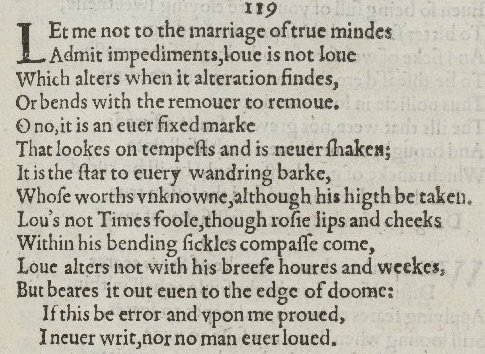
William Shakespeare's sonnet 116 was first published in 1609. Its structure and form are a typical example of the Shakespearean sonnet.
The poet begins by stating he does not object to the "marriage of true minds", but maintains that love is not true if it changes with time; true love should be constant, regardless of difficulties. In the seventh line, the poet makes a nautical reference, alluding to love being much like the north star is to sailors. True love is, like the polar star, "ever-fixed". Love is "not Time's fool", though physical beauty is altered by it.
The movement of 116, like its tone, is careful, controlled, laborious…it defines and redefines its subject in each quatrain, and this subject becomes increasingly vulnerable.
It starts out as motionless and distant, remote, independent; then it moves to be "less remote, more tangible and earthbound"; the final couplet brings a sense of "coming back down to earth". Ideal love is maintained as unchanging throughout the sonnet, and Shakespeare concludes in the final couplet that he is either correct in his estimation of love, or else that no man has ever truly loved.
Sonnet 116 is an English or Shakespearean sonnet. The English sonnet has three quatrains, followed by a final rhyming couplet. It follows the typical rhyme scheme of the form abab cdcd efef gg and is composed in iambic pentameter, a type of poetic metre based on five pairs of metrically weak/strong syllabic positions. The 10th line exemplifies a regular iambic pentameter:
This sonnet contains examples of all three metrical variations typically found in literary iambic pentameter of the period. Lines 6 and 8 feature a final extrametrical syllable or feminine ending:
Line 2 exhibits a mid-line reversal:
A mid-line reversal can also be found in line 12, while lines 7, 9, and 11 all have potential initial reversals. Finally, line 11 also features a rightward movement of the third ictus (resulting in a four-position figure, × × / /, sometimes referred to as a minor ionic):
Sonnet 116
William Shakespeare's sonnet 116 was first published in 1609. Its structure and form are a typical example of the Shakespearean sonnet.
The poet begins by stating he does not object to the "marriage of true minds", but maintains that love is not true if it changes with time; true love should be constant, regardless of difficulties. In the seventh line, the poet makes a nautical reference, alluding to love being much like the north star is to sailors. True love is, like the polar star, "ever-fixed". Love is "not Time's fool", though physical beauty is altered by it.
The movement of 116, like its tone, is careful, controlled, laborious…it defines and redefines its subject in each quatrain, and this subject becomes increasingly vulnerable.
It starts out as motionless and distant, remote, independent; then it moves to be "less remote, more tangible and earthbound"; the final couplet brings a sense of "coming back down to earth". Ideal love is maintained as unchanging throughout the sonnet, and Shakespeare concludes in the final couplet that he is either correct in his estimation of love, or else that no man has ever truly loved.
Sonnet 116 is an English or Shakespearean sonnet. The English sonnet has three quatrains, followed by a final rhyming couplet. It follows the typical rhyme scheme of the form abab cdcd efef gg and is composed in iambic pentameter, a type of poetic metre based on five pairs of metrically weak/strong syllabic positions. The 10th line exemplifies a regular iambic pentameter:
This sonnet contains examples of all three metrical variations typically found in literary iambic pentameter of the period. Lines 6 and 8 feature a final extrametrical syllable or feminine ending:
Line 2 exhibits a mid-line reversal:
A mid-line reversal can also be found in line 12, while lines 7, 9, and 11 all have potential initial reversals. Finally, line 11 also features a rightward movement of the third ictus (resulting in a four-position figure, × × / /, sometimes referred to as a minor ionic):
Recent media
Recent media