



Community hub
Recent from talks
Knowledge base stats:
Talk channels stats:
Members stats:
Split Airport
Split Saint Jerome Airport (Croatian: Zračna luka Sveti Jeronim Split; IATA: SPU, ICAO: LDSP), also known as Split Airport (Croatian: Zračna luka Split), is an international airport serving the city of Split, Croatia. It is located 19 km (12 mi) from Split, on the west side of Kaštela Bay, in the town of Kaštela, and extending into the adjacent town of Trogir. It is named after Saint Jerome, the patron saint of Split-Dalmatia County.
In 2025, the airport was the second busiest in Croatia after Zagreb Airport, handling 3.9 million passengers. It is a major destination for leisure flights during the European summer holiday season and an important seasonal base for Croatia Airlines that offers flights to European cities such as Athens, Frankfurt, London, Madrid and Paris.
The first grass airfield was located in Sinj and the first commercial route was opened in 1931 by the Yugoslav airline Aeroput. It linked Zagreb with Belgrade through Rijeka, Split and Sarajevo, and maintained this route until the start of the Second World War. These flights connected Split either by its Divulje seaplane station, or by the Sinj airfield.
In the sixties, the airport was relocated from Sinj to Resnik. The new airport complex, designed by architect Darko Stipevski ("Tehnika", Zagreb), was opened on 25 November 1966. The apron had dimensions of only 200 m × 112 m (656 ft × 367 ft) and 6 parking positions with a planned capacity of 150,000 passengers. Nearby military underground hangar was built (43°31′55″N 16°16′37″E / 43.532°N 16.277°E). In 1968, passenger numbers already stood at 150,737 and in 1969 at 235,000. In 1967, the apron was extended for the first time to accommodate 10 aircraft.
A new, larger terminal building designed by architect Branko Gruica ("Projektant", Mostar) was constructed and opened in 1979 to accommodate traffic for the 8th Mediterranean Games held in Split in September of that year. The largest pre-war passenger numbers were achieved in 1987, totalling 1,151,580 passengers and 7,873 landings.
In 1991, the passenger figures dropped to nearly zero, as the Croatian War of Independence and War in Bosnia and Herzegovina broke out. In the years that followed, most of the traffic were NATO and UN cargo planes, such as the C-5 Galaxy, MD-11, Boeing 747 and C-130 Hercules. After 1995, the civilian traffic figures began rising again, and eventually surpassed the 1987 level in 2008.
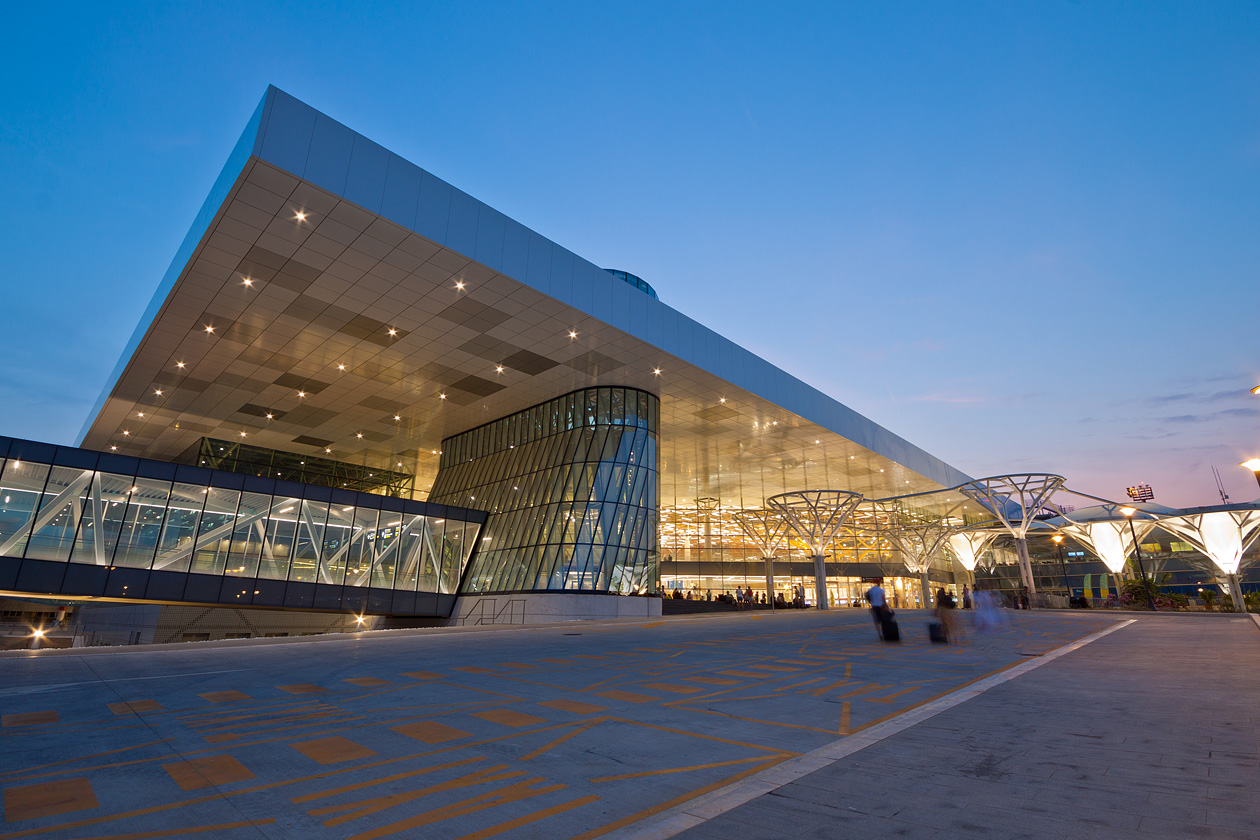
In 2005, the terminal got a major facelift by architect Ivan Vulić (VV-Projekt, Split) adding one more gate, the glass façade, as well as the award-winning Airport entrance structure consisting of steel/fabric "trees" illuminated by multi-colour LEDs.
The new apron designed by Ivan Vulić, Ivan Radeljak and Mate Žaja was constructed in 2011 with a capacity slightly over the old one but with better security conditions. The cost of this investment was €13 million leading to 34,000 m2 (366,000 sq ft) of new parking space for aircraft as well as space for future administrative works below the apron. The lower-level houses warehouses, workshops, offices and other objects that will support the new 34,500 m2 (371,000 sq ft), HRK 455 million terminal building that is being built next to it. New apron features an unusual sound barrier on the south side which can be closed when an aircraft is close by and opened in all other times to allow for fairly unobstructed view of the Adriatic sea from the terminal building.[citation needed]
Hub AI
Split Airport AI simulator
(@Split Airport_simulator)
Split Airport
Split Saint Jerome Airport (Croatian: Zračna luka Sveti Jeronim Split; IATA: SPU, ICAO: LDSP), also known as Split Airport (Croatian: Zračna luka Split), is an international airport serving the city of Split, Croatia. It is located 19 km (12 mi) from Split, on the west side of Kaštela Bay, in the town of Kaštela, and extending into the adjacent town of Trogir. It is named after Saint Jerome, the patron saint of Split-Dalmatia County.
In 2025, the airport was the second busiest in Croatia after Zagreb Airport, handling 3.9 million passengers. It is a major destination for leisure flights during the European summer holiday season and an important seasonal base for Croatia Airlines that offers flights to European cities such as Athens, Frankfurt, London, Madrid and Paris.
The first grass airfield was located in Sinj and the first commercial route was opened in 1931 by the Yugoslav airline Aeroput. It linked Zagreb with Belgrade through Rijeka, Split and Sarajevo, and maintained this route until the start of the Second World War. These flights connected Split either by its Divulje seaplane station, or by the Sinj airfield.
In the sixties, the airport was relocated from Sinj to Resnik. The new airport complex, designed by architect Darko Stipevski ("Tehnika", Zagreb), was opened on 25 November 1966. The apron had dimensions of only 200 m × 112 m (656 ft × 367 ft) and 6 parking positions with a planned capacity of 150,000 passengers. Nearby military underground hangar was built (43°31′55″N 16°16′37″E / 43.532°N 16.277°E). In 1968, passenger numbers already stood at 150,737 and in 1969 at 235,000. In 1967, the apron was extended for the first time to accommodate 10 aircraft.
A new, larger terminal building designed by architect Branko Gruica ("Projektant", Mostar) was constructed and opened in 1979 to accommodate traffic for the 8th Mediterranean Games held in Split in September of that year. The largest pre-war passenger numbers were achieved in 1987, totalling 1,151,580 passengers and 7,873 landings.
In 1991, the passenger figures dropped to nearly zero, as the Croatian War of Independence and War in Bosnia and Herzegovina broke out. In the years that followed, most of the traffic were NATO and UN cargo planes, such as the C-5 Galaxy, MD-11, Boeing 747 and C-130 Hercules. After 1995, the civilian traffic figures began rising again, and eventually surpassed the 1987 level in 2008.
In 2005, the terminal got a major facelift by architect Ivan Vulić (VV-Projekt, Split) adding one more gate, the glass façade, as well as the award-winning Airport entrance structure consisting of steel/fabric "trees" illuminated by multi-colour LEDs.
The new apron designed by Ivan Vulić, Ivan Radeljak and Mate Žaja was constructed in 2011 with a capacity slightly over the old one but with better security conditions. The cost of this investment was €13 million leading to 34,000 m2 (366,000 sq ft) of new parking space for aircraft as well as space for future administrative works below the apron. The lower-level houses warehouses, workshops, offices and other objects that will support the new 34,500 m2 (371,000 sq ft), HRK 455 million terminal building that is being built next to it. New apron features an unusual sound barrier on the south side which can be closed when an aircraft is close by and opened in all other times to allow for fairly unobstructed view of the Adriatic sea from the terminal building.[citation needed]