


Community hub
Recent from talks
Contribute something
Nothing was collected or created yet.
Stevie Ray
View on Wikipedia
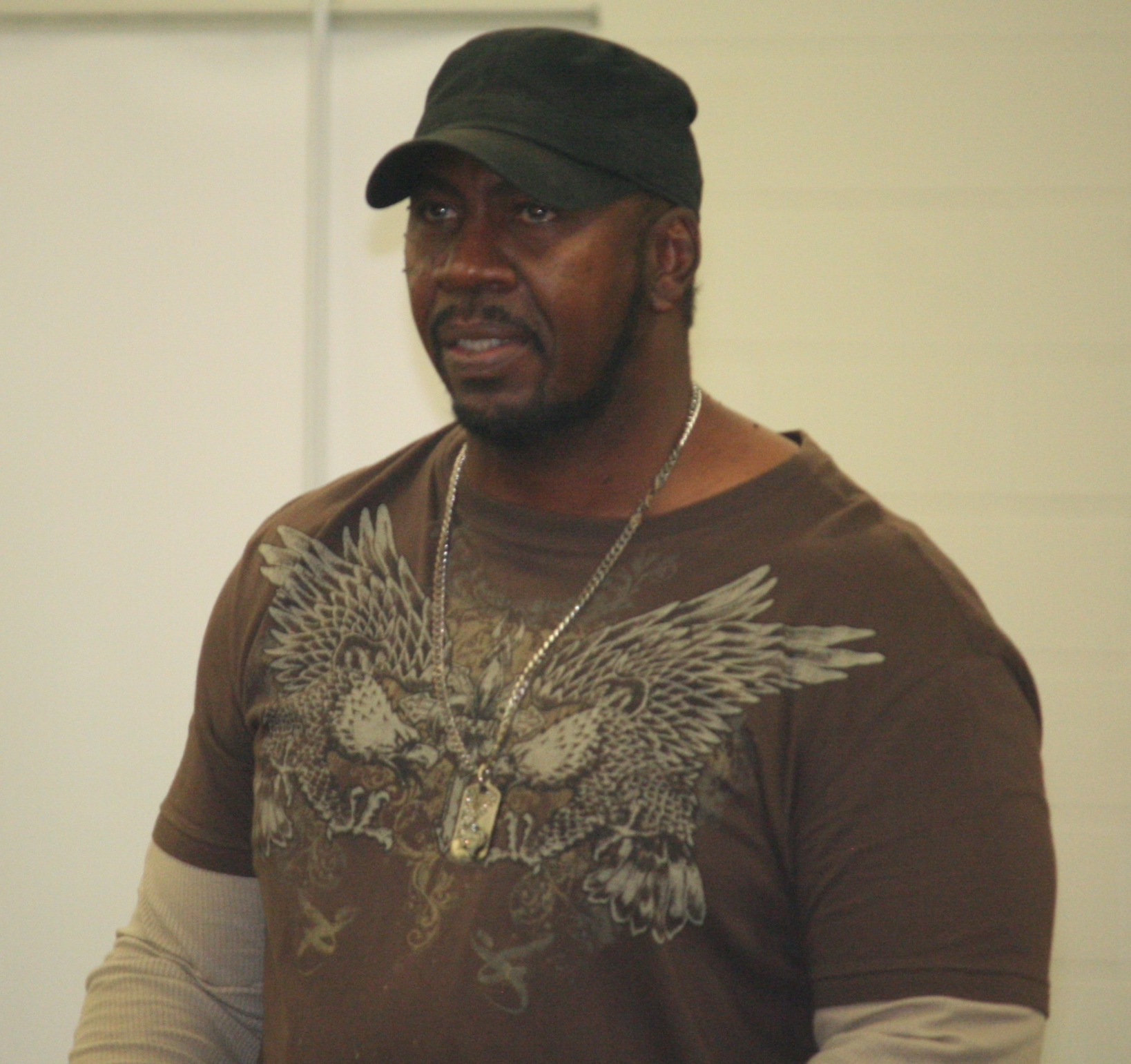
Laslon "Lash" Steven Huffman[6] (born August 22, 1958) is an American retired professional wrestler, better known by his ring name, Stevie Ray. Stevie Ray is best known for his seven-year tenure with World Championship Wrestling (WCW) from 1993 to 2000, where he was one-half of the tag team Harlem Heat, with his younger brother Booker T. Huffman, better known as Booker T. They won the WCW World Tag Team Championship a record ten times.
Key Information


Huffman is also a one-time WCW World Television Champion.[2][5] Among other events, he headlined the Fall Brawl 1993 and 1998 pay-per-views.
Huffman, as part of Harlem Heat, was inducted into the WWE Hall of Fame class of 2019.[7]
Professional wrestling career
[edit]Early career (1989–1993)
[edit]Laslon Huffman started wrestling in 1989 as Super Collider on the independent circuit in Texas. In Ivan Putski's Western Wrestling Alliance, he first started feuding with his brother, Booker (who was G.I. Bro at the time) under the ring name Jive Soul Bro. He began teaming with his brother as Stevie Ray (named after a combination of musical artists Stevie Wonder and Ray Charles[8]) in a tag team called The Ebony Experience for the Global Wrestling Federation, which was on ESPN.[9] They were faces and feuded with the "Blackbirds" of Iceman King Parsons and Brickhouse Brown. They won the GWF Tag Team Championship three times. Stevie Ray then went on to win the GWF North American Heavyweight Championship in 1993.
World Championship Wrestling (1993–2001)
[edit]Harlem Heat (1993–1997)
[edit]In August 1993, they went to World Championship Wrestling (WCW) and changed their team name to Harlem Heat. Initially Lash was known as Kane while Booker became Kole. They were then billed from Harlem. They became heels and were on Harley Race and Col. Rob Parker's team in the War Games at Fall Brawl on September 19, 1993, with Vader and Sid Vicious against Sting, Davey Boy Smith, Dustin Rhodes and The Shockmaster. They lost the match when Shockmaster forced Booker (Kole) to submit. In 1994, they got Sister Sherri as their manager and changed their names back to Booker T and Stevie Ray. They feuded with Stars and Stripes (The Patriot and Buff Bagwell) and won the WCW Tag Team Titles for the first time.
From there, they feuded with The Nasty Boys (Jerry Sags and Brian Knobs) and got into a feud with Col. Parker's "Stud Stable" of Dick Slater and Bunkhouse Buck where Parker and Sherri were carrying on a love affair. During this time, Stevie and Booker lost the titles to the Nasty Boys, regained them, then lost them to Slater and Buck and regained them again. They eventually gained Parker as a manager as he abandoned Slater and Buck to be with Sherri. Harlem Heat won the WCW World Tag Team Championship three times in 1995, trading the titles with the American Males (Bagwell and Scotty Riggs) in the early fall. They had brief feuds with Lex Luger and Sting, trading the titles back and forth in early 1996 and The Road Warriors before starting a long feud with Rick and Scott Steiner in 1996.
In October, they lost their titles to The Outsiders, Kevin Nash and Scott Hall, when Nash used Parker's cane to attack Stevie. They would then fire the Colonel, beat him up, turn face, and enter into a brief feud against Parker's newest team The Amazing French Canadians, a feud they would win. In 1997 they feuded with Public Enemy (Johnny Grunge and Rocco Rock), The Steiners and the New World Order. In the summer of 1997, they fired Sherri and added a new manager, Jacqueline. They were briefly put out of action by the nWo and returned to feud with The Faces of Fear (Meng and The Barbarian).
Singles appearances; New World Order (1998–1999)
[edit]As 1998 started to roll around, Stevie had to take some time off from WCW from January to June. Meanwhile, Booker T would go on to win the WCW World Television Championship. Through the association with his brother, he would gain his only singles title in WCW, as when Booker took time off with an injury as Television Champion from July to October, Stevie got a "power of attorney" to defend the belt for Booker. He then engaged in a short feud with Chavo Guerrero Jr. over the right to defend the belt before dropping it to Chris Jericho afterwards. By June 1998, Stevie Ray had returned to the ring, and the powerful gang-like faction of the nWo had been split into two: Hollywood Hogan's nWo Hollywood and Kevin Nash's nWo Wolfpac. Stevie Ray would be offered a spot in nWo Hollywood, but was hesitant at first. He would join the "black & white" in August, effectively turning him heel. Although this would make Stevie Ray known for using dirty tactics and a strength-in-numbers mentality, his brother, Booker, showed little resentment and respected Stevie Ray's decision to be a part of the nWo, and they were able to peacefully co-exist. Meanwhile, Booker was steadily gaining popularity as a face, climbing the ranks of the WCW roster and winning championship titles.
During his tenure with the nWo, Stevie Ray would tag team with the likes of Horace Hogan and Scott Norton as well as performing in singles competition, often with Vincent at ringside. Alongside Hollywood Hogan and Bret Hart, he also participated in the War Games of Fall Brawl 1998. The slapjack became known as Stevie Ray's trademark weapon which he would frequently use to knock an opponent unconscious, typically when the referee was distracted. By early 1999, both nWo factions had fused back together, but members of nWo Hollywood started bickering over who the leader of the sub-faction was. Hollywood Hogan began telling various members in private that he had granted them official leadership, causing confusion and friction between members. Not long after, Stevie Ray won the leadership role in a 4-man battle royal on the April 5, 1999, episode of WCW Monday Nitro, defeating Horace Hogan, Brian Adams, and Vincent.
Harlem Heat reformation and feud with Booker T (1999–2000)
[edit]As tension grew between members of nWo Hollywood, Stevie Ray started helping Booker T during his matches. As Booker was getting ganged up on in July, the two reunited Harlem Heat. They began feuding with Barry and Kendall Windham as well as The Jersey Triad of Diamond Dallas Page, Chris Kanyon and Bam Bam Bigelow. They went on to win the Tag Titles three more times, making them 10 time champions.
By late 1999, a female bodybuilder named Midnight had joined Harlem Heat. Stevie resented her help and started disputing with Booker over her. He eventually challenged Midnight in a match that would decide whether or not she would stay with Harlem Heat. After being defeated with a surprise small package, Stevie Ray would turn on both Booker and Midnight to form Harlem Heat, Inc. with Big T, Kash and J. Biggs. They won the rights to the Harlem Heat name in a match with Big T against Booker on February 20, 2000, at SuperBrawl X.
Color commentator (2000–2001)
[edit]In May, Stevie split from Big T, Kash and Biggs (who all left WCW) and helped Booker T out of a jam. He then retired from in-ring competition to become a color commentator for WCW Thunder. As a commentator, Stevie referred to all of the women as "yaks" and coined his catchphrase "Suckas gots to know!" He also provided in-depth analysis from a wrestler's point of view during matches and constantly criticized wrestlers for mistakes made in the ring. For example, he would often say that a wrestler "should have went [sic] for the cover!" or "needed to hook the leg!" and this advice earned him the nickname, "Straightshootin'" Stevie Ray. Stevie came back for one more WCW match (a title vs. career match) for the WCW World Heavyweight Championship against Scott Steiner on the November 27, 2000, edition of WCW Monday Nitro, which he lost. A few months later, WCW was bought by the WWF in March 2001. Stevie did not want to go to WWF.[10]
World Wrestling All-Stars (2001–2002)
[edit]After WCW was bought by WWF, Stevie Ray wrestled a few matches for WWA against Jerry Lawler, and Buff Bagwell in 2001, and Ernest Miller in 2002, retiring later that year.
Semi-retirement (2005–2017)
[edit]In 2005, Stevie Ray and Booker T opened the "Booker T and Stevie Ray Pro Wrestling Academy" in Houston, Texas.[11] In April 2013, Stevie Ray inducted Booker T into the WWE Hall of Fame.[2] On February 21, 2015, Booker T and Stevie Ray reunited as Harlem Heat for one last match at Booker T's promotion, Reality of Wrestling's "The Final Heat" event, where they defeated the Heavenly Bodies for the ROW Tag Team Championship. On March 14, the titles were vacated. On May 16, 2015, Ray won the WildKat Heavyweight Championship defeating Shane Taylor. He dropped to title back to Taylor on November 14, 2015. In 2015 Ray was added to WWE 2K16 as DLC. On March 30, 2016, Stevie Ray debuted a new weekly radio talk show, Straight Shooting with Stevie Ray which airs on KCOH radio 92.9 FM HD2 every Wednesday. He is also the host of the podcast Stand Up for Greatness.[12] Ray's last match was at Reality of Wrestling on August 12, 2017, teaming with Abel Andrew Jackson as they lost to Ernest Miller and Ryan Davidson.[13]
Championships and accomplishments
[edit]- Cauliflower Alley Club
- Tag Team Award (2018) – with Booker T[14]
- Global Wrestling Federation
- Reality of Wrestling
- Pro Wrestling Illustrated
- Tag Team of the Year (1995, 1996) with Booker T
- Ranked No. 67 of the 500 best singles wrestlers of the year in the PWI 500 in 1996[16]
- Ranked No. 248 of the 500 best singles wrestlers during the "PWI Years" in 2003
- Ranked No. 62 of the 100 best tag teams of the "PWI Years" with Booker T in 2003
- WildKat Pro Wrestling
- WPW Heavyweight Championship (1 time)[17]
- World Championship Wrestling
- WCW World Television Championship (1 time)
- WCW World Tag Team Championship (10 times) – with Booker T[4]
- WWE
- WWE Hall of Fame (Class of 2019) – as a member of Harlem Heat
References
[edit]- ^ a b "WWE 24". WWE Network. Retrieved July 30, 2018.
- ^ a b c Giannini, A. & Murphy, R. (April 4, 2013). "Stevie Ray to induct Booker T into WWE Hall of Fame". WWE.com. WWE. Retrieved August 2, 2013.
- ^ Cawthon, Graham (2015). the History of Professional Wrestling Vol 5: World Championship Wrestling 1995–2001. CreateSpace Independent Publishing Platform. ISBN 978-1499656343.
- ^ a b c d "Stevie Ray profile". Online World of Wrestling. Retrieved August 10, 2009.
- ^ a b Clayton, C. (March 6, 2008). "Booker T & Stevie Ray: Bringing the 'Heat'". WWE.com. WWE. Retrieved September 7, 2013.
- ^ Mitchel, Pamela (December 3, 1998). "Wrestling 101: getting a grip on the basics". Houston Chronicle. Archived from the original on November 29, 2012. Retrieved July 22, 2017.
- ^ "Harlem Heat To Be Inducted Into The 2019 WWE Hall Of Fame | Fightful Wrestling". www.fightful.com. Retrieved March 11, 2019.
- ^ Keller, Wade (April 6, 2019). "KELLER'S WWE HALL OF FAME SEGMENT REPORT 4/6: Booker T and Stevie Ray tell stories from early years, Ole Anderson, Arn Anderson, Eddie Gilbert, Sid, Hogan, and then endorses Kofimania". Pro Wrestling Torch. Retrieved October 15, 2022.
- ^ Lash Huffman. Shoot Interview with Stevie Ray (2006) (DVD).
- ^ "Stevie Ray Reveals Why He Never Went To WWE". April 14, 2019. Retrieved May 18, 2021.
- ^ Jason Clevett (June 22, 2005). "Booker T to play two more years". SLAM! Wrestling. Archived from the original on January 1, 2013. Retrieved April 17, 2008.
- ^ Mooneyham, Mike (November 10, 2017). "Stevie Ray is now host of a Houston-based weekly radio talk show".
- ^ Lambert, Jeremy (August 22, 2022). "Stevie Ray Thinks He Has One Last Match In Him". Fightful.com. Retrieved October 15, 2022.
- ^ "Harlem Heat Will Be Honored in Las Vegas – Cauliflower Alley Club". www.caulifloweralleyclub.org.
- ^ "RoW Tag Team Title (Houston)". Wrestling-Titles.com.
- ^ Kreikenbohm, Philip. "Awards « Stevie Ray « Wrestlers Database « CAGEMATCH – The Internet Wrestling Database". www.cagematch.net.
- ^ "WildKat Sports & Entertainment". www.facebook.com. Archived from the original on February 26, 2022.
Bibliography
[edit]- Lash Huffman. Shoot Interview with Stevie Ray (2006) (DVD).
External links
[edit]
- Harlem Heat at WWE.com
- Stevie Ray at IMDb
- Stevie Ray's profile at Cagematch , Wrestlingdata , Internet Wrestling Database


Stevie Ray
View on GrokipediaEarly life
Childhood and family background
Lash Steven Huffman, professionally known as Stevie Ray, was born on August 22, 1958, in Dallas, Texas.[8] He grew up in a large working-class family as one of eight siblings, with his mother, Rosa Huffman, serving as the sole provider after his father's death when younger brother Booker T (born 1965) was just 10 months old; the family had relocated to Houston from Plain Dealing, Louisiana, around that time to support Rosa's career as a nurse.[9][10] As the older brother, Huffman helped raise his siblings amid these humble circumstances, contributing to a close-knit family dynamic shaped by economic challenges and maternal resilience in Houston's urban environment.[11] Huffman's childhood in Houston fostered early interests in sports and physical activities, influenced by local athletic culture and the need for discipline in a demanding household, which built his robust physique and competitive spirit. These pursuits, particularly in football during his high school years in Texas, earned him initial recognition and set the stage for further athletic development.[12]Football career and transition to wrestling
In the late 1980s, Huffman shifted his athletic focus toward professional wrestling. He trained under Scott Casey in Texas-based promotions, debuting in 1989 under the ring name Super Ninja (also known as Super Collider).[4][2]Professional wrestling career
Early career (1989–1993)
Lash Huffman, better known by his later ring name Stevie Ray, debuted in professional wrestling in 1989 as Super Collider after training under Scott Casey and Ivan Putski.[5] He competed primarily in the Global Wrestling Federation (GWF) in Dallas, forming The Ebony Experience with his brother Booker T under the guidance of promoter Eddie Gilbert and winning the GWF Tag Team Championship three times with various partners, including Gary Young and Stevie Dane in 1992.[4] Huffman also captured the GWF North American Heavyweight Championship on February 5, 1993, holding it for 49 days before losing it to Rod Price.[13] This period established him as a tag team specialist with a focus on power-based offense and teamwork.WCW debut and initial roles (1993)
Stevie Ray signed with World Championship Wrestling (WCW) in early 1993, leveraging his prior success as the GWF North American Heavyweight Champion in the Global Wrestling Federation.[5] His initial WCW television appearance occurred on August 21, 1993, where he debuted as the powerhouse Kane, teamed with his brother as Kole to form the heel tag team Harlem Heat.[4] Positioned as mid-card enforcers, the duo quickly established themselves through aggressive brawling styles, often aligned with other heels like Sid Vicious under manager Col. Robert Parker.[5] In his early WCW tenure, Kane primarily filled a jobber role in mid-card bouts and television tapings, losing to top-tier talent to build their momentum. He suffered defeats against stars like Sting, including a singles loss by disqualification on the September 18, 1993, episode of WCW Saturday Night, where Sting overcame Kane's power-based offense with technical counters and high-impact moves.[14] Similar losses occurred in TV tapings against veterans such as Rick Steamboat, reinforcing Kane's status as an enhancement act while allowing him to showcase his athleticism in short, intense exchanges. These matches highlighted his role in elevating established competitors without pursuing singles accolades at the time. Kane also featured in multi-man contests that underscored his enhancement function, such as the August 18, 1993, Clash of the Champions XXIV, where Harlem Heat secured a tag team victory over The Nasty Boys via pinfall, yet the bout served to transition focus to ongoing feuds involving bigger stars.[15] Later that year, at Fall Brawl on September 19, 1993, Kane joined Sid Vicious and Big Van Vader in a losing WarGames effort against Sting, Davey Boy Smith, Dustin Rhodes, and The Shockmaster, emphasizing the faces' resilience in a high-stakes environment.[16] By late 1993, Kane's character evolved toward his established Stevie Ray identity, with house show bookings billing him under that name and promos accentuating his Texas heritage as a rugged, no-nonsense competitor from Houston.[17] This groundwork laid the foundation for the official ring name switch in 1994, marking a shift from generic heel enforcer to a more personalized powerhouse persona rooted in regional pride.[4]Formation and first run of Harlem Heat (1994–1996)
In 1994, WCW formed the tag team Harlem Heat by pairing Booker T with Stevie Ray, real-life brothers positioned as a tough, urban enforcer duo hailing from Harlem. The team adopted a streetwise gimmick that drew significant crowd heat through their aggressive style and portrayal as no-nonsense brawlers. Managed by Sister Sherri, who adopted the persona of Sister Sherri to guide their heel antics, Harlem Heat debuted on WCW television that year, quickly establishing themselves as a dominant force in the tag division.[18] Harlem Heat's breakthrough came on July 17, 1994, at Bash at the Beach, where they defeated Cactus Jack and Kevin Sullivan to capture the WCW World Tag Team Championship in their debut title match, holding the belts for 63 days until losing them to Stars and Stripes on September 18, 1994, at Fall Brawl.[19] Their second championship reign followed in 1995, secured on September 17 at Fall Brawl by defeating Dick Slater and Bunkhouse Buck of the Stud Stable, though the run lasted only one day before the American Males claimed the titles the next night on WCW Monday Nitro. The duo engaged in intense feuds during this period, clashing with the Nasty Boys in brutal, hardcore-influenced matches that highlighted their physicality, the Rock 'n' Roll Express in fast-paced Southern-style bouts emphasizing teamwork, and Sting and Randy Savage in high-profile encounters, including a tag team match at Bash at the Beach 1995 where the champions retained amid chaotic interference from Sherri.[20][21] By September 1996, Harlem Heat achieved their third WCW World Tag Team Championship at Fall Brawl, overcoming the Nasty Boys in a hard-fought contest with interference from managers Col. Robert Parker and Sister Sherri, beginning a reign that included successful defenses against Lex Luger and Sting. Their signature double-team finisher, the Heat Seeker—a rocket launch-style move where one partner elevated the other for a diving clothesline—became a hallmark of their matches, often securing victories and amplifying their enforcer persona. However, as the year progressed, internal tensions between Booker T and Stevie Ray began to surface, marked by disagreements over leadership and spotlight, foreshadowing the team's eventual split later in 1996.[22][23][18]Harlem Heat splits and transitions (1996–1997)
Following the conclusion of Harlem Heat's third WCW World Tag Team Championship reign, the duo lost the titles to The Outsiders (Kevin Nash and Scott Hall) in a contentious match at Halloween Havoc on October 27, 1996, marked by interference and post-match tension, including Scott Hall spitting on Stevie Ray.[24] This defeat prompted a temporary split, with Booker T shifting focus to singles competition and capturing the WCW World Television Championship from Disco Inferno on the December 29, 1996, episode of WCW Saturday Night, establishing him as a rising individual star.[25] Stevie Ray, in the interim, engaged in brief storyline angles teasing alignment with The Outsiders, leveraging the Havoc incident to build heel tension without a full commitment, as WCW navigated the emerging nWo narrative.[26] The team reformed briefly in early 1997 amid a heated feud with The Steiner Brothers (Rick and Scott Steiner), who had claimed the tag titles in December 1996.[27] Harlem Heat confronted the Steiners on WCW Monday Nitro episodes, including a physical brawl on June 9, 1997, and direct tag team clashes starting February 3, 1997, where the brothers' raw power clashed with the Heat's coordinated aggression.[28] This rivalry culminated in non-title encounters, such as the February 3 Nitro match, but yielded no championship success for Harlem Heat.[29] At SuperBrawl VII on February 23, 1997, they competed in a three-way tag team match against The Faces of Fear (Meng and The Barbarian) and The Public Enemy (Johnny Grunge and Rocco Rock), ending in defeat via pinfall to The Public Enemy after chaotic brawling.[30] During the transitional period, Stevie Ray filled mid-card slots with singles bouts that showcased his brawling power style against technically proficient opponents, such as a January 20, 1997, WCW Nitro match against Lord Steven Regal, where Ray's size advantage was countered by Regal's submission expertise.[31] These encounters highlighted stylistic contrasts, with Ray relying on strikes and slams to overpower agile foes, though victories remained sporadic as WCW prioritized main event angles. Harlem Heat's promos during this era evolved to incorporate stronger Harlem cultural references, portraying the brothers as tough, urban survivors from New York's streets, complete with slang-heavy deliveries and nods to neighborhood resilience under manager Sister Sherri.[32] For instance, a October 26, 1996, Nitro promo emphasized their "Harlem heat" as an unstoppable force from the city, blending bravado with regional pride to connect with audiences.[32] However, the team's overall momentum waned due to WCW booking shifts emphasizing the New World Order's dominance and singles pushes, sidelining tag divisions and limiting Harlem Heat to intermittent appearances by mid-1997.[33]Singles competition and New World Order involvement (1998–1999)
Following a period of absence due to injury in early 1998, Stevie Ray returned to WCW in June, embarking on a singles push by positioning himself as his brother Booker T's protector during the latter's best-of-seven series for the WCW World Television Championship against Chris Benoit.[34] Ray frequently interfered in Booker's matches, aiding him in retaining the title at The Great American Bash on June 14, where Booker defeated Benoit in the decisive seventh bout via disqualification after Bret Hart's involvement; however, Ray's actions sowed seeds of discord, as he began criticizing Booker for adopting a "soft" babyface persona.[35] This tension escalated into a personal feud, with Ray berating Booker on WCW Monday Nitro for not embracing a more aggressive, heelish style, culminating in Ray's betrayal of his brother shortly after.[36] In mid-August 1998, Ray officially turned heel by aligning with nWo Hollywood, the dominant faction led by Hollywood Hulk Hogan, after attacking Booker T during a tag team match on Nitro.[37] As an enforcer for the group, Ray adopted an arrogant veteran persona, delivering boastful promos laced with hip-hop flair that emphasized his street toughness and disdain for WCW loyalists.[38] His nWo tenure included defending the faction's interests in high-stakes encounters, most notably participating in the triple-team WarGames match at Fall Brawl on September 13, where nWo Hollywood (Hogan, Bret Hart, and Ray) clashed with WCW's Diamond Dallas Page, Roddy Piper, and The Warrior, as well as the nWo Wolfpac; the match ended with Page pinning Ray after a Diamond Cutter, marking the first WarGames victory by pinfall.[39] Ray's individual efforts as champion further highlighted his singles ambitions; on July 13, 1998, he invoked power of attorney from the injured Booker T to "defend" the WCW World Television Championship on his behalf, defeating Chris Jericho via submission with the Slapjack to claim the title as his own, holding it for 28 days before dropping it to Konnan on Nitro.[40] Throughout late 1998 and into 1999, Ray engaged in rivalries aligned with nWo Hollywood, including skirmishes with Raven's Flock, a counter-culture group led by Raven that targeted corporate heels like the nWo; these clashes often saw Ray overpower Flock members such as Lodi and Sick Boy in multi-man brawls on Thunder, reinforcing his role as a physical enforcer.[41] By early 1999, internal nWo Hollywood conflicts eroded Ray's standing, as power struggles with members like Scott Norton and Brian Adams led to backstage confrontations and diminished booking.[42] A notable setback came in February 1999 on Thunder, where Ray lost a number-one contender's match for the WCW World Television Championship to Disco Inferno via roll-up after a distraction, stalling his momentum and highlighting the faction's disarray.[43] These tensions, coupled with repeated losses in tag and multi-man matches against WCW stars, prompted Ray's gradual departure from the nWo by mid-1999, shifting focus away from his solo enforcer role.[37]Harlem Heat reformation and internal feud (1999–2000)
In mid-1999, following his departure from the New World Order, Stevie Ray reunited with his brother Booker T to reform the Harlem Heat tag team in World Championship Wrestling (WCW).[20] The duo, now managed by the female bodybuilder Midnight, quickly reestablished themselves as contenders in the tag division. Their reformation culminated in a successful title challenge at WCW Road Wild on August 14, 1999, where they defeated Bam Bam Bigelow and Chris Kanyon to capture the WCW World Tag Team Championship for an eighth time as a team.[44] This reign lasted only nine days, as the West Texas Rednecks (Barry and Kendall Windham) dethroned them on the August 23 episode of WCW Monday Nitro.[45] Harlem Heat regained the titles in a rematch against the Rednecks at Fall Brawl on September 12, 1999, marking their record ninth reign as champions.[44] Under Midnight's guidance, the team defended the belts successfully in several high-profile matches, including a three-way street fight victory over the Filthy Animals (Konnan and Rey Mysterio Jr.) and the First Family (Brian Knobbs and Hugh Morrus) at Halloween Havoc on October 24, 1999, securing their tenth and final WCW World Tag Team Championship as Harlem Heat.[46] However, internal tensions began to surface, particularly over Midnight's role; while Booker T embraced her involvement, Stevie Ray grew resentful of her interference and influence within the group.) The simmering discord escalated in early 2000 when Stevie Ray challenged Midnight to a match on the January 6 episode of WCW Thunder, stipulating that a loss would force him to accept her as part of the team. Midnight won via a surprise small package roll-up, prompting Stevie to attack both her and Booker T immediately afterward, effectively dissolving the partnership.[47] Stevie then aligned with Big T (formerly Ahmed Johnson of Kronik) and formed Harlem Heat 2000, a short-lived stable that included J. Biggs and Kash, positioning them as antagonists to Booker and Midnight. This betrayal storyline drew on the real-life fraternal bond between Stevie Ray and Booker T—brothers Lash and Booker Huffman—amplifying the emotional stakes through heated promos that blurred kayfabe with personal tension, as Stevie accused Booker of abandoning their roots for individual stardom.[5] The internal feud transitioned into a personal singles rivalry in 2000, with Stevie Ray positioning himself as Booker's obstacle to main event status. At Souled Out on January 16, 2000, the brothers clashed in a singles match that ended in disqualification when Big T interfered, further entrenching the stable's opposition.[4] The conflict peaked at SuperBrawl X on February 20, 2000, where Big T, accompanied by Stevie Ray, defeated Booker in a match for the rights to the "Harlem Heat" name and the letter "T" in Booker's ring name, forcing him to compete simply as Booker—a humiliating setback that underscored Stevie's role in hindering his brother's ascent.[44] Subsequent encounters, including tag and singles bouts throughout the spring, saw Stevie and his allies repeatedly lose to Booker, who overcame the adversity to capture the WCW World Heavyweight Championship later that year, solidifying his transition to a top singles star while marking the end of Stevie's on-screen relevance in the feud.[18]WCW color commentator role (2000–2001)
In mid-2000, following his retirement from active in-ring competition after a contentious split from his reformed Harlem Heat stable, Stevie Ray transitioned to a color commentator role for World Championship Wrestling (WCW), debuting on episodes of WCW Monday Nitro and WCW Thunder.[37][2] He joined the broadcast team alongside play-by-play announcer Tony Schiavone and fellow color commentator Mark Madden, providing analysis during a turbulent period marked by frequent creative changes within the promotion.[48] Ray's commentary style was characterized by his gruff, straightforward Texan persona, drawing on his extensive experience as a tag team specialist to offer insider perspectives on matches involving teams like the Natural Born Thrillers or the Filthy Animals.[5] He frequently hyped his brother Booker T's performances, including title defenses, adding a personal layer to his calls while occasionally calling out botched spots with unfiltered candor rather than forced positivity.[49] This approach brought a raw energy to the booth, particularly on Thunder broadcasts where he emphasized the physicality of tag wrestling dynamics.[50] Despite his primary focus on broadcasting through early 2001, Ray made an occasional in-ring return, most notably challenging Scott Steiner to a career-threatening match on the November 27, 2000, episode of Nitro, which he lost but used to underscore ongoing storylines.[51] His microphone work continued until WCW's sale to the World Wrestling Federation in March 2001, after which he reflected on the promotion's decline in later interviews, expressing deep loyalty to WCW as a foundational part of his career and citing it as a reason for not immediately pursuing opportunities elsewhere.[52][53]World Wrestling All-Stars stint (2001–2002)
Following the closure of World Championship Wrestling in March 2001, Stevie Ray signed with the Australian-based World Wrestling All-Stars (WWA) promotion in late 2001, marking his return to in-ring competition after serving as a color commentator.[5] He debuted during WWA's inaugural Australian tour in October 2001, competing in singles matches against notable opponents such as Jerry Lawler on October 19 and Jeff Jarrett on October 23.[54] These bouts, part of house shows building toward the promotion's first pay-per-view, highlighted Ray's physical style but resulted in losses, with Lawler securing a submission victory via the ankle lock in their encounter.[51] Ray continued appearing on the tour leading to the WWA Revolution pay-per-view on December 8, 2001, in Auckland, New Zealand, where he wrestled multiple times against Buff Bagwell, losing via pinfall in each instance between late October and early December.[51] During this period, he also began teaming with fellow WCW alumnus Disco Inferno (billed as Disqo), forming an impromptu tag unit reminiscent of Inferno's prior dancing gimmicks; the pair faced teams like Buff Bagwell and Ernest "The Cat" Miller in December house shows across the UK, adapting Ray's powerhouse presence from his Harlem Heat days to complement Inferno's comedic flair for international crowds.[51] Although no title contention arose, their matches emphasized Ray's promos, which retained elements of his intense, streetwise Harlem Heat persona to connect with diverse audiences in Australia and Europe.[5] In 2002, Ray participated in WWA's Australian tour, including a series of matches against Scott Steiner that positioned him as an underdog challenger, losing cleanly to Steiner's suplexes and Steiner Recliner on dates such as April 7, 10, 11, 13, and 14.[54] This brief feud setup occurred amid the promotion's WrestleWar pay-per-view on April 7 in Sydney, where Ray's loss to Steiner served as his final televised appearance.[51] Teaming again with Inferno during the tour, they fell to opponents like Brian Christopher and Miller, but Ray's tenure ended shortly thereafter at age 43, influenced by his advancing years and desire for stateside opportunities closer to home.[5] He retired from full-time wrestling later that year, returning to Texas to focus on business ventures.[5]Independent circuit and sporadic appearances (2003–2010)
Following the conclusion of his stint with World Wrestling All-Stars, Stevie Ray transitioned to the United States independent wrestling scene in 2003, beginning with tryout matches for Total Nonstop Action Wrestling (TNA). He competed in several dark matches, including bouts against Jeff Jarrett, but ultimately did not receive a contract offer from the promotion. In 2004, Stevie Ray made appearances for NWA Wildside, reuniting with his brother Booker T as Harlem Heat in showcase matches on the regional circuit. He also participated in events for Independent Professional Wrestling (IPW), focusing on hardcore-style matches that showcased his power-based offense. Harlem Heat saw further reunions on the independent circuit, including a notable appearance at the IWA Mid-South's Ballpark Brawl V event on August 13, 2005, in Clarksville, Indiana, where they teamed against local talent in a non-title showcase match. Between 2006 and 2007, Stevie Ray made sporadic one-off appearances, often teaming with Glacier in multi-promotion shows across the Southeast, emphasizing nostalgia-driven tag team bouts rather than full tours. Stevie Ray's activity during this period was limited by ongoing injuries, resulting in a reduced workload compared to his WCW days. He maintained semi-regular bookings in Philadelphia-area promotions, such as Jersey All Pro Wrestling (JAPW) and Pro Wrestling Unbound, through 2010, appearing in 4-6 events annually in tag or multi-man matches to draw on his Harlem Heat legacy.[55]Later career and semi-retirement (2011–present)
Following the sporadic independent bookings of the previous decade, Stevie Ray entered a phase of limited in-ring activity centered around reunions with his brother Booker T as Harlem Heat. In February 2015, the duo reunited at Booker T's Reality of Wrestling (ROW) promotion in Texas, defeating The New Heavenly Bodies to capture the ROW Tag Team Championship in what was billed as a one-time return to the ring.[5] This match marked Stevie Ray's first significant appearance since 2010, highlighting the enduring popularity of the Harlem Heat gimmick among independent audiences.[56] The partnership extended into additional guest spots during 2014–2016, including teaming with Booker T at various Texas independent cards under the ROW banner, where they defended the tag titles before vacating them later that year.[57] In 2017, Stevie Ray competed in a non-title tag match at ROW, partnering with Abel Andrew Jackson in a loss to Ernest "The Cat" Miller and Ryan Davidson, signaling a shift toward even rarer physical involvement. These outings emphasized legacy matches over full schedules, with Stevie Ray expressing satisfaction in supporting his brother's promotion while limiting his own exposure due to age and prior commitments.[58] By 2019, Harlem Heat staged what would become their final in-ring reunion at ROW's "The Final Heat" event, defeating The Heavenly Bodies in a nostalgic tag bout shortly after their induction into the WWE Hall of Fame as a team.[59] This performance, attended by a dedicated crowd in Houston, underscored Stevie Ray's transition into semi-retirement, a status he had maintained informally since 2002 but formalized through reduced bookings post-2019. No full-time matches followed, though Stevie Ray made virtual cameos in promotional content during the 2020 pandemic, including ROW highlights shared online to engage fans amid event cancellations.[60] In 2023, Stevie Ray participated in the WWE Hall of Fame ceremonies honoring Harlem Heat, reflecting on their legacy during interviews tied to Booker T's ongoing ROW events.[61] As of 2025, at age 67, he remains in semi-retirement with no competitive matches, focusing instead on advisory roles in Texas independent wrestling, such as mentoring aspiring talents at backyard and indie sessions through ROW affiliations.[62] These efforts include sharing professional insights on technique and career longevity, contributing to the development of younger wrestlers in the region without resuming full-time performance.[63] Occasional signings and appearances, like those at fan conventions, round out his post-retirement presence in the industry.[64]Championships and accomplishments
Major championships
Stevie Ray's major championship accomplishments were primarily as part of the tag team Harlem Heat with his brother Booker T in World Championship Wrestling (WCW), where they secured the WCW World Tag Team Championship a record ten times between 1994 and 1999. Additionally, Ray won the WCW World Television Championship once in singles competition.[44]WCW World Tag Team Championship (10 times; with Booker T)
The following list details all ten reigns:| Reign | Date won | Location | Event | Days held | Notes |
|---|---|---|---|---|---|
| 1 | December 8, 1994 | Atlanta, Georgia | WCW Saturday Night (taped) | 164 | Defeated Stars & Stripes (Marcus Bagwell and The Patriot); lost to The Nasty Boys (Brian Knobbs and Jerry Sags) on May 21, 1995, in St. Petersburg, Florida. |
| 2 | June 24, 1995 | Atlanta, Georgia | WCW Worldwide (taped) | 28 | Defeated The Nasty Boys; lost to Bunkhouse Buck and Dick Slater on July 22, 1995, in Atlanta, Georgia. |
| 3 | September 17, 1995 | Asheville, North Carolina | Fall Brawl | 1 | Defeated Bunkhouse Buck and Dick Slater; lost to The American Males (Marcus Bagwell and Scotty Riggs) on September 18, 1995, in Johnson City, Tennessee. |
| 4 | September 27, 1995 | Atlanta, Georgia | WCW Saturday Night (taped) | 117 | Defeated The American Males; lost to Sting and Lex Luger on January 22, 1996, in Las Vegas, Nevada. |
| 5 | June 24, 1996 | Charlotte, North Carolina | WCW Monday Nitro | 30 | Defeated Sting and Lex Luger; lost to The Steiner Brothers (Rick and Scott Steiner) on July 24, 1996, in Cincinnati, Ohio. |
| 6 | July 27, 1996 | Dayton, Ohio | House show | 58 | Defeated The Steiner Brothers; lost to The Public Enemy (Johnny Grunge and Rocco Rock) on September 23, 1996, in Birmingham, Alabama. |
| 7 | October 1, 1996 | Canton, Ohio | WCW Saturday Night (taped) | 26 | Defeated The Public Enemy; lost to The Outsiders (Kevin Nash and Scott Hall) on October 27, 1996, in Las Vegas, Nevada. |
| 8 | August 14, 1999 | Sturgis, South Dakota | WCW Road Wild | 9 | Defeated The New Jersey Triad (Juventud Guerrera and Rey Misterio Jr.); lost to The West Texas Rednecks (Barry and Kendall Windham) on August 23, 1999, in Las Vegas, Nevada. |
| 9 | September 12, 1999 | Winston-Salem, North Carolina | WCW Fall Brawl | 36 | Defeated The West Texas Rednecks (Barry and Kendall Windham); lost to Konnan and Rey Misterio Jr. on October 18, 1999, in Philadelphia, Pennsylvania. |
| 10 | October 24, 1999 | Las Vegas, Nevada | Halloween Havoc | 1 | Defeated Konnan and Billy Kidman; lost to Konnan and Billy Kidman on October 25, 1999, in Phoenix, Arizona. |
WCW World Television Championship (1 time)
- July 13, 1998 – August 10, 1998: Won from Chris Jericho on WCW Monday Nitro in Las Vegas, Nevada, under power of attorney for injured brother Booker T; held for 28 days before losing to Rick Martel in Panama City, Florida. This reign showcased Ray's singles ability during a period of faction involvement.