


Community hub
Stiff-arm fend
View on Wikipedia
The stiff-arm fend (also known as a hand off or fend off in rugby league and rugby union, sometimes as a don't argue in Australian rules football, or a stiff arm or straight arm in American football) is a tactic employed by the ball-carrier in many forms of contact football.
The skill
[edit]In rugby league, rugby union, American football and Australian football, ball-carriers run towards defenders who are attempting to tackle them. By positioning the ball securely in one arm, the ball-carrier can fully extend their other arm, locking their elbow, and outstretching their palm. Then, the ball-carrier pushes directly outwards with the palm of their hand onto the chest or shoulder of the would-be tackler. The fend is a pushing action, rather than a striking action.
A stiff-arm fend may cause the tackler to fall to the ground, taking them out of the play. Even if the tackler keeps their feet, it becomes impossible for them to complete a tackle, as they cannot come close enough to wrap their arms around the ball-carrier.
A well-executed stiff-arm fend can be a very powerful offensive weapon.
The term don't argue was coined in Australia to describe the stiff-arm fend. The term describes what a commentator imagined the ball-carrier might be saying as they shoved their opponent in the face or chest, and is used as a noun. Ball-carriers in Australian football must be careful to avoid fending opponents in the head or neck, otherwise they will concede a high tackle free kick. High fends will generally be allowed in rugby unless the referee rules that the fend is too forceful, constituting a strike rather than a push. In rugby, a stiff-arm tackle (i.e. locked elbow and extended arm prior to making contact with the attacker) is dangerous play. A player makes a stiff-arm tackle when using a stiff-arm to strike an opponent.[1] Therefore, a stiff-arm fend, as described above is permitted (even a high fend) so long as it does not constitute striking the opponent (similar to an open-handed punch).
The stiff arm is also known as "pie in the face" in NFL slang.
Physics
[edit]The stiff-arm fend is particularly effective because its force is applied down the length of a straight arm, directly into the shoulder. This puts the arm bones exclusively under compressive axial stress, the stress to which bone is strongest, and ensures that minimal torque is applied to the shoulder joint. As such, the force that can be applied by a stiff-arm fend can easily repel or topple an oncoming defender. The same techniques are practised by some schools of martial artists when striking or punching; by ensuring that the direction of the force is directly down a locked, straight arm, martial artists can punch through bricks and tiles without damaging their arms.
By code
[edit]Australian football
[edit]Australian football, unlike rugby football where the majority of tackles are gang tackles, has frequent opportunities for an effective fend-off (to the running player's advantage) in that ball carriers face one-on-one contests in open space. Unlike rugby football, if a player does not successfully fend off the tackler it can result in them losing possession of the ball through the holding the ball rule. Also the majority of tacklers in open space tend to chase and tackle from behind the ball carrier and strong front on contact is discouraged. In addition, high contact can result in a free kick against the player in possession so the Australian football fend requires additional precision to avoid contact to the face or neck, though in practice such incidental contact is not always penalised. Players typically push off the shoulder or chest of the opponent. There is no statistic for stiff-arm fends in Australian rules, however they are counted as broken tackles and are most commonly performed by mid-fielders and forwards. Historically backs would not risk their opponent getting a kick at goal from holding the ball but increasing forward pressure and professionalism has seen more players across the whole field become competent in the skill. Use of forearms and elbows can be dangerous and are usually penalised.[2]
One of the first players noted to do this regularly in matches from the 1877 VFA season was superstar George Coulthard.
His speciality is, undoubtedly, running with the ball; many are the runs he has made, warding off his opponents with his long, muscular arms. This peculiar style of passing is really a treat to witness, and we may well say that Coulthard is unequalled at it, being a custom almost his own.
Some of the best modern exponents of the don't argue include Dustin Martin,[4] Harley Reid,[5] Sam Powell-Pepper,[6] Lance Franklin,[7] Barry Hall,[8] Fraser Gehrig,[2] Michael Conlon,[2] Jason Johnson,[2] Nathan Jones, Ben Cunnington[9][10] Gary Ablett Snr and Gary Ablett Jnr.[2]
-
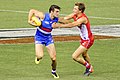 Easton Wood applies a fend to the chest of Will Hayward
 -
 Nathan Jones applies a fend to the collar of Brad Crouch
 -
 James Harmes fends off Luke Dahlhaus
 -
 Shaun Higgins fends off Luke Dunstan
 -
 Charlie Cameron fends to the shoulder of Shaun Burgoyne
 -
 Kodi Jacques fends off Tyla Hanks


_06.02.21.jpg)
Gridiron football
[edit]Stiff arms are most often performed by running backs.[11] Some notable players to use the stiff arm are Walter Payton, Earl Campbell, Derrick Henry, Adrian Peterson and Marshawn Lynch.[11]
-
 J. D. McKissic applies a fend to the face mask of an opponent during an American football game

Rugby football
[edit]Some famous players who use the fend include dual rugby/league international Sonny Bill Williams,[12][13][14][15] and rugby union players Jonah Lomu, Jonathan Davies, Seán O'Brien, Cory Jane, Robbie Fruean and Julian Savea.[16]
-
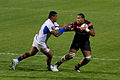 Fend by Edwin Maka during a rugby union game.
 -
 The Jonah Lomu stiff-arm immortalised in wax


References
[edit]- ^ (Laws of the Game, Rugby Union, Law 10.4, dangerous Play and Misconduct, Section (e), dangerous tackling)
- ^ a b c d e The Old Don't Argue from afl.com.au
- ^ Pennings, Mark (2014). Origins of Australian Football: Victoria's Early History: Volume 2: A Golden Era Begins: Football in 'Marvellous Melbourne', 1877 to 1885. Grumpy Monks Publishing. pp. 3132, 233. ISBN 9780646918655.
- ^ RAZOR RAY EXPLAINS WHY DUSTY ISN'T PINGED FOR FEND OFFS Sports Entertainment Network
- ^ Anatomy of a fend-off: What goes into Reid's signature move By Callum Twomey 22 May 2024
- ^ Handy Point: Who has the better ‘don’t argue’, Dustin Martin or Sam Powell-Pepper? The West Australian 6 April 2017
- ^ Pies in great escape from Hawk heist By Martin Blake 24 September 2011
- ^ Watch: Barry Hall kicks outrageous goal for Labrador after huge don't argue in the QAFL from PerthNow 1 September 2017
- ^ North Melbourne v Richmond: Tasmania no place for crumbling Tigers By Larissa Nicholson for Canberra Times 24 April 2018
- ^ "Carey on Cunnington". North Melbourne Kangaroos Club. 7 July 2019.
- ^ a b The Art of the Stiff ArmEric Moreno 22 December 2015
- ^ "Sonny Bill's fend in good form". AAP. 1 January 2009. Retrieved 15 February 2015.
- ^ John Mitchell (4 December 2014). "Why Sonny Bill Williams is king of the offload". ESPN. Retrieved 15 February 2015.
- ^ Will Greenwood (7 November 2014). "Will Greenwood believes Kyle Eastmond will hold his own against Sonny Bill Williams". Sky Sports. Retrieved 15 February 2015.
- ^ Benji Marshall (22 July 2012). "Taking a punt on super-freakish Sonny Bill worth the risk". Brisbane Times. Retrieved 15 February 2015.
- ^ The Art Of The Rugby Fend: A Guide To Combative Ball Carrying from The Runner Sports 25 July 2017
External links
[edit]
- Classic Sports Moves: The Stiff Arm - slideshow by Life magazine
Stiff-arm fend
View on GrokipediaIntroduction
Definition
The stiff-arm fend is an offensive tactic employed by the ball carrier in contact sports, involving the rigid extension of one arm with an open palm to push or ward off an approaching tackler, thereby maintaining separation while preserving forward momentum and ball security with the opposite arm. This maneuver allows the player to contact the defender's upper body, such as the shoulders or chest, without grasping or striking, distinguishing it from prohibited actions like closed-fist blows.[4][7] The primary purpose of the stiff-arm fend is to create immediate space, evade full tackles, and secure extra yardage or meters without breaking stride, enabling the ball carrier to potentially extend a play beyond what might otherwise result in a stoppage. It is recognized as a legal action across governing rules, provided the arm is not locked in a striking manner or used to deliver excessive force, which could lead to penalties for illegal contact.[4][8] To perform it without incurring fouls, the ball carrier must secure a firm grip on the ball using the non-extended arm to minimize fumble risk, time the extension accurately to meet the defender's approach at permissible contact points, and sustain overall balance to prevent unintended high or back contact.[4][7][8] This technique is utilized in rugby league and rugby union, gridiron football (American and Canadian), and Australian rules football, where it supports evasive play by the player in possession.[7][4][8]Terminology
The term "stiff-arm" originated in American football as early as 1927, describing the action of extending a rigid arm to push away or fend off a defender. This usage derives from the literal combination of "stiff" (indicating rigidity) and "arm," emphasizing the extended, unyielding posture employed by ball carriers to maintain momentum. In contrast, the term "fend" or "hand-off" traces its roots to rugby traditions, where it refers to warding off tacklers with an open palm, a technique codified in official rules as a permitted action using the hand to repel opponents without grasping or striking.[7] In Australian rules football and rugby, the maneuver is commonly known as a "don't argue," a colloquialism implying decisive, unquestionable contact that leaves no room for debate, or simply "fend-off," highlighting the push to create separation. The phrase "don't argue" emerged in 1914 from advertisements by J. C. Hutton Pty Ltd, a Melbourne-based meat products company, whose campaign depicted a man thrusting his hand into another's face with the slogan "Don't argue—Hutton's is best," visually mirroring the on-field action and quickly adopting into the lexicon of contact sports including rugby and Australian rules football.[9][10] Gridiron football slang includes "stiff-arm" as the primary term, alongside the vivid colloquialism "pie in the face," an NFL-specific expression evoking the forceful, palm-to-face impact reminiscent of a comedic slapstick gesture.[11] In rugby union and rugby league, the action is generally termed a "fend" or "fend-off," with "push-off" also used to describe the open-hand repulsion that emphasizes legal, non-closed-fist contact to deter tacklers. These terms underscore the technique's role in repelling opponents while adhering to rules prohibiting dangerous plays.[7][12] The evolution of "don't argue" illustrates cross-sport linguistic diffusion, originating from early 20th-century Australian advertising through Hutton's marketing and entering the lexicons of rugby and Australian rules football via shared cultural ties.[9][13]History
Origins
The stiff-arm fend, known variably as a hand-off or fend in early forms of the game, originated as a fundamental tactic in 19th-century contact football sports where running with the ball was central to play. Rugby football, the sport's foundational code, traces its beginnings to 1823 at Rugby School in England, when William Webb Ellis reportedly picked up the ball and ran with it during a match, diverging from traditional kicking games and introducing the need for ball carriers to ward off pursuers using extended arms to protect possession in unstructured, physical encounters.[14] This natural warding motion predated formal rules, evolving organically in mid-19th-century play before the Rugby Football Union codified the laws in 1871, emphasizing running and tackling without protective padding or forward passing options.[15] The technique transitioned to other emerging codes influenced by rugby, including Australian rules football, formalized in Melbourne in 1858 as a hybrid of English public school games that permitted ball handling and running, thereby necessitating similar arm-based defenses against tacklers in open-field scrums and chases. In the United States, rugby-style rules were introduced via the 1874 Harvard-McGill game, where Canadian players brought elements of running and fending, adapting the move into early gridiron football as a means for ball carriers to advance through mass plays without the forward pass, which was not legalized until 1906 amid concerns over the game's brutality.[16] The term "stiff-arm" itself entered American usage around 1909, capturing the extended, rigid arm push that became iconic in the running-heavy era preceding aerial offenses.[17] This fend arose from the cultural demands of non-padded, territorial sports in the Victorian era, where ball carriers relied on physical leverage and straight-arm repulsion to evade clusters of defenders in games devoid of forward passing, prioritizing endurance and direct confrontation over strategic throws.[18]Development across sports
The stiff-arm fend, originating from rugby's hand-off tactic, spread to American football in the late 19th and early 20th centuries through rule changes pioneered by Walter Camp, who reduced team sizes to 11 players in 1880 and introduced the line of scrimmage and downs system by 1882, shifting emphasis toward structured running plays that rewarded ball carriers evading defenders with extended arms.[19] In Australia, the technique integrated into Victorian Football League (VFL, predecessor to the AFL) play as contact rules evolved, with amendments like the 1897 free kick for pushing from behind and 1905 allowances for unintentional interference during marks intensifying physical confrontations and encouraging fending motions during runs.[20] By the mid-20th century, advancements in NFL protective gear refined the stiff-arm's execution, as plastic helmets patented in the 1940s and upgraded shoulder pads in the 1960s-1970s provided better impact absorption, enabling ball carriers to deliver bolder, more forceful fends without excessive injury risk.[21] In rugby league, following the 1907 split from rugby union that established professional competitions in Australia and New Zealand, the code's faster, more open style—driven by working-class players and modest payments—highlighted the hand-off for maintaining speed through contact, distinguishing it from the amateur union game's denser scrums.[22] In the late 20th and early 21st centuries, video analysis transformed stiff-arm training across codes, with NFL teams adopting film breakdowns as early as the 1970s for technique refinement, evolving into digital tools by the 1990s that allowed coaches to dissect fend timing and leverage.[23] Rugby union saw a surge post-1995 professionalism, where players like Jonah Lomu popularized aggressive fends, using his 1.96-meter frame and arm span to trample defenders—such as in his four tries against England at the 1995 World Cup—contributing to the trend of backs increasing in size and power following the advent of professionalism.[24][25] The technique's global reach extended to Gaelic football, where fending motions aid ball carriers in evading shoulder charges, reflecting cross-code influences amid the sport's 19th-century roots in Irish play.[26] Media like NFL Films amplified its visibility in the 1970s through wired coach audio in Super Bowl IV (1970) and highlight packages for Monday Night Football (1972), offering cinematic breakdowns that popularized refined fends worldwide.[27]Technique
Execution
The stiff-arm fend requires precise timing and body control to effectively repel an incoming defender while protecting the ball and advancing. The technique begins with the ball carrier securing possession tightly and positioning themselves to respond to the threat without compromising speed or balance. The execution follows a structured step-by-step process:- Secure the ball in the non-fending arm, tucking it close to the body and away from the approaching tackler to minimize fumble risk.[28]
- Identify the incoming tackler and extend the dominant arm at shoulder height toward the defender as they close in, timing the motion to coincide with their commitment to the tackle.[29]
- Position the palm open with fingers spread, making contact on the defender's chest, shoulder, or upper body using a straight elbow to push downward or outward for separation, avoiding any grabbing to prevent penalties.[30][29]
- Drive through the contact with powerful leg movement, keeping the feet churning to transfer momentum and maintain forward progress.[29]
- Sustain balance post-contact by staying low and scanning the field for additional defenders, ensuring continued advancement.[30]