



Community hub
Recent from talks
Knowledge base stats:
Talk channels stats:
Members stats:
Taxi to the Dark Side
Taxi to the Dark Side is a 2007 American documentary film directed by Alex Gibney, and produced by Gibney, Eva Orner, and Susannah Shipman. It won the 2007 Academy Award for Best Documentary Feature. It focuses on the December 2002 killing of an Afghan taxi driver named Dilawar, who was beaten to death by American soldiers while being held in extrajudicial detention and interrogated at a black site at Bagram air base.
It was part of the Why Democracy? documentary film series produced by The Why Foundation. The series consisted of ten documentary films from around the world questioning and examining contemporary democracy. As part of this series, the documentary was broadcast in over 30 countries from October 8–18, 2007. The BBC showed the film in its Storyville series.
Taxi to the Dark Side examines US policy on torture and interrogation, specifically the CIA's use of torture and their research into sensory deprivation. The film includes discussions against the use of torture by political and military opponents, as well as the defense of such methods; attempts by Congress to uphold the standards of the Geneva Convention forbidding torture; and popularization of the use of torture techniques in TV shows such as 24.
The documentary concerns the death of Dilawar, an Afghan peanut farmer, who gave up farming to become a taxi driver and who died after several days of beating at Bagram detention center.
Dilawar left his home of Yakubi in eastern Afghanistan in the autumn of 2002, investing his family money in a new taxi to make money in a larger city. On 1 December 2002 he and three passengers were handed over to US military officials by a local Afghan warlord, accused of organising an attack on Camp Salerno. The warlord was later found guilty of the attack himself, but had been ingratiating himself (for $1000 per person) by handing over alleged terrorists.
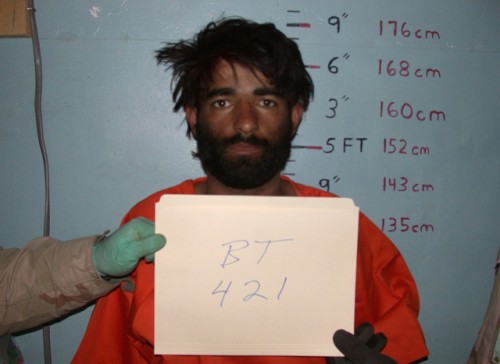
Dilawar was held at the prison at Bagram Air Base, and given the prisoner number BT421. Chained from the ceiling, he received multiple attacks on his thighs, a standard technique viewed as "permissible" and non-life-threatening. It is likely that the severe attack caused a blood clot which then killed him. His official death certificate created by the US military to pass to his family, with his body, was marked "homicide". Medical conclusion stated that Dilawar's legs were "pulpified" and, had he lived, would have required amputation.
The film explores the background of increasingly sanctioned torture following 9/11 in contravention of the Geneva Convention and looks at the exposure of Abu Ghraib.
Interviews include Tim Golden of The New York Times who brought the case into the international spotlight, and Moazzam Begg, a British citizen imprisoned at the same time, and witness to the events. Military interviewees include Damien Corsetti the main interrogator, and Sgt. Anthony Morden. Cpt Christopher Beiring explains how he was the only person charged (charged with dereliction of duty).
Hub AI
Taxi to the Dark Side AI simulator
(@Taxi to the Dark Side_simulator)
Taxi to the Dark Side
Taxi to the Dark Side is a 2007 American documentary film directed by Alex Gibney, and produced by Gibney, Eva Orner, and Susannah Shipman. It won the 2007 Academy Award for Best Documentary Feature. It focuses on the December 2002 killing of an Afghan taxi driver named Dilawar, who was beaten to death by American soldiers while being held in extrajudicial detention and interrogated at a black site at Bagram air base.
It was part of the Why Democracy? documentary film series produced by The Why Foundation. The series consisted of ten documentary films from around the world questioning and examining contemporary democracy. As part of this series, the documentary was broadcast in over 30 countries from October 8–18, 2007. The BBC showed the film in its Storyville series.
Taxi to the Dark Side examines US policy on torture and interrogation, specifically the CIA's use of torture and their research into sensory deprivation. The film includes discussions against the use of torture by political and military opponents, as well as the defense of such methods; attempts by Congress to uphold the standards of the Geneva Convention forbidding torture; and popularization of the use of torture techniques in TV shows such as 24.
The documentary concerns the death of Dilawar, an Afghan peanut farmer, who gave up farming to become a taxi driver and who died after several days of beating at Bagram detention center.
Dilawar left his home of Yakubi in eastern Afghanistan in the autumn of 2002, investing his family money in a new taxi to make money in a larger city. On 1 December 2002 he and three passengers were handed over to US military officials by a local Afghan warlord, accused of organising an attack on Camp Salerno. The warlord was later found guilty of the attack himself, but had been ingratiating himself (for $1000 per person) by handing over alleged terrorists.
Dilawar was held at the prison at Bagram Air Base, and given the prisoner number BT421. Chained from the ceiling, he received multiple attacks on his thighs, a standard technique viewed as "permissible" and non-life-threatening. It is likely that the severe attack caused a blood clot which then killed him. His official death certificate created by the US military to pass to his family, with his body, was marked "homicide". Medical conclusion stated that Dilawar's legs were "pulpified" and, had he lived, would have required amputation.
The film explores the background of increasingly sanctioned torture following 9/11 in contravention of the Geneva Convention and looks at the exposure of Abu Ghraib.
Interviews include Tim Golden of The New York Times who brought the case into the international spotlight, and Moazzam Begg, a British citizen imprisoned at the same time, and witness to the events. Military interviewees include Damien Corsetti the main interrogator, and Sgt. Anthony Morden. Cpt Christopher Beiring explains how he was the only person charged (charged with dereliction of duty).