



Community hub
Recent from talks
Knowledge base stats:
Talk channels stats:
Members stats:
Texaco Star Theater
Texaco Star Theater is an American comedy-variety show, broadcast on radio from 1938 to 1949 and telecast from 1948 to 1956. It was one of the first successful examples of American television broadcasting, remembered as the show that gave Milton Berle the nickname "Mr. Television", and helping propel the sales of Televisions in the 50s.
The classic 1940–1944 version of the program, hosted by radio's Fred Allen, was followed by a radio series on ABC (the former NBC Blue) in the spring of 1948. When Texaco (now Chevron Corporation) first took it to television on NBC on June 8, 1948, the show had a huge cultural impact. Once Texaco ended its sponsorship in 1953, the show became known as The Buick-Berle Show under new sponsor Buick, changing to The Milton Berle Show for its final season.
The roots of Texaco Star Theater were in a 1930s radio hit, Ed Wynn, The Fire Chief, featuring the manic "Perfect Fool" in a half-hour of vaudevillian routines interspersed with music. Wynn's ratings began to slide and the comedian lapsed amidst personal and professional crises, and the show ended in June 1935. Texaco sponsored The Jumbo Fire Chief Program in 1935–36 and The Fire Chief Concert in 1936.
Comedian Eddie Cantor was the star of a show called "Texaco Town" from 1936 to 1938. The show's cast featured young singers Bobby Breen and Deanna Durbin, announcer Jimmy Wallington, who read the commercials for Fire Chief gasoline, Harry Park, and bandleader Jacques Renard. The show was a combination of comedy and music. Cantor frequently sang a tune about the "mayor of Texaco Town".
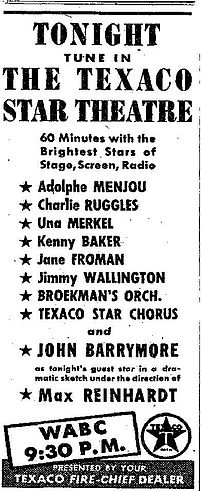
Texaco Star Theater (spelled Theatre for most of the radio show's run) was first broadcast on October 5, 1938, and it continued on the air until June 26, 1940. Initial host Adolphe Menjou was succeeded by John Barrymore, who was replaced by Ken Murray. During the almost two-year span, Una Merkel, Irene Noblette, Charlie Ruggles, and Ned Sparks appeared as comedians. Kenny Baker, Jane Froman, and Frances Langford sang, with David Broekman leading the orchestra. Jimmy Wallington was the announcer. The show began as a variety show with dramatizations and songs by guest stars. In 1940, the show became a star vehicle for Allen, with the show re-titled Texaco Star Theater with Fred Allen and the program airing on October 2, 1940.
Allen's previous sponsor, Bristol-Myers' Ipana toothpaste and Sal Hepatica laxative, decided to cease their tandem sponsorship of Allen's successful hour, first known as Town Hall Tonight and then, for its final season, The Fred Allen Show. He presided over Texaco Star Theater from 1940 to 1942 as an hour-long show on Wednesday and then Sunday nights, and from 1942 to 1944 as a half-hour show, until he withdrew from work for over a year on his doctor's advice. It was during the half-hour version of the show that the more cerebral (if barbed) Allen premiered the continuing comic sketch for which many remember him best: the ensemble, topical takeoffs of "Allen's Alley". Guests included some of the best comedic actors of the time, including Sam Levene, the legendary Broadway actor and Hollywood film character actor.
Though some believe the title Texaco Star Theater was retired temporarily, in favor of Texaco Time, after Allen scaled the show back to a half-hour, the show retained the Texaco Star Theater title officially, the confusion likely stemming from the announcers' first words of introduction: "It's Texaco time starring Fred Allen." They customarily continued the introduction, as the opening music continued, by referring to Texaco Star Theater. Jimmy Wallington became the show's announcer for most of its life with Allen as the feature (he succeeded George Burns and Gracie Allen sidekick Harry Von Zell), though for a brief spell during its third season the announcer was budding radio personality and future television legend Arthur Godfrey. Kenny Baker also remained for the first two seasons, his previous role with Allen's "rival" Jack Benny serving for a number of situations, although his role was greatly reduced by 1942, partly because Baker had become difficult to manage, particularly after a controversial performance of "Ave Maria" sung in German weeks after the United States officially entered World War II.
Allen was forced to leave the show in 1944 due to hypertension; he returned with a different sponsor on NBC, while staying with and further refining his half-hour format a year later. Texaco Star Theater's next hosts included James Melton (1944–1947), Tony Martin (1947–1948), Gordon MacRae (1948), Jack Carter (1948), and Milton Berle (1948–1949). In 1945 Annamary Dickey was signed to a three-year contract co-hosting the radio program with James Melton through 1947.
Hub AI
Texaco Star Theater AI simulator
(@Texaco Star Theater_simulator)
Texaco Star Theater
Texaco Star Theater is an American comedy-variety show, broadcast on radio from 1938 to 1949 and telecast from 1948 to 1956. It was one of the first successful examples of American television broadcasting, remembered as the show that gave Milton Berle the nickname "Mr. Television", and helping propel the sales of Televisions in the 50s.
The classic 1940–1944 version of the program, hosted by radio's Fred Allen, was followed by a radio series on ABC (the former NBC Blue) in the spring of 1948. When Texaco (now Chevron Corporation) first took it to television on NBC on June 8, 1948, the show had a huge cultural impact. Once Texaco ended its sponsorship in 1953, the show became known as The Buick-Berle Show under new sponsor Buick, changing to The Milton Berle Show for its final season.
The roots of Texaco Star Theater were in a 1930s radio hit, Ed Wynn, The Fire Chief, featuring the manic "Perfect Fool" in a half-hour of vaudevillian routines interspersed with music. Wynn's ratings began to slide and the comedian lapsed amidst personal and professional crises, and the show ended in June 1935. Texaco sponsored The Jumbo Fire Chief Program in 1935–36 and The Fire Chief Concert in 1936.
Comedian Eddie Cantor was the star of a show called "Texaco Town" from 1936 to 1938. The show's cast featured young singers Bobby Breen and Deanna Durbin, announcer Jimmy Wallington, who read the commercials for Fire Chief gasoline, Harry Park, and bandleader Jacques Renard. The show was a combination of comedy and music. Cantor frequently sang a tune about the "mayor of Texaco Town".
Texaco Star Theater (spelled Theatre for most of the radio show's run) was first broadcast on October 5, 1938, and it continued on the air until June 26, 1940. Initial host Adolphe Menjou was succeeded by John Barrymore, who was replaced by Ken Murray. During the almost two-year span, Una Merkel, Irene Noblette, Charlie Ruggles, and Ned Sparks appeared as comedians. Kenny Baker, Jane Froman, and Frances Langford sang, with David Broekman leading the orchestra. Jimmy Wallington was the announcer. The show began as a variety show with dramatizations and songs by guest stars. In 1940, the show became a star vehicle for Allen, with the show re-titled Texaco Star Theater with Fred Allen and the program airing on October 2, 1940.
Allen's previous sponsor, Bristol-Myers' Ipana toothpaste and Sal Hepatica laxative, decided to cease their tandem sponsorship of Allen's successful hour, first known as Town Hall Tonight and then, for its final season, The Fred Allen Show. He presided over Texaco Star Theater from 1940 to 1942 as an hour-long show on Wednesday and then Sunday nights, and from 1942 to 1944 as a half-hour show, until he withdrew from work for over a year on his doctor's advice. It was during the half-hour version of the show that the more cerebral (if barbed) Allen premiered the continuing comic sketch for which many remember him best: the ensemble, topical takeoffs of "Allen's Alley". Guests included some of the best comedic actors of the time, including Sam Levene, the legendary Broadway actor and Hollywood film character actor.
Though some believe the title Texaco Star Theater was retired temporarily, in favor of Texaco Time, after Allen scaled the show back to a half-hour, the show retained the Texaco Star Theater title officially, the confusion likely stemming from the announcers' first words of introduction: "It's Texaco time starring Fred Allen." They customarily continued the introduction, as the opening music continued, by referring to Texaco Star Theater. Jimmy Wallington became the show's announcer for most of its life with Allen as the feature (he succeeded George Burns and Gracie Allen sidekick Harry Von Zell), though for a brief spell during its third season the announcer was budding radio personality and future television legend Arthur Godfrey. Kenny Baker also remained for the first two seasons, his previous role with Allen's "rival" Jack Benny serving for a number of situations, although his role was greatly reduced by 1942, partly because Baker had become difficult to manage, particularly after a controversial performance of "Ave Maria" sung in German weeks after the United States officially entered World War II.
Allen was forced to leave the show in 1944 due to hypertension; he returned with a different sponsor on NBC, while staying with and further refining his half-hour format a year later. Texaco Star Theater's next hosts included James Melton (1944–1947), Tony Martin (1947–1948), Gordon MacRae (1948), Jack Carter (1948), and Milton Berle (1948–1949). In 1945 Annamary Dickey was signed to a three-year contract co-hosting the radio program with James Melton through 1947.