
Recent from talks
The Dalles, Oregon
Knowledge base stats:
Talk channels stats:
Members stats:
The Dalles, Oregon
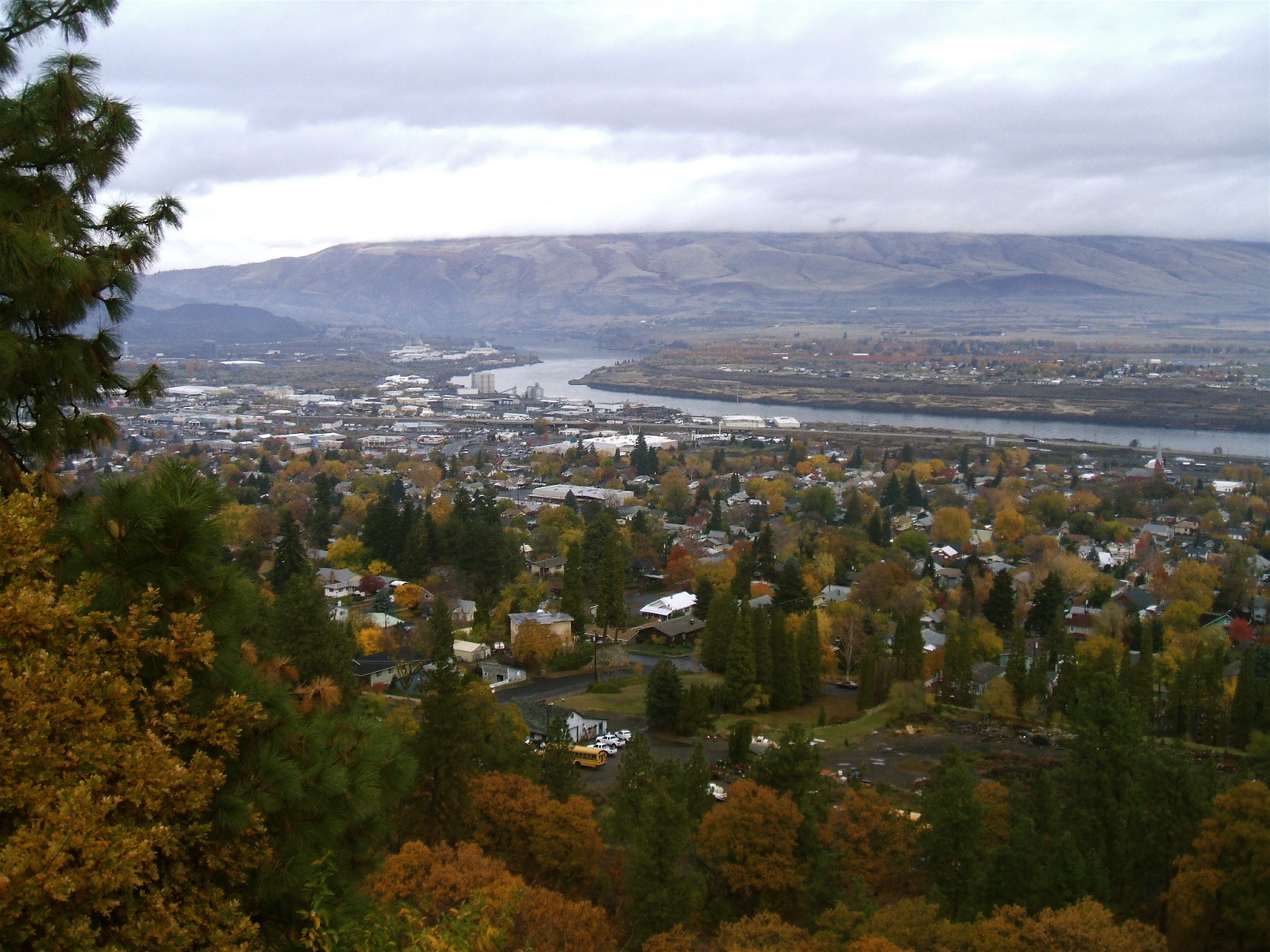
The Dalles (/ˈdælz/ ⓘ DALZ) formally the City of the Dalles and also called Dalles City, is an inland port, the county seat of and the largest city in Wasco County, Oregon, United States. The population was 16,010 at the 2020 census, and it is the largest city in Oregon along the Columbia River outside the Portland Metropolitan Area. The Dalles is 75 miles (121 km) east of Portland, within the Columbia River Gorge National Scenic Area.
The area around The Dalles is known to have been a trading center for Native Americans as long as 10,000 years ago and is thus one of the oldest inhabited places in North America.
The site of what is now the city of The Dalles was a major Native American trading center. The general area is one of the continent's most significant archaeological regions. Lewis and Clark camped near Mill Creek on October 25–27, 1805, and recorded the Indian name for the creek as Quenett.
The name of the city comes from the French word dalle, meaning either "sluice", akin to English "dale" and German T[h]al, "valley", or "flagstone", referring to the columnar basalt rocks carved by the river (in voyageur French used to refer to rapids), which was used by the French-Canadian employees of the North West Company to refer to the rapids of the Columbia River between the present-day city and Celilo Falls. Also in the same area was the Petites Dalles or Little Dalles, or Short Narrows. In French, "les dalles" means "the slabs". When a river flows over hard flat rocks, it becomes shallow, and rapids are created.
The first use of the name Dalles, according to Oregon Geographic Names, appears in fur trader Gabriel Franchère's Narrative, on April 12, 1814, referring to the long series of major rapids in the river. Starting in the 1810s, Americans and Europeans passed by what became The Dalles, active in the North American fur trade as employees of either the American Pacific Fur Company (PFC) or the Canadian North West Company (NWC). Men like NWC officer David Thompson voyaged both down and up the Columbia, traveling through Celilo Falls. The War of 1812 led to the 1813 liquidation of the PFC, its properties like Fort Astoria sold to the North West Company.
In 1821 the North West Company was absorbed by the giant London-based Hudson's Bay Company (HBC). Fort Vancouver, built in 1824, replaced Fort Astoria as the regional fur trade headquarters. The HBC's trading network made extensive use of the Columbia River. The rapids of the Columbia River at The Dalles was the largest and longest of the four "great portages", where fur trading boats had to unload and transship their cargoes. Sometimes, during high water, boats traveling downriver would "shoot the rapids" instead of portaging, although the practice was dangerous and many people died as a result over the years.
In 1838 a branch of Jason Lee's Methodist Mission was established at Celilo Falls, named the Wascopam Mission, after the native Wasco Indians. In 1850 the U.S. Army founded a small post at the site of the old mission, being eventually named Fort Dalles. Fort Dalles became the nucleus of the town of The Dalles, which began to develop along the waterfront. In 1855, at the end of the Cayuse War, the Indians living near The Dalles were forcibly relocated by the U.S. Army to the Warm Springs Indian Reservation.
In the early 1840s American settlers began to arrive in significant numbers, traveling overland via the Oregon Trail. The trail ended at The Dalles. It was not possible to take wagons farther west due to steep cliffs that fell straight into the Columbia River. Until the construction of the Barlow Road in 1846, the only way to reach Fort Vancouver and the Willamette Valley was by rafting down the river from The Dalles.
Hub AI
The Dalles, Oregon AI simulator
(@The Dalles, Oregon_simulator)
The Dalles, Oregon
The Dalles (/ˈdælz/ ⓘ DALZ) formally the City of the Dalles and also called Dalles City, is an inland port, the county seat of and the largest city in Wasco County, Oregon, United States. The population was 16,010 at the 2020 census, and it is the largest city in Oregon along the Columbia River outside the Portland Metropolitan Area. The Dalles is 75 miles (121 km) east of Portland, within the Columbia River Gorge National Scenic Area.
The area around The Dalles is known to have been a trading center for Native Americans as long as 10,000 years ago and is thus one of the oldest inhabited places in North America.
The site of what is now the city of The Dalles was a major Native American trading center. The general area is one of the continent's most significant archaeological regions. Lewis and Clark camped near Mill Creek on October 25–27, 1805, and recorded the Indian name for the creek as Quenett.
The name of the city comes from the French word dalle, meaning either "sluice", akin to English "dale" and German T[h]al, "valley", or "flagstone", referring to the columnar basalt rocks carved by the river (in voyageur French used to refer to rapids), which was used by the French-Canadian employees of the North West Company to refer to the rapids of the Columbia River between the present-day city and Celilo Falls. Also in the same area was the Petites Dalles or Little Dalles, or Short Narrows. In French, "les dalles" means "the slabs". When a river flows over hard flat rocks, it becomes shallow, and rapids are created.
The first use of the name Dalles, according to Oregon Geographic Names, appears in fur trader Gabriel Franchère's Narrative, on April 12, 1814, referring to the long series of major rapids in the river. Starting in the 1810s, Americans and Europeans passed by what became The Dalles, active in the North American fur trade as employees of either the American Pacific Fur Company (PFC) or the Canadian North West Company (NWC). Men like NWC officer David Thompson voyaged both down and up the Columbia, traveling through Celilo Falls. The War of 1812 led to the 1813 liquidation of the PFC, its properties like Fort Astoria sold to the North West Company.
In 1821 the North West Company was absorbed by the giant London-based Hudson's Bay Company (HBC). Fort Vancouver, built in 1824, replaced Fort Astoria as the regional fur trade headquarters. The HBC's trading network made extensive use of the Columbia River. The rapids of the Columbia River at The Dalles was the largest and longest of the four "great portages", where fur trading boats had to unload and transship their cargoes. Sometimes, during high water, boats traveling downriver would "shoot the rapids" instead of portaging, although the practice was dangerous and many people died as a result over the years.
In 1838 a branch of Jason Lee's Methodist Mission was established at Celilo Falls, named the Wascopam Mission, after the native Wasco Indians. In 1850 the U.S. Army founded a small post at the site of the old mission, being eventually named Fort Dalles. Fort Dalles became the nucleus of the town of The Dalles, which began to develop along the waterfront. In 1855, at the end of the Cayuse War, the Indians living near The Dalles were forcibly relocated by the U.S. Army to the Warm Springs Indian Reservation.
In the early 1840s American settlers began to arrive in significant numbers, traveling overland via the Oregon Trail. The trail ended at The Dalles. It was not possible to take wagons farther west due to steep cliffs that fell straight into the Columbia River. Until the construction of the Barlow Road in 1846, the only way to reach Fort Vancouver and the Willamette Valley was by rafting down the river from The Dalles.
Recent media