Hubbry Logo
search
logo
2304786

The Dreaming

logo
Community Hub0 Subscribers
Read side by side
from Wikipedia

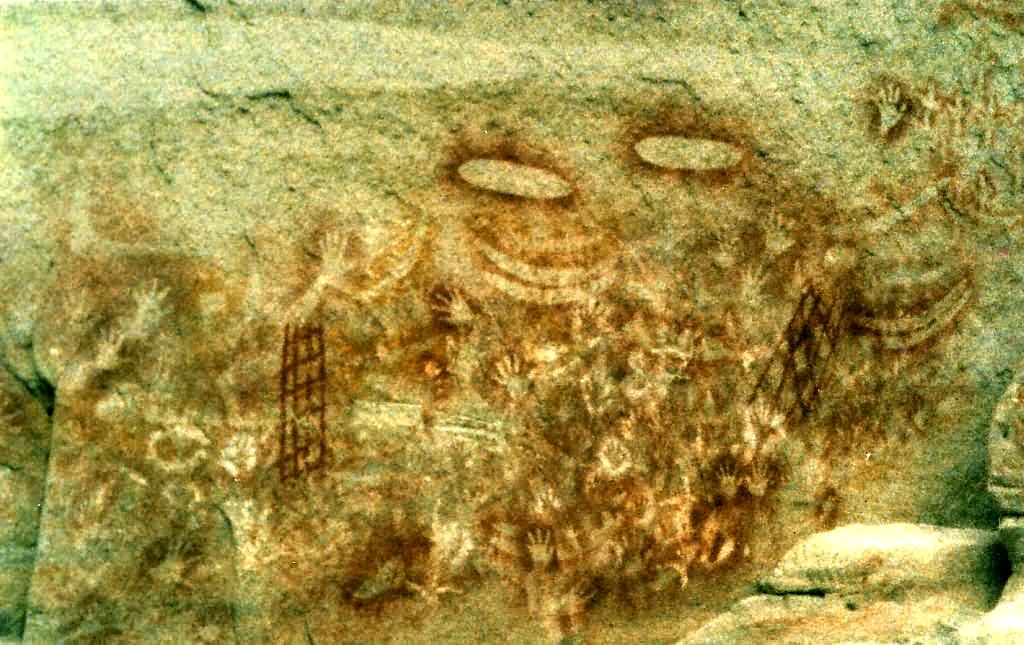
Stencil art at Carnarvon Gorge, which may be memorials, signs from, or appeals to totemic ancestors or records of Dreaming stories[1]

The Dreaming, also referred to as Dreamtime, is a term devised by early anthropologists to refer to a religio-cultural worldview attributed to Australian Aboriginal mythology. It was originally used by Francis Gillen, quickly adopted by his colleague Walter Baldwin Spencer, and thereafter popularised by A. P. Elkin, who later revised his views.

The Dreaming is used to represent Aboriginal concepts of "Everywhen", during which the land was inhabited by ancestral figures, often of heroic proportions or with supernatural abilities.

The term is based on a rendition of the Arandic word alcheringa, used by the Arrernte (Aranda, Arunta) people of Central Australia, although it has been argued that it is based on a misunderstanding or mistranslation. Some scholars suggest that the word's meaning is closer to "eternal, uncreated".[2] Anthropologist William Stanner said that the concept was best understood by non-Aboriginal people as "a complex of meanings".[3] Jukurrpa, a widespread term used by Warlpiri people and other peoples of the Western Desert cultural bloc, is sometimes also translated as Dreaming.[4][3][5][6]

By the 1990s, Dreaming had acquired its own currency in popular culture, based on idealised or fictionalised conceptions of Australian mythology. Since the 1970s, Dreaming has also returned from academic usage via popular culture and tourism and is now ubiquitous in the English vocabulary of Aboriginal Australians in a kind of "self-fulfilling academic prophecy".[2][a]

Etymology

[edit]

The station-master, magistrate, and amateur ethnographer Francis Gillen first used the terms in an ethnographical report in 1896. Along with Walter Baldwin Spencer, Gillen published a major work, Native Tribes of Central Australia, in 1899.[7] In that work, they spoke of the Alcheringa as "the name applied to the far distant past with which the earliest traditions of the tribe deal".[8][b] Five years later, in their Northern Tribes of Central Australia, they gloss the far distant age as "the dream times", link it to the word alcheri meaning "dream", and affirm that the term is current also among the Kaytetye and Anmatyerr.[9]

Altjira

[edit]
The Milky Way over Uluru. The Dreaming, according to Carl Strehlow, sees the Milky Way as a river connected to the dwelling of a Creator Deity.

Early doubts about the precision of Spencer and Gillen's English gloss were expressed by the German Lutheran pastor and missionary Carl Strehlow in his 1908 book Die Aranda (The Arrernte). He noted that his Arrernte contacts explained altjira (also spelled alchera), whose etymology was unknown, as an eternal being who had no beginning. In the Upper Arrernte language, the proper verb for "to dream" was altjirerama, literally "to see God". Strehlow theorised that the noun is the somewhat rare word altjirrinja, which Spencer and Gillen gave a corrupted transcription and a false etymology. "The native," Strehlow concluded, "knows nothing of 'dreamtime' as a designation of a certain period of their history."[10][c]

Strehlow gives Altjira or Altjira mara (mara meaning "good") as the Arrernte word for the eternal creator of the world and humankind. Strehlow describes him as a tall, strong man with red skin, long fair hair, and emu legs, with many red-skinned wives (with dog legs) and children. In Strehlow's account, Altjira lives in the sky (which is a body of land through which runs the Milky Way, a river).[11]

However, by the time Strehlow was writing, his contacts had been converts to Christianity for decades, and critics suggested that Altjira had been used by missionaries as a word for the Christian God.[11]

In 1926, Spencer conducted a field study to challenge Strehlow's conclusion about Altjira and the implied criticism of Gillen and Spencer's original work. Spencer found attestations of altjira from the 1890s that used the word to mean "associated with past times" or "eternal", not "god".[11]

Academic Sam Gill finds Strehlow's use of Altjira ambiguous, sometimes describing a supreme being, and sometimes describing a totem being but not necessarily a supreme one. He attributes the clash partly to Spencer's cultural evolutionist beliefs that Aboriginal people were at a pre-religion "stage" of development (and thus could not believe in a supreme being), while Strehlow as a Christian missionary found presence of belief in the divine a useful entry point for proselytising.[11]

Linguist David Campbell Moore is critical of Spencer and Gillen's "Dreamtime" translation, concluding:[12]

"Dreamtime" was a mistranslation based on an etymological connection between "a dream" and "Altjira", which held only over a limited geographical domain. There was some semantic relationship between "Altjira" and "a dream", but to imagine that the latter captures the essence of "Altjira" is an illusion.

Other terms

[edit]

The complex of religious beliefs encapsulated by the Dreamings are also called:

Translations and meaning

[edit]

In English, anthropologists have variously translated words normally understood to mean Dreaming or Dreamtime in a variety of other ways, including "Everywhen", "world-dawn", "ancestral past", "ancestral present", "ancestral now" (satirically), "unfixed in time", "abiding events" or "abiding law".[15]

Most translations of the Dreaming into other languages are based on the translation of the word dream. Examples include Espaces de rêves in French ("dream spaces") and Snivanje in Croatian (a gerund derived from the verb for "to dream").[16]

The concept of the Dreaming is inadequately explained by English terms, and difficult to explain in terms of non-Aboriginal cultures. It has been described as "an all-embracing concept that provides rules for living, a moral code, as well as rules for interacting with the natural environment ... [it] provides for a total, integrated way of life ... a lived daily reality". It embraces past, present and future.[3] Another definition suggests that it represents "the relationship between people, plants, animals and the physical features of the land; the knowledge of how these relationships came to be, what they mean and how they need to be maintained in daily life and in ceremony".[5] According to Simon Wright, "jukurrpa has an expansive meaning for Warlpiri people, encompassing their own law and related cultural knowledge systems, along with what non-Indigenous people refer to as 'dreaming'".[17]

A dreaming is often associated with a particular place, and may also belong to specific ages, gender or skin groups. Dreamings may be represented in artworks, for example "Pikilyi Jukurrpa" by Theo (Faye) Nangala represents the Dreaming of Pikilyi (Vaughan Springs) in the Northern Territory, and belongs to the Japanangka/ Nanpanangka and Japangardi/ Napanangka skin groups.[18]

Aboriginal beliefs and culture

[edit]
Ku-ring-gai Chase-petroglyph, via Waratah Track, depicting Baiame, the Creator God and Sky Father in the dreaming of several Aboriginal language groups
Waugals (yellow triangles with a black snake in the centre) are the official Bibbulmun Track trailmarkers between Kalamunda and Albany in Western Australia. The Noongar believe that the Waugal, or Wagyl, created the Swan River and is represented by the Darling scarp.

Related entities are known as Mura-mura by the Dieri and as Tjukurpa in Pitjantjatjara.

The grouping of all Aboriginal people's belief's and culture around the Dreaming together can only give a generalised view. The Australian Institute of Aboriginal and Torres Strait Islander Studies cites 250 distinct language groups[19] (though that does includeTorres Stait Islander people's), each with variation in belief's to one another.

"Dreaming" is now also used as a term for a system of totemic symbols, so that an Aboriginal person may "own" a specific Dreaming, such as Kangaroo Dreaming, Shark Dreaming, Honey Ant Dreaming, Badger Dreaming, or any combination of Dreamings pertinent to their country. This is because in the Dreaming an individual's entire ancestry exists as one, culminating in the idea that all worldly knowledge is accumulated through one's ancestors. Many Aboriginal Australians also refer to the world-creation time as "Dreamtime". The Dreaming laid down the patterns of life for the Aboriginal people.[20]

Creation is believed to be the work of culture heroes who travelled across a formless land, creating sacred sites and significant places of interest in their travels. In this way, "songlines" (or Yiri in the Warlpiri language) were established, some of which could travel right across Australia, through as many as six to ten different language groupings. The dreaming and travelling trails of these heroic spirit beings are the songlines.[6] The signs of the spirit beings may be of spiritual essence, physical remains such as petrosomatoglyphs of body impressions or footprints, among natural and elemental simulacra.[citation needed]

Some of the ancestor or spirit beings inhabiting the Dreamtime become one with parts of the landscape, such as rocks or trees.[21] The concept of a life force is also often associated with sacred sites, and ceremonies performed at such sites "are a re-creation of the events which created the site during The Dreaming". The ceremony helps the life force at the site to remain active and to keep creating new life: if not performed, new life cannot be created.[22]

Dreaming existed before the life of the individual begins, and continues to exist when the life of the individual ends. Both before and after life, it is believed that this spirit-child exists in the Dreaming and is only initiated into life by being born through a mother. The spirit of the child is culturally understood to enter the developing fetus during the fifth month of pregnancy.[23] When the mother felt the child move in the womb for the first time, it was thought that this was the work of the spirit of the land in which the mother then stood. Upon birth, the child is considered to be a special custodian of that part of their country and is taught the stories and songlines of that place. As Wolf (1994: p. 14) states: "A 'black fella' may regard his totem or the place from which his spirit came as his Dreaming. He may also regard tribal law as his Dreaming."

In the Wangga genre, the songs and dances express themes related to death and regeneration.[24] They are performed publicly with the singer composing from their daily lives or while Dreaming of a nyuidj (dead spirit).[25]

Dreaming stories vary throughout Australia, with variations on the same theme. The meaning and significance of particular places and creatures is wedded to their origin in The Dreaming, and certain places have a particular potency or Dreaming. For example, the story of how the sun was made is different in New South Wales and in Western Australia. Stories cover many themes and topics, as there are stories about creation of sacred places, land, people, animals and plants, law and custom. In Perth, the Noongar believe that the Darling Scarp is the body of the Wagyl – a serpent being that meandered over the land creating rivers, waterways and lakes and who created the Swan River. In another example, the Gaagudju people of Arnhemland, for whom Kakadu National Park is named, believe that the sandstone escarpment that dominates the park's landscape was created in the Dreamtime when Ginga (the crocodile-man) was badly burned during a ceremony and jumped into the water to save himself.[citation needed]

See also

[edit]

Notes

[edit]

Sources

[edit]

Further reading

[edit]
Revisions and contributorsEdit on WikipediaRead on Wikipedia
from Grokipedia
The Dreaming, rendered in English from diverse Indigenous Australian terms such as Jukurrpa in Warlpiri or Alcheringa in Arrernte, denotes the primordial and enduring creative epoch central to Aboriginal ontologies, during which ancestral spirit-beings traversed and molded the continent's topography, engendered flora, fauna, and human lineages, and ordained moral, social, and ecological precepts that persist as inviolable law.[1][2] This framework transcends linear chronology, embodying an "everywhen" where past creations infuse present existence and future obligations, binding individuals to specific totems, territories, and kin through songlines—narrative pathways encoding navigational, ritual, and juridical knowledge.[3][1] Distinct from Western notions of myth as fanciful relic, the Dreaming functions as operational cosmology, dictating custodianship of land via patrilineal or matrilineal inheritance, enforcing taboos against resource overuse to sustain biodiversity, and underpinning ceremonies that renew cosmic order.[4][3] Variations proliferate across over 250 Aboriginal language groups, with no uniform doctrine; for instance, Central Desert narratives emphasize transformative journeys of beings like the Rainbow Serpent, while coastal traditions highlight sea voyages, reflecting adaptive responses to disparate biomes rather than abstracted universalism.[2] Anthropological coinage of "Dreaming" in the early 20th century, drawing from terms connoting vision or increase rites, has drawn critique for evoking ephemeral illusion over the concrete, authoritative Law Aboriginal custodians invoke in governance and dispute resolution.[3][2] Embodied in rock engravings, body paint, and oral recitations, the Dreaming preserves empirical insights into paleoenvironments and hydrology, as evidenced by motifs aligning with now-extinct megafauna or ancient water sources, underscoring its role in pre-contact survival strategies amid Australia's variable climate.[4][3] Contemporary expressions, including acrylic paintings commercialized since the 1970s Papunya Tula movement, transmit these tracks globally, though debates persist over commodification diluting esoteric initiations reserved for elders.[1]

Terminology and Etymology

Origins of the English Term

The English term "The Dreaming" originated from early anthropological interpretations of Indigenous Australian spiritual concepts, particularly those documented among the Arrernte (formerly Aranda) people of Central Australia.[5] In the late 1890s, British-born anthropologist Baldwin Spencer and Australian ethnologist Francis James Gillen conducted fieldwork with Arrernte communities, publishing their findings in The Native Tribes of Central Australia (1899). They encountered the Arrernte phrase altjiranga ngambakala, which they associated with ancestral beings and eternal origins, rendering it in English through notions of "dreaming" to convey a foundational era of creation and law-making.[5] This translation drew on the partial overlap between the Arrernte aljira (root meaning something akin to "eternal" or "uncreated," rather than nocturnal dreams) and Western ideas of visionary or mythical states, though later scholars critiqued it as an imperfect approximation that imposed European connotations.[6] The broader application of "Dreamtime" as an English descriptor for diverse Aboriginal cosmologies gained traction in the early 20th century through Spencer and Gillen's subsequent works, such as The Arunta: A Study of a Stone Age People (1927), where they explicitly linked altjiranga ngambakala to an ancestral "dreaming" phase.[5] However, this term implied a linear, past-tense event akin to a "time" of dreaming, which did not fully align with the perpetual, non-chronological essence of the Indigenous concepts it sought to describe.[1] In 1956, Australian anthropologist W.E.H. Stanner refined the terminology in his influential essay "The Dreaming," deliberately coining "The Dreaming" to emphasize its character as an enduring, multifaceted reality—encompassing creation narratives, moral order, and ongoing ancestral presence—rather than a discrete historical period.[1] Stanner argued that "Dreamtime" suffered from mistranslation and temporal limitations, advocating "The Dreaming" to better reflect the holistic, "everywhen" quality observed across Aboriginal traditions, though he acknowledged the term's limitations as a non-Indigenous construct applied variably to heterogeneous cultural systems.[7] This formulation has since predominated in academic and popular discourse, despite ongoing debates about its adequacy in capturing regionally specific Indigenous ontologies without Eurocentric bias.[1]

Indigenous Terms and Regional Variations

The English term "The Dreaming" originated as an anthropological rendering of the Arrernte (also spelled Aranda) word alcheringa (or altjira), used by the Arrernte people of Central Australia to describe the foundational era of ancestral creation and its perpetual influence on the present.[8] This nomenclature was introduced by anthropologists Baldwin Spencer and Francis Gillen based on their fieldwork among Arrernte communities in the 1890s, where alcheringa connoted an eternal, dream-like state of origin rather than nocturnal sleep.[5] The term's adoption reflected early ethnographic efforts to translate complex Indigenous cosmologies into English, though it has been critiqued for implying a temporal "time" distinct from ongoing reality, which misaligns with many Aboriginal understandings of an "everywhen."[1] Across Australia's diverse Indigenous language groups—historically numbering over 250 distinct languages—the concept equivalent to the Dreaming manifests in varied terminology, each tied to local ancestral narratives, songlines, and totemic systems rather than a monolithic "Dreamtime." In Warlpiri communities of the Northern Territory, it is expressed as jukurrpa, a multifaceted notion integrating creation stories, moral codes, and ecological knowledge passed through oral traditions and ceremonies.[2] Similarly, Pitjantjatjara and Yankunytjatjara speakers in the Central Desert use tjukurpa (a phonetic variant of jukurrpa), emphasizing ancestral beings' transformative actions on landscapes and the enduring obligations they impose on descendants.[1] Regional differences extend to Western Desert dialects, where Martu Wangka employs manguny to denote ancestral pathways and spiritual continuity, distinct from but analogous to Central Australian usages. In North-East Arnhem Land, Yolngu languages reference comparable ideas through terms like burruguu, highlighting eternal law and clan-specific myths without direct equivalence to "dreaming." These linguistic variations arise from the absence of a pan-Aboriginal lingua franca, with each group's terminology embedding unique emphases on place-based cosmogonies, as documented in ethnographic studies since the early 20th century; however, post-colonial syntheses risk oversimplifying this diversity into a singular English construct.[1][4]

Cosmological Framework

Conception of Time as "Everywhen"

In Aboriginal Australian cosmology, the Dreaming is understood not as a linear sequence of events confined to a primordial past, but as an eternal dimension where creative acts of ancestral beings remain dynamically present and accessible. Anthropologist W.E.H. Stanner, drawing from ethnographic observations among groups such as the Murinbata, introduced the term "everywhen" in his 1953 Boyer Lectures to describe this temporality, emphasizing that "one cannot 'fix' the Dreaming in time: it was, and is, everywhen."[9][10] This formulation rejects Western chronological models, positing instead a unified continuum where past creations, present existence, and future possibilities interpenetrate without succession.[11] The "everywhen" integrates causality across temporal boundaries, as ancestral actions—such as shaping landscapes or establishing social laws—retain causal efficacy today through sacred sites (e.g., waterholes or rock formations) that embody those events.[12] Ethnographic records indicate that this is not abstract philosophy but a lived ontology: for instance, among Yolngu people, the Wangarr (Dreaming) ancestors' journeys are ritually invoked to renew environmental and kin relations, collapsing historical distance into immediate potency.[13] Stanner's analysis, informed by decades of fieldwork from the 1930s onward, underscores that this view arises from empirical engagement with Country, where natural phenomena serve as verifiable indices of ancestral agency rather than mere symbols.[14] This conception manifests in practices that actualize the everywhen, such as increase ceremonies where participants—through song, dance, and body paint—reperform ancestral feats to ensure ecological continuity, as documented in studies of Central Desert groups like the Pintupi.[15] Variability exists across over 250 language groups; for example, Warlpiri jukurrpa narratives emphasize cyclical renewal tied to seasonal cycles, yet all share the core rejection of time as irreversible progression.[1] Stanner cautioned against over-romanticizing, noting that the everywhen enforces moral realism: breaches of Dreaming-derived laws disrupt this eternal order, yielding tangible consequences like resource scarcity, as inferred from oral histories corroborated by archaeological evidence of long-term site maintenance.[10][16]

Ancestral Beings and Their Eternal Presence

In Aboriginal cosmologies, ancestral beings—often characterized as powerful, transformative entities combining human and animal attributes—emerged during the Dreaming to traverse unformed lands, molding landscapes, initiating life forms, and instituting enduring social and moral codes. These beings, such as the Rainbow Serpent in widespread traditions or region-specific figures like the Wandjina among the Mowanjum people, are credited with actions that produced rivers, mountains, and waterholes through their movements and creative powers.[17][18] Their deeds established totemic links binding humans to specific species and territories, with descendants inheriting responsibilities to uphold these connections.[19] The eternal presence of ancestral beings manifests in the non-linear temporal framework of the Dreaming, termed "everywhen," wherein their creative potency persists beyond the initial epoch, permeating the contemporary world through embedded spiritual essences. This continuity is evident in beliefs that the beings' spirits inhabit sacred sites, natural phenomena like river systems recognized as living extensions of ancestors, and human custodians who carry their vitality via conception totems or ritual knowledge.[5][20] Anthropological accounts, drawing from Indigenous informants, describe how these spirits can influence events, enforce norms, or be invoked in ceremonies, underscoring a causal link between ancestral actions and ongoing ecological and social dynamics.[2][17] Variations exist across language groups; for instance, in Warlpiri Jukurrpa narratives, ancestral beings' tracks form songlines that encode their perpetual journeys, accessible via ritual performance to reaffirm their agency in the present.[2] This eternal immanence contrasts with Western linear chronologies, positioning the beings not as historical relics but as active forces sustaining cosmic order, with disruptions to associated sites potentially invoking their retributive presence.[5] Empirical observations from ethnographic studies note that such beliefs correlate with adaptive land management practices, where knowledge of ancestral paths guides resource use and environmental stewardship.[19]

Creation Narratives

Shaping of Land and Environment

In Aboriginal Dreaming narratives, ancestral beings emerged during the creative epoch to traverse and transform a featureless primordial earth into the diverse landscapes of Australia, forming mountains, valleys, rivers, and waterholes through their physical movements and actions.[1] These beings, often totemic figures combining human and animal characteristics, left enduring imprints on the terrain; for example, their bodies would coil to create hills, shed skin to form reefs, or dig paths that became permanent waterways, thereby establishing the physical and spiritual structure of specific territories known as "country."[21] This shaping process was not uniform but varied regionally, reflecting local ecologies—coastal groups described marine ancestors forming reefs and estuaries, while desert traditions emphasized beings who engineered arid features like rock outcrops and soaks to sustain life.[1] A central figure in numerous accounts is the Rainbow Serpent, depicted as a powerful, serpentine entity that awoke from slumber beneath the ground, slithering across the continent to release water from its body, thereby carving river systems such as the Darling River in southeastern Australia and filling waterholes essential for survival in arid zones.[22] In these stories, the Serpent's passage not only sculpted hydrographic features but also punished wrongdoers by flooding areas or creating dangerous sites, embedding moral dimensions into the geography.[23] Complementary narratives involve other ancestors, such as python or goanna totems, who metamorphosed parts of their forms into stone formations—evident in sites like the Bungle Bungle Range, attributed to dreaming serpents stacking rocks—or dispersed seeds and embryos to initiate flora and fauna, linking biological diversity directly to these creative acts.[21][24] The environmental outcomes of these transformations extended beyond topography to infuse the land with vitality; ancestral beings populated ecosystems by releasing animal spirits from their own essences or teaching nascent humans to harvest resources, ensuring ecological balance through totemic responsibilities where clans maintain sites to perpetuate the beings' generative power.[24] Archaeological evidence, including rock art from sites like Arnhem Land dating to approximately 8,000–10,000 years ago, corroborates oral traditions by depicting serpentine figures associated with water creation, suggesting continuity in these cosmological explanations of landscape formation.[25] Regional specificity underscores causal adaptations: in the Kimberley, Wandjina beings painted clouds and storms to nourish topsoil, while Central Desert groups narrate spinifex and goanna ancestors engineering spinose vegetation and burrows suited to harsh conditions.[1] This framework posits the environment as dynamically alive, with human custodianship required to avert degradation, as ancestral laws dictate sustainable interactions to honor the original shaping events.[26]

Human Origins and Totemic Connections

In Australian Aboriginal cosmologies encompassed by the Dreaming, human origins trace to the transformative actions of ancestral beings who traversed a formless landscape. These beings, manifesting as spirits or hybrid entities with animal and human traits, emerged from subterranean sources or the earth itself and engaged in creative acts that populated the world with humans. Specific narratives recount ancestors shaping human forms from natural substances such as clay, sand, or blood, infusing them with life at designated sites along their paths; for example, in Western Desert traditions, snake-like ancestors molded people and established their foundational laws before metamorphosing into permanent landscape features.[27][21] This creation process integrates humans into an ongoing ancestral continuum, where spirit essences from the Dreaming persist in human lineages. Upon birth, individuals receive a spiritual connection to these origins, often through conception totems—visions or signs linking the fetus to an ancestor's domain—that determine personal identity and obligations. Regional variations exist, such as in Arrernte traditions where ancestors deposited spirit-children in waterholes from which humans descend, but the unifying principle holds that humanity embodies the perpetual presence of these creators.[27][28] Totemic connections further bind humans to ancestral beings, assigning each person or clan a totem representative of a specific creator's essence, typically an animal, plant, or phenomenon tied to the Dreaming event. This affiliation, inherited matrilineally or patrilineally depending on the language group, implies consubstantiality: humans share vital substance with their totem, prohibiting its harm and mandating ceremonial care to sustain natural and social order. For instance, dingo totems in some groups confer healing responsibilities linked to ancestral narratives, while enforcement through kinship rules reinforces territorial and moral boundaries established in the Dreaming. Such totems serve as mnemonic devices for lore transmission, embedding individuals within the causal chain of creation and ensuring fidelity to ancestral precedents.[29][30][31]

Enforcement of Laws and Norms

In traditional Aboriginal societies, the laws and norms originating from the Dreaming—comprising moral codes, kinship obligations, and prohibitions on behaviors like incest or resource misuse—were enforced through decentralized, community-based mechanisms rather than formalized state institutions. These systems relied on the authority of elders, who interpreted Dreaming-derived rules, and the collective pressure of kin groups to maintain social harmony, with violations often addressed via mediation or ritual ordeals to restore balance.[32] Kinship structures, embedded in the Dreaming as totemic connections tracing back to ancestral beings, formed the primary framework for enforcement, dictating responsibilities for dispute resolution and ensuring reciprocity in obligations such as food sharing or marriage alliances.[32] Breaches prompted interventions by affected kin, including avoidance practices—such as physical separation between certain relatives (e.g., mother-in-law and son-in-law)—to prevent discord, or public shaming through ridicule and ostracism, which leveraged communal opinion to deter deviance without physical coercion. Elders' councils handled public offenses like sacrilege against sacred sites, invoking the Dreaming's eternal authority to impose consensus-based sanctions, reflecting a causal emphasis on maintaining cosmological order over individual rights.[32] For interpersonal disputes, such as adultery or minor wounding, enforcement often involved ritualized payback, where the offender's kin group compensated the victim's through material exchange or controlled violence, like limited spearing to draw blood without fatality, calibrated by the offender's status and offense severity.[33] Serious violations against Dreaming norms, including homicide or incest, escalated to collective retribution, potentially including death by spearing, sorcery-induced affliction (believed to enforce supernatural causality), or banishment, with kin enforcing execution to avert feuds.[33][32] These methods, varying by region and group (e.g., more ordeal-based in Central Australia), prioritized group survival and reciprocity, though they could perpetuate cycles of vengeance if mediation failed. Fear of supernatural repercussions, tied to Dreaming beliefs in ancestral oversight, supplemented human enforcement; offenders risked illness or misfortune attributed to violated spirits, reinforcing compliance through perceived causal links between norm adherence and environmental stability.[32] Empirical accounts from early observers, corroborated by anthropological studies, indicate these norms sustained small-scale societies for millennia pre-contact, with low homicide rates in stable groups but risks of escalation in resource-scarce contexts.

Punishments and Social Control Mechanisms

In traditional Aboriginal societies, violations of Dreaming-derived laws—such as taboos on sacred sites, totemic food restrictions, or misuse of ancestral knowledge—were enforced through a combination of community-mediated sanctions and beliefs in supernatural retribution, maintaining social order without formal centralized authority. These laws, originating from ancestral beings' actions in the Dreaming, prescribed behaviors to preserve harmony between humans, land, and spiritual entities; breaches were seen as disrupting this eternal balance, potentially invoking ancestral displeasure manifested as illness, misfortune, or death. Enforcement relied on elders and kin groups, who assessed offenses based on context, often opting for restorative or deterrent measures rather than uniform penalties.[33] Punishments varied widely by region, offense severity, offender status, and kinship ties, ranging from verbal reprimands and public shaming to physical harm or exile. Lesser infractions, like minor disputes or breaches of conduct, might result in ridicule, deprivation of privileges, or ceremonial compensation such as adoption into another group to restore equilibrium. More serious violations, including sorcery accusations, adultery, or desecration of sacred objects tied to Dreaming narratives, could lead to spearing—typically in the thigh or arm to incapacitate without killing—or ritual duels like makarrata, where combatants settled scores under elder supervision to prevent endless feuds.[33][34] For grave offenses against Dreaming elements, such as stealing or destroying tjurunga (sacred objects embodying ancestral essence) or trespassing on forbidden grounds, penalties escalated to death by spearing, clubbing, or induced sorcery, reflecting the perceived existential threat to group survival and cosmic order. In communities like those at Lajamanu or Mornington Island, elders enforced these through informal courts, imposing fines, community labor, or banishment to deter repetition and reaffirm totemic responsibilities. Supernatural mechanisms complemented human action: Dreaming stories depicted ancestors punishing transgressors with spectral vengeance, fostering internalized compliance via fear of intangible consequences like sudden sickness attributed to violated spirits.[34][33] These mechanisms prioritized group cohesion over individual rights, with mediation often resolving conflicts through negotiation rather than unilateral punishment, though cycles of payback could perpetuate violence if unchecked. Anthropological observations, such as those from Cape York groups, note that women's offenses typically incurred lighter sanctions like seclusion, while men's might involve initiation-linked ordeals to reinforce adherence. Overall, the system's efficacy stemmed from small-scale, kin-based structures where social ostracism equated to existential peril, though post-contact disruptions have altered practices.[33]

Cultural Expressions and Practices

Oral Traditions and Art

Oral traditions among Australian Aboriginal peoples transmit Dreaming narratives through songs, stories, and performances such as corroborees, which integrate song, dance, and recitation to convey creation events, totemic laws, and navigational knowledge across generations without written records.[35] These traditions function as mnemonic systems, with songlines—sequences of songs tied to specific landscapes—serving as oral maps that encode routes, resource locations, and ancestral paths, enabling precise travel and cultural continuity over vast distances.[36] [37] For instance, Dreaming stories have preserved empirical observations of environmental changes, such as post-glacial sea level rises dated to approximately 7,000–13,000 years ago, demonstrating the reliability of oral transmission in recording verifiable historical phenomena.[38] Artistic expressions of the Dreaming manifest in rock art forms like paintings and petroglyphs, which visually represent ancestral beings, creation sequences, and totemic associations tied to specific sites.[39] These works, found in regions such as Carnarvon Gorge and Ku-ring-gai Chase, often combine geometric motifs, animal figures, and human forms to depict Dreaming events, serving both as didactic tools for cultural education and as sacred markers of territory and law.[40] Oral histories interpret these parietal arts, linking them to performative traditions where paintings are "read" alongside songs to recount layered temporal narratives from creation to recent contacts.[41] Later developments include bark paintings and acrylic works from Central Desert communities, such as Papunya Tula artists in the 1970s, which adapt Dreaming iconography—dots symbolizing tracks or campsites, U-shapes for people—to contemporary media while maintaining connections to ancestral stories like those of the flying ant or goanna totems.[42] [43] The interplay of oral and visual media ensures Dreaming knowledge's fidelity, as art reinforces verbal accounts during ceremonies, with elders using paintings to validate songline recitations and enforce totemic responsibilities.[44] This multimedia approach underscores causal links between art, orality, and land-based epistemology, where depictions are not mere decoration but evidentiary records of ancestral actions shaping physical and social realities.[45]

Ceremonial Rituals and Songlines

Ceremonial rituals among Australian Aboriginal groups reenact events from the Dreaming, employing song, dance, mime, and body adornments to invoke ancestral beings, transmit cultural knowledge, and reinforce social laws. These performances, often termed corroborees in broader contexts, occur at sacred sites and vary by region and totemic affiliation, serving both initiatory and communal functions. In secret-sacred gatherings, participants maintain continuity with the eternal Dreaming by dramatizing creation acts, ensuring the flow of life-force from ancestors to the present.[46][47] In the Western Desert, among Mardu people, major rituals involve men singing songlines for extended periods—often from evening until dawn—while striking wooden batons against the ground to build rhythmic intensity. These songs, cryptic and repetitive, originate from dream-inspired innovations and describe environmental phenomena tied to ancestral actions, such as rainmaking sequences evoking whirlwinds and clouds. The practices not only perpetuate Dreaming narratives but also facilitate regional exchange of ritual knowledge, adapting traditions while preserving core spiritual connections.[48] Songlines constitute intricate sequences of verses mapping the routes traversed by Dreaming ancestors, functioning as oral encyclopedias that encode navigational cues, ecological data, and mythological lore across vast terrains. Among the Wardaman of Northern Territory, these songlines align terrestrial paths with celestial patterns, such as those of the Southern Cross, enabling nighttime travel and resource location without written aids. Performed during ceremonies at waypoints marked by natural features or rock art, songlines demarcate territorial boundaries and invoke ancestral authority to regulate resource use and kinship obligations.[36][27] The integration of songlines into rituals underscores their role in sustaining causal links between past creations and ongoing ecological management, with verses detailing water sources, food plants, and seasonal cues verified through intergenerational transmission. Anthropological observations confirm that such systems supported pre-contact mobility over thousands of kilometers, as evidenced by alignments of ancient trade routes with songline paths like the Victoria Highway. While some interpretations emphasize spiritual dimensions, empirical alignments with landscape features highlight their practical utility in survival and social cohesion.[36][36]

Western Interpretations and Scholarship

Early Anthropological Accounts

The pioneering anthropological documentation of the Aboriginal concept of Alcheringa, later rendered in English as "dreamtime," emerged from the fieldwork of Baldwin Spencer, a biologist and anthropologist, and Francis James Gillen, a civil servant stationed at the Alice Springs telegraph station, conducted primarily with Arrernte (Arunta) communities in Central Australia during the 1890s. Their collaborative efforts, informed by direct observation of initiation ceremonies and participation in rituals— including partial initiation into the tribe—culminated in the 1899 publication The Native Tribes of Central Australia. In this work, they characterized Alcheringa as a foundational epoch in which incised ancestral beings (often depicted as possessing human or animal forms) traversed undifferentiated land, performing creative acts that originated totemic sites, sacred objects, kinship rules, and moral precedents binding subsequent generations.[49][50] These ancestors did not merely recount myths but embodied causal origins, with their paths and actions manifesting enduring physical features like waterholes and rock formations, while embedding unalterable social norms that informants invoked to legitimize practices, asserting that deviations were inconceivable because "it was so in the Alcheringa."[51] Spencer and Gillen's accounts, drawn from over 2,000 pages of ethnographic notes and corroborated by multiple informants, highlighted Alcheringa's dual temporal nature: a remote "past" of origination coexisting with present-day efficacy through ritual reenactment, which they observed in ceremonies like the Engwura, spanning weeks and involving hundreds of participants to transmit knowledge and enforce totemic affiliations.[52] Gillen had introduced the phrase "dream times" as early as 1896 in reports from the Horn Scientific Expedition, translating the Arrernte term Ülchurringa (Alcheringa) to evoke its visionary and ancestral dimensions, though this rendering drew from limited linguistic data and an evolutionary framework viewing Aboriginal beliefs as rudimentary stages of religious development.[50] Their interpretations, while empirically grounded in firsthand data, imposed a Western dichotomy of myth versus reality, potentially underemphasizing the concept's role as an operative legal and ontological framework rather than illusory narrative.[50] Subsequent early scholarship built on this foundation, with A. P. Elkin, an anthropologist and government advisor, adopting and refining "Dreamtime" and "The Dreaming" in his 1938 book The Australian Aborigines: How to Understand Them, extending observations beyond Central Australia to portray it as a pan-Aboriginal "ground of existence" integrating cosmology, ethics, and territorial claims across diverse language groups.[50] Elkin, informed by fieldwork in regions like Arnhem Land during the 1930s, stressed its functional integration with social organization, including totemism and increase rites to ensure ecological continuity, but his syntheses generalized from Spencer and Gillen's Arrernte-centric data, risking oversimplification of linguistic and regional variations in terms like jukurrpa (Warlpiri) or bugari (southeast).[50] These accounts, produced amid colonial expansion and informed by unilinear evolutionary paradigms, provided foundational empirical descriptions but have been critiqued for translating dynamic, law-enforcing ancestral agency into terms evoking dream-like unreality, thereby obscuring its causal primacy in pre-contact Aboriginal societies.[50]

Developments in 20th-21st Century Analysis

In the early 20th century, anthropologists like A. P. Elkin framed the Dreaming as a foundational religious and metaphysical system, describing it as "the ever-present, unseen ground of being" that underpinned Aboriginal social order, totemic associations, and ritual practices.[53] Elkin's work, drawing from fieldwork in the 1930s and 1940s, emphasized its role in constructing Aboriginal conceptions of time, often translating indigenous terms like Alcheringa into Western categories of a sacred "dream-time" era of ancestral creation.[54] This interpretation positioned the Dreaming as a static cosmology, akin to origin myths, though Elkin acknowledged its ongoing influence on daily life and law. Mid-century scholarship, particularly W. E. H. Stanner's 1953 Boyer Lectures, advanced a more dynamic understanding by introducing the concept of the Dreaming as an "everywhen"—a timeless, non-linear continuum integrating past, present, and future rather than a confined "dreamtime" of remote antiquity.[1] Stanner argued that this framework rejected linear Western temporality, portraying the Dreaming as an enduring narrative of organized, normative events that ancestors performed and which humans must continually reenact through ceremonies to maintain cosmic and social equilibrium.[13] His analysis critiqued earlier evolutionist views, such as those equating it solely with primitive mythology, and highlighted its subtlety as a holistic worldview binding land, identity, and morality. From the late 20th century onward, analyses incorporated interdisciplinary insights, including archaeology and oral history, revealing the Dreaming's alignment with empirical evidence of human antiquity in Australia dating back over 65,000 years. Scholars like Billy Griffiths in Deep Time Dreaming (2018) documented how Aboriginal narratives encode geological and migratory knowledge, challenging Eurocentric dismissals of them as ahistorical fables and integrating them into reconstructions of pre-colonial deep pasts.[55] Contemporary anthropological work, such as examinations of Dreaming in modern ceremonial contexts, underscores its adaptability amid urbanization, where it persists as a relational ontology emphasizing human-environment interdependence rather than supernatural literalism.[5] This shift reflects a broader ontological turn, prioritizing indigenous epistemologies over reductive psychological or functionalist explanations, though debates persist on avoiding over-romanticization while verifying claims against archaeological data.[56]

Criticisms, Misconceptions, and Realities

Popular depictions of The Dreaming in Western literature and film often emphasize its mystical and harmonious dimensions, portraying it as a timeless spiritual blueprint for ecological balance and ancestral wisdom that contrasts with modern disconnection from nature. Bruce Chatwin's 1987 book The Songlines, which blends travelogue with speculative anthropology, exemplifies this by framing songlines as ancient mnemonic maps sung by nomadic ancestors, evoking a romantic vision of fluid, land-bound consciousness that influenced subsequent popular interpretations.[57] However, Chatwin himself classified the work as fiction, admitting to fabricating elements, which critics contend amplifies a selective, idealized narrative over ethnographic rigor.[58] This romantic lens aligns with the broader "noble savage" trope, where Aboriginal custodianship of the land via The Dreaming is rendered as innate moral superiority and sustainable harmony, as seen in films like Nicolas Roeg's Walkabout (1970), which casts an Aboriginal youth as a near-mythic guide harmonizing with the outback to aid urban children.[59] Such portrayals, while visually evocative, project Enlightenment-era ideals of primitive virtue onto complex totemic systems, sidelining The Dreaming's regulatory functions—like kinship taboos, dispute resolutions through ritual combat, and resource allocation amid aridity—that empirical records indicate were adaptive responses to environmental pressures rather than idyllic equilibrium.[60] Anthropologist Peter Sutton has critiqued these cultural romanticizations for perpetuating policy distortions, arguing that idealizing pre-contact traditions as unchanging and superior obscures evidence-based assessments of societal practices, including intertribal raids and population controls documented in early ethnographies. Documentaries and New Age appropriations further this trend, extracting Dreamtime motifs for inspirational content—such as animated retellings of creation beings shaping the landscape—while downplaying archaeological data on anthropogenic fire regimes and territorial conflicts that shaped Dreaming narratives as pragmatic lore, not ethereal poetry.[61] Critics note that mainstream media's affinity for these sanitized versions stems partly from post-colonial atonement narratives, which prioritize symbolic redemption over causal analysis of how Dreaming laws enforced survival in a harsh ecology, evidenced by skeletal trauma patterns indicating chronic violence predating European contact.[62] This selective emphasis not only misrepresents The Dreaming's holistic integration of cosmology, law, and expediency but also burdens contemporary Aboriginal identities with unattainable archetypes of primordial purity.[63]

Alignment with Empirical Evidence of Pre-Contact Society

Empirical evidence from skeletal analyses reveals prevalent interpersonal violence in pre-contact Aboriginal society, with osteological markers such as parrying fractures on ulnae and cranial depression fractures appearing at rates higher among females than males, consistent with patterns of conflict and retaliation. [64] These findings align with Dreaming narratives that incorporate ancestral conflicts and payback systems as foundational laws, where offenses against totemic or kinship rules warranted spearing or other retributive acts to restore balance, reflecting causal mechanisms for social regulation in resource-scarce environments. [64] Archaeological visibility of collective warfare remains low due to perishable wooden weapons, lack of fortifications, and dispersed burial practices like secondary interment or abandonment, yet rock art in regions such as Arnhem Land depicts group battles potentially dating back 10,000 years, and ethnographic extrapolations indicate raids over women and territory as recurrent, with up to 32 documented high-lethality events (10+ deaths) in early colonial records mirroring pre-contact territoriality. [64] The Dreaming's emphasis on songlines delineating bounded estates and totemic ownership corresponds to this evidence of enforced territorial boundaries, where incursions triggered disputes adaptive to hunter-gatherer densities of approximately 0.1-1 person per square kilometer, prioritizing survival through exclusionary norms over expansive harmony. [64] Infanticide, estimated at 15-30% of births across groups, served population control in nomadic contexts where excess dependents hindered mobility and food procurement, as corroborated by anthropological surveys like those of Aram Yengoyan, and aligns with Dreaming-sanctioned practices of selective child-rearing tied to maternal capacity and group sustainability. [65] Such measures, often targeting females to maintain sex ratios skewed toward polygynous males, underscore the pragmatic, if severe, causal logic embedded in ancestral laws, countering idealized views of untrammeled abundance by evidencing chronic scarcity driving demographic checks. Certain Dreaming stories demonstrate alignment with paleoenvironmental data by preserving memories of post-glacial sea-level rises, with 21 narratives across coastal groups accurately recalling inundations 7,000-10,000 years ago that submerged land bridges and islands, cross-verified against geological records of rapid Holocene transgressions. [66] This oral encoding of empirical landscape transformations, transmitted via mnemonic songlines, highlights the Dreaming's role in causal knowledge retention, adapting mythological forms to track changes in hydrology and biota relevant to foraging strategies, though archaeological continuity in tool assemblages confirms long-term human responses to such shifts without implying societal stasis. [67] Mainstream academic reticence to emphasize these stories' historical fidelity, amid biases favoring symbolic over literal interpretations, risks undervaluing their evidentiary weight against purely metaphorical readings. [66]

Modern Applications and Debates

Role in Land Rights and Identity

The Dreaming constitutes a core element of Aboriginal identity, linking individuals and groups to specific territories through ancestral narratives that define totemic affiliations, kinship systems, and custodial duties to "Country." These stories establish an ontological bond where personal and communal self-conception derives from the land's formation by ancestral beings, rendering disconnection from Country detrimental to cultural continuity and wellbeing.[68][69] In this framework, identity is not abstract but territorially anchored, with Dreaming lore prescribing moral obligations and spiritual responsibilities that sustain social order and ecological knowledge.[70] In the realm of land rights, the Dreaming provides evidentiary foundation for native title claims under Australian law, particularly following the High Court's 1992 Mabo decision, which overturned terra nullius and recognized pre-existing Indigenous rights subsisting under traditional laws and customs. Claimants demonstrate continuous connection to land by presenting Dreaming-based knowledge, including songlines, site-specific stories, and rock art that encode ancestral pathways and boundaries, as required by the Native Title Act 1993 to prove rights and interests not extinguished by sovereignty.[71] For instance, in the 2000 Spinifex People's native title determination, documentation of Tjukurpa (Western Desert Dreaming) narratives, including birthplaces and ceremonial sites, substantiated claims over vast arid regions in Western Australia.[72] Similarly, cultural artifacts and paintings serve as proof of unbroken transmission of Dreaming traditions, validating territorial boundaries and resource use rights in court proceedings.[73][74] This integration of Dreaming into legal processes underscores its role in affirming sovereignty over land management, yet challenges persist due to requirements for empirical demonstration of continuity amid historical disruptions like colonization. Native title outcomes often hinge on anthropological and ethnographic evidence corroborating Dreaming-derived customs, enabling co-management agreements for over 30% of Australia's land mass by 2023, though contested claims highlight tensions between spiritual custodianship and statutory proofs.[75][76]

Challenges in Contemporary Contexts

Urbanization poses significant barriers to the transmission and practice of Dreaming knowledge, as the majority of Aboriginal and Torres Strait Islander people now live in regional or metropolitan areas, reducing opportunities for direct interaction with ancestral lands and songlines. This shift, accelerated by historical policies of relocation and modern economic pressures, disrupts the embodied learning central to Dreaming, where physical navigation of Country reinforces spiritual and ecological understanding.[77][78] The decline in proficiency with Indigenous languages further complicates preservation efforts, as Dreaming narratives are embedded in linguistic structures that encode specific environmental and relational knowledge. Of the approximately 250 Aboriginal languages originally spoken, only around 120 remain in use as of the 2020s, with many classified as endangered and spoken fluently by fewer than 10% of community members in affected groups. Government initiatives aim to reverse this trend by 2031, but ongoing assimilation into English-dominant education systems prioritizes Western curricula, sidelining oral traditions tied to the Dreaming.[79][80] Physical threats from development, mining, and climate change endanger songlines and sacred sites, which serve as repositories of Dreaming lore. For instance, urban expansion and resource extraction have fragmented landscapes traversed by these paths, while rising temperatures and altered weather patterns—such as intensified cyclones and droughts—degrade ecological markers integral to ancestral stories. These disruptions not only hinder ceremonial access but also challenge the causal continuity between past creative acts in the Dreaming and present-day custodianship of Country.[78][81] Generational knowledge gaps, exacerbated by the legacy of forced removals and the intergenerational trauma from policies like the Stolen Generations (active until the 1970s), have led to uneven transmission of esoteric Dreaming elements, particularly among youth exposed to secular or Christian influences. Surveys of Indigenous communities indicate declines in traditional practices, with experts reporting reduced engagement in customary occupations and rituals over the past decade, reflecting broader shifts toward modern livelihoods. While syncretic adaptations persist—blending Dreaming with contemporary contexts—empirical evidence points to measurable losses in specialized knowledge, as quantified through ethnographic assessments of cultural recall in remote and urban cohorts alike.[82][83][84]

References

User Avatar
No comments yet.