
Recent from talks
Tivoli, Lazio
Knowledge base stats:
Talk channels stats:
Members stats:
Tivoli, Lazio
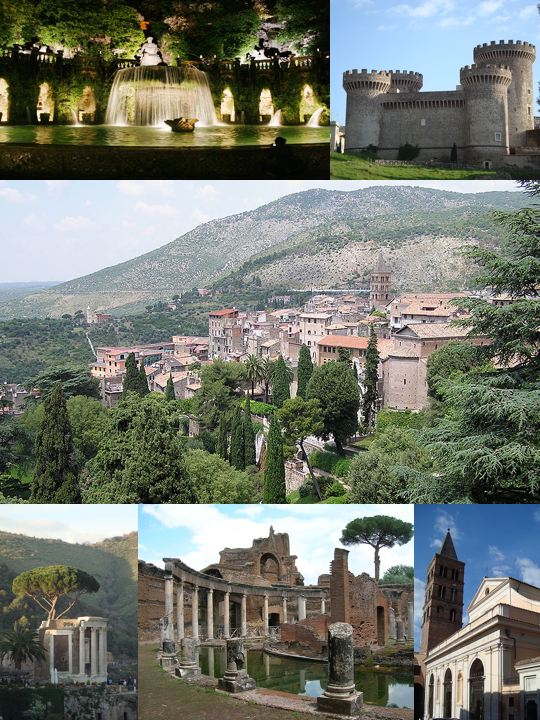
Tivoli (/ˈtɪvəli/ TIV-ə-lee; Italian: [ˈtiːvoli]; Latin: Tibur) is a town and comune in Lazio, Central Italy, 30 kilometres (19 miles) north-east of the city centre of Rome, at the falls of the Aniene river where it issues from the Sabine Hills. The city offers a wide view over the Roman Campagna.
Gaius Julius Solinus cites Cato the Elder's lost Origines for the story that the city of Tibur was founded by Catillus the Arcadian, a son of Amphiaraus, who came there having escaped the slaughter at Thebes, Greece. Catillus and his three sons Tiburtus, Coras, and Catillus drove out the Siculi from the Aniene plateau and founded a city they named Tibur in honor of Tiburtus. According to another account, Tibur was a colony of Alba Longa. Historical traces of settlement in the area date back to the thirteenth century BC. Tibur may share a common root with the river Tiber and the Latin praenomen Tiberius.
From Etruscan times Tibur, a Sabine city, was the seat of the Tiburtine Sibyl. There are two small temples above the falls, the rotunda traditionally associated with Vesta and the rectangular one with the Sibyl of Tibur, whom Varro calls Albunea, the water nymph who was worshipped on the banks of the Aniene as a tenth Sibyl added to the nine mentioned by the Greek writers. In the nearby woods, Faunus had a sacred grove. During the Roman age Tibur maintained a certain importance, being on the way (the Via Tiburtina, extended as the Via Valeria) that Romans had to follow to cross the mountain regions of the Apennines towards the Abruzzo, the region where lived some of its fiercest enemies such as Volsci, Sabines, and Samnites.
At first an independent ally of Rome, Tibur allied itself with the Gauls in 361 BC. Vestiges remain of its defensive walls of this period, in opus quadratum. In 338 BC, however, Tibur was defeated and absorbed by the Romans. The city acquired Roman citizenship in 90 BC and became a resort area famed for its beauty and its good water, and was enriched by many Roman villas. The most famous one, of which the ruins remain, is the Villa Adriana (Hadrian's Villa). Maecenas and Augustus also had villas at Tibur, and the poet Horace had a modest villa: he and Catullus and Statius all mention Tibur in their poems. In 273, Zenobia, the captive queen of Palmyra, was assigned a residence here by the Emperor Aurelian. The second-century temple of Hercules Victor is being excavated. The present Piazza del Duomo occupies the Roman forum.
In 547, in the course of the Gothic War, the city was fortified by the Byzantine general Belisarius, but was later destroyed by Totila's army. After the end of the war it became a Byzantine duchy, later absorbed into the Patrimony of St. Peter. After Italy was conquered by Charlemagne, Tivoli was under the authority of a count, representing the emperor.
From the tenth century onwards, Tivoli, as an independent commune governed by its elected consuls, was the fiercest rival of Rome in the struggle for the control over the impoverished central Lazio. Emperor Otto III conquered it in 1001, and Tivoli fell under the papal control. Tivoli however managed to keep a level of independence until the 15th century: symbols of the city's strength were the Palace of Arengo, the Torre del Comune and the church of St. Michael, all built in this period, as well as the new line of walls (authorized in 1155), needed to house the increasing population. Reminders of the internal turbulence of communal life are the tower houses that may be seen in Vicolo dei Ferri, Via di Postera, Via del Seminario and Via del Colle.
In the 13th century Rome imposed a tribute on the city, and gave itself the right to appoint a count to govern it in conjunction with the local consuls. In the fourteenth century, Tivoli sided with the Guelphs and strongly supported Urban VI against Antipope Clement VII. King Ladislaus of Naples was twice repulsed from the city, as was the condottiero Braccio da Montone.
In the city there was also a Jewish community.
Hub AI
Tivoli, Lazio AI simulator
(@Tivoli, Lazio_simulator)
Tivoli, Lazio
Tivoli (/ˈtɪvəli/ TIV-ə-lee; Italian: [ˈtiːvoli]; Latin: Tibur) is a town and comune in Lazio, Central Italy, 30 kilometres (19 miles) north-east of the city centre of Rome, at the falls of the Aniene river where it issues from the Sabine Hills. The city offers a wide view over the Roman Campagna.
Gaius Julius Solinus cites Cato the Elder's lost Origines for the story that the city of Tibur was founded by Catillus the Arcadian, a son of Amphiaraus, who came there having escaped the slaughter at Thebes, Greece. Catillus and his three sons Tiburtus, Coras, and Catillus drove out the Siculi from the Aniene plateau and founded a city they named Tibur in honor of Tiburtus. According to another account, Tibur was a colony of Alba Longa. Historical traces of settlement in the area date back to the thirteenth century BC. Tibur may share a common root with the river Tiber and the Latin praenomen Tiberius.
From Etruscan times Tibur, a Sabine city, was the seat of the Tiburtine Sibyl. There are two small temples above the falls, the rotunda traditionally associated with Vesta and the rectangular one with the Sibyl of Tibur, whom Varro calls Albunea, the water nymph who was worshipped on the banks of the Aniene as a tenth Sibyl added to the nine mentioned by the Greek writers. In the nearby woods, Faunus had a sacred grove. During the Roman age Tibur maintained a certain importance, being on the way (the Via Tiburtina, extended as the Via Valeria) that Romans had to follow to cross the mountain regions of the Apennines towards the Abruzzo, the region where lived some of its fiercest enemies such as Volsci, Sabines, and Samnites.
At first an independent ally of Rome, Tibur allied itself with the Gauls in 361 BC. Vestiges remain of its defensive walls of this period, in opus quadratum. In 338 BC, however, Tibur was defeated and absorbed by the Romans. The city acquired Roman citizenship in 90 BC and became a resort area famed for its beauty and its good water, and was enriched by many Roman villas. The most famous one, of which the ruins remain, is the Villa Adriana (Hadrian's Villa). Maecenas and Augustus also had villas at Tibur, and the poet Horace had a modest villa: he and Catullus and Statius all mention Tibur in their poems. In 273, Zenobia, the captive queen of Palmyra, was assigned a residence here by the Emperor Aurelian. The second-century temple of Hercules Victor is being excavated. The present Piazza del Duomo occupies the Roman forum.
In 547, in the course of the Gothic War, the city was fortified by the Byzantine general Belisarius, but was later destroyed by Totila's army. After the end of the war it became a Byzantine duchy, later absorbed into the Patrimony of St. Peter. After Italy was conquered by Charlemagne, Tivoli was under the authority of a count, representing the emperor.
From the tenth century onwards, Tivoli, as an independent commune governed by its elected consuls, was the fiercest rival of Rome in the struggle for the control over the impoverished central Lazio. Emperor Otto III conquered it in 1001, and Tivoli fell under the papal control. Tivoli however managed to keep a level of independence until the 15th century: symbols of the city's strength were the Palace of Arengo, the Torre del Comune and the church of St. Michael, all built in this period, as well as the new line of walls (authorized in 1155), needed to house the increasing population. Reminders of the internal turbulence of communal life are the tower houses that may be seen in Vicolo dei Ferri, Via di Postera, Via del Seminario and Via del Colle.
In the 13th century Rome imposed a tribute on the city, and gave itself the right to appoint a count to govern it in conjunction with the local consuls. In the fourteenth century, Tivoli sided with the Guelphs and strongly supported Urban VI against Antipope Clement VII. King Ladislaus of Naples was twice repulsed from the city, as was the condottiero Braccio da Montone.
In the city there was also a Jewish community.
Recent media