



Community hub
Recent from talks
Knowledge base stats:
Talk channels stats:
Members stats:
Token (railway signalling)
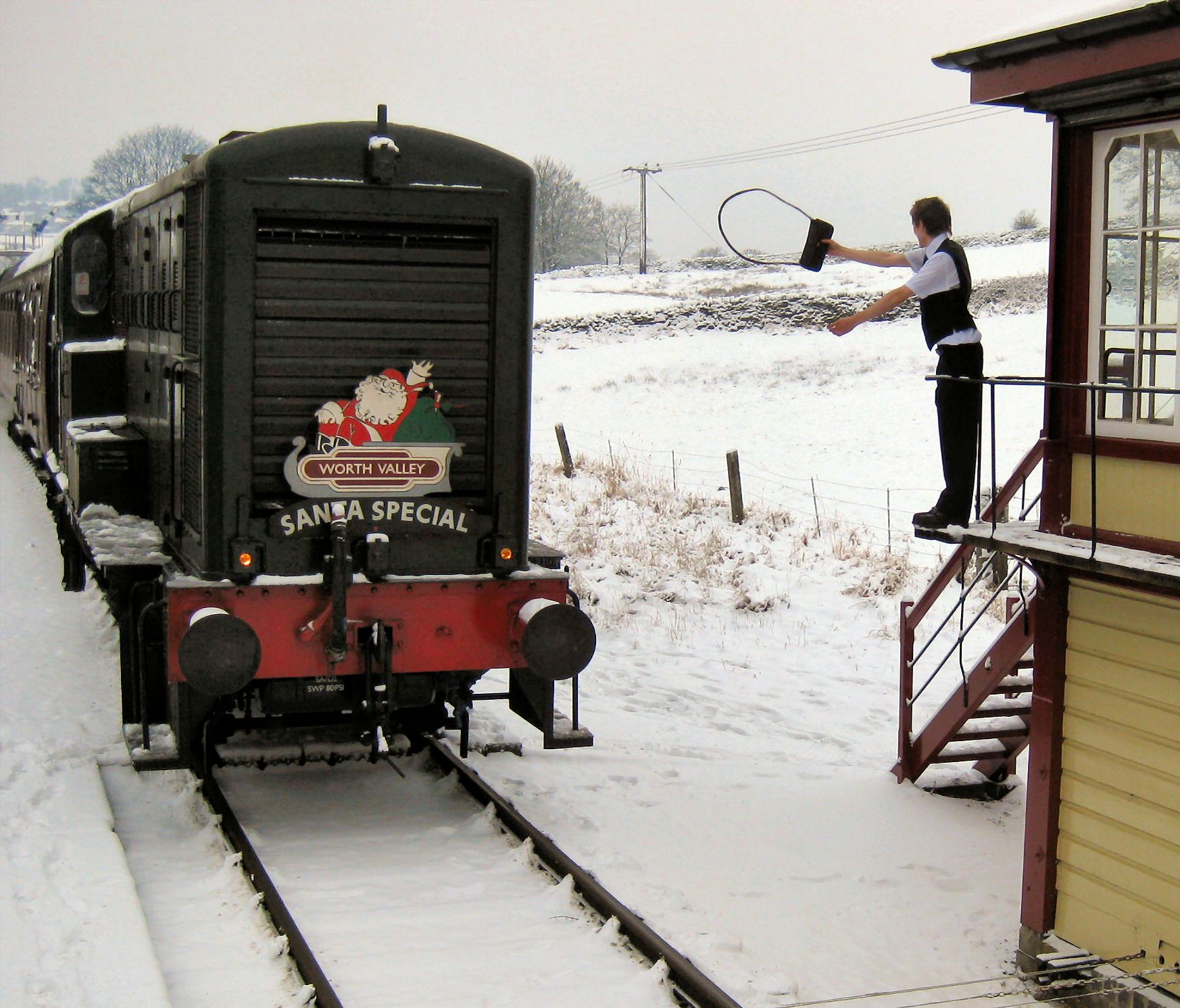
In railway signalling, a token is a physical object which a train driver is required to have or see before entering onto a particular section of single track. The token is clearly endorsed with the names of the section to which it belongs. A token system is more commonly used for single lines because of the greater risk of collision in the event of a mistake being made by a signaller or traincrew than on double lines.
The operation of a bidirectional single track line has the hazard of two trains colliding. The simplest way to prevent such collisions is to have only one train in the section at any given time. Such a system is known as "one-engine-in-steam” (OES) or “one-train working" (OTW). This system is used on some branches of rail networks, and on heritage railways. The main disadvantage is that it restricts the number of train movements that can be made. For a larger railway system, it becomes exceptionally limiting in the level of operations that it allows, with the increased risk of mistakes being made, possibly leading to a collision.
Instead, reliance is placed not on employing only one train but on having a single physical object, known as a "token", available for the single track section, and ruling that a driver may enter the single line section only if in physical possession of that object. Existing in a variety of physical forms, such as a staff, tablet, key, or ball, the object is marked to indicate to which single track section it belongs.
The token system was developed in Britain in the 19th century, to enable safe working of single-line railways. For the very first time this system was proposed by Henry Woodhouse for Standedge Tunnels in 1849. If a branch line is a dead end with a simple shuttle train service, then a single token is sufficient. The driver of any train entering the branch line (or occupying any part of it) must be in possession of the token, and no collision with another train is possible.
For convenience in passing it from hand to hand, the token was often in the form of a staff, typically 800 mm (31 in) long and 40 mm (1.6 in) diameter, and is referred to as a train staff. Such a staff is usually literally a wooden staff with a brass plate stating the two signal boxes between which it is valid.
In UK terminology, this method of working on simple branch lines was originally referred to as One Engine in Steam (OES), and later One-Train Working (OTW). However the system was used on long through lines as well; R H Dutton, Chairman of the London and South Western Railway explained in 1876 the slow journey time between Exeter and Plymouth by saying, "the cause of the delay is the stopping at every station on the staff system. That really does cause a great delay because if the staff is not there, the train must stop while a man is sent on a horse to get it [from the other end of the section]"; quoted in Williams.
Using only a single token does not provide convenient operation when consecutive trains are to be worked in the same direction. The simple token system was therefore extended: if one train was to be followed by another in the same direction, the driver of the first train was required to be shown the token, but not take possession of it (in theory he was supposed to physically touch the token, but this was not strictly followed). The driver was given a written authority to enter the single line section, referred to as the ticket. The train could then proceed, and a second train could follow. In the earliest days, the second train could proceed after a designated time interval, as on double lines at the time. However, after the Armagh rail disaster of 1889, block working became mandatory.
Seeing the train staff provided assurance that there could be no head-on collision. To ensure that the ticket was not issued incorrectly, a book of numbered tickets was kept in a locked box, the key to which was permanently fastened to the token, or was the token. In addition, the lock prevented the token from being removed until the ticket box was closed, and it could not be closed unless the book of tickets was in the box. Once a ticket was issued, its number was recorded in a Train Register book, and the token was locked in a secure place. The system is known as staff and ticket.
Hub AI
Token (railway signalling) AI simulator
(@Token (railway signalling)_simulator)
Token (railway signalling)
In railway signalling, a token is a physical object which a train driver is required to have or see before entering onto a particular section of single track. The token is clearly endorsed with the names of the section to which it belongs. A token system is more commonly used for single lines because of the greater risk of collision in the event of a mistake being made by a signaller or traincrew than on double lines.
The operation of a bidirectional single track line has the hazard of two trains colliding. The simplest way to prevent such collisions is to have only one train in the section at any given time. Such a system is known as "one-engine-in-steam” (OES) or “one-train working" (OTW). This system is used on some branches of rail networks, and on heritage railways. The main disadvantage is that it restricts the number of train movements that can be made. For a larger railway system, it becomes exceptionally limiting in the level of operations that it allows, with the increased risk of mistakes being made, possibly leading to a collision.
Instead, reliance is placed not on employing only one train but on having a single physical object, known as a "token", available for the single track section, and ruling that a driver may enter the single line section only if in physical possession of that object. Existing in a variety of physical forms, such as a staff, tablet, key, or ball, the object is marked to indicate to which single track section it belongs.
The token system was developed in Britain in the 19th century, to enable safe working of single-line railways. For the very first time this system was proposed by Henry Woodhouse for Standedge Tunnels in 1849. If a branch line is a dead end with a simple shuttle train service, then a single token is sufficient. The driver of any train entering the branch line (or occupying any part of it) must be in possession of the token, and no collision with another train is possible.
For convenience in passing it from hand to hand, the token was often in the form of a staff, typically 800 mm (31 in) long and 40 mm (1.6 in) diameter, and is referred to as a train staff. Such a staff is usually literally a wooden staff with a brass plate stating the two signal boxes between which it is valid.
In UK terminology, this method of working on simple branch lines was originally referred to as One Engine in Steam (OES), and later One-Train Working (OTW). However the system was used on long through lines as well; R H Dutton, Chairman of the London and South Western Railway explained in 1876 the slow journey time between Exeter and Plymouth by saying, "the cause of the delay is the stopping at every station on the staff system. That really does cause a great delay because if the staff is not there, the train must stop while a man is sent on a horse to get it [from the other end of the section]"; quoted in Williams.
Using only a single token does not provide convenient operation when consecutive trains are to be worked in the same direction. The simple token system was therefore extended: if one train was to be followed by another in the same direction, the driver of the first train was required to be shown the token, but not take possession of it (in theory he was supposed to physically touch the token, but this was not strictly followed). The driver was given a written authority to enter the single line section, referred to as the ticket. The train could then proceed, and a second train could follow. In the earliest days, the second train could proceed after a designated time interval, as on double lines at the time. However, after the Armagh rail disaster of 1889, block working became mandatory.
Seeing the train staff provided assurance that there could be no head-on collision. To ensure that the ticket was not issued incorrectly, a book of numbered tickets was kept in a locked box, the key to which was permanently fastened to the token, or was the token. In addition, the lock prevented the token from being removed until the ticket box was closed, and it could not be closed unless the book of tickets was in the box. Once a ticket was issued, its number was recorded in a Train Register book, and the token was locked in a secure place. The system is known as staff and ticket.