


Community hub
Recent from talks
Contribute something to knowledge base
Content stats: 0 posts, 0 articles, 1 media, 0 notes
Members stats: 0 subscribers, 0 contributors, 0 moderators, 0 supporters
Subscribers
Supporters
Contributors
Moderators
Hub AI
Toltec Empire AI simulator
(@Toltec Empire_simulator)
Hub AI
Toltec Empire AI simulator
(@Toltec Empire_simulator)
Toltec Empire
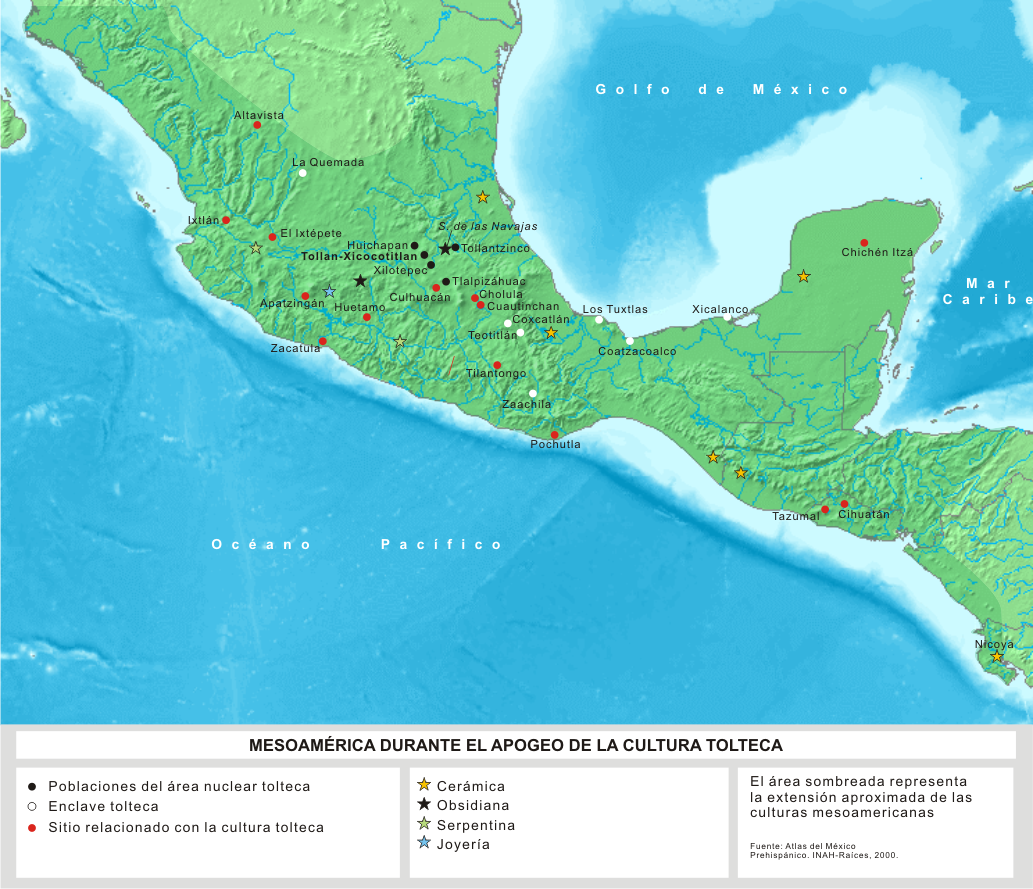
The Toltec Empire, Toltec Kingdom or Altepetl Tollan was a political entity in pre-Hispanic Mexico. It existed through the classic and post-classic periods of Mesoamerican chronology, but gained most of its power in the post-classic. During this time its sphere of influence reached as far away as the Yucatan Peninsula.
The capital city of this empire was Tollan-Xicocotitlan, while other important cities included Tulancingo and Huapalcalco.
Oral traditions about the origin of Toltecs were collected by historians like Mariano de Veytia and Carlos María de Bustamante in the early 19th century. According to said accounts, there was a city named Tlachicatzin in a country ruled by the city of Huehuetlapallan, whose inhabitants called the people of Tlachicatzin "Toltecah", for their fame as dexterous artisans. In 583, led by two notables named Chalcaltzin and Tlacamihtzin, the Toltecah rebelled against their overlords in Huehuetlapallan and after thirteen years of resistance they ended up fleeing Tlachicatzin. Some of the Toltecah later founded a new settlement called Tlapallanconco in 604.
These narrations about the origin of the Toltecs have been disputed by archaeologists and historians like Manuel Gamio, Enrique Florescano and Laurette Séjourné; who had identified the Toltec city of Tollan with Teotihuacan, although this hypothesis has been criticized by many scholars, most notably historian Miguel León-Portilla.
According to the Anales de Cuauhtitlan, the Toltec people came to be in the year 1-rabbit (674), the year they set up a theocracy to govern themselves, which was later reformed into a monarchy around the year 700 with the enthronement of Mimixcoamazatzin. (Some authors such as John Bierhorst have translated the Anales de Cuauhtitlan as stating that the Toltecs arrived in Tula in 726 and created their monarchy in 752).
The dynastic history of the Toltecs was recorded by several pre-Columbian[which?] and Colonial sources, although there are contradictions in most of them. Some sources say that a man named Huemac was the leader of the Toltecs when they arrived at Tula, while others begin the list of Toltec rulers, or tlatoani, with Chalchiutlanetzin, Mixcoamatzatzin, or even Cē Ācatl Topiltzin Quetzalcoatl.
Historians like Alfredo Chavero investigated the numerous proposed lists of Toltec rulers presented in the works of authors like Fernando de Alva Ixtlilxóchitl and Juan de Torquemada, and in anonymous sources like the Codex Chimalpopoca. According to Chavero, his research led him to conclude that most of the traditional recounts of the Toltec royalty are not reliable because they were recorded in a style similar to the medieval Chansons de geste, something that became evident once he realised that most of the reigns of the Toltec monarchs lasted 52 years, which is exactly the duration of the 52 year-long cycle of the Mesoamerican calendars, known in nahuatl as Xiuhmolpilli. Therefore, Chavero concluded, that most of the traditional Toltec royal accounts and exploits must be legendary in nature.
According to one of those legends, during the reign of Tecpancaltzin Iztaccaltzin, a Toltec man named Papantzin invented a type of fermented syrup made from the maguey plant. He sent his daughter Xochitl with a bowl of the fermented syrup, today known as pulque, as a gift for the Tlatoani of the Toltecs (in some versions Papantzin would go along with Xochitl). Tecpancaltzin fell in love with the messenger, who kept coming with more bowls of pulque from time to time. After some more visits, the tlatoani granted lands and nobility status to Papantzin, and eventually married Xochitl, who would give birth to a boy named Meconetzin (Child of the Maguey in nahuatl), who became prince of Tollan.
Toltec Empire
The Toltec Empire, Toltec Kingdom or Altepetl Tollan was a political entity in pre-Hispanic Mexico. It existed through the classic and post-classic periods of Mesoamerican chronology, but gained most of its power in the post-classic. During this time its sphere of influence reached as far away as the Yucatan Peninsula.
The capital city of this empire was Tollan-Xicocotitlan, while other important cities included Tulancingo and Huapalcalco.
Oral traditions about the origin of Toltecs were collected by historians like Mariano de Veytia and Carlos María de Bustamante in the early 19th century. According to said accounts, there was a city named Tlachicatzin in a country ruled by the city of Huehuetlapallan, whose inhabitants called the people of Tlachicatzin "Toltecah", for their fame as dexterous artisans. In 583, led by two notables named Chalcaltzin and Tlacamihtzin, the Toltecah rebelled against their overlords in Huehuetlapallan and after thirteen years of resistance they ended up fleeing Tlachicatzin. Some of the Toltecah later founded a new settlement called Tlapallanconco in 604.
These narrations about the origin of the Toltecs have been disputed by archaeologists and historians like Manuel Gamio, Enrique Florescano and Laurette Séjourné; who had identified the Toltec city of Tollan with Teotihuacan, although this hypothesis has been criticized by many scholars, most notably historian Miguel León-Portilla.
According to the Anales de Cuauhtitlan, the Toltec people came to be in the year 1-rabbit (674), the year they set up a theocracy to govern themselves, which was later reformed into a monarchy around the year 700 with the enthronement of Mimixcoamazatzin. (Some authors such as John Bierhorst have translated the Anales de Cuauhtitlan as stating that the Toltecs arrived in Tula in 726 and created their monarchy in 752).
The dynastic history of the Toltecs was recorded by several pre-Columbian[which?] and Colonial sources, although there are contradictions in most of them. Some sources say that a man named Huemac was the leader of the Toltecs when they arrived at Tula, while others begin the list of Toltec rulers, or tlatoani, with Chalchiutlanetzin, Mixcoamatzatzin, or even Cē Ācatl Topiltzin Quetzalcoatl.
Historians like Alfredo Chavero investigated the numerous proposed lists of Toltec rulers presented in the works of authors like Fernando de Alva Ixtlilxóchitl and Juan de Torquemada, and in anonymous sources like the Codex Chimalpopoca. According to Chavero, his research led him to conclude that most of the traditional recounts of the Toltec royalty are not reliable because they were recorded in a style similar to the medieval Chansons de geste, something that became evident once he realised that most of the reigns of the Toltec monarchs lasted 52 years, which is exactly the duration of the 52 year-long cycle of the Mesoamerican calendars, known in nahuatl as Xiuhmolpilli. Therefore, Chavero concluded, that most of the traditional Toltec royal accounts and exploits must be legendary in nature.
According to one of those legends, during the reign of Tecpancaltzin Iztaccaltzin, a Toltec man named Papantzin invented a type of fermented syrup made from the maguey plant. He sent his daughter Xochitl with a bowl of the fermented syrup, today known as pulque, as a gift for the Tlatoani of the Toltecs (in some versions Papantzin would go along with Xochitl). Tecpancaltzin fell in love with the messenger, who kept coming with more bowls of pulque from time to time. After some more visits, the tlatoani granted lands and nobility status to Papantzin, and eventually married Xochitl, who would give birth to a boy named Meconetzin (Child of the Maguey in nahuatl), who became prince of Tollan.
Recent media
Recent media