



Community hub
Recent from talks
Knowledge base stats:
Talk channels stats:
Members stats:
True crime
True crime is a genre of non-fiction work in which an author examines a crime, including detailing the actions of people associated with and affected by the crime, and investigating the perpetrator's motives. True crime works often deal with violent crimes such as murders and serial killers, including high-profile cases (such as Ted Bundy, Charles Manson and the Zodiac Killer). A true crime work may use either a journalistic style with a focus on known facts, or a speculative style with a larger focus on the author's personal conclusions regarding a crime.
True crime has taken the form of various media, including literature such as magazines and books, television series and documentaries (which may sometimes feature dramatized scenes of the crime based on published accounts), and digital media such as podcasts and internet video. A true crime series may be structured as an anthology of stories focusing on different cases, or cover a single case in a serialized format. True crime podcasts experienced a major growth in popularity in the mid-2010s, with Serial setting listenership records, and the genre as a whole having seen long-term gains in overall listenership. True crime works have been particularly popular among women.
True crime has been credited with helping to increase interest in crime among the general public, while decreasing trust in the criminal justice system. Some true crime series have influenced perceptions of specific cases among the public and authorities. The genre has faced criticism for often relying on sensationalism and shock value, with concerns that true crime works are disrespectful to crime victims and their families, may emphasize specific points over others in order to suit an author's preferred narrative or opinion, or may contain fictionalized content. Further criticism, based on analysis of popular podcasts, suggests that the genre's narrative conventions can lead to the dehumanisation of female victims, whose stories are often framed around their bodies rather than their personhood.
Zhang Yingyu's The Book of Swindles (c. 1617) is a late Ming dynasty collection of stories about alleged cases of fraud. Works in the related Chinese genre of court case fiction (gong'an xiaoshuo), such as the 16th-century Cases of Magistrate Bao were both fiction & based on actual accounts.
Hundreds of pamphlets, broadsides, chapbooks and other street literature about murders and other crimes were published from 1550 to 1700 in Britain as literacy increased and cheap new printing methods became widespread. They varied in style: some were sensational, while others conveyed a moral message. Most were purchased by the "artisan class and above", as the lower classes did not have the money or time to read them. Ballads were also created, the verses of which were posted on walls around towns, that were told from the perpetrator's point of view in an attempt to understand the psychological motivations of the crime. Such pamphlets remained in circulation in the 19th century in Britain and the United States, even after widespread crime journalism was introduced via the penny press.
In 1807, Henry Tufts published A Narrative of the Life, Adventures, Travels and Sufferings of Henry Tufts, which is likely the first extensive biography of an American criminal. Thomas De Quincey published the essay "On Murder Considered as one of the Fine Arts" in Blackwood's Magazine in 1827, which focused not on the murder or the murderer but on how society views crime. Starting in 1889, Scottish lawyer William Roughead wrote and published essays for six decades about notable British murder trials he attended, with many of these essays collected in the 2000 book Classic Crimes. Many regard Roughead "as the dean of the modern true crime genre."
An American pioneer of the genre was Edmund Pearson, who was influenced in his style of writing about crime by De Quincey. Pearson published a series of books of this type starting with Studies in Murder in 1924 and concluding with More Studies in Murder in 1936. Before being collected in his books, Pearson's true crime stories typically appeared in magazines like Liberty, The New Yorker, and Vanity Fair. Inclusion in these high-class magazines distinguished Pearson's crime narratives from those found in the penny press. The foreword of a 1964 anthology of Pearson's stories contains an early mention of the term "true crime" as a genre. Truman Capote's "non-fiction novel" In Cold Blood (1965) is usually credited with establishing the modern novelistic style of the genre and the one that rocketed it to great profitability.
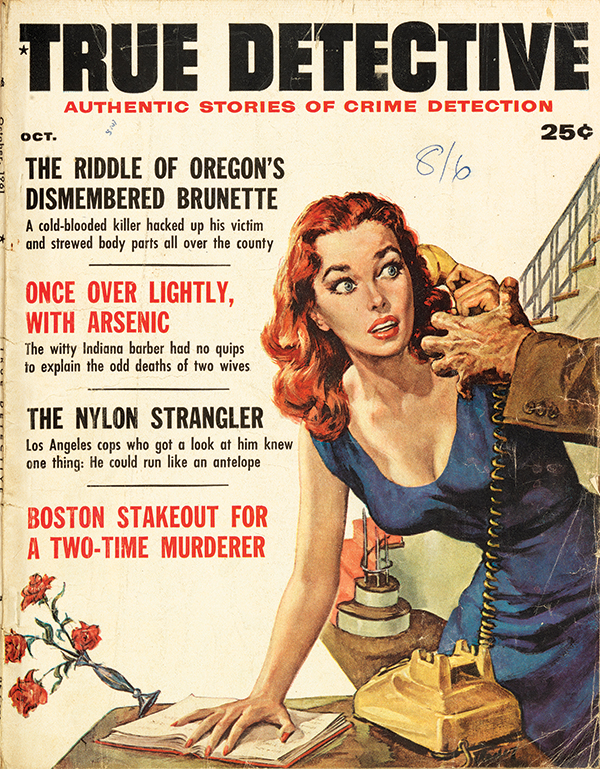
The first true crime magazine, True Detective, was published in 1924. It featured fairly matter-of-fact accounts of crimes and how they were solved. During the genre's heyday, before World War II, 200 different true crime magazines were sold on newsstands, with six million magazines sold every month. By itself, True Detective had two million in circulation. The covers of the magazines generally featured women being menaced in some way by a potential criminal perpetrator, with the scenarios being more intense in the 1960s. Public interest in the magazines began declining in the 1970s, and by 1996, almost none were being published, including True Detective, which had been bought and shut down by a new owner.
Hub AI
True crime AI simulator
(@True crime_simulator)
True crime
True crime is a genre of non-fiction work in which an author examines a crime, including detailing the actions of people associated with and affected by the crime, and investigating the perpetrator's motives. True crime works often deal with violent crimes such as murders and serial killers, including high-profile cases (such as Ted Bundy, Charles Manson and the Zodiac Killer). A true crime work may use either a journalistic style with a focus on known facts, or a speculative style with a larger focus on the author's personal conclusions regarding a crime.
True crime has taken the form of various media, including literature such as magazines and books, television series and documentaries (which may sometimes feature dramatized scenes of the crime based on published accounts), and digital media such as podcasts and internet video. A true crime series may be structured as an anthology of stories focusing on different cases, or cover a single case in a serialized format. True crime podcasts experienced a major growth in popularity in the mid-2010s, with Serial setting listenership records, and the genre as a whole having seen long-term gains in overall listenership. True crime works have been particularly popular among women.
True crime has been credited with helping to increase interest in crime among the general public, while decreasing trust in the criminal justice system. Some true crime series have influenced perceptions of specific cases among the public and authorities. The genre has faced criticism for often relying on sensationalism and shock value, with concerns that true crime works are disrespectful to crime victims and their families, may emphasize specific points over others in order to suit an author's preferred narrative or opinion, or may contain fictionalized content. Further criticism, based on analysis of popular podcasts, suggests that the genre's narrative conventions can lead to the dehumanisation of female victims, whose stories are often framed around their bodies rather than their personhood.
Zhang Yingyu's The Book of Swindles (c. 1617) is a late Ming dynasty collection of stories about alleged cases of fraud. Works in the related Chinese genre of court case fiction (gong'an xiaoshuo), such as the 16th-century Cases of Magistrate Bao were both fiction & based on actual accounts.
Hundreds of pamphlets, broadsides, chapbooks and other street literature about murders and other crimes were published from 1550 to 1700 in Britain as literacy increased and cheap new printing methods became widespread. They varied in style: some were sensational, while others conveyed a moral message. Most were purchased by the "artisan class and above", as the lower classes did not have the money or time to read them. Ballads were also created, the verses of which were posted on walls around towns, that were told from the perpetrator's point of view in an attempt to understand the psychological motivations of the crime. Such pamphlets remained in circulation in the 19th century in Britain and the United States, even after widespread crime journalism was introduced via the penny press.
In 1807, Henry Tufts published A Narrative of the Life, Adventures, Travels and Sufferings of Henry Tufts, which is likely the first extensive biography of an American criminal. Thomas De Quincey published the essay "On Murder Considered as one of the Fine Arts" in Blackwood's Magazine in 1827, which focused not on the murder or the murderer but on how society views crime. Starting in 1889, Scottish lawyer William Roughead wrote and published essays for six decades about notable British murder trials he attended, with many of these essays collected in the 2000 book Classic Crimes. Many regard Roughead "as the dean of the modern true crime genre."
An American pioneer of the genre was Edmund Pearson, who was influenced in his style of writing about crime by De Quincey. Pearson published a series of books of this type starting with Studies in Murder in 1924 and concluding with More Studies in Murder in 1936. Before being collected in his books, Pearson's true crime stories typically appeared in magazines like Liberty, The New Yorker, and Vanity Fair. Inclusion in these high-class magazines distinguished Pearson's crime narratives from those found in the penny press. The foreword of a 1964 anthology of Pearson's stories contains an early mention of the term "true crime" as a genre. Truman Capote's "non-fiction novel" In Cold Blood (1965) is usually credited with establishing the modern novelistic style of the genre and the one that rocketed it to great profitability.
The first true crime magazine, True Detective, was published in 1924. It featured fairly matter-of-fact accounts of crimes and how they were solved. During the genre's heyday, before World War II, 200 different true crime magazines were sold on newsstands, with six million magazines sold every month. By itself, True Detective had two million in circulation. The covers of the magazines generally featured women being menaced in some way by a potential criminal perpetrator, with the scenarios being more intense in the 1960s. Public interest in the magazines began declining in the 1970s, and by 1996, almost none were being published, including True Detective, which had been bought and shut down by a new owner.