


Community hub
Recent from talks
Contribute something
Nothing was collected or created yet.
University Interscholastic League
View on Wikipedia
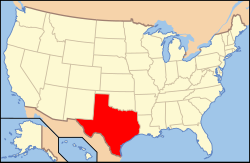
The University Interscholastic League (UIL) is an organization that creates rules for and administers almost all athletic, musical, and academic contests for public primary and secondary schools in the U.S. state of Texas. It is the largest organization of its type in the world.[1]
Key Information


Activities range from American football and cross-examination debate to mathematics and marching band competitions; however, the UIL does not administer Academic Decathlon competitions.
The UIL is under the governance of the Vice President for Diversity and Community Engagement at the University of Texas at Austin in Austin, Texas. Although the Texas Education Agency governs the activities of schools and school districts in Texas, the UIL does not report to TEA, but is instead a separate entity.
History
[edit]The UIL was originally created by the University of Texas at Austin in 1910 as two different entities, the Debating League of Texas High Schools (to govern debating contests) and the Interscholastic Athletic Association (to govern athletic contests). The two entities merged in 1913 and adopted the UIL name.[2]
At the time, UIL governed only white schools in Texas. From 1940 to 1970, an era of racial segregation in Texas, the Prairie View Interscholastic League (PVIL), headquartered at Prairie View A&M University, served as a separate parallel organization for African-American public high schools in Texas.
In 1965, the UIL agreed to admit PVIL member schools for competition. Black schools began UIL competitions beginning in the 1967–68 school year. After the 1969–70 school year, the UIL fully absorbed all PVIL member schools, the majority of which would later be merged with their white counterparts.[3]
Beginning with the 2003–2004 academic year, two large all-male private schools, Dallas Jesuit and Houston Strake Jesuit, were granted UIL membership. This came after extensive court battles and negotiations from both the UIL's lawyers and the schools' joint lawyers. Previously, both schools were members of the now-defunct Texas Christian Interscholastic League (TCIL); after that league's demise and their inability to gain admittance into the Texas Association of Private and Parochial Schools (TAPPS) or Southwest Preparatory Conference (SPC), they decided to further pursue their decade-long battle of gaining membership into the UIL. They are so far the only private schools to be granted UIL membership, as the new UIL rules established after the Jesuit schools' entry prohibited those schools who were eligible for memberships in other similar associations (such as TAPPS or the SPC) to apply.[4]
On October 10, 2010, the Third District Court of Appeals in Austin ruled that the UIL operates as a public organization and not a private organization. The ruling clarified that the UIL is legally considered a state agency and must comply with the prerequisites and duties that all other state agencies have. As a state agent, the UIL must treat individuals equally and show the purpose/need as well as a rational basis for eligibility restrictions.[5][6][7][8][9][10][11]
The Texas Legislature rewrote titles 1 and 2 of the Texas Education Code and greatly restricted the functions to be performed by the Texas Education Agency and the UIL. The changes made Texas an equal access state. The law now requires the public schools to allow all students that reside within the school's boundary equal access to all activities. The Senate also made amendments that expressly regulate the UIL and invalidated certain UIL rules limiting student eligibility for competitions by providing that UIL rules would only apply to a student enrolled in the public school. The UIL no longer has the authority to determine the eligibility of charter/home/private school students. [citation needed]
All students must abide by the state No Pass No Play law. Only students that are enrolled in a public school must abide by UIL eligibility rules, even if the activity is not a UIL event.
Organization
[edit]Activities for most Texas private schools are governed by separate bodies, the largest of which is TAPPS. However, private schools are allowed to join the UIL only if 1) they meet UIL's definition of a high school, 2) they are accredited by the Texas Private School Accreditation Commission, and 3) they are ineligible for membership in any league similar to UIL (such as TAPPS or the Southwest Preparatory Conference). Furthermore, private schools must compete at one classification higher than their enrollment would otherwise dictate. UIL schools are permitted to schedule contests with private schools and/or home school groups.
Charter schools must participate at no lower than the classification of the smallest high school in the district where the charter school resides; for example, a charter school within Dallas ISD must participate in at least Class AAAA, as DISD has high schools which participate at this level.
Schools are arranged by conference to ensure that schools compete on a regular basis with other schools in the geographic area of a similar size. The conferences are A (the smallest), AA, AAA, AAAA, AAAAA and AAAAAA (the largest). The corresponding alphanumeric designations (1A, 2A, 3A, 4A, 5A, and 6A) are used in everyday conversation (as well as in this article), but officially UIL only uses the alphabetic designations. The general guideline is that the UIL desires between 220 and 245 schools in Conference AAAAAA, at least 200 schools in Conferences AA, AAA, AAAA, and AAAAA with the grades 9–12 enrollment ratio for those classes no greater than 2.0 between the largest and smallest school in each class.
In addition, for football participation, a school whose enrollment is at or below 104.5 students may choose to play either six-man football (which, as of the 2014 alignment, is Conference 1A) or 11-man football (at Conference 2A). Schools with enrollments over 104.5 are only eligible for 11-man football; however, some schools organize a six-man team and play an "outlaw" schedule (i.e., the school is not eligible for the postseason). Moreover, for some events (such as team tennis, swimming, or diving), the UIL organizes all participating schools into Conference 6A and Conference 5A, with the latter encompassing all schools not meeting the Conference 6A enrollment requirements.
Within each conference, the UIL separates the schools into regions, and then further separates the regions into districts for various contests. The districts are numbered from 1 (in far west Texas) to 32 (in south Texas). There are always 32 districts in Conference 6A and Conference 5A, but the smaller conferences may have numbers skipped based on the number of schools in the conference. No more than 10 schools are permitted in a single district unless all schools and the UIL consent otherwise; the preference is for an even number of schools in each district (6, 8, 10), though in some cases travel issues may prevent such.
Previously, schools were permitted to request to be placed in a higher conference than their enrollment would otherwise dictate, usually to play at a higher level of competition. The "play up" rule was later eliminated for competition reasons, but has been retained for geographic reasons (where playing at the current level would create a travel hardship for the school), and where school districts with eight or more high schools could keep all or most of them in the same conference. However, the school must then participate at the higher conference in all UIL events in which it does participate.
Each type of contest has different regions and competitors, as there is no requirement that a school participate in all UIL events – some small rural schools do not participate in football or choose six-man over 11-man, while some magnet schools do not field athletic teams but participate in academic events only.
Unlike the college ranks or other states, the regions and districts are not permanently set, but are redrawn biennially by the UIL behind closed doors in an attempt to keep schools of similar sizes within a certain distance of their geographic area when attending competitions, and to adjust for the changing enrollments of schools (moving schools with increased attendance up in conference and those with decreased attendance down) and new schools opening. The main redrawing of regions and districts takes place on February 1 of even-numbered years (and the final allocation, especially relating to high school football, is the subject of much pre-announcement anticipation and speculation as to which schools move up or down and the final composition of the districts), but as new schools open or smaller schools close or disband programs, interim adjustments can be made.
The changing districts and regions have produced unusual results – for example, the 2008-09 Conference 5A boys' basketball championship featured champion DeSoto from Region II defeating Cedar Hill from Region I, notwithstanding that the schools were in neighboring districts.
Playoff formats
[edit]Football
[edit]In Conference 6A, the top four teams from each district are eligible for the playoffs. The two eligible teams with the highest student enrollment for its district are seeded in the Division I playoff bracket, and the remaining two teams (with the lower enrollment) are seeded in the Division II playoff bracket. This method is supposed to prevent matchups between large and small schools within a classification, although in practice this is not always the case – for example, in the 2006 playoffs, Southlake Carroll (the Conference 5A Division I champion; at that time 5A was the largest conference) had a lower student enrollment than Cedar Hill (the Conference 5A Division II champion).
For all other 11-man conferences and for six-man football, the UIL divides schools into separate Division I (large) and Division II (small) districts at its biennial redistricting session (in these cases, there are a maximum of 16 districts statewide, as opposed to the 32 in the larger conferences); separate playoffs are held for each division with the top four teams (top two in six-man) from each district eligible.
Other major team sports
[edit]In 2A-6A volleyball, the top four teams in each district qualify for the playoffs. For 1A, the top three teams qualify for the playoffs, with the first-place team receiving a first-round bye.
In 1A-6A basketball, the top four teams in each district qualify for the playoffs.
In 4A-6A soccer, the top four teams in each district qualify for the playoffs.
In 2A-6A baseball and softball, the top four teams in each district qualify for the playoffs. In 1A baseball and softball, the top two teams qualify for the playoffs.
For baseball and softball, at all levels except the state tournament, playoff rounds are best 2-of-3 only if both coaches agree; if they do not then the coaches flip a coin to decide the format of the playoff (single game or two out of three series). At the state tournament both the semifinals and finals are single-game format.
Beginning with the 2024-2025 school year, the 6A football playoff format was implemented for 1A-6A basketball, 2A-6A volleyball, baseball and softball, and 4A-6A soccer, with the two largest schools by enrollment playing in a Division I bracket, and the two smallest schools playing in a Division II bracket.[12]
Academics and other sports
[edit]Advancement varies significantly by event. In most Academic events, the top three District medalists plus the first place District team advance to Region. Likewise, the top three Region medalists plus the first place Region team advance to State competition. Furthermore, the highest-scoring second place team in each Region at District competition advances to Region as a Wild Card, and the highest scoring second place Region team advances to State as a Wild Card. In Computer Applications, all Journalism events, all Speech & Debate events, and Ready Writing, no team component, and therefore no wild cards, exist. Exceptions include the following:
- In Congressional Debate, ESC Regions are utilized instead of districts and competition occurs in the fall rather than spring. The top three medalists from each Region advance to state. For every ten competitors beyond thirty at a regional meet, an additional spot to advance to state is granted to that region.
- In Cross-Examination Debate, the top two teams advance directly from district to state
- In Science, additional spots to qualify to region and to state are given to the highest individual scorer in each of Biology, Chemistry, and Physics subsections.
- In a variety of other contests, such as the Film Festival, Robotics, Essay Competitions, and Theatrical Design, submissions are sent directly to the state level.
One-Act Play Contest
[edit]The UIL One-Act Play contest is a competition where similarly sized Texas schools present an 18-40 minute play and may be adjudicated by a panel of three judges or a single judge. The contest is held on a single day and open to the public. There are five possible levels of competition: District, Bi-District, Area, Region, and State. At each level of competition a judge awards individual acting awards as well as selecting three productions to advance to the next level of competition up to the Regional Level where only two will advance to the State Level. After the awards are announced a Judge gives an oral critique to each of the schools. Because of the wide participation and diversity of plays produced certain rules and guidelines have been adopted by the State One-Act Play Office. These rules are in place to ensure safety, allow for equity, satisfy legal standards, and make the running of the contest practical.[13]
Musical competition
[edit]In musical competitions, schools are aligned into 33 regions (the regions themselves are set not by the UIL, but by the Texas Music Educators Association).[14] Schools of all sizes are grouped into a region.
in general, advancement within musical competition is not based on direct competition against other schools. Instead, musicians are compared against an established rubric (this is comparable to conformation dog shows where dogs compete against the written standard for their breed, not against other dogs of differing breeds), and are given a rating of Division I (Superior), Division II (Excellent), Division III (Average), Division IV (Below Average), or Division V (Poor).[15] All individuals or ensembles who are given an overall Division I (based on the consensus of each judge's rating) may advance to the next level, except for area and state marching band competition (which use an alternative system).
For marching band, schools compete against other schools in the same UIL conference. The 33 regions are grouped into nine areas (named A-I) for Conferences 5A and 6A, and five areas (A-E) for Conference 4A and down. All schools of all conferences compete in region, area, and state competition annually as a fall semester activity. There are no area contests for Conference 1A or military class bands, only for 2A and up.
Prior to the region competition, marching bands choose to enter one of two classes: open class or military class. Since bands do not compete against each other directly at the region contest, military class and open class bands perform at the same region contest. After the region contest, open class and military class bands compete separately.
In order for bands to advance from region to area (or state for Conference 1A or military bands), they must receive an overall Division I rating.
The format of the area contest is dependent on the number of bands receiving the required ratings at the region contest. If less than 9 bands advance to area, one round of competition is held, with either the top 2 bands (in 5A and 6A) or the top 3 bands (in 4A and lower) advancing to state. If more than 9 bands are to participate at area, a preliminary and final round are conducted, with the number of bands advancing to finals determined by contest size. The number of bands that advance to state from finals is likewise determined by contest size.
State competition uses a similar format to area, with a preliminary and final round always being held.
Area and state contests use an ordinal system, in which each judge assigns each band an ordinal. These ordinals are then added together, with the lowest total determining the champion. For example, School 1 receives a first place ranking from three judges, a second place ranking from the fourth judge, and a fourth place ranking from the fifth judge. The ordinal total for School 1 is 9 (1+1+1+2+4). School 2 receives two first place rankings and three second place rankings. The ordinal total for School 2 is 8 (2+2+2+1+1). Therefore, School 2 would be the champion despite receiving fewer first place rankings because School 2's ordinal score is lower than School 1's.
Concert and sight-reading is divided into 3 divisions: band, orchestra, and vocal, and is held in the spring semester. Concert ensembles prepare a program from the UIL's Prescribed Music List and perform for a panel of 3 judges, who each rate the ensemble on the Division I-Division V scale. Immediately after performing their concert program, ensembles move to a separate sight-reading room, where they sight-read a piece that is specially prepared for that school year and used statewide. Sight-reading is also adjudicated with the Division I-Division V system.
In sight-reading, schools in different conferences read different pieces, and second or third groups (officially called "non-varsity" groups) read different pieces from other conferences than the varsity group. Sight-reading is held at the region level only. Wind ensembles can advance from region to state; however, the state event is not a competition but an educational event.[18]
In solo and small ensemble competition, held in the spring semester, conference alignments are disregarded. Advancement in solo and small ensemble competition is from region to state, and at state the top two soloists and top ensemble are awarded medals. Individual performers may be given Outstanding Performer awards. However, advancement is limited not only to Division 1 winners, but the winners must have performed "Class 1" (difficult level) performances at region, and the performance must have been from a selection on the UIL's Prescribed Music List and also performed from memory (except for certain instrumental pieces which are designated as exempt from such on the List).
Music theory
[edit]Music theory is held at state only and is open to any and all students in grades 9–12 having the permission of the school principal and school music director; the student is not required to have advanced from region in another musical contest (or even participated, for that matter).
Events
[edit]Athletics
[edit]Historically, football championship games have been held at neutral sites mutually agreed upon by both teams, but in 2006, 2007 and 2009, both Conference 5A championship games were played at the Alamodome in San Antonio. Frequent sites for those games included the Astrodome in Houston, Texas Stadium in Irving, Alamo Stadium in San Antonio and Darrell K Royal–Texas Memorial Stadium in Austin.
In 2010, the UIL designated sites for all championship games: the 5A, 4A, and 3A championships were held at AT&T Stadium in Arlington, while the 2A and 1A championships were held at Newsom Stadium in Mansfield and the six-man championships at Shotwell Stadium in Abilene. In 2011, Conferences 1A-5A played their state championships at AT&T Stadium, while the six-man games were played at Abilene. In 2013, the six-man games moved to AT&T Stadium as well. In 2015 the 11-man championships were played at NRG Stadium in Houston due to a conflict with a Dallas Cowboys-New York Jets game, while the six-man title games returned to Shotwell. All championship games returned to AT&T Stadium in 2016.
The state semifinal and championship games for all five classes in boys and girls basketball were previously held at the Frank Erwin Center on the campus of The University of Texas at Austin. In 2015 it was decided to move the boys & girls state tournaments to the Alamodome in San Antonio, TX, due to ongoing price and venue disputes in Austin. The state track and field meet and swimming championships are also held on the UT Austin campus, the former at Mike A. Myers Stadium and the latter at the Lee and Joe Jamail Texas Swimming Center.
The soccer semifinals and finals for 4A and 5A are held at Birkelbach Field in the Austin suburb of Georgetown, and the state baseball tournament is held at Dell Diamond in another Austin suburb, Round Rock. The state softball tournament is held at Red and Charline McCombs Field on the UT Austin campus. The state cross-country meet is held at Old Settlers Park in Round Rock. The state wrestling tournament is held at the Berry Center in Houston. The Conference 5A state golf tournament is held at Jimmy Clay Golf Course, a municipal course in Austin.
From 2000–2011 the girls' volleyball tournament was held in Strahan Coliseum on the campus of Texas State University in San Marcos. Since 2012, the tournament has been held at the Curtis Culwell Center in Garland.
Current State Championship sites
[edit]- Baseball: Dell Diamond, Round Rock
- Basketball: Alamodome, San Antonio
- Cross Country: Old Settler's Park, Round Rock
- Football: AT&T Stadium, Arlington
- Soccer: Birkelbach Field, Georgetown
- Softball: Red and Charline McCombs Field, Austin
- Swimming and Diving: Josh Davis Natatorium, San Antonio (4A); Lee and Joe Jamail Texas Swimming Center, Austin (5A and 6A)
- Team Tennis: Waco Regional Tennis Center and Baylor University, Waco
- Tennis: Blossom Tennis Center, Annemarie Tennis Center, and Northside Tennis Center, San Antonio (North East ISD and Northside ISD)
- Track and Field: Mike A. Myers Stadium, Austin
- Volleyball: Curtis Culwell Center, Garland
- Water Polo: Josh Davis Natatorium, San Antonio
- Wrestling: Berry Center, Cypress
Academics and spring meet
[edit]Though UIL is best known as the governing body for public school athletic competition, it also hosts numerous academic competitions as well, such as Math, Science, Ready Writing, Social Studies, and many others. Between athletics, music, theatre, spirit (cheer) and academics, UIL estimates that half of all public high school graduates have competed in at least one UIL-sanctioned event during their high school tenure.
The state level academic and speech competitions are held on the campus of The University of Texas at Austin, with the exception of Spirit/Cheer State Championship (Arlington, Texas), One-Act Play + Theatrical Design State Championships (Round Rock ISD Performing Arts Center) and UIL Young Filmmakers State Contest (Majestic Theatre - San Antonio, TX). The Student Congress state contest is typically held in the State Capitol Building.
For fine arts and journalism contests, the UIL has not adopted an "amateur rule.” Thus, students who have acted or performed professionally or who have written for a local newspaper may still compete in UIL-sanctioned contests provided they are otherwise eligible.
Speech and debate
[edit]In addition to academic and athletic competitions, UIL also organizes various public speaking and debate events such as cross-examination debate, congressional debate, prose, poetry, extemporaneous speaking, and Lincoln-Douglas debate. Speech & Debate is the league's longest running contest, first being introduced in 1910.[21]
Participation
[edit]In the 2016–17 season, the University Interscholastic League featured 834,558 participants, with 59% boys and 41% girls.[22]
The sports with most boys are:
- American football: 163,922
- Track and field (athletics): 71,741
- Basketball: 70,040
- Baseball: 47,845
- Soccer: 38,491
- Cross country athletics: 23,580
The sports with most girls are:
- Basketball: 67,400
- Track and field (athletics): 58,960
- Volleyball: 45,938
- Softball: 34,020
- Soccer: 30,583
- Competitive spirit squads: 25,000
- Cross country athletics: 23,706
Scholarship fund
[edit]Any student who competes at a state academic meet (at any high school grade) is also eligible to apply for a scholarship from the Texas Interscholastic League Foundation, an affiliate of UIL. The student must attend college in Texas full-time and meet certain grade requirements.[23]
References
[edit]- ^ University Interscholastic League (August 2014). "University Interscholastic League Self-Evaluation Report submitted to the Sunset Advisory Commission" (PDF). UIL SER 2013 84 Leg.pdf. Texas Sunset Commission. Retrieved March 12, 2016.
- ^ Johnson, Emily; Ogle, Steven; Roberson, Dawn; Jones, Jennifer; Levine, Ken (July 2015). "Sunset Advisory Commission Staff Report with Final Results University Interscholastic League" (PDF). University Interscholastic League Sunset Staff Report with Final Results July 2015. Austin, Texas: Texas Sunset Commission. Retrieved March 12, 2016.
- ^ "PVIL Past Football Champions - Texas High School Football". Friday Night History. Archived from the original on December 8, 2006. Retrieved December 8, 2006.
- ^ League, University Interscholastic. "Membership Requirements — University Interscholastic League (UIL)". www.uiltexas.org. Retrieved August 1, 2017.
- ^ Morales, Dan; Vega, Jorge; Shirley, Sarah J.; Garrison, Susan L. (July 25, 1997). "Morales Opinion No. DM-446". Texas Attorney General. Office of the Attorney General State of Texas. Retrieved March 11, 2016.[permanent dead link]
- ^ Khan. Jr., Sam (August 28, 2010). "TASO expects to re-file lawsuit against UIL". Houston Chronicle. Hearst Newspapers, LLC. Retrieved March 11, 2016.
- ^ Weaver, Bill (February 2, 2016). "UIL director gets letter from State Rep. Lozano". Alice Echo News Journal. Gatehouse Media, LLC. Archived from the original on March 12, 2016. Retrieved March 11, 2016.
- ^ Hunter, Todd (July 31, 2014). "UIL under sunset review". Port Aransas South Jetty. No. Island Life. Southern Publishing, Inc. Retrieved March 11, 2016.[permanent dead link]
- ^ Price, Jack N.; Hill, John L.; Sparks, Jack; Oliver, Robert L.; Ladon, Bernard; Patterson, Kirk; Hart, James P.; Keahey, James H.; BROWN, Chief Judge; DYER, Circuit Judge; SIMPSON, Circuit Judge (November 29, 1973). "487 F.2d 1026 1973-2 Trade Cases 74,803 E. G. SAENZ, Plaintiff-Appellant, v. UNIVERSITY INTERSCHOLASTIC LEAGUE et al., Defendants-Appellees. No. 73-2415 Summary Calendar.* United States Court of Appeals, Fifth Circuit". 487 F.2d 1026. PUBLIC.RESOURCE.ORG. Retrieved March 11, 2016.
- ^ "487 F. 2d 1026 - Saenz v. University Interscholastic League". 487 F. 2d 1026 - Saenz v. University Interscholastic League Open Jurist. F2d (487). OpenJurist: 1026. November 29, 1973. Retrieved March 11, 2016.
- ^ "Court of Appeals of Texas, Austin. The UNIVERSITY INTERSCHOLASTIC LEAGUE, Appellant v. SOUTHWEST OFFICIALS ASSOCIATION, INC., d/b/a Texas Association of Sports Officials, Appellee. No. 03-10-00030-CV". UNIVERSITY INTERSCHOLASTIC LEAGUE v. SOUTHWEST OFFICIALS ASSOCIATION INC. Court of Appeals of Texas, Austin: FindLaw, a Thomson Reuters business. August 27, 2010. Retrieved March 11, 2016.
- ^ Livengood, Paul (June 13, 2024). "UIL approves major change to high school sports playoffs". WFAA. Retrieved March 4, 2025.
- ^ "High School One Act Play Results — Theatre — University Interscholastic League (UIL)".
- ^ Region Alignment, Region Alignment, TMEA Website, viewed 11 March 2016.
- ^ a b c League, University Interscholastic. "Constitution and Contest Rules — University Interscholastic League (UIL)". www.uiltexas.org. Retrieved October 9, 2024.
- ^ League, University Interscholastic. "Constitution and Contest Rules — University Interscholastic League (UIL)". www.uiltexas.org. Retrieved October 9, 2024.
- ^ League, University Interscholastic. "Constitution and Contest Rules — University Interscholastic League (UIL)". www.uiltexas.org. Retrieved October 9, 2024.
- ^ League, University Interscholastic. "Constitution and Contest Rules — University Interscholastic League (UIL)". www.uiltexas.org. Retrieved October 9, 2024.
- ^ League, University Interscholastic. "Constitution and Contest Rules — University Interscholastic League (UIL)". www.uiltexas.org. Retrieved October 9, 2024.
- ^ League, University Interscholastic. "Constitution and Contest Rules — University Interscholastic League (UIL)". www.uiltexas.org. Retrieved October 9, 2024.
- ^ University Interscholastic League - Speech & Debate Overview
- ^ 2016-17 High school athletics participation survey Archived 2018-02-25 at the Wayback Machine - National Federation of State High School Associations
- ^ "Eligibility Requirements | Texas Interscholastic League Foundation".
Further reading
[edit]- Bedichek, Roy (1956). Educational Competition: The Story of the University Interscholastic League. Austin: University of Texas Press.
- Breazeale, George (1993). Tops in Texas: Records and Notes on UIL State Football Champions, 1920-1992. Austin: Martin Communications.
- University Interscholastic League (August 2014). "University Interscholastic League Self-Evaluation Report submitted to the Sunset Advisory Commission" (PDF). UIL SER 2013 84 Leg.pdf. Texas Sunset Commission. Retrieved March 12, 2016.
- Johnson, Emily; Ogle, Steven; Roberson, Dawn; Jones, Jennifer; Levine, Ken (July 2015). "Sunset Advisory Commission Staff Report with Final Results University Interscholastic League" (PDF). University Interscholastic League Sunset Staff Report with Final Results July 2015. Austin, Texas: Texas Sunset Commission. Retrieved March 12, 2016.
- Johnson, Emily (February 2015). "Sunset Advisory Commission February 2015 Much confusion exists over UIL's structure and authority. University Interscholastic League" (PDF). sunset.texas.gov. Austin, Texas: Texas Sunset Advisory Commission. Retrieved March 12, 2016.
External links
[edit]University Interscholastic League
View on GrokipediaHistory
Founding and Early Years (1910–1940)
The University Interscholastic League (UIL) originated in 1910 as the Debating League of Texas High Schools, established at a meeting of the Texas State Teachers Association in Abilene under the direction of E.D. Shurter and University of Texas President Sidney E. Mezes.[7][3] This initiative, part of the UT Extension Bureau's efforts inspired by the Wisconsin cooperative education model, aimed to standardize interscholastic debate among public high schools to foster public speaking skills and civic preparation.[3] Initially comprising 28 schools, the league held its first state meet on May 5–6, 1911, in Austin, drawing participants focused on debate contests.[8] That same year, membership opened to all Texas schools below college level, and declamation events were added.[9] In 1911, Professor Charles W. Ramsdell proposed the Interscholastic Athletic Association (IAA), which organized its inaugural state track meet in 1912, marking the entry of sports into the framework.[7][8] The two entities merged on May 3, 1913, to form the UIL, housed in UT's Bureau of Public School Services with its first office at Hargis Hall; football was designated an official sport that year.[8] Shurter was appointed the first director, overseeing rapid expansion: membership grew to 128 schools in 1912, 248 in 1913, 503 in 1914, and peaked at 2,275 by 1918, reflecting near-universal adoption in many districts.[10][9] Additional contests in spelling, essay writing, and tennis followed, alongside graduated membership fees and separate divisions for rural schools to accommodate varying resources.[9] Through the 1920s and 1930s, the UIL broadened its scope amid Texas's segregated education system, establishing the Prairie View Interscholastic League in 1920 for over 150 African American high schools excluded from main participation.[8] Roy Bedichek assumed leadership in 1922, guiding further institutionalization until 1948.[7] Key milestones included the first boys' basketball state championship in 1921 (won by El Paso High School) and the inaugural One-Act Play Contest in 1927, extending into dramatics, journalism, music, and academics.[8] By 1940, the UIL had evolved into a comprehensive regulator of extracurricular competitions, emphasizing fair play and educational value while affiliated with UT to resolve disputes and set rules across hundreds of events.[2]Expansion and Institutionalization (1940s–1970s)
Following World War II, the University Interscholastic League expanded alongside Texas's postwar economic boom and population growth, which increased school enrollments and extracurricular participation, though precise membership figures for the era remain undocumented in primary records.[11] The league maintained its administrative base within the University of Texas's Extension Division, solidifying operational routines for regulating academic, athletic, and emerging activities across member districts.[3] In 1948, the UIL formally incorporated music competitions, extending its oversight to include band, orchestra, and solo events, which broadened participation and institutionalized fine arts as core components of interscholastic governance.[8] This addition reflected growing emphasis on comprehensive extracurricular frameworks, aligning with national trends in school programs amid rising student numbers. Racial segregation defined UIL operations through the 1950s and early 1960s, with the league restricted to white public and private schools while the parallel Prairie View Interscholastic League (PVIL), established in 1920 and peaking at approximately 500 African American member schools, managed competitions for Black students.[12] On October 14, 1964, the UIL amended its constitution to eliminate explicit racial membership barriers, followed by formal opening of participation to all schools regardless of race on June 9, 1965, after consultations between PVIL executive secretary Dr. C.D. Yancy and UIL director Rodney J. Kidd.[12][8] Integration accelerated institutional unification: PVIL schools began merging into UIL starting the 1967–68 school year, with full dissolution of the PVIL by the end of 1969–70, establishing the UIL as Texas's singular statewide authority for interscholastic activities and resolving dual-league fragmentation.[12][8] This shift, driven by federal desegregation pressures, expanded UIL's scope to encompass previously segregated institutions, enhancing competitive equity while requiring adaptive rulemaking for unified classifications and eligibility. By the late 1970s, these changes had cemented the league's role in standardizing high school competitions across a diversifying participant base.[8]Reforms and Modern Developments (1980s–Present)
In 1980, the UIL revised its classification system for athletic competitions, advancing all conferences upward to create five main divisions—AAAAA (now 6A), AAAA (5A), AAA (4A), AA (2A), and A (1A)—while eliminating the smaller Conference B to accommodate population growth and larger school enrollments across Texas.[13] This realignment, occurring biennially thereafter based on enrollment data, addressed disparities in competition sizes and ensured more balanced matchups.[14] Concurrently, the introduction of state championships for boys' and girls' soccer marked an expansion in sponsored sports, with Richardson Pearce and Dallas Kimball claiming the inaugural titles.[8] A pivotal academic reform came in 1984 with the enactment of the "No Pass, No Play" rule under House Bill 72, signed by Governor Mark White and championed by business leader H. Ross Perot as part of broader education accountability measures.[15] Effective for the fall semester, the policy required students in grades 7–12 to achieve passing grades (at least 70%) in all courses from the prior grading period to remain eligible for UIL activities, including athletics, fine arts, and academics; initial ineligibility lasted six weeks, with subsequent failures triggering longer suspensions.[16] Though amended over time—such as adjustments to grading periods and allowances for summer school recovery—the rule persists, aiming to prioritize scholastic performance amid criticisms from coaches and districts for potentially reducing participation.[17] By 1985, the UIL added state softball championships, crowning Pasadena Dobie as the first winner, further broadening athletic offerings.[8] The 1990s saw refinements to playoff structures, including the formal split into Division I and II for larger classifications in football, renaming from "Big School-Small School" formats and incorporating fourth-place district teams to increase postseason access while maintaining competitive equity based on enrollment subgroups.[18] This evolution extended to other sports over time. In 1986, the UIL introduced its first State Marching Band Contest, enhancing music competition scope during its 75th anniversary.[8] From the 2010s onward, developments emphasized technological integration and format adaptability; for instance, 2024 approvals permitted in-game video tablet use in football for real-time analysis, signaling a shift toward modern coaching tools previously restricted.[19] Playoff expansions included split divisions for non-football sports like basketball, volleyball, soccer, baseball, and softball across Classes 1A–6A starting in 2024–25, yielding two state champions per classification to better reflect enrollment variances.[20] Recent Legislative Council actions have addressed emerging issues, such as guidelines for name, image, and likeness (NIL) opportunities and expanded homeschooler participation, while 2025 proposals consider sanctioning new sports including boys' volleyball, girls' flag football, bowling, table tennis, and lacrosse to promote inclusivity and gender equity in line with federal standards.[21][22] These changes reflect ongoing legislative oversight and responses to demographic shifts, with the addition of Class 6A in 2010 further segmenting elite programs.[23]Governance and Organization
Administrative Structure and Leadership
The University Interscholastic League (UIL) is administered by an executive director supported by a staff of approximately 50 personnel, headquartered at 1701 Manor Road on the University of Texas at Austin campus.[24] This central administration handles day-to-day operations, provides rule interpretations and advisory opinions, but lacks authority to impose penalties, which is reserved for designated committees.[24] Many UIL-sponsored contests are directed by faculty from the University of Texas at Austin, leveraging academic expertise in relevant fields such as music and athletics.[24] Leadership is headed by the executive director, who oversees policy implementation, staff coordination, and organizational direction; the position has been held by Dr. Jamey Harrison since April 1, 2025, following his appointment announced on March 24, 2025.[25] Prior directors include figures such as E.D. Shurter (1910–1922), Roy Bedichek (1922–1948), and Rodney J. Kidd (1948–1968), reflecting a historical emphasis on continuity in administration.[10] The primary rule-making authority resides with the Legislative Council, comprising 32 public school administrators selected through a combination of elections by superintendents across six conferences and four regions, supplemented by appointments by the council chair to represent larger districts.[26] This body proposes and adopts eligibility standards and major policy changes via majority vote, subject to approval by the Texas Commissioner of Education for significant alterations.[26] The council's structure ensures representation from diverse district sizes and geographic areas, with recent leadership including Dr. Jesus Hernandez as chair, elected on October 15, 2024.[27] Enforcement and adjudication fall under the State Executive Committee (SEC), appointed by the Texas Education Agency Commissioner and consisting of eight school administrators representing regions and conferences, plus a minimum of four at-large members.[28] The SEC interprets rules, investigates violations, conducts hearings, settles inter-district disputes, and hears appeals; for the 2025–2026 term, it is chaired by Mike Motheral, with members including Stephanie Behrens, Dr. Arturo Cavazos, and others.[28] At the local level, District Executive Committees—each formed by one administrator per participating school within a district—manage contest scheduling, certify representatives for advancement, enforce rules, resolve intra-district eligibility issues, and handle preliminary disputes before escalation to the SEC.[26] Additional specialized bodies, such as the 12-member Waiver Review Board (six elected and six appointed), oversee appeals of administrative waiver decisions, maintaining a layered structure for checks and accountability.[26]Affiliation with the University of Texas
The University Interscholastic League (UIL) was founded in 1910 by The University of Texas at Austin as part of its efforts to organize interscholastic activities for public high schools, beginning with the establishment of the Debating League of Texas High Schools under the university's Extension Bureau of Public School Services.[3] This initiative, approved by the UT Board of Regents on June 7, 1909, aimed to support academic and athletic competitions, with the first state debating meet held on May 5–6, 1911, involving 28 participating schools.[8] The league's early operations were housed within UT's administrative structure, reflecting the university's role in standardizing extracurricular education across Texas.[2] On May 3, 1913, the Debating League merged with the University of Texas Interscholastic Athletic Association—formed in 1911 to oversee track and field events, with its inaugural state meet in 1912—to create the consolidated UIL, headquartered in Austin.[3] This merger centralized governance under UT's Extension Division, expanding the scope to include both academic debates and athletic contests while maintaining direct university oversight to ensure alignment with educational objectives.[8] The affiliation has endured, positioning the UIL as an integral component of UT Austin rather than an independent entity, with its activities funded and directed through university channels.[2] Today, the UIL operates as a voluntary membership organization within The University of Texas at Austin, administered under the Deputy to the President for Governmental Affairs and Initiatives, which provides leadership, policy enforcement, and resource allocation for over 1.8 million students in more than 1,200 Texas school districts.[2] This structural tie ensures continuity in rule-making and event management, though the UIL functions semi-autonomously through its legislative council and staff, with headquarters relocated multiple times within Austin to accommodate growth, including a move to a dedicated office building on Lake Austin Boulevard.[8] The arrangement has faced no major disruptions, underscoring UT's longstanding commitment to interscholastic governance as an extension of public education support.[3]Rule-Making and Legislative Influences
The University Interscholastic League's rule-making authority is vested in its Legislative Council, a body comprising 32 public school administrators selected to represent districts statewide. Of these, 26 members are elected by district superintendents—one per conference across the six UIL conferences and four regions—while the remaining eight are appointed by the council chair to ensure balanced representation from larger schools.[29][26] This structure delegates primary responsibility for proposing, debating, and approving amendments to the UIL Constitution and Contest Rules, which govern eligibility, competition formats, and operational standards for member schools.[30] Major changes, particularly those affecting eligibility, require a majority vote among the superintendent-elected members, followed by ratification from the Texas Commissioner of Education to take effect.[29] The council convenes at least twice annually, typically in June and October, to review proposals originating from UIL staff or public submissions.[29] Public input is facilitated through a formal process where individuals or groups may submit written proposals for consideration; these are presented verbatim to the council without UIL endorsement, and a public forum allows direct testimony during meetings, such as the session scheduled for October 26, 2025.[29] Approved rules are codified in the annual UIL Constitution and Contest Rules publication, distributed to member schools and enforced through district and state executive committees.[31] This process emphasizes administrator-led deliberation while incorporating external perspectives, though final implementation hinges on state oversight to align with broader educational mandates.[26] UIL rules are also shaped by legislative actions from the Texas Legislature, which periodically enact statutes requiring UIL compliance or direct modifications to extracurricular policies. Under delegated authority, UIL staff may amend rules, documents, and policies to conform to new state laws, with changes effective August 1 of the relevant school year pending Commissioner approval.[21] For instance, Senate Bill 401, passed in the 89th Legislature (effective 2025), mandates that public schools permit participation by non-enrolled students, including homeschoolers, in UIL activities unless the district opts out, overriding prior restrictions under Texas Education Code Section 33.082.[32] Similarly, Senate Bill 2929 (effective 2025-2026) empowers UIL officials to eject disruptive spectators from events, enhancing enforcement mechanisms for conduct at sanctioned activities.[33] These interventions reflect the Legislature's role in addressing gaps or controversies in UIL governance, such as access equity and safety, while preserving the council's interpretive discretion within statutory bounds.[34]Eligibility and Participation
Student Eligibility Standards
The University Interscholastic League (UIL) establishes student eligibility standards primarily to ensure equitable competition and maintain activities in proper perspective relative to educational priorities.[35] An individual qualifies as eligible for UIL varsity contests representing a member school if they have not graduated from high school, are enrolled as a full-time day student in regular attendance since the sixth class day of the school year or at least 15 school days prior to the contest, and are participating in a four-year high school program, with ninth-grade enrollment occurring no more than four years prior and subsequent grades aligning accordingly.[36] Compliance with Texas Education Agency (TEA) academic rules is mandatory, alongside prohibitions on recruitment and awards violations.[35] Academic eligibility operates on a two-phase structure. During the first six weeks of the school year, students in ninth grade and below must have been promoted from the prior grade; second-year high school students require five credits toward state graduation requirements; third-year students need ten total credits or five in the preceding 12 months; and fourth-year students require 15 total credits or five in the last 12 months.[37] Failure to meet these thresholds results in ineligibility for the initial six weeks, though eligibility may be restored thereafter if the student passes all classes following a seven-day grace period.[37] Beyond the first six weeks, eligibility hinges on the "no-pass, no-play" rule, rendering a student ineligible for three school weeks (15 class days) if they receive below 70 in any class at the end of a grading period (typically six, nine, or 12 weeks), excluding certain honors or special education courses; practice is permitted during ineligibility, but competition is barred.[17] Restoration occurs after seven calendar days if passing grades are achieved in all classes by the subsequent evaluation.[17] Age restrictions apply particularly to athletic participation, limiting eligibility to students under 19 years old as of September 1 preceding the contest, with exceptions via waiver for disabilities delaying normal progress.[35] A four-year participation limit enforces eight consecutive semesters following entry into ninth grade, preventing extended eligibility through grade repetition for competitive advantage.[35] Residence requirements mandate that students reside within the school's district attendance zone, presuming the domicile of parents or legal guardians as the basis for unemancipated minors; married students follow spousal residence, while special cases like foster placements or parental divorce allow flexibility under documented conditions.[36] Transfers prompted by parental separation incur a one-year athletic ineligibility unless waived, and students of military, peace officer, or educator parents may qualify upon prompt relocation.[36] Permanent domicile is verified through evidence such as leases, utility bills, or voter registration.[36] Schools may impose stricter local standards, but UIL rules prohibit participation motivated by contest advantages, including school changes solely for academic or music events.[35] Foreign exchange students face additional certifications, and waivers for hardships are available via written application signed by the student and guardian.[35]Transfer and Recruitment Regulations
The University Interscholastic League (UIL) enforces strict transfer regulations to ensure student-athletes do not change schools primarily for athletic advantages, mandating a one-year ineligibility period for varsity athletics if a transfer is deemed to be for athletic purposes.[36] This rule applies statewide to public schools, with eligibility restored only under specific conditions, such as a parent's bona fide change of residence into the new school's attendance zone.[36] Transfers within the same district allow limited exceptions, permitting participation in one varsity athletic activity not previously offered at the prior school, while requiring a one-year wait for all other varsity sports.[36] Students must also demonstrate full-time enrollment and attendance since the sixth class day of the school year or at least 15 calendar days prior to the first athletic contest to qualify post-transfer.[35] Additional exceptions include intra-district moves approved by administrators or returns to the original school within 30 days of departure, preserving prior eligibility.[36] Violations, including attempts to circumvent rules through non-athletic claims, can extend ineligibility via rulings from district executive committees or the UIL State Executive Committee, which investigates indicators like coach contacts or dissatisfaction at the previous school.[36] Recruitment by schools, coaches, or personnel is categorically prohibited at all grade levels, constituting a violation attributable to both the recruited student and the offending institution.[36] This ban extends to any inducements, direct solicitations, or undue influences aimed at enrolling students for UIL activities, with penalties potentially including school disqualifications, coach suspensions, or program sanctions enforced by the State Executive Committee.[36] For instance, in February 2024, a North Shore High School football coach received a suspension for recruiting violations, highlighting enforcement against improper enticements.[38] Overall eligibility requires certification that no recruitment occurred, underscoring the UIL's emphasis on amateurism and district-based participation over competitive recruitment.[35]Accommodations for Special Cases (e.g., Homeschoolers)
Homeschool students in Texas are permitted to participate in University Interscholastic League (UIL) activities as non-enrolled participants on behalf of their zoned public school, provided the district has not opted out and the students meet standard UIL eligibility criteria.[39] This access stems from Senate Bill 401, enacted during the 89th Texas Legislature and effective for the 2025-2026 school year, which mandates that public school districts allow such participation by default unless the school board votes to opt out by September 1, 2025 (or August 1 in subsequent years).[39] [40] Districts opting out maintain a running list published by UIL, with homeschoolers then eligible at the nearest participating school based on geographic proximity to their residence.[39] [41] To qualify, homeschool students must submit proof of residency, a valid social security number or individual taxpayer identification number, and documentation of academic proficiency, such as scores from a standardized test like the Iowa Test of Basic Skills, particularly for the initial six weeks of eligibility determination.[39] [42] They are also required to complete the Previous Athletic Participation Form (PAPF) and adhere to the 15-day rule for transfers or prior participation, ensuring no undue recruitment advantages.[39] Participation occurs under the same manner as enrolled students, without exemptions from UIL's core rules on practice attendance (minimum 75% involvement) or competitive standards, though special needs homeschoolers may request accommodations during the first six weeks of competition.[39] [43] Private school students remain excluded from this provision, as the law targets only non-enrolled homeschoolers rather than students from independent institutions.[40] For students with disabilities or special needs, UIL evaluates accommodation requests on a case-by-case basis across athletics, academics, music, theatre, and other contests, aligning modifications with Section 504 plans or Admission, Review, and Dismissal (ARD) committee recommendations where applicable.[44] [45] Requests must be submitted via the official UIL form at least two weeks prior to the affected contest, including detailed rationale, signatures from school administrators or guardians, and no student medical records, with late submissions considered only under extenuating circumstances.[44] Approvals, issued by UIL staff such as the athletics director, may cover equipment needs, rule adjustments, or additional support, with schools responsible for notifying officials and bearing related costs.[44] Senate Bill 776, effective May 2023, further requires Texas public schools to manage interscholastic sports programs for students with disabilities, integrating them into UIL frameworks where feasible to promote inclusive competition.[46] These processes ensure access while preserving competitive integrity, without blanket exemptions from eligibility standards.[44]Athletic Competitions
Overview of Sponsored Sports
The University Interscholastic League (UIL) sponsors interscholastic athletic competitions for public high schools across Texas, emphasizing regulated seasons, eligibility standards, and postseason tournaments structured by school enrollment classifications ranging from 6A (largest schools) to 1A (smallest).[47] These classifications, determined biennially based on average daily attendance, ensure competitive equity, with recent cutoffs for the 2024-2026 realignment setting 6A at schools with 2,275 or more students and 1A at fewer than 105.[14] Sponsored sports encompass team-based and individual events across fall, winter, and spring, with separate divisions for boys and girls where applicable, though some like football remain predominantly male despite co-ed allowances under strict rules.[48]| Sport | Season | Primary Participants |
|---|---|---|
| Football | Fall | Boys (co-ed permitted) |
| Volleyball | Fall | Girls[49] |
| Cross Country | Fall | Boys and Girls[48] |
| Team Tennis | Fall | Boys and Girls[48] |
| Basketball | Winter | Boys and Girls |
| Swimming & Diving | Winter | Boys and Girls[48] |
| Baseball | Spring | Boys |
| Golf | Spring | Boys and Girls[48] |
| Soccer | Spring | Boys and Girls |
| Softball | Spring | Girls |
| Tennis | Spring | Boys and Girls[48] |
| Track & Field | Spring | Boys and Girls |
| Wrestling | Winter | Boys and Girls (emerging program)[48] |
Playoff Formats and Structures
The University Interscholastic League (UIL) structures athletic playoffs as single-elimination tournaments following district regular-season play, with schools classified into six divisions (1A to 6A) based on enrollment to ensure competitive balance across Texas's approximately 1,900 member high schools. District champions and additional qualifiers—typically the top three or four teams per district, depending on classification and sport—advance to regional brackets, where seeding by district finish determines matchups and early-round hosting by the higher seed. Playoff rounds generally progress from bi-district to area, regional, quarterfinal (where applicable), semifinal, and state championship, with neutral-site semifinals and finals in larger classes to accommodate large crowds and standardize conditions.[47] Football exemplifies the UIL's traditional playoff model, with Conference 1A (six-man) advancing the top two teams per district into separate Division I and II brackets, each crowning one champion; Conferences 2A through 5A send the top four teams per district to divisional playoffs (one champion per division); and Conference 6A advances the top four, assigning the two largest-enrollment qualifiers to Division I and the others to Division II for dual championships. The five-round structure includes bi-district games hosted by mutual agreement or higher seed preference in 5A/6A, escalating to neutral-site semifinals and state finals at venues like AT&T Stadium in Arlington for 5A and 6A, where instant replay is employed.[50] In 2024, the UIL Legislative Council amended rules for non-football team sports to introduce split-division playoffs effective the 2024-2025 school year, mirroring football's format to crown two champions per classification and promote equity by segregating teams via enrollment or performance metrics into parallel brackets. Basketball (1A-6A) advances the top four district teams, splitting into divisions with semifinals at neutral sites like the Alamodome; baseball, softball, and volleyball (2A-6A) follow suit, transitioning from unified brackets to divisional best-of-three series (baseball/softball) or single-elimination (volleyball) leading to dual titles; soccer (4A-6A) adopts divisions for similar progression. These changes expand championship opportunities, with 12 basketball state finals games as a result, while maintaining top-three or top-four district qualification in most cases.[51][52][53][54] Individual or relay sports like track and field diverge from bracket playoffs, instead qualifying top performers from district meets to regional and state championships via time/distance standards, but team advancement in sports such as golf or tennis follows seeded tournament progression without elimination until state. Overall, UIL formats prioritize merit-based district performance for entry, adapting structures to sport demands while recent divisions address criticisms of lopsided brackets in enrollment-heavy classes.[55]Championship Venues and Traditions
The University Interscholastic League (UIL) hosts state athletic championships at fixed venues tailored to each sport's requirements, prioritizing facilities with sufficient capacity for multiple classifications and spectator attendance. Football state championships, encompassing all divisions from six-man to 6A, are traditionally held over four consecutive days in mid-December at AT&T Stadium in Arlington, a format that has drawn tens of thousands of fans annually since the venue's adoption in 2012.[56][57] The 2024 event occurred December 18-21, with all 12 title games broadcast live, though total attendance declined for the second year, reflecting 68,000 fewer spectators than peak years.[58] This multi-day clustering creates a centralized "championship week" tradition, emphasizing Texas high school football's cultural prominence, but the current contract expires after 2025, prompting discussions of alternatives like NRG Stadium in Houston or returning to the Alamodome.[59][60] Basketball state tournaments for both boys and girls follow a similar concentrated schedule at the Alamodome in San Antonio, with girls' events in early March and boys' a week later, accommodating classifications from 1A to 6A Division I and II.[61][62] The 2025 boys' tournament ran March 6-8, featuring semifinal and final games under one roof to streamline logistics and enhance the event's pageantry, including on-site ticketing at $15 per game.[63] Track and field state meets occur at Mike A. Myers Stadium on the University of Texas campus in Austin, hosting preliminary and final events in May with media coverage via MaxPreps for results and photos.[64] These venues uphold traditions of accessibility and spectacle, such as digital ticketing and clear bag policies at major sites to manage crowds, while the UIL's emphasis on educational extracurriculars extends to post-championship archiving of results for historical records.[65][66] Fixed locations foster rivalries and fan pilgrimages, particularly for football's "road to Arlington," though evolving contracts signal potential shifts to maintain cost-effectiveness amid rising venue demands.[67]Academic and Intellectual Competitions
Spring Meet Events
The University Interscholastic League (UIL) organizes Spring Meet academic competitions for high school students primarily during the spring semester, progressing from district-level qualification to regional meets and culminating in state championships typically held in late April or early May.[68][69] These events emphasize objective testing of subject mastery, with formats including written exams, practical applications, and performance-based assessments, drawing participation from over 500,000 students annually across Texas public schools.[70] Unlike athletic contests, academic Spring Meets prioritize individual and team scores based on standardized criteria outlined in UIL handbooks, with no subjective elements like fan voting.[71] The contests span multiple disciplines, totaling 29 events at the high school level, as defined in Section 902 of the UIL Constitution and Contest Rules.[69] They are grouped into categories such as business skills, journalism, language arts, social studies, speech and debate, STEM, and theatre, with each requiring preparation aligned to Texas Essential Knowledge and Skills (TEKS) standards.[71]- Business Skills: Accounting, which evaluates proficiency in financial record-keeping, debits, credits, and basic auditing through multiple-choice and problem-solving questions.[68]
- Journalism: Five sub-events—Copy Editing (proofreading and layout), Editorial Writing (opinion pieces), Headline Writing (concise titles), Feature Writing (narrative reporting), and News Writing (factual articles)—tested via timed prompts on current topics.[68]
- Language Arts: Literary Criticism (analysis of prose and poetry excerpts), Ready Writing (original essays on assigned themes), and Spelling and Vocabulary (homonyms, roots, and usage in context).[68]
- Social Studies: Current Issues and Events (quiz on recent national and international developments) and Social Studies (broad historical and geographical knowledge).[68]
- Speech and Debate: Congressional Debate (legislative simulation), Cross-Examination Debate (policy resolution clashes), Lincoln-Douglas Debate (ethical values), Informative Speaking (research presentations), Persuasive Speaking (advocacy speeches), Prose Interpretation (oral delivery of literature), and Poetry Interpretation (expressive recitation).[68]
- STEM: Calculator Applications (rapid numerical computations), Computer Science (programming logic and algorithms), Mathematics (algebra through calculus problems), Number Sense (mental math speed drills), Robotics (design and operation challenges), and Science (lab-based and theoretical questions across disciplines).[68]
- Theatre: Filmmaking (short video production), One-Act Play (scripted performances), and Theatrical Design (technical elements like sets and costumes).[68]