Hubbry Logo
search
logo

Upper half-plane

logo
Community Hub0 Subscribers
Read side by side
from Wikipedia

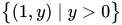
In mathematics, the upper half-plane, is the set of points in the Cartesian plane with The lower half-plane is the set of points with instead. Arbitrarily oriented half-planes can be obtained via a planar rotation. Half-planes are an example of two-dimensional half-space. A half-plane can be split in two quadrants.

Affine geometry

[edit]

The affine transformations of the upper half-plane include

  1. shifts , , and
  2. dilations ,

Proposition: Let and be semicircles in the upper half-plane with centers on the boundary. Then there is an affine mapping that takes to .

Proof: First shift the center of to Then take

and dilate. Then shift to the center of

Inversive geometry

[edit]

Definition: .

can be recognized as the circle of radius centered at and as the polar plot of

Proposition: in and are collinear points.

In fact, is the inversion of the line in the unit circle. Indeed, the diagonal from to has squared length , so that is the reciprocal of that length.

Metric geometry

[edit]

The distance between any two points and in the upper half-plane can be consistently defined as follows: The perpendicular bisector of the segment from to either intersects the boundary or is parallel to it. In the latter case and lie on a ray perpendicular to the boundary and logarithmic measure can be used to define a distance that is invariant under dilation. In the former case and lie on a circle centered at the intersection of their perpendicular bisector and the boundary. By the above proposition this circle can be moved by affine motion to Distances on can be defined using the correspondence with points on and logarithmic measure on this ray. In consequence, the upper half-plane becomes a metric space. The generic name of this metric space is the hyperbolic plane. In terms of the models of hyperbolic geometry, this model is frequently designated the Poincaré half-plane model.

Complex plane

[edit]

Mathematicians sometimes identify the Cartesian plane with the complex plane, and then the upper half-plane corresponds to the set of complex numbers with positive imaginary part:

The term arises from a common visualization of the complex number as the point in the plane endowed with Cartesian coordinates. When the axis is oriented vertically, the "upper half-plane" corresponds to the region above the axis and thus complex numbers for which .

It is the domain of many functions of interest in complex analysis, especially modular forms. The lower half-plane, defined by is equally good, but less used by convention. The open unit disk (the set of all complex numbers of absolute value less than one) is equivalent by a conformal mapping to (see "Poincaré metric"), meaning that it is usually possible to pass between and

It also plays an important role in hyperbolic geometry, where the Poincaré half-plane model provides a way of examining hyperbolic motions. The Poincaré metric provides a hyperbolic metric on the space.

The uniformization theorem for surfaces states that the upper half-plane is the universal covering space of surfaces with constant negative Gaussian curvature.

The closed upper half-plane is the union of the upper half-plane and the real axis. It is the closure of the upper half-plane.

Generalizations

[edit]

One natural generalization in differential geometry is hyperbolic -space the maximally symmetric, simply connected, -dimensional Riemannian manifold with constant sectional curvature . In this terminology, the upper half-plane is since it has real dimension

In number theory, the theory of Hilbert modular forms is concerned with the study of certain functions on the direct product of copies of the upper half-plane. Yet another space interesting to number theorists is the Siegel upper half-space which is the domain of Siegel modular forms.

See also

[edit]

References

[edit]
Revisions and contributorsEdit on WikipediaRead on Wikipedia
from Grokipedia
The upper half-plane, denoted H\mathbb{H}, is the open subset of the complex plane consisting of all complex numbers z=x+iyz = x + iy with imaginary part y>0y > 0.[1][2] This domain plays a central role in several branches of mathematics, particularly as a model for the hyperbolic plane in non-Euclidean geometry and as a simply connected Riemann surface in complex analysis.[1][3] In hyperbolic geometry, the upper half-plane serves as the Poincaré half-plane model, where the hyperbolic plane H2\mathbb{H}^2 is equipped with the Riemannian metric ds2=dx2+dy2y2ds^2 = \frac{dx^2 + dy^2}{y^2}, which has constant curvature 1-1.[4][5] Geodesics in this model are either vertical rays extending upward from the real axis or semicircles orthogonal to the real axis, ensuring that the geometry satisfies the hyperbolic parallel postulate, with infinitely many lines through a point parallel to a given line.[1][4] The group of orientation-preserving isometries is isomorphic to PSL(2,R)\mathrm{PSL}(2, \mathbb{R}), acting via Möbius transformations of the form zaz+bcz+dz \mapsto \frac{az + b}{cz + d} where a,b,c,dRa, b, c, d \in \mathbb{R} and adbc=1ad - bc = 1.[3][5] This model is conformal, preserving angles from the Euclidean plane, which facilitates visualizations and computations.[2] In complex analysis, the upper half-plane is a standard domain for studying holomorphic functions, automorphisms, and conformal mappings, as it is biholomorphic to the unit disk via the Cayley transform zziz+iz \mapsto \frac{z - i}{z + i}.[3] Its automorphism group, also PSL(2,R)\mathrm{PSL}(2, \mathbb{R}), classifies transformations as elliptic, parabolic, or hyperbolic based on the discriminant of the matrix, influencing fixed points on the extended real line R{}\mathbb{R} \cup \{\infty\}.[5] The upper half-plane is invariant under the action of SL(2,Z)\mathrm{SL}(2, \mathbb{Z}), the modular group, which quotients it to form the modular surface, a fundamental object in the theory of modular forms and number theory.[5] The hyperbolic metric extends naturally to this setting, providing tools for estimates in geometric function theory, such as Schwarz-Pick theorems adapted to the half-plane.[5]

Definition and Fundamentals

Definition

The upper half-plane is formally defined as the set of points (x,y)(x, y) in the Euclidean plane R2\mathbb{R}^2 such that y>0y > 0.[6] Equivalently, in the context of the complex plane, it consists of all complex numbers z=x+iyz = x + iy where xRx \in \mathbb{R} and the imaginary part Im(z)=y>0\operatorname{Im}(z) = y > 0.[6][7] The boundary of the upper half-plane is the real axis, which serves as a natural "horizon" or limit set separating it from the lower half-plane.[6][8] It is conventionally denoted by HH, H\mathcal{H}, H\mathbb{H}, or H+\mathbb{H}^{+}.[6] This defines an open half-plane, excluding the boundary real axis, in contrast to the closed upper half-plane which includes points where y0y \geq 0; the concept generalizes to open or closed half-spaces in higher-dimensional Euclidean spaces Rn\mathbb{R}^n for n>2n > 2.[9][6]

Basic Properties

The upper half-plane, denoted $ H = { z = x + iy \in \mathbb{C} \mid y > 0 } $, is an open subset of the complex plane C\mathbb{C}, as the condition Im(z)>0\operatorname{Im}(z) > 0 defines an open set in the standard topology of CR2\mathbb{C} \cong \mathbb{R}^2.[6] Its boundary is the real axis, characterized by the equation Im(z)=0\operatorname{Im}(z) = 0.[10] Topologically, $ H $ is simply connected, meaning every closed curve in $ H $ can be continuously contracted to a point within $ H $, and contractible, as it admits a continuous deformation retraction to any point inside it.[10] This follows from its convexity: for any two points $ z_1, z_2 \in H $ with Im(z1)>0\operatorname{Im}(z_1) > 0 and Im(z2)>0\operatorname{Im}(z_2) > 0, the line segment connecting them lies entirely in $ H $, since the imaginary part varies linearly and remains positive.[10] Furthermore, $ H $ is homeomorphic to the open unit disk $ \mathbb{D} = { w \in \mathbb{C} \mid |w| < 1 } $ via the Cayley transform $ F(z) = \frac{z - i}{z + i} $, which is a continuous bijection with continuous inverse.[10] Algebraically, viewing C\mathbb{C} as a vector space over R\mathbb{R}, $ H $ is a proper open convex subset but not a subspace, as it fails closure under scalar multiplication by all real numbers (e.g., multiplication by 1-1 maps points in $ H $ to the lower half-plane).[11] It is also not closed under complex multiplication; for instance, multiplying $ i \in H $ by itself yields $ i \cdot i = -1 $, which lies on the boundary Im(z)=0\operatorname{Im}(z) = 0. With respect to the standard Lebesgue measure on R2\mathbb{R}^2 (identifying CR2\mathbb{C} \cong \mathbb{R}^2), $ H $ has infinite area, as the integral Hdxdy=0dydx\iint_H dx\, dy = \int_{-\infty}^{\infty} \int_0^{\infty} dy\, dx diverges due to unbounded extent in both real and imaginary directions.[12]

Geometric Contexts

Euclidean and Affine Geometry

The upper half-plane, denoted H={z=x+iyCy>0}\mathbb{H} = \{ z = x + iy \in \mathbb{C} \mid y > 0 \}, is embedded in the Euclidean plane R2\mathbb{R}^2 as an open half-space bounded below by the real axis. In this embedding, it inherits the standard structure of Euclidean geometry, where points are equipped with coordinates (x,y)(x, y) and the geometry is flat, with parallel lines remaining parallel and the Pythagorean theorem holding locally. The Euclidean distance between two points (x1,y1)(x_1, y_1) and (x2,y2)(x_2, y_2) in H\mathbb{H} is given by
d((x1,y1),(x2,y2))=(x1x2)2+(y1y2)2. d((x_1, y_1), (x_2, y_2)) = \sqrt{(x_1 - x_2)^2 + (y_1 - y_2)^2}.
This metric induces the usual notions of length, angle, and area, with straight line segments serving as shortest paths (geodesics) within the space.[4] Affine transformations that preserve the upper half-plane consist primarily of horizontal translations zz+bz \mapsto z + b where bRb \in \mathbb{R}, which shift points parallel to the real axis without altering the imaginary part, and positive dilations (scalings) zkzz \mapsto k z where k>0k > 0, which expand or contract distances radially from the origin while maintaining the sign of the imaginary part. These form a subgroup of the projective special linear group PSL(2,R)\mathrm{PSL}(2, \mathbb{R}), specifically the affine subgroup generated by upper-triangular matrices, acting via Möbius transformations of the form za2z+bz \mapsto a^2 z + b with a>0a > 0 and bRb \in \mathbb{R}. This subgroup acts transitively on H\mathbb{H} in a way that respects its Euclidean structure, preserving parallelism and ratios of distances along parallel lines.[13] A key property of these affine transformations is that they map semicircles in H\mathbb{H} that are orthogonal to the real axis—namely, those with diameters lying on the real axis—to other such semicircles. Since translations and dilations are similarities (preserving angles up to orientation), they maintain the right-angle condition at the endpoints on the real axis, transforming the curves into scaled and shifted versions while keeping them perpendicular to the boundary. For instance, the affine transformation z2z+1z \mapsto 2z + 1 maps the semicircle with diameter from 00 to 11 (centered at 0.50.5 with radius 0.50.5) to the semicircle with diameter from 11 to 33 (centered at 22 with radius 11). This preservation highlights how the affine group stabilizes the family of these semicircles, which serve as "generalized lines" in certain contexts but are not geodesics in the Euclidean (or affine) sense, contrasting with their role as geodesics in the hyperbolic geometry of H\mathbb{H}.[2][13]

Inversive Geometry

In inversive geometry, the upper half-plane is studied through transformations that preserve the family of circles and lines, known as generalized circles or clines. Inversion with respect to a circle is a fundamental operation, mapping points P to P' such that the center O, P, and P' are collinear and OP · OP' = r², where r is the radius of the inversion circle. For a circle C centered at o with radius r, the image of a point z under inversion is given by
z=o+r2(zo). z' = o + \frac{r^2}{\overline{(z - o)}}.
This transformation maps clines to clines: the inverse image of a circle or line under inversion is another circle or line, unless the original passes through the center o, in which case it maps to itself.[14][15] A specific case is inversion in the unit circle, where o = 0 and r = 1, given by the map $ z \mapsto 1 / \bar{z} $. This transformation is an involution (its own inverse) and conformal, preserving angles up to orientation. For z in the upper half-plane (Im z > 0), the image satisfies Im(1 / \bar{z}) = (Im z) / |z|^2 > 0, so it maps the upper half-plane to itself. To relate the upper half-plane to the unit disk, one composes inversion with reflection or uses inversion in a suitable non-unit circle; for instance, inversion in the circle centered at i with radius 2\sqrt{2} (passing through -1 and 1 on the real axis) maps the open unit disk bijectively to the upper half-plane, with the unit circle mapping to the real axis. The inverse transformation then maps the upper half-plane to the unit disk, facilitating the equivalence of the two domains in inversive contexts.[14][16][17] In inversive geometry, the family of clines orthogonal to the real axis—vertical lines and semicircles with diameters on the real axis—plays a key role, as inversions preserve orthogonality relations. A key proposition concerns collinearity under inversion: three points are collinear if and only if their images under inversion lie on a cline passing through the center of inversion. If the original line avoids the center, the images lie on a circle through the center; if it passes through the center, the images remain collinear. This property underscores how inversion distorts Euclidean collinearity while preserving incidence relations among clines.[14][18]

Complex Analysis and Transformations

Representation in the Complex Plane

The upper half-plane, denoted H\mathbb{H}, is the set of all complex numbers z=x+iyz = x + iy, where x,yRx, y \in \mathbb{R} and y>0y > 0. This region represents the portion of the complex plane above the real axis, excluding the boundary.[6] As an open subset of the complex plane C\mathbb{C}, H\mathbb{H} serves as a domain for holomorphic functions, which are complex differentiable everywhere within it. For example, the exponential function exp(z)=ex(cosy+isiny)\exp(z) = e^x (\cos y + i \sin y) is entire, meaning it is holomorphic on all of C\mathbb{C} and thus restricted to H\mathbb{H}. Similarly, the principal branch of the complex logarithm, \Log(z)=lnz+i\Arg(z)\Log(z) = \ln |z| + i \Arg(z) where \Arg(z)(π,π)\Arg(z) \in (-\pi, \pi), is holomorphic on C\mathbb{C} minus the non-positive real axis (the branch cut), a region that contains H\mathbb{H}.[19][20] A fundamental feature of H\mathbb{H} in complex analysis is its conformal equivalence to the open unit disk via the Cayley transform f(z)=ziz+if(z) = \frac{z - i}{z + i}, which is a biholomorphic mapping from H\mathbb{H} onto D={wC:w<1}\mathbb{D} = \{w \in \mathbb{C} : |w| < 1\}. This transformation sends the upper half-plane to the interior of the unit disk, the real axis (boundary of H\mathbb{H}) to the unit circle, and the point ii to the origin.[21] The upper half-plane H\mathbb{H} is conformally equivalent to one component of the Riemann sphere minus the extended real line. The Riemann sphere is the one-point compactification C^=C{}\hat{\mathbb{C}} = \mathbb{C} \cup \{\infty\} of the complex plane, and the extended real line R{}\mathbb{R} \cup \{\infty\} embeds as a Jordan curve (homeomorphic to a circle) on it; removing this curve leaves two connected components—the open upper and lower half-planes—each of which is simply connected and conformally equivalent to the unit disk D\mathbb{D}.[22]

Möbius Transformations and Group Actions

Möbius transformations that preserve the upper half-plane H={zC:Im(z)>0}\mathbb{H} = \{ z \in \mathbb{C} : \operatorname{Im}(z) > 0 \} are those of the form $ z \mapsto \frac{az + b}{cz + d} $, where $ a, b, c, d \in \mathbb{R} $ and $ ad - bc = 1 $.[23] These transformations correspond to matrices in the special linear group $ \mathrm{SL}(2, \mathbb{R}) $, and the action factors through the projective special linear group $ \mathrm{PSL}(2, \mathbb{R}) = \mathrm{SL}(2, \mathbb{R}) / { \pm I } $, since $ -\begin{pmatrix} a & b \ c & d \end{pmatrix} $ induces the same map as $ \begin{pmatrix} a & b \ c & d \end{pmatrix} $.[24] The group $ \mathrm{PSL}(2, \mathbb{R}) $ acts as the full group of biholomorphic automorphisms of $ \mathbb{H} $, preserving its complex structure and acting transitively on $ \mathbb{H} $.[25] This action is faithful and consists of orientation-preserving isometries of $ \mathbb{H} $, with fixed points of non-identity elements lying on the boundary $ \mathbb{R} \cup { \infty } $.[24] Specific examples include translations $ z \mapsto z + b $ for $ b \in \mathbb{R} $, corresponding to matrices $ \begin{pmatrix} 1 & b \ 0 & 1 \end{pmatrix} $; dilations (or scalings) $ z \mapsto k^2 z $ for $ k > 0 $, given by $ \begin{pmatrix} k & 0 \ 0 & 1/k \end{pmatrix} $; and inversions such as $ z \mapsto -1/z $, represented by $ \begin{pmatrix} 0 & -1 \ 1 & 0 \end{pmatrix} $.[23] These generate $ \mathrm{PSL}(2, \mathbb{R}) $ under composition, and each preserves $ \mathbb{H} $ while mapping the boundary to itself.[25] A discrete subgroup of interest is the modular group $ \mathrm{PSL}(2, \mathbb{Z}) $, which acts on $ \mathbb{H} $ via the same Möbius transformations but with integer entries in the matrices.[26] This action is properly discontinuous, and a fundamental domain for $ \mathrm{PSL}(2, \mathbb{Z}) $ is the region $ D = { z \in \mathbb{H} : |z| > 1, |\operatorname{Re}(z)| < 1/2 } $, which tiles $ \mathbb{H} $ under the group action up to boundary identifications.[26] The upper half-plane is conformally equivalent to the unit disk via a Möbius transformation, allowing similar group actions to be studied there.[23]

Hyperbolic Geometry

Poincaré Half-Plane Model

The Poincaré half-plane model realizes the upper half-plane H={zC:Imz>0}\mathbb{H} = \{ z \in \mathbb{C} : \operatorname{Im} z > 0 \} as a geometric model of the hyperbolic plane, where geodesics are either vertical lines extending to the real axis or semicircles centered on the real axis that intersect it orthogonally.[27] These semicircles arise naturally from properties of inversive geometry, preserving orthogonality under inversion with respect to circles.[28] This model provides an isomorphism between H\mathbb{H} equipped with the hyperbolic metric and the two-dimensional hyperbolic space H2H^2, which has constant Gaussian curvature 1-1.[29] The isometries of this model are generated by the projective special linear group PSL(2,R)\mathrm{PSL}(2, \mathbb{R}), acting via Möbius transformations that map H\mathbb{H} to itself and preserve the hyperbolic structure.[30] For instance, the geodesic connecting the points ii and 2i2i is the vertical line segment {x+iy:x=0,1y2}\{ x + iy : x = 0, 1 \leq y \leq 2 \}, which extends infinitely in the hyperbolic sense toward the boundary.[29] The model is conformal, meaning it preserves angles as measured in the Euclidean plane, though Euclidean distances are distorted to reflect the hyperbolic geometry.[27] This conformality facilitates visualizations of hyperbolic figures, such as triangles with angle sums less than π\pi, directly within the familiar complex plane.[31]

Hyperbolic Metric and Distance

The upper half-plane H={z=x+iyCy>0}\mathbb{H} = \{ z = x + iy \in \mathbb{C} \mid y > 0 \} is endowed with the Poincaré hyperbolic metric, a Riemannian metric of constant curvature 1-1 that defines the geometry of the hyperbolic plane. This metric is expressed in real coordinates as
ds2=dx2+dy2y2, ds^2 = \frac{dx^2 + dy^2}{y^2},
where the infinitesimal arc length element dsds measures distances conformally scaled by the imaginary part yy.[32] In complex notation, identifying z=x+iyz = x + iy, the metric takes the form ds=dzy=dzIm(z)ds = \frac{|dz|}{y} = \frac{|dz|}{\operatorname{Im}(z)}, which highlights its invariance under the action of the special linear group SL(2,R)\mathrm{SL}(2, \mathbb{R}).[17] The hyperbolic distance d(z1,z2)d(z_1, z_2) between two points z1,z2Hz_1, z_2 \in \mathbb{H} is the infimum of the lengths of all piecewise smooth paths γ\gamma connecting them, where the length of a path γ:[a,b]H\gamma: [a, b] \to \mathbb{H} is given by the integral
(γ)=abγ(t)Im(γ(t))dt. \ell(\gamma) = \int_a^b \frac{|\gamma'(t)|}{\operatorname{Im}(\gamma(t))} \, dt.
This length is realized uniquely along the geodesic connecting z1z_1 and z2z_2, which in the Poincaré model consists of semicircles orthogonal to the real axis or vertical rays. The closed-form distance formula is
d(z1,z2)=\arcosh(1+z1z222Im(z1)Im(z2)), d(z_1, z_2) = \arcosh\left(1 + \frac{|z_1 - z_2|^2}{2 \operatorname{Im}(z_1) \operatorname{Im}(z_2)}\right),
derived by integrating the metric along the geodesic and using hyperbolic trigonometric identities.[33] An equivalent expression is d(z1,z2)=2\arcsinh(z1z22Im(z1)Im(z2))d(z_1, z_2) = 2 \arcsinh\left( \frac{|z_1 - z_2|}{2 \sqrt{\operatorname{Im}(z_1) \operatorname{Im}(z_2)}} \right), obtained via the identity cosh(2u)=1+2sinh2u\cosh(2u) = 1 + 2 \sinh^2 u.[17] A key feature of this metric is its behavior near the boundary R{}\mathbb{R} \cup \{\infty\}: as y0+y \to 0^+, the factor 1/y1/y causes local distances to expand dramatically, effectively modeling an infinite expanse approaching the geodesic boundary at infinity. This expansion is evident in the length integral, where paths near the real axis accrue large hyperbolic lengths despite short Euclidean distances. Horocycles, which are curves of constant distance from a fixed ideal point on the boundary, appear in the upper half-plane as Euclidean circles tangent to the real axis or as horizontal lines parallel to it.[34]

Applications

In Number Theory and Modular Forms

The modular group, denoted PSL(2, ℤ), consists of 2×2 matrices with integer entries and determinant 1, modulo the center {±I}, and acts on the upper half-plane ℍ via Möbius transformations of the form τ ↦ (aτ + b)/(cτ + d) for γ = \begin{pmatrix} a & b \ c & d \end{pmatrix} ∈ PSL(2, ℤ). This action is properly discontinuous, allowing the construction of a fundamental domain, typically the region D = {τ ∈ ℍ : |Re(τ)| ≤ 1/2, |τ| ≥ 1}, which tiles ℍ under the group action, with identifications along its boundaries and a cusp at infinity corresponding to the rational projective line ℙ¹(ℚ) ∪ {∞}.[35] Modular forms are central to this framework, defined as holomorphic functions f: ℍ → ℂ of weight k ∈ 2ℤ_{≥0} satisfying the transformation property (f|_k γ)(τ) = f(τ) for all γ ∈ PSL(2, ℤ), where the slash operator is (f|k γ)(τ) = (cz + d)^{-k} f(γτ), along with holomorphy at the cusps, meaning the Fourier expansion q ↦ ∑{n=0}^∞ a_n q^n (with q = e^{2πiτ}) at infinity has no negative powers after suitable scaling by cusp width. This invariance encodes arithmetic data, with the space of such forms M_k(PSL(2, ℤ)) forming a finite-dimensional vector space over ℂ, graded by weight. Cusp forms, the kernel of the constant term map, further refine this to functions vanishing at cusps. Prominent examples include the Eisenstein series E_k(τ) for even k ≥ 4, defined as the normalized sum E_k(τ) = \frac{1}{2ζ(k)} ∑{(m,n) ≠ (0,0)} (mτ + n)^{-k} over the integer lattice ℤ² \ {0}, which are non-constant holomorphic modular forms generating the Eisenstein subspace. Their Fourier expansions are $E_k(\tau) = 1 - \frac{2k}{B_k} \sum{n=1}^\infty \sigma_{k-1}(n) q^n $, where $ q = e^{2\pi i \tau} $ and $ \sigma_{k-1}(n) = \sum_{d \mid n} d^{k-1} $ is the sum of the (k-1)th powers of the positive divisors of n; the constant term relates to Bernoulli numbers $ B_k $ via the normalization. These series converge absolutely for Im(τ) > 0 and transform correctly under the group. Another key example is the j-invariant, j(τ) = 1728 \frac{E_4(τ)^3}{E_4(τ)^3 - E_6(τ)^2} (up to the discriminant Δ = η^{24}), a weight-zero modular function (hauptmodul) that maps the fundamental domain bijectively onto ℂ, parameterizing isomorphism classes of elliptic curves over ℂ.[36] The quotient ℍ / PSL(2, ℤ), compactified by adding cusps to form the modular curve X(1), is biholomorphic to the Riemann sphere ℙ¹(ℂ), with the j-invariant inducing this isomorphism and serving as a coordinate on the curve. This structure plays a pivotal role in class number problems in algebraic number theory, where the values of j at quadratic imaginary points τ (singular moduli) generate ring class fields of imaginary quadratic orders, and the minimal polynomials of these values relate directly to class numbers; for instance, the class number one problem for imaginary quadratic fields was resolved using properties of Heegner points on X(1), confirming only nine such fields exist.[37]

In Riemann Surfaces and Uniformization

The uniformization theorem, a cornerstone of complex geometry, classifies simply connected Riemann surfaces up to biholomorphic equivalence as one of three canonical models: the Riemann sphere P1(C)\mathbb{P}^1(\mathbb{C}), the complex plane C\mathbb{C}, or the open unit disk D\mathbb{D} (which is biholomorphically equivalent to the upper half-plane H={zC:(z)>0}\mathbb{H} = \{ z \in \mathbb{C} : \Im(z) > 0 \} via the Cayley transform). Riemann surfaces of hyperbolic type—those admitting a non-constant bounded holomorphic function or equivalently those with universal cover of infinite area—have H\mathbb{H} (or D\mathbb{D}) as their universal cover. This result, proved independently by Henri Poincaré and Paul Koebe in 1907, underscores the upper half-plane's role as the prototypical simply connected hyperbolic Riemann surface, enabling the global study of conformal structures through its rich automorphism group PSL(2,R)\mathrm{PSL}(2, \mathbb{R}).[38] For multiply connected Riemann surfaces, particularly compact ones of genus g2g \geq 2, the uniformization theorem extends via quotient constructions: such a surface SS is biholomorphic to H/Γ\mathbb{H} / \Gamma, where ΓPSL(2,R)\Gamma \subset \mathrm{PSL}(2, \mathbb{R}) is a discrete, torsion-free Fuchsian group acting freely and properly discontinuously on H\mathbb{H}, with Γ\Gamma isomorphic to the fundamental group of SS. These quotients inherit the hyperbolic metric from H\mathbb{H}, yielding a complete Riemann surface of finite area whose Euler characteristic is 22g<02-2g < 0. Seminal work by Poincaré (1882) and later developments by Felix Klein and Henri Poincaré formalized this representation, highlighting how Fuchsian groups tile H\mathbb{H} to produce the topology and complex structure of SS. This framework not only uniformizes higher-genus surfaces but also facilitates the computation of invariants like the Gauss-Bonnet theorem's total curvature, fixed at 2π(2g2)2\pi(2g-2).[39] Teichmüller space Tg\mathcal{T}_g for a surface of genus g2g \geq 2 parameterizes the distinct hyperbolic structures up to isotopy, modeled as the space of marked Fuchsian representations ρ:π1(S)PSL(2,R)\rho: \pi_1(S) \to \mathrm{PSL}(2, \mathbb{R}) modulo conjugation, where each ρ\rho defines a quotient (H,ρ(π1(S)))(\mathbb{H}, \rho(\pi_1(S))) biholomorphic to SS with a marked hyperbolic metric. Oswald Teichmüller's 1940 work established that Tg\mathcal{T}_g is a contractible complex manifold of dimension 3g33g-3, equipped with the Teichmüller metric measuring quasiconformal deformations, and it serves as the "universal deformation space" near the basepoint corresponding to a fixed embedding of H\mathbb{H}. This structure captures the local rigidity and global flexibility of hyperbolic geometries on surfaces, with Bers' simultaneous uniformization theorem (1958) embedding Tg\mathcal{T}_g into spaces of quadratic differentials on H\mathbb{H}.[40] In the parabolic case of genus 11 (tori), uniformization uses C/Λ\mathbb{C} / \Lambda for a lattice Λ=Zω1+Zω2\Lambda = \mathbb{Z} \omega_1 + \mathbb{Z} \omega_2, but the moduli space of isomorphism classes of such tori is parameterized by the upper half-plane H\mathbb{H} via the modulus τ=ω2/ω1H\tau = \omega_2 / \omega_1 \in \mathbb{H}, with elliptic functions like the Weierstrass \wp-function providing the explicit biholomorphism from the torus to its projective model y2=4x3g2xg3y^2 = 4x^3 - g_2 x - g_3 in P2(C)\mathbb{P}^2(\mathbb{C}). The modular group SL(2,Z)\mathrm{SL}(2, \mathbb{Z}) acts on H\mathbb{H} to identify equivalent moduli, yielding the orbifold H/SL(2,Z)\mathbb{H} / \mathrm{SL}(2, \mathbb{Z}) as the coarse moduli space, compactified by the jj-invariant map. This connection, developed by Karl Weierstrass and others in the 19th century, links the upper half-plane directly to the analytic uniformization of elliptic curves.[41] The upper half-plane's uniformization role extends to boundary value problems: for a Riemann surface SS of hyperbolic type, the Dirichlet problem—solving Δu=0\Delta u = 0 with prescribed continuous boundary values—reduces via the covering map π:HS\pi: \mathbb{H} \to S to solving the analogous problem on H\mathbb{H}, where the Poisson integral formula provides the explicit harmonic solution u(z)=1πy(xt)2+y2f(t)dtu(z) = \frac{1}{\pi} \int_{-\infty}^{\infty} \frac{y}{(x-t)^2 + y^2} f(t) \, dt for z=x+iyz = x + iy and boundary data ff on R\mathbb{R}. Pulling back via π\pi yields the solution on SS, with Γ\Gamma-invariance ensuring well-definedness; this method, rooted in Poincaré's integral representations, leverages the explicit geometry of H\mathbb{H} for computational and theoretical advances in potential theory on surfaces.[42]

Generalizations and Extensions

Higher-Dimensional Half-Spaces

The upper half-space in nn dimensions, denoted Hn\mathbb{H}^n, is defined as the set {(x1,,xn)Rnxn>0}\{(x_1, \dots, x_n) \in \mathbb{R}^n \mid x_n > 0\}.[43] This generalizes the two-dimensional upper half-plane H2\mathbb{H}^2 by extending the domain to higher Euclidean dimensions while preserving the boundary at xn=0x_n = 0.[43] In coordinates (x1,,xn1,t)(x_1, \dots, x_{n-1}, t) with t>0t > 0, it can be expressed equivalently as Rn1×R+\mathbb{R}^{n-1} \times \mathbb{R}^+.[43] The Poincaré half-space model endows Hn\mathbb{H}^n with a hyperbolic metric of constant sectional curvature 1-1, given by
ds2=i=1n1dxi2+dt2t2. ds^2 = \frac{\sum_{i=1}^{n-1} dx_i^2 + dt^2}{t^2}.
[43] This metric is conformal to the Euclidean metric and induces the hyperbolic distance function dHn(z,w)=\arccosh(1+zw22tztw)d_{\mathbb{H}^n}(z, w) = \arccosh\left(1 + \frac{ \|z - w\|^2 }{2 t_z t_w }\right), where \| \cdot \| denotes the Euclidean norm in Rn\mathbb{R}^n and tz,tw>0t_z, t_w > 0 are the final coordinates of zz and ww. Geodesics in this model are the intersections of Hn\mathbb{H}^n with Euclidean spheres (or hyperplanes) that meet the boundary Rn1×{0}\mathbb{R}^{n-1} \times \{0\} orthogonally; these include vertical lines parallel to the tt-axis and semicircles (or hemispherical arcs) centered on the boundary.[44] A key geometric property of Hn\mathbb{H}^n is the exponential growth of ball volumes: the volume of a hyperbolic ball of radius rr centered at any point satisfies Vol(Bn(x,r))Vol(Sn1)(n1)2n1e(n1)r\operatorname{Vol}(B_n(x, r)) \sim \frac{\operatorname{Vol}(S^{n-1}) }{(n-1) 2^{n-1}} e^{(n-1)r} as rr \to \infty, reflecting the rapid expansion characteristic of negative curvature spaces.[45] The full isometry group of Hn\mathbb{H}^n is the orthogonal group O(n,1)O(n,1), acting transitively and preserving the metric; the orientation-preserving subgroup is O+(n,1)O^+(n,1).[43] This group is generated by scalings, translations in the first n1n-1 coordinates, rotations via O(n1)O(n-1), and inversions in spheres orthogonal to the boundary.[43]

Siegel Upper Half-Space

The Siegel upper half-space of genus gg, denoted Hg\mathcal{H}_g, consists of all g×gg \times g symmetric complex matrices τ\tau such that the imaginary part Im(τ)\operatorname{Im}(\tau) is positive definite, formally Hg={τMg(C)τT=τ,Im(τ)>0}\mathcal{H}_g = \{ \tau \in M_g(\mathbb{C}) \mid \tau^T = \tau, \operatorname{Im}(\tau) > 0 \}.[46] This space generalizes the classical upper half-plane H\mathbb{H} to higher dimensions, serving as a fundamental domain for multi-variable analytic objects in algebraic geometry.[47] When g=1g=1, H1\mathcal{H}_1 coincides exactly with the standard upper half-plane {zCIm(z)>0}\{ z \in \mathbb{C} \mid \operatorname{Im}(z) > 0 \}.[46] The space Hg\mathcal{H}_g is a Hermitian symmetric domain equipped with the Bergman metric, a Kähler metric derived from the Bergman kernel that is invariant under the group's action and induces a natural geometry on the space.[48] The automorphism group of Hg\mathcal{H}_g is the real symplectic group Sp(2g,R)\mathrm{Sp}(2g, \mathbb{R}), which acts transitively via fractional linear transformations: for γ=(ABCD)Sp(2g,R)\gamma = \begin{pmatrix} A & B \\ C & D \end{pmatrix} \in \mathrm{Sp}(2g, \mathbb{R}) with A,B,C,DMg(R)A, B, C, D \in M_g(\mathbb{R}), the action is given by τ(Aτ+B)(Cτ+D)1\tau \mapsto (A\tau + B)(C\tau + D)^{-1}.[49] This action preserves the positive definiteness of the imaginary part, making Hg\mathcal{H}_g the symmetric space Sp(2g,R)/U(g)\mathrm{Sp}(2g, \mathbb{R}) / \mathrm{U}(g).[50] In applications, Hg\mathcal{H}_g parametrizes the period matrices of compact Riemann surfaces of genus gg, where the period matrix encodes the integrals of holomorphic differentials over homology cycles and lies in Hg\mathcal{H}_g due to the positive definiteness from the Riemann bilinear relations.[51] The quotient Sp(2g,Z)\Hg\mathrm{Sp}(2g, \mathbb{Z}) \backslash \mathcal{H}_g forms the moduli space of principally polarized abelian varieties of dimension gg, classifying isomorphism classes of such varieties up to the action of the Siegel modular group Sp(2g,Z)\mathrm{Sp}(2g, \mathbb{Z}).[52] To compactify this moduli space, the Satake compactification Sp(2g,Z)\HgSat\overline{\mathrm{Sp}(2g, \mathbb{Z}) \backslash \mathcal{H}_g}^{\mathrm{Sat}} adjoins cusps corresponding to strata of semi-stable points, where degenerate abelian varieties appear as lower-dimensional components.[53]

References

User Avatar
No comments yet.



