



Community hub
Recent from talks
Knowledge base stats:
Talk channels stats:
Members stats:
West Africa Cable System
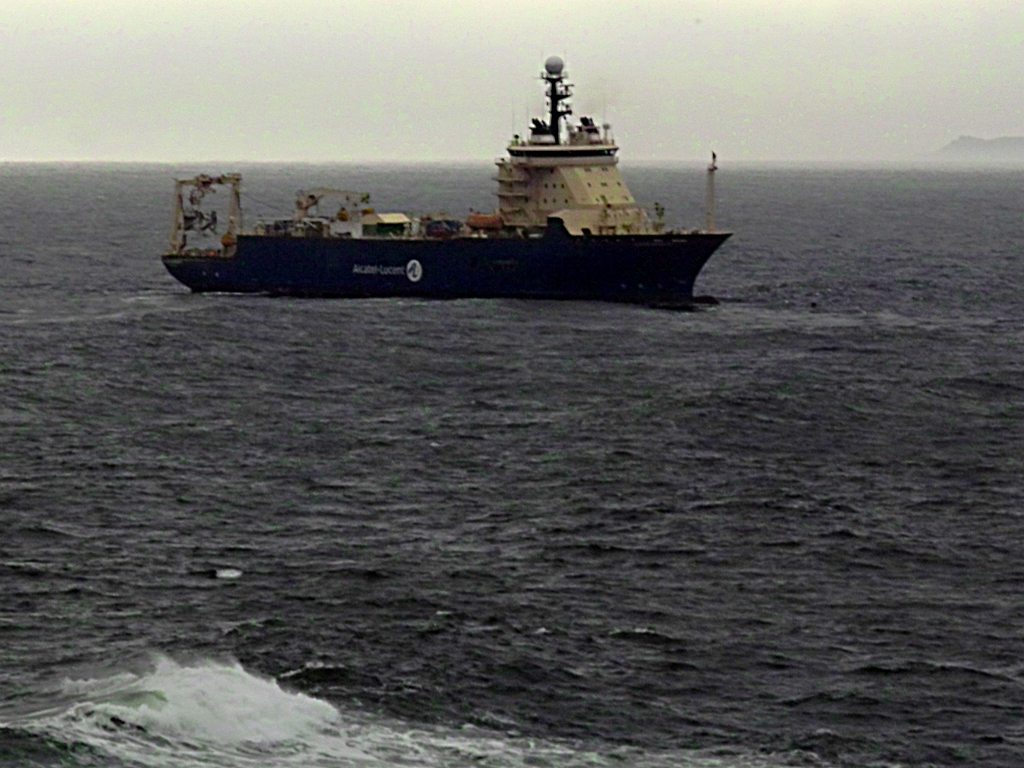
The West Africa Cable System (WACS) is a submarine communications cable linking South Africa with the United Kingdom along the west coast of Africa that was constructed by Alcatel-Lucent. The cable consists of four fibre pairs and is 14,530 km in length, linking from Yzerfontein in the Western Cape of South Africa to London in the United Kingdom. It has 14 landing points, 12 along the western coast of Africa (including Cape Verde and Canary Islands) and 2 in Europe (Portugal and England) completed on land by a cable termination station in London. The total cost for the cable system is $650 million. WACS was originally known as the Africa West Coast Cable (AWCC) and was planned to branch to South America but this was dropped and the system eventually became the West African Cable System.
On 6 August 2023, the cable system snapped simultaneously with the SAT-3 Cable System after a rock fall in the Congo Canyon. Internet Speeds in Sub-Saharan Africa were impacted, despite new cable systems such as Google Owned Equiano recently landing in the country.
The cable has landed in the following countries and locations:
The landings in Namibia, the DRC, the Republic of Congo and Togo will provide the first direct connections for these countries to the global submarine cable network.[citation needed] While all earlier submarine cables were terminated at South Africa's international submarine gateways in Melkbosstrand or Mtunzini the WACS cable has been landed at Yzerfontein in order to reduce risk of complete isolation from the rest of the world in the case of damages by earthquakes or a large ship dragging its anchor.
The planned design capacity of WACS was 3.84 Tbit/s when the project agreement was signed in 2008. When delivered in 2012 the initial design capacity was 5.12 Tbit/s. An upgrade delivered by Huawei Marine in December 2015 using WDM Soft Decision FEC and bit interleaved coded modulation advanced decoders permitting the design capacity to be increased to 14.5 Tbit/s.
Instead of powering the 236 undersea optical amplifiers and the 12 Submarine branching units along the cable by a single conductor which would require the voltage to be well over 12,000 to 14,000 V in the order of some 24,000 V DC, the system is supplied by two independent rings from Europe to West Africa and West Africa to South Africa, thus reducing the power requirements to around 12,000 V DC. Branching units are designed to keep the main trunk intact in case of failure. Repairing a branch will not affect the traffic on the main cable. Landing stations support wavelength pass through which means a wavelength coming into a landing station does not just stop there but carries on. This feature allows future upgrade to be carried out without the necessity to have to upgrade each landing point.
One of the four fibre pairs is a direct route from South Africa to Europe, a so-called express lane. The second and third fibre pairs are designed as a semi-express lane, one with two hops, from South Africa to West Africa and West Africa to Europe and the other with three stops. The fourth fibre pair is an omnibus fibre that stops off at all landing ports en route.
The following South African companies were announced as participants in the construction and maintenance of the cable system. MTN Group has invested $90 million in the cable making it the largest investor, and in return will receive 11% of the initial capacity of the cable.
Hub AI
West Africa Cable System AI simulator
(@West Africa Cable System_simulator)
West Africa Cable System
The West Africa Cable System (WACS) is a submarine communications cable linking South Africa with the United Kingdom along the west coast of Africa that was constructed by Alcatel-Lucent. The cable consists of four fibre pairs and is 14,530 km in length, linking from Yzerfontein in the Western Cape of South Africa to London in the United Kingdom. It has 14 landing points, 12 along the western coast of Africa (including Cape Verde and Canary Islands) and 2 in Europe (Portugal and England) completed on land by a cable termination station in London. The total cost for the cable system is $650 million. WACS was originally known as the Africa West Coast Cable (AWCC) and was planned to branch to South America but this was dropped and the system eventually became the West African Cable System.
On 6 August 2023, the cable system snapped simultaneously with the SAT-3 Cable System after a rock fall in the Congo Canyon. Internet Speeds in Sub-Saharan Africa were impacted, despite new cable systems such as Google Owned Equiano recently landing in the country.
The cable has landed in the following countries and locations:
The landings in Namibia, the DRC, the Republic of Congo and Togo will provide the first direct connections for these countries to the global submarine cable network.[citation needed] While all earlier submarine cables were terminated at South Africa's international submarine gateways in Melkbosstrand or Mtunzini the WACS cable has been landed at Yzerfontein in order to reduce risk of complete isolation from the rest of the world in the case of damages by earthquakes or a large ship dragging its anchor.
The planned design capacity of WACS was 3.84 Tbit/s when the project agreement was signed in 2008. When delivered in 2012 the initial design capacity was 5.12 Tbit/s. An upgrade delivered by Huawei Marine in December 2015 using WDM Soft Decision FEC and bit interleaved coded modulation advanced decoders permitting the design capacity to be increased to 14.5 Tbit/s.
Instead of powering the 236 undersea optical amplifiers and the 12 Submarine branching units along the cable by a single conductor which would require the voltage to be well over 12,000 to 14,000 V in the order of some 24,000 V DC, the system is supplied by two independent rings from Europe to West Africa and West Africa to South Africa, thus reducing the power requirements to around 12,000 V DC. Branching units are designed to keep the main trunk intact in case of failure. Repairing a branch will not affect the traffic on the main cable. Landing stations support wavelength pass through which means a wavelength coming into a landing station does not just stop there but carries on. This feature allows future upgrade to be carried out without the necessity to have to upgrade each landing point.
One of the four fibre pairs is a direct route from South Africa to Europe, a so-called express lane. The second and third fibre pairs are designed as a semi-express lane, one with two hops, from South Africa to West Africa and West Africa to Europe and the other with three stops. The fourth fibre pair is an omnibus fibre that stops off at all landing ports en route.
The following South African companies were announced as participants in the construction and maintenance of the cable system. MTN Group has invested $90 million in the cable making it the largest investor, and in return will receive 11% of the initial capacity of the cable.