



Community hub
Recent from talks
Knowledge base stats:
Talk channels stats:
Members stats:
West African CFA franc
The West African CFA franc (French: franc CFA or simply franc, ISO 4217 code: XOF; abbreviation: F.CFA) is the currency used by eight independent states in West Africa which make up the West African Economic and Monetary Union (UEMOA): Benin, Burkina Faso, Côte d'Ivoire, Guinea-Bissau, Mali, Niger, Senegal and Togo. These eight countries had a combined population of 105.7 million people in 2014, and a combined GDP of US$128.6 billion as of 2018.[update][citation needed]
The initialism CFA stands for Communauté Financière Africaine (transl. African Financial Community). The currency is issued by the Central Bank of West African States (BCEAO; Banque Centrale des États de l'Afrique de l'Ouest), located in Dakar, Senegal, for the members of the UEMOA. The franc is nominally subdivided into 100 centimes but no coins or banknotes denominated in centimes have ever been issued. The production of CFA franc notes has been carried out at Chamalières by the Bank of France since its creation in 1945.
The Central African CFA franc is of equal value to the West African CFA franc, and is in circulation in several central African states. They are both commonly referred to as the CFA franc.
In December 2019 it was announced that the West African CFA franc would be reformed, which will include renaming it the eco and reducing France's role in the currency. The broader Economic Community of West African States (ECOWAS), of which the members of UEMOA are also members, plans to introduce its own common currency for its member states for which the name eco has also been formally adopted. The fifth target launch date is set for July 2027.
The CFA franc was introduced to the French colonies in West Africa in 1945, replacing the French West African franc. The West African colonies and territories using the CFA franc were Ivory Coast, Dahomey, French Sudan, Mauritania, Niger, Sénégal, Togo and Upper Volta. The currency continued in use when these colonies gained their independence, except in Mali (formerly French Sudan), which replaced at par the CFA franc with its own franc in 1961.
In 1973, Mauritania replaced the CFA franc with the ouguiya at a rate of 1 ouguiya = 5 francs. Mali readopted the CFA franc in 1984, at a rate of 1 CFA franc = 2 Malian francs. The former Portuguese colony of Guinea-Bissau adopted the CFA franc in 1997, replacing the Guinea-Bissau peso at a rate of 1 CFA franc = 65 pesos.
The currency was pegged to the French franc at F.CFA 1 = F 2, from 1948, becoming 1 F.CFA = NF 0.02 after introduction of the new franc at 1 new franc = 100 old francs. In 1994 the currency was devalued by half to F.CFA 1 = F 0.01. From 1999 it has since been pegged to the euro at €1 = F 6.55957 = F.CFA 655.957
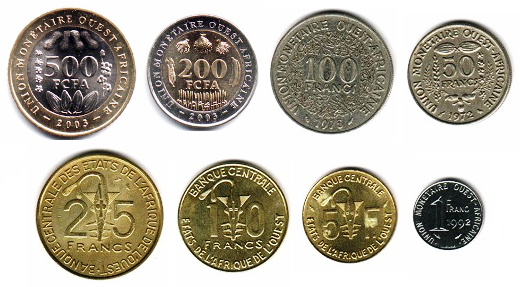
In 1948, aluminium 1 and 2 franc coins were introduced. These were followed in 1956 by aluminium-bronze 5, 10, and 25 francs. All carried the name "Afrique Occidentale Française". In 1957, 10 and 25 franc coins were issued with the name of "Togo" were minted for use in that country; these were issued only for that year. From 1959, all coins have been issued by the BCEAO.
Hub AI
West African CFA franc AI simulator
(@West African CFA franc_simulator)
West African CFA franc
The West African CFA franc (French: franc CFA or simply franc, ISO 4217 code: XOF; abbreviation: F.CFA) is the currency used by eight independent states in West Africa which make up the West African Economic and Monetary Union (UEMOA): Benin, Burkina Faso, Côte d'Ivoire, Guinea-Bissau, Mali, Niger, Senegal and Togo. These eight countries had a combined population of 105.7 million people in 2014, and a combined GDP of US$128.6 billion as of 2018.[update][citation needed]
The initialism CFA stands for Communauté Financière Africaine (transl. African Financial Community). The currency is issued by the Central Bank of West African States (BCEAO; Banque Centrale des États de l'Afrique de l'Ouest), located in Dakar, Senegal, for the members of the UEMOA. The franc is nominally subdivided into 100 centimes but no coins or banknotes denominated in centimes have ever been issued. The production of CFA franc notes has been carried out at Chamalières by the Bank of France since its creation in 1945.
The Central African CFA franc is of equal value to the West African CFA franc, and is in circulation in several central African states. They are both commonly referred to as the CFA franc.
In December 2019 it was announced that the West African CFA franc would be reformed, which will include renaming it the eco and reducing France's role in the currency. The broader Economic Community of West African States (ECOWAS), of which the members of UEMOA are also members, plans to introduce its own common currency for its member states for which the name eco has also been formally adopted. The fifth target launch date is set for July 2027.
The CFA franc was introduced to the French colonies in West Africa in 1945, replacing the French West African franc. The West African colonies and territories using the CFA franc were Ivory Coast, Dahomey, French Sudan, Mauritania, Niger, Sénégal, Togo and Upper Volta. The currency continued in use when these colonies gained their independence, except in Mali (formerly French Sudan), which replaced at par the CFA franc with its own franc in 1961.
In 1973, Mauritania replaced the CFA franc with the ouguiya at a rate of 1 ouguiya = 5 francs. Mali readopted the CFA franc in 1984, at a rate of 1 CFA franc = 2 Malian francs. The former Portuguese colony of Guinea-Bissau adopted the CFA franc in 1997, replacing the Guinea-Bissau peso at a rate of 1 CFA franc = 65 pesos.
The currency was pegged to the French franc at F.CFA 1 = F 2, from 1948, becoming 1 F.CFA = NF 0.02 after introduction of the new franc at 1 new franc = 100 old francs. In 1994 the currency was devalued by half to F.CFA 1 = F 0.01. From 1999 it has since been pegged to the euro at €1 = F 6.55957 = F.CFA 655.957
In 1948, aluminium 1 and 2 franc coins were introduced. These were followed in 1956 by aluminium-bronze 5, 10, and 25 francs. All carried the name "Afrique Occidentale Française". In 1957, 10 and 25 franc coins were issued with the name of "Togo" were minted for use in that country; these were issued only for that year. From 1959, all coins have been issued by the BCEAO.