Hubbry Logo
search
logo
2291772

Window Rock, Arizona

logo
Community Hub0 Subscribers
Read side by side
from Wikipedia

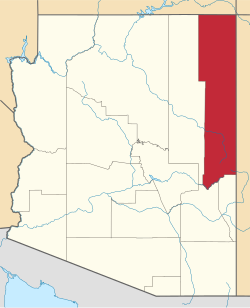
Window Rock, known in Navajo as Tségháhoodzání (pronounced [tsʰéɰáhòːtsání]), is a city and census-designated place that serves as the capital of the Navajo Nation, the largest Native American tribe by both land and tribal enrollment.[3] The capital lies within the boundaries of the St. Michaels Chapter, adjacent to the Arizona and New Mexico state line. Window Rock is the site of the Navajo Nation governmental campus, which contains the Navajo Nation Council, Navajo Nation Supreme Court, the offices of the Navajo Nation President and Vice President, and many Navajo government buildings.

Key Information

Window Rock's population was 2,500 at the 2020 census.[4] It is estimated to reach around 20,000 during weekdays when tribal offices are open.[citation needed]

Window Rock's main natural attraction is the window formation of sandstone, after which the community is named. The Navajo Nation Museum, the Navajo Nation Zoological and Botanical Park, and the Navajo Nation Code Talkers World War II memorial are tribal attractions located in Window Rock.

Name

[edit]
Tségháhoodzání, the "Window Rock"

Until 1936, the area was sparsely populated and known by the Navajo only by its ceremonial name Niʼ Ałníiʼgi ("Center of the World"). John Collier, a reforming Commissioner of Indian Affairs, chose this site to establish the seat of the Navajo Central Agency, the Bureau of Indian Affairs official connection to the nation. His proposal to make the ceremonial name the official name met with resistance, and Navajos soon ridiculed it as "ni ałnííʼgóó" (~ "into your middle (parts)").

Due to this, the BIA chose the name of the major local landmark, the rock-with-hole-through-it (Navajo: tségháhoodzání) for this Indian agency site. It was rendered in English as Window Rock.[5] This landmark is north of the Navajo governmental administration buildings. It is important in the traditional Navajo Water Way Ceremony (Tóee), as one of the four places where Navajo medicine men go with their traditional woven water jugs to get water for the ceremony that is held to pray for an abundance of rainfall.[6]

Government

[edit]
The Navajo Nation Council Chamber hosts the legislative branch of the nation, known as the Navajo Nation Council.

Window Rock is the capital of the Navajo Nation's government. Its complex houses the Navajo Nation President and Vice President, Navajo Nation Supreme Court, the 24-member Navajo Nation Council, and Navajo government administration buildings. As a district within the St. Michaels Chapter, Window Rock is served by a Navajo Council Delegate and Chapter President and Vice President.

Demographics

[edit]
Historical population
CensusPop.Note
19802,230
19903,30648.3%
20003,059−7.5%
20102,712−11.3%
20202,500−7.8%
U.S. Decennial Census[7]

As of the census[8] of 2000, there were 3,059 people, 876 households, and 713 families residing in the CDP. The population density was 589.3 inhabitants per square mile (227.5/km2). There were 998 housing units at an average density of 192.3 per square mile (74.2/km2). The racial makeup of the CDP was 95.5% Native American, 3.2% White, 0.4% Asian, 0.2% African American, <0.1% Pacific Islander, 0.1% from other races, and 0.7% from two or more races. Hispanic or Latino of any race were 1.4% of the population.

There were 876 households, out of which 51.0% had children under the age of 18 living with them, 43.7% were married couples living together, 29.7% had a female householder with no husband present, and 18.6% were non-families. 15.6% of all households were made up of individuals, and 2.4% had someone living alone who was 65 years of age or older. The average household size was 3.42 and the average family size was 3.81.

In the CDP, the age distribution of the population shows 36.3% under the age of 18, 10.9% from 18 to 24, 28.7% from 25 to 44, 19.6% from 45 to 64, and 4.5% who were 65 years of age or older. The median age was 27 years. For every 100 females, there were 92.6 males. For every 100 females age 18 and over, there were 88.4 males.

The median income for a household in the CDP was $36,885, and the median income for a family was $36,500. Males had a median income of $27,266 versus $26,902 for females. The per capita income for the CDP was $11,122. About 24.6% of families and 24.6% of the population were below the poverty line, including 28.6% of those under age 18 and 6.8% of those age 65 or over.

Languages (2000)[9] Percent
Spoke Navajo at home 57%
Spoke English at home 43%

Geography

[edit]
Navajo Nation World War II Memorial

The Arizona/New Mexico state line marks the town's eastern edge, and some of the town's buildings are located a few feet (meters) from the state line.[10] Immediately across the state line from Window Rock is the village of Tse Bonito, New Mexico.

The greater Window Rock area comprises the Fort Defiance and St. Michaels chapters, and the hamlets of Hunter's Point and the Summit in Arizona, and Tse Bonito on the New Mexico side of the border.

According to the United States Census Bureau, Window Rock CDP (census designated place) has a total area of 5.3 square miles (13.7 km2), all land. The area is atop and encompassed within the Defiance Plateau.

Climate

[edit]

Window Rock is categorized as being within the 6a USDA hardiness zone, meaning the average annual extreme minimum temperature is between −10 and −5 °F (−23 and −21 °C).[11] The city is cooler than most of Arizona due to its high elevation.

Climate data for Window Rock, Arizona (Window Rock Airport),[a] (1991–2020 normals, extremes 1998–present)
Month Jan Feb Mar Apr May Jun Jul Aug Sep Oct Nov Dec Year
Record high °F (°C) 63
(17)
70
(21)
77
(25)
83
(28)
92
(33)
101
(38)
98
(37)
97
(36)
96
(36)
86
(30)
81
(27)
66
(19)
101
(38)
Mean maximum °F (°C) 57.2
(14.0)
61.7
(16.5)
70.0
(21.1)
77.1
(25.1)
85.4
(29.7)
93.6
(34.2)
94.6
(34.8)
90.5
(32.5)
86.9
(30.5)
78.8
(26.0)
70.3
(21.3)
59.7
(15.4)
95.4
(35.2)
Mean daily maximum °F (°C) 45.3
(7.4)
49.2
(9.6)
57.5
(14.2)
64.8
(18.2)
74.1
(23.4)
85.4
(29.7)
88.4
(31.3)
84.6
(29.2)
78.9
(26.1)
67.8
(19.9)
56.3
(13.5)
45.6
(7.6)
66.5
(19.2)
Daily mean °F (°C) 29.9
(−1.2)
34.2
(1.2)
40.7
(4.8)
46.8
(8.2)
55.1
(12.8)
65.2
(18.4)
71.5
(21.9)
68.5
(20.3)
60.8
(16.0)
49.2
(9.6)
38.6
(3.7)
29.7
(−1.3)
49.2
(9.5)
Mean daily minimum °F (°C) 14.4
(−9.8)
19.2
(−7.1)
23.8
(−4.6)
28.8
(−1.8)
36.2
(2.3)
45.0
(7.2)
54.7
(12.6)
52.4
(11.3)
42.7
(5.9)
30.6
(−0.8)
20.8
(−6.2)
13.8
(−10.1)
31.9
(−0.1)
Mean minimum °F (°C) −5.8
(−21.0)
1.3
(−17.1)
8.7
(−12.9)
15.7
(−9.1)
23.2
(−4.9)
32.3
(0.2)
43.4
(6.3)
42.3
(5.7)
28.6
(−1.9)
17.9
(−7.8)
5.0
(−15.0)
−5.1
(−20.6)
−9.6
(−23.1)
Record low °F (°C) −25
(−32)
−23
(−31)
−8
(−22)
10
(−12)
13
(−11)
26
(−3)
37
(3)
35
(2)
22
(−6)
1
(−17)
−5
(−21)
−17
(−27)
−25
(−32)
Average precipitation inches (mm) 1.04
(26)
0.87
(22)
0.66
(17)
0.46
(12)
0.57
(14)
0.28
(7.1)
1.78
(45)
1.85
(47)
1.34
(34)
0.92
(23)
0.75
(19)
0.83
(21)
11.35
(288)
Average precipitation days (≥ 0.01 inch) 6.1 6.0 5.4 4.5 4.4 2.8 10.6 10.9 7.0 6.3 5.2 7.0 76.2
Source 1: NOAA[12]
Source 2: National Weather Service[13]

Note

[edit]
  1. ^ 6,830 feet above sea level

Education

[edit]
Office of the President of the Navajo Nation.

Window Rock is a part of the Window Rock Unified School District,[14] which serves the greater Fort Defiance and St. Michaels chapters population center.

Window Rock is served by:

  • Window Rock Elementary School
  • Tséhootsooí Middle School
  • Window Rock High School located in the Fort Defiance Chapter.

The community is also served by the private Saint Michael Indian School, a K-12 private, Catholic school established by Katharine Drexel in 1902. Saint Michael Indian School is a member of the National Catholic Education Association and the Roman Catholic Diocese of Gallup Catholic School System.

The surrounding community is also served by Hilltop Christian School, operated by Across Nations offering pre-K through 6th grade learning curriculum.

In addition, the Saint Michaels Association for Special Education, Inc. (SMASE) school serves the greater Navajo Nation in Arizona and New Mexico. A non-profit school, founded by Sister Marijane Ryan in 1970 serves as an educational and residential center for individuals with disabilities of all ages.

Travel and tourism

[edit]
The World War II Navajo Code Talkers Memorial in Window Rock.

Tourism is an integral part of the local economy. Window Rock attracts a large number of tourists and visitors due to its close proximity to many national parks and sites and Navajo government. The area is a popular base of commerce for the regional people as well.

Window Rock is near to:

[edit]
Navajo Nation Museum

In the year of 1961 the Navajo Tribe established the first Navajo Tribal Museum in a small building on the Window Rock Tribal Fairgrounds. It was moved in 1982 to the back room of the Navajo Arts and Crafts Store. In 1997, a $7 million permanent home was built to store the Navajo artifacts in a museum specially built in a modern Navajo hogan style near the Navajo Nation Zoo.[15]

The Navajo Nation Museum and its colocated Library offer many relics and artifacts of the Navajo people and Navajo Nation, many resources on the Navajo people, language and ceremonies are also offered in the Navajo Nation Library which is adjacent to the museum. The museum is open Monday through Friday and is free to the public. [16]

[edit]
The Navajo Nation Zoological and Botanical Park

The Navajo Tribal Zoo opened in Window Rock in 1963 featuring reservation animals such as bear, coyotes, snake, elk, and the golden eagle. The Navajo Nation Zoological and Botanical Park offers a wide variety of plants, animals, fishes, birds and insects native to the Four Corners area of the Navajo Nation such as elk, mule deer, Mexican gray wolf, black bear, cougar, golden eagle, bighorn sheep, lynx, Rio Grande wild turkey, raccoon, Canada goose, and fox. The Navajo Nation Zoo is open Monday through Saturday and is free to the public.[17]

Infrastructure

[edit]
Aerial view from the south, with Window Rock Airport (right of center), Black Creek (lower center), and Tse Bonito, New Mexico (right edge center)
Window Rock post office

Transportation

[edit]

Window Rock is served by Arizona State Route 264, and Indian Route 12 .

Window Rock is served by a local regional airport : Window Rock Airport. Window Rock Airport is a public use airport located one nautical mile south of the central business district of Window Rock, in Apache County. It is owned by the Navajo Nation.

Local transportation is provided by the Navajo Transit System which operates from Window Rock. It provides several routes that serve the community, the Navajo Nation, the Hopi Nation, and San Juan Southern Paiute Tribe.

Business

[edit]

Window Rock is served by two regional shopping centers: Diné Bashas' and Lowe's Market. The Navajo Nation Shopping Center Enterprise also serves the area. This includes local business, such as Navajo Arts And Crafts Enterprise, Caffeinated Ape, Dee Barber Shop, Shima Grill & Catering, Ch'ihootso Indian Market Place, Arizonian's Bookstore, Window Rock Coffee Company, Navajo United Way, IndigeHub, Navajo Technology Services, LLC, the DVD Collection, National Flowers, and New Mexico Chile Fair.[citation needed][18][19]

Culture

[edit]
Navajo Times

Numerous events are hosted throughout the year in the greater Window Rock area, which includes Fort Defiance and St. Michaels, such as:

  • Fourth of July Celebration & PRCA ProRodeo
  • Navajo Nation Fair
  • Navajo Nation Treaty Day Celebration
  • Navajo Nation Prayer Day
  • Megabucks Bull Riding

Health care

[edit]

Window Rock is served by the Tséhootsooí Medical Center.[20] Located in Fort Defiance, Arizona it also serves the Window Rock and the surrounding area.

References

[edit]

Further reading

[edit]
[edit]
Revisions and contributorsEdit on WikipediaRead on Wikipedia
from Grokipedia
Window Rock (Navajo: Tségháhoodzání), a census-designated place in Apache County, northeastern Arizona, serves as the capital and seat of government for the Navajo Nation, the largest Native American reservation in the United States by land area.[1][2] Named for a prominent natural sandstone arch formed by wind and water erosion in a cliff overlooking the community, the site holds cultural significance and features a tribal park established around 1936.[3] As the administrative hub, it houses key institutions including the Navajo Nation Council Chambers, the Office of the President and Vice President, the Navajo Nation Museum, and the Navajo Zoo and Botanical Park, supporting governance for over 300,000 enrolled Navajo members across Arizona, New Mexico, and Utah.[1][4] The resident population stands at approximately 2,384 according to recent U.S. Census data, though it swells to around 20,000 on weekdays due to employees commuting to tribal offices.[5][6]

Name and Etymology

Origin and Significance

The name Window Rock originates from a distinctive natural sandstone arch situated near the town center, formed through prolonged erosion processes involving wind and precipitation acting on a cliff face composed of Entrada Sandstone from the Late Jurassic period.[2] In the Navajo language, this feature is termed tségháhoodzání, translating to "rock with a hole in it" or "perforated rock," reflecting its characteristic aperture.[3][7] This geological formation has long served as a cultural landmark for the Navajo people, embodying spiritual reverence and historical continuity predating colonial influences.[8] Navajo oral traditions associate the arch with sacred qualities, positioning it as a point of natural significance within the broader landscape of Dinétah, the traditional Navajo homeland.[9] During the 1930s, as the Navajo Tribal Council established its headquarters in the area under the Indian Reorganization Act of 1934, the site's namesake arch was deliberately chosen to underscore the permanence of ancestral landscapes over ephemeral administrative constructs, thereby anchoring the emerging capital in enduring environmental and cultural symbolism.[10][3]

History

Early Navajo Settlement and Pre-Colonial Era

The Athabaskan-speaking ancestors of the Navajo migrated southward into the American Southwest from subarctic regions, with linguistic and archaeological evidence indicating arrival after A.D. 1450 and establishment prior to sustained Spanish contact in the mid-16th century.[11] Initial proto-Navajo settlements concentrated in the Dinétah core area of northwestern New Mexico, where tree-ring dated structures and ceramics document occupation beginning around 1500 CE.[12] From this homeland, Navajo groups expanded westward into northeastern Arizona, incorporating the Window Rock vicinity into their territory through dispersed, semi-sedentary communities adapted to local arroyos and plateaus. The region had previously hosted Ancestral Puebloan populations, whose sites—abandoned amid prolonged droughts circa 1300 CE—provided models for Navajo agricultural practices, including floodwater farming of maize, beans, and squash in high-desert bottoms.[13] Pre-contact Navajo subsistence emphasized this dry farming alongside hunting of deer and small game, piñon nut gathering, and seasonal mobility to exploit patchy resources, enabling resilience in an arid environment with elevations exceeding 6,500 feet. Distinctive archaeological markers, such as slab-lined cists and early grayware pottery, trace this adaptation, though livestock herding emerged only post-European introduction.[14] Navajo oral histories recount emergence from underworlds and migratory journeys shaping their relation to the landscape, with natural features like the Window Rock sandstone arch (Tsééłání) serving as landmarks in traditional narratives; however, no archaeological data verifies cosmological events specifically at this formation, distinguishing such accounts from material evidence of settlement patterns.[15]

Colonial Encounters and the Long Walk

European contact with the Navajo began in the sixteenth century through Spanish expeditions into the Southwest, though initial interactions were sporadic and primarily involved trade or reconnaissance rather than settlement.[16] Sustained Spanish colonization in New Mexico from the late 1500s onward brought more frequent encounters, marked by Navajo raids on missions and settlements for livestock, which Spanish forces countered with punitive campaigns.[17] In 1680, Navajo groups allied with Pueblo peoples during the Pueblo Revolt, temporarily expelling Spanish authorities from the region and acquiring horses, sheep, and weaving techniques that bolstered Navajo pastoralism.[16] By the early 1700s, Spanish records depicted the Navajo as a growing threat due to intensified stock raids and resistance to missionary efforts, prompting alliances with Ute tribes to conduct joint slave raids and military expeditions against Navajo communities.[17] These Ute-Navajo conflicts, peaking in the late eighteenth century, involved territorial disputes and captive-taking, with Utes often serving as Spanish auxiliaries in exchange for goods, disrupting Navajo settlements in the Chama Valley and Gobernador region.[18] Following Mexican independence in 1821, governance weakened, exacerbating cross-border raiding without the structured Spanish-Indian alliances, though Ute-Navajo skirmishes continued over hunting grounds and captives into the 1840s.[18] U.S. acquisition of the Southwest after the 1846–1848 Mexican-American War shifted dynamics, with initial treaties in 1849 and 1850 recognizing Navajo land rights but failing to curb raids on Anglo and Mexican settlers, prompting escalated military responses.[19] In 1863, amid Civil War distractions, Union General James H. Carleton ordered Colonel Christopher "Kit" Carson to subdue Navajo resistance through a scorched-earth strategy, establishing Forts Defiance and Canby as bases and systematically destroying crops, hogans, orchards, and livestock to induce starvation and surrender.[20] Carson's campaign from July 1863 to January 1864, including the January assault in Canyon de Chelly, compelled over 8,000 Navajo to capitulate by early 1864, as resource deprivation rendered prolonged resistance untenable.[19][21] Between August 1864 and late 1866, approximately 8,500 to 10,000 Navajo endured forced marches—totaling over 300 miles in groups under military escort—to Bosque Redondo near Fort Sumner, New Mexico, a designated reservation intended for agricultural "civilization" but plagued by alkaline water, crop failures, disease, and inadequate supplies, resulting in roughly 2,500 deaths from exposure, malnutrition, and illness.[20][22] The confinement's failures, including intertribal tensions with interned Mescalero Apache and unsustainable logistics, led federal inspector General Benjamin O. Cutler to deem the experiment a humanitarian disaster in 1866.[23] On June 1, 1868, Navajo delegates signed the Treaty of Bosque Redondo with U.S. commissioners, conceding most ancestral claims outside a 3.5-million-acre reservation while securing provisions for return, tools, livestock, and schools; this delimited core territory encompassing the Four Corners region, including the future site of Window Rock as a strategic eastern enclave.[24][25] The treaty's ratification enabled the Navajo exodus back to Dinétah and Dinetah-adjacent lands by late 1868, reestablishing pastoral lifeways amid reduced population and altered clan distributions from the prior disruptions.[23]

Establishment as Tribal Capital

In 1933, Commissioner of Indian Affairs John Collier selected Window Rock as the site for the new administrative headquarters of the Navajo tribal government, aiming to centralize operations across the vast reservation spanning over 25,000 square miles.[26] This choice positioned the agency near the Arizona-New Mexico border, facilitating governance for the Navajo people following the formation of the initial tribal council in 1923.[27] The site, previously known as a sacred location called Nee Alneeng or "center of the world," was renamed Tségháhoodzání, reflecting its prominent sandstone arch formation.[26] Construction of key structures, including the Navajo Nation Council Chamber, commenced in 1934 and was completed by December 1935, funded through the Public Works Administration as part of New Deal initiatives to bolster reservation infrastructure and employment.[28] The octagonal chamber, designed in a style evoking traditional Navajo hogans, measured approximately 70 feet in diameter and was built using local sandstone, ponderosa pine vigas, and Navajo labor under the Civilian Conservation Corps-Indian Division, at a cost of about $27,614 for construction.[26] [28] Additional executive buildings followed in the late 1930s, forming a cohesive administrative complex that symbolized a shift toward tribal self-determination.[26] The establishment of Window Rock as the tribal capital aligned with the Indian Reorganization Act of 1934, which sought to promote tribal self-government despite the Navajo's rejection of the act in a reservation-wide vote.[29] The council chamber hosted the first formal meetings of the Navajo Tribal Council in 1937, where efforts began to draft a tribal constitution and codify elements of Navajo common law alongside federal oversight, laying foundational steps for organized sovereignty and dispute resolution systems.[26] This centralization enabled the transition from ad hoc tribal business committees to a more structured legislative body, though full constitutional adoption occurred later.[27]

Modern Developments and Sovereignty Era

Following World War II, Navajo veterans, including approximately 400 Code Talkers who transmitted unbreakable encrypted messages in their native language during Pacific Theater operations, returned to the Navajo Nation and contributed to post-war rebuilding efforts.[30] [31] Their service underscored Navajo loyalty to the United States while reinforcing tribal self-determination aspirations, though initial secrecy oaths delayed public recognition until 1968.[32] Integration challenges persisted, including limited access to federal benefits, yet veterans influenced governance expansions centered in Window Rock.[33] Economic diversification efforts in the 1950s targeted resource extraction, with uranium mining commencing in 1948 on Navajo lands to fuel Cold War demands, peaking production in 1955–1956 and generating temporary employment for tribal members.[34] The boom supported infrastructure like roads and irrigation under the Navajo-Hopi Rehabilitation Act of 1950, which allocated federal funds for development projects.[35] However, by the early 1980s, market collapse led to mine closures, exposing economic vulnerabilities and reliance on federal aid, as uranium output dwindled to zero amid oversupply.[34] [36] Governance advancements included the 1959 establishment of formal tribal courts, which by the late 1970s incorporated Navajo common law principles to assert jurisdiction over internal matters.[37] U.S. Supreme Court rulings in the 1980s bolstered sovereignty, such as Ramah Navajo School Board, Inc. v. Bureau of Revenue (1982), exempting tribal construction contracts from state gross receipts taxes, and Kerr-McGee Corp. v. Navajo Tribe (1985), upholding the tribe's authority to impose business activity taxes on mining lessees.[38] [39] These decisions affirmed Navajo taxing powers on federal enclaves, enhancing fiscal autonomy despite ongoing Bureau of Indian Affairs oversight in areas like resource leasing.[40]

Recent Events and Challenges (2000–2025)

In September 2014, the United States government agreed to pay the Navajo Nation $554 million to settle claims of mismanagement of tribal trust funds and natural resources, including royalties from oil, gas, and mineral extraction, stemming from lawsuits filed over decades of federal oversight failures.[41][42] This settlement, one of the largest for a single tribe, addressed accounting errors and underpayments but highlighted ongoing dependencies on federal trusteeship for resource revenues critical to the Navajo economy centered in Window Rock.[43] In June 2023, the U.S. Supreme Court ruled 5-4 in Arizona v. Navajo Nation that the federal government holds no affirmative, judicially enforceable duty to secure water supplies from the Colorado River for the Navajo Reservation, despite the tribe's implied rights under the Winters doctrine and the 1868 treaty establishing the reservation.[44][45] The decision, which rejected the tribe's argument for federal action amid severe shortages affecting Window Rock-area communities, underscored limitations on tribal sovereignty in interstate water allocation, leaving negotiations to states and the Bureau of Reclamation without mandated federal intervention.[46] The Oak Ridge Fire, ignited in late June 2025 near Window Rock, burned approximately 11,000 acres, prompting a state of emergency declaration, evacuations of dozens of families and livestock (including 236 sheep, 39 cattle, and other animals), and threats to infrastructure in the Navajo capital region.[47][48] Contained by mid-July through efforts of over 500 firefighters, the blaze exacerbated drought conditions and respiratory health issues from smoke, with recovery focusing on devastated landscapes while sparing most homes.[49][50] The 77th Navajo Nation Fair, held September 2–7, 2025, in Window Rock, featured parades, rodeos, and traditional events amid post-fire recovery, drawing participants to the Dean C. Jackson Arena despite lingering environmental challenges.[51][52] In October 2025, protests erupted in Window Rock against Navajo Nation President Buu Nygren, organized by groups including the American Indian Movement, demanding his resignation over disputes including the abrupt firing of the tribal controller, line-item vetoes slashing legislative budgets, and a court-approved restraining order blocking his interim appointments.[53][54] Nygren, absent from the October 24 rally outside the executive offices, faced signs reading "Resign Shi Yázhí" and criticisms of governance accountability, reflecting tensions between the executive and the 25th Navajo Nation Council.[55][56]

Geography

Location and Physical Features

Window Rock is situated in Apache County, northeastern Arizona, at approximate geographic coordinates of 35°40′51″N 109°03′09″W.[57] The community lies at an elevation ranging from 6,800 to 7,000 feet (2,070 to 2,130 meters) above sea level, primarily atop a mesa-like terrain characteristic of the Colorado Plateau.[57][58] It occupies a position directly bordering the New Mexico state line to the east, placing it within the southwestern extent of the Navajo Nation's territorial boundaries.[59] The town serves as the administrative capital of the Navajo Nation, encompassing over 27,000 square miles (70,000 square kilometers) of land across Arizona, New Mexico, and Utah.[59] Window Rock is located approximately 26 miles (42 kilometers) northwest of Gallup, New Mexico, facilitating regional connectivity via U.S. Route 191 and proximity to interstate corridors.[60] This positioning integrates the settlement into the broader Navajo reservation landscape, where governance structures and infrastructure radiate from the central hub. Physically, Window Rock derives its name from a prominent natural sandstone arch formation, a geological feature carved by erosion in the Mesozoic sandstone layers exposed in the area, standing at an elevation of 7,054 feet (2,150 meters).[61] The surrounding topography features the western escarpment of the Chuska Mountains, a northwest-trending range forming a dissected volcanic-capped plateau with average elevations around 9,000 feet (2,740 meters).[62][63] These mountains, composed of sedimentary rocks overlain by basaltic volcanics, create a transitional highland environment that rises abruptly from the adjacent plains, historically channeling water resources and defining natural corridors for human movement and habitation.[64][65]

Climate and Environmental Conditions

Window Rock experiences a cold semi-arid climate classified under the Köppen system as BSk, typical of high-desert regions in the American Southwest, with low humidity, sparse vegetation, and pronounced seasonal temperature swings driven by elevation around 6,500 feet and continental air masses.[66][67] Average annual precipitation totals approximately 11 inches, predominantly from summer monsoons (JulySeptember) contributing over 50% of the yearly total, while winter snowfall averages 19 inches but melts irregularly due to variable freeze-thaw cycles.[67][68] This aridity limits surface water availability, shaping habitability by necessitating reliance on groundwater and distant aquifers for domestic and agricultural needs, with soil erosion and flash flooding during rare intense storms further constraining land use.[69] Temperatures exhibit wide diurnal and annual ranges: winter months (December–February) see average daily highs of 43–47°F and lows dipping to 14–19°F, with occasional extremes below 0°F from Arctic outbreaks, while summer highs average 81–88°F in JuneAugust, moderated slightly by afternoon thunderstorms but capable of exceeding 90°F during heat waves.[67][66] These patterns reflect regional high-desert dynamics, where clear skies promote radiative cooling at night and solar heating by day, impacting energy demands for heating in winter and cooling in summer, as well as livestock grazing viability tied to forage growth limited by moisture deficits.[70] Persistent drought cycles, part of multi-decadal oscillations in the Southwest linked to Pacific Ocean variability such as the Pacific Decadal Oscillation and variable monsoon strength, exacerbate water scarcity beyond baseline aridity, reducing stream flows and reservoir levels without sole attribution to recent anthropogenic influences.[71][72] These cycles have intensified resource constraints, with over 30% of Navajo Nation households lacking piped water access amid prolonged dry periods that diminish snowpack recharge and groundwater replenishment.[73] Wildfire risks are elevated due to fuel accumulation from decades of fire suppression policies that prevented natural low-intensity burns, allowing dense understory growth in piñon-juniper woodlands; the June 2025 Oak Ridge Fire, ignited by human activity eight miles southwest of Window Rock, exemplifies this, scorching over 11,000 acres, prompting evacuations of hundreds, and reaching 96% containment by mid-July amid windy conditions.[49][74][75] Such events highlight how unmanaged fuel loads, compounded by drought-dried vegetation, heighten burn severity potential in untreated areas, though mechanical thinning efforts have shown effectiveness in reducing ladder fuels where implemented.[76][77]

Government and Politics

Window Rock functions as the central operational hub for the Navajo Nation's three branches of government, enabling the exercise of tribal sovereignty through administrative, legislative, and adjudicative activities across its territory in Arizona, New Mexico, and Utah.[78] The legislative branch, comprising the 24-member Navajo Nation Council elected from agency districts, conducts its deliberations in the Council Chambers located there, where delegates address policy, budgeting, and lawmaking for the Nation's approximately 300,000 members.[79] Annual sessions include the Spring Session (April 21-25), Summer Session (July 21-25), and Fall Session (October 20-24) in 2025, focusing on critical issues such as resource allocation and intergovernmental relations.[80][81] The executive branch, headed by the President and Vice President, maintains its primary offices in Window Rock, from which it oversees executive agencies, implements Council-approved legislation, and manages daily governance operations including public safety, health services, and economic development initiatives.[82] This centralization supports coordinated decision-making and resource distribution to the Nation's 110 chapters.[1] The judicial branch, including the Navajo Nation Supreme Court and district courts, is headquartered in Window Rock's Judicial District, handling civil, criminal, and appellate cases under the Nation's legal code to uphold internal sovereignty and resolve disputes autonomously from federal courts where possible.[83][84] Window Rock's government facilities also facilitate coordination with the federal Bureau of Indian Affairs (BIA), whose Navajo Regional Office historically based in the area provides administrative support, trust land management, and federal funding channels that bolster the Nation's self-determination while navigating U.S. treaty obligations.[85][86] This interplay underscores practical implementations of sovereignty, such as joint environmental and infrastructure projects, without supplanting tribal authority.[87]

Tribal Governance Structure

The Navajo Nation maintains a tripartite governmental framework with executive, legislative, and judicial branches, centered in Window Rock as the tribal capital. The executive branch is led by a president and vice president, elected by popular vote to four-year terms, with a constitutional limit of two consecutive terms to promote accountability and turnover.[1] The legislative branch consists of the Navajo Nation Council, reduced from 88 to 24 delegates via a 2009 referendum approved by voters to streamline decision-making and reduce costs, with delegates serving four-year terms and representing clusters of the 110 local chapters.[79][88][89] These chapters function as grassroots units for community input, electing local officials under the Local Governance Act to handle resolutions, budgets, and coordination with the central council, though the delegate consolidation has prompted debates on whether it sufficiently captures diverse chapter perspectives across the vast reservation.[78][90] The judicial branch relies on Navajo common law, a system blending traditional Diné principles of harmony and peacemaking with codified statutes originating in the 1950s, adjudicated through district and supreme courts to resolve disputes internal to the Nation.[37][91] This framework emphasizes restorative justice over adversarial models, evolving from early agency courts to a sovereign system post-1959 Williams v. Lee ruling affirming tribal jurisdiction.[91] Given Window Rock's position in Arizona, tribal governance intersects with state authority, particularly in law enforcement, where overlaps with Apache County necessitate cooperative protocols; for instance, memoranda with the Arizona Department of Public Safety authorize state officers to enforce certain tribal criminal and traffic laws on reservation lands during joint operations.[92] Such arrangements mitigate gaps in coverage but highlight ongoing tensions in delineating sovereignty versus state interests, with primary policing handled by the Navajo Nation Police under tribal codes.[1] While formal structures enable broad representation, their efficacy is tested by the Nation's scale—spanning 27,000 square miles—and reliance on consensus, often resulting in protracted deliberations that prioritize deliberation over rapid action.[79]

Corruption and Governance Criticisms

In 2010, Navajo Nation prosecutors charged 77 tribal council delegates with crimes including conspiracy, theft, fraud, and forgery related to the misuse of discretionary funds intended for community projects, marking one of the largest corruption probes in the tribe's history.[93] By 2016, at least 11 former delegates, including two former council speakers, had been convicted and sentenced for embezzlement and abuse of office, with the scandal exposing how centralized control over slush funds enabled personal enrichment amid widespread poverty.[94] These cases highlighted systemic nepotism, as funds were often directed to allies rather than verified needs, eroding public trust in Window Rock's leadership.[95] Earlier precedents include the 1989 ouster of Navajo Chairman Peter MacDonald for bribery and corruption, which sparked a riot at the tribal council chambers in Window Rock and led to his conviction in both tribal and federal courts, resulting in an eight-year prison sentence.[96] In response to entrenched graft, grassroots activists dubbed "Monster Slayers"—evoking traditional Navajo heroes who vanquish threats—emerged around 2011 to expose ongoing embezzlement and push for reforms, though their efforts faced resistance from entrenched elites protective of clan-based patronage networks.[96] Critics, including tribal watchdogs, argue that such insular governance fosters impunity, as centralized authority in Window Rock overrides local chapters' oversight, limiting accountability mechanisms like independent audits.[97] Governance centralization, formalized in 1923 amid federal pressures tied to oil leasing, has drawn scrutiny for concentrating power in unelected bureaucracies and a 88-member council, which dilutes incentives for efficient resource allocation and stifles chapter-level innovation.[98] This structure correlates with persistent socioeconomic failures, such as the Navajo Nation's 38.3% poverty rate in recent census data—over three times Arizona's approximate 13%—exacerbated by sovereignty constraints on land titling that prevent individual property rights, collateral for loans, and market-driven development, trapping capital in communal trusts prone to political capture.[99] [100] While tribal sovereignty preserves cultural autonomy, analysts contend it causally impedes economic mobility by insulating governance from competitive pressures, as evidenced by higher joblessness and underinvestment compared to adjacent non-tribal areas with fee-simple ownership.[101] Recent fraud cases, including a 2022 federal sentencing of a Navajo employee for program embezzlement and 2021 charges against an official for COVID-19 relief misuse, underscore ongoing vulnerabilities in this framework.[102][103]

Demographics

The population of Window Rock, a census-designated place in Apache County, Arizona, was recorded at 2,500 in the 2020 United States Census, reflecting a decline of 7.8% from the 2,712 residents enumerated in 2010.[104][105] This downward trend continued into recent years, with American Community Survey estimates indicating approximately 2,384 residents as of 2023, driven primarily by net out-migration amid limited local employment opportunities.[6][5] Projections based on recent annual decline rates of around 2-3% suggest a further reduction to approximately 1,900 by mid-2025, underscoring ongoing population instability in this remote community.[106] Empirical metrics from census data highlight a high youth dependency ratio, with child dependents (under 18) comprising roughly 44% of the Navajo Nation's broader population structure—including Window Rock—relative to working-age adults, attributable to elevated fertility rates and family sizes averaging above national norms. This demographic pressure contributes to the observed stagnation and contraction, as younger cohorts seek prospects beyond the area.

Ethnic and Socioeconomic Composition

Window Rock's population is predominantly Native American, accounting for 95.4% of residents per the 2020 U.S. Census, with the overwhelming majority identifying as Navajo (Diné).[107] Smaller proportions include White (1.2%), Hispanic or Latino (1.6%), and negligible shares of Black (0.1%) or Asian residents.[107] This ethnic homogeneity stems from Window Rock's role as the seat of the Navajo Nation government, attracting Diné families and tribal employees while limiting non-Native settlement. Linguistically, the community features widespread bilingualism in Navajo (Diné bizaad) and English, with the former remaining a vital medium for cultural, ceremonial, and daily interactions despite pressures from English dominance in education and administration.[108] Surveys indicate that while monolingual Navajo speakers persist among elders, younger residents increasingly adopt bilingual proficiency, fostering a diglossic environment where Navajo holds prestige in traditional contexts.[109] Socioeconomically, Window Rock exhibits stark disparities, with a 2023 median household income of $44,918—less than half the U.S. median—and a poverty rate of 29.82%.[6][106] Unemployment affects the broader Navajo Nation at an alternative estimated rate of 39.3%, adjusting for undercounted discouraged workers excluded from standard American Community Survey metrics; this reflects reliance on limited tribal government jobs, seasonal labor, and welfare programs rather than robust private sector opportunities.[110] Average household sizes hover around 3 persons, exceeding national norms and intensifying strains on housing, utilities, and income distribution in a context of geographic isolation and underdeveloped infrastructure.[111]

Economy

Key Industries and Employment

The primary industries in Window Rock revolve around public administration tied to its role as the Navajo Nation capital, alongside health care, education, and emerging tourism-related activities. In 2023, the local economy supported 874 jobs, with public administration ranking as the second-largest sector at 166 employees, reflecting the concentration of tribal government offices and administrative functions in the area.[6] Health care and social assistance led with 199 jobs, followed by educational services at 129, underscoring reliance on government-funded services rather than private sector diversification.[6] Tribal governance employs thousands across the Navajo Nation, with Window Rock serving as the hub for legislative, executive, and administrative roles that sustain local employment in policy, clerical, and support positions.[112] Tourism contributes through attractions such as the Navajo Nation Museum, Council Chambers, and cultural events, fostering jobs in arts, entertainment, recreation, and hospitality, though these remain secondary to government work.[113] Revenue from off-reservation gaming operations, including casinos like Twin Arrows, indirectly bolsters tribal funds that support public payrolls, but direct gaming employment is limited in Window Rock itself.[114] The Navajo Nation's 2024–2029 Comprehensive Economic Development Strategy identifies utilities and health care as top current employment sectors, while prioritizing growth in manufacturing, wholesale/retail trade, transportation, professional services, agriculture, and renewable energy to expand beyond administrative dominance.[110] Small-scale enterprises in Navajo crafts, retail services, and cultural vending provide supplementary income, often linked to tourism visitors drawn to the area's heritage sites.[113] Federal transfers and tribal revenues sustain these public-heavy sectors, with limited private industrial presence due to the community's remote, administrative focus.[115]

Economic Dependencies and Barriers

The Navajo Nation, encompassing Window Rock as its capital, maintains a poverty rate of 35.5%, more than double the U.S. average of 12.4%, with persistence tied to structural dependencies on federal transfers that constitute a substantial portion of the tribal budget and crowd out incentives for private-sector expansion.[116] [117] This reliance fosters a cycle where approximately 5,000 tribal members depend on federal paychecks amid overall unemployment near 50%, limiting diversification into taxable, self-generated revenue streams.[118] Compounding this, fractionated land ownership—stemming from the Dawes Act's allotment era—divides parcels among hundreds or thousands of heirs per tract, rendering development infeasible without improbable consensus for leasing or sales, thereby depressing land values and deterring investment.[119][120] Tribal sovereignty introduces market distortions by imposing unique regulatory hurdles that isolate the economy from broader U.S. commerce, such as fragmented zoning and taxation regimes that complicate external business entry and capital flows.[121] The Navajo Nation's alcohol prohibition, while rooted in cultural preservation, sustains black markets for bootlegged liquor, evading formal taxation and fueling informal economies that undermine legal enterprise; enforcement targets suppliers, yet smuggling endures as a response to unmet demand in dry communities.[122][123] Resource monetization faces judicial barriers, as evidenced by the U.S. Supreme Court's 5-4 decision on June 22, 2023, in Arizona v. Navajo Nation, rejecting the tribe's claim for federal action to secure additional Colorado River water and affirming no implied trust duty beyond quantified rights, which curtails potential for agriculture, industry, or exports reliant on reliable supplies.[44][45] This ruling highlights how federal-tribal legal frameworks prioritize reserved rights quantification over proactive allocation, perpetuating underutilization of assets in water-scarce regions.[124]

Infrastructure

Transportation Networks

U.S. Route 191 constitutes the main arterial roadway serving Window Rock, running north-south through Apache County and connecting the community to Interstate 40 approximately 25 miles south at the Chambers interchange, enabling linkage to broader national freight and travel networks.[125] This two-lane highway, managed by the Arizona Department of Transportation, experiences seasonal challenges from weather and terrain, contributing to the logistical isolation of the Navajo Nation capital.[125] Public transit options remain sparse, with the Navajo Transit System providing fixed-route bus services such as Route 15, which operates weekdays between Sanders and Window Rock, departing as early as 5:50 a.m. from outlying points and returning similarly.[126] These services, coordinated by the Navajo Nation Division of Transportation, prioritize connectivity among chapters but operate limited hours—typically 5:00 a.m. to 7:00 p.m. on weekdays—fostering heavy reliance on personal vehicles for daily commutes and remote area access across the expansive reservation.[127] Air access depends on the Window Rock Airport (KRQE), a public-use facility 1.15 miles south of the central business district supporting general aviation but lacking scheduled commercial flights.[128] Travelers must proceed to the nearest commercial airport, Gallup Municipal Airport (GUP), situated 19 miles west, or regional hubs like Albuquerque International Sunport for broader connectivity, underscoring barriers for time-sensitive or high-volume travel from the isolated locale.[129] Freight movement hinges on trucking along U.S. Route 191 to Interstate 40, as the absence of local rail or intermodal facilities amplifies delivery distances from supply origins, thereby elevating costs for goods and materials essential to the Navajo Nation's operations and economy.[130] This road dependency, compounded by the reservation's vast scale and variable road conditions, intensifies logistical strains, including delays from maintenance needs and regulatory hurdles for hazardous or bulk shipments.[131]

Utilities, Water, and Development Issues

Approximately 30 percent of homes on the Navajo Nation, including areas around Window Rock, lacked running water as of 2021, compelling residents to haul water from distant sources amid an arid geography that exacerbates scarcity.[132][133] This persistent gap traces to historical federal failures in fulfilling trust responsibilities under treaties and statutes, compounded by tribal governance delays in infrastructure prioritization despite available federal funding allocations.[134][135] Recent efforts, such as a multibillion-dollar pipeline linking Window Rock to regional aquifers, aim to address this but face ongoing legal and logistical hurdles tied to water rights adjudication.[135] Electricity services in Window Rock and surrounding Navajo Nation regions are managed by the Navajo Tribal Utility Authority (NTUA), established in 1959 to extend power across the 27,000-square-mile reservation, yet about 32 percent of homes remained unelectrified as of 2024 due to remote terrain and extension costs.[136][137] Intermittent outages occur frequently from severe weather, such as winds exceeding 65 mph damaging lines or monsoon flooding, with restoration delayed by rugged access and limited grid redundancy.[138][139] NTUA reported connecting 28 tribal homes in Window Rock via a 2023-2024 pilot for multi-utility service, but broader rural extensions lag, leaving thousands off-grid and vulnerable to climate-intensified heat without reliable power.[140][141] Economic development in Window Rock stalls due to land tenure complexities under federal trust status, which restrict alienation and complicate leasing for commercial projects, alongside disputes over grazing permits and unauthorized uses that erode enforcement capacity.[121][142] Stringent environmental regulations, including National Environmental Policy Act reviews for any surface disturbance, further impede infrastructure like transmission lines or housing subdivisions, as tribal sovereignty intersects with federal oversight in ways that prolong approvals without clear resolution mechanisms.[143][144] These barriers, rooted in fragmented jurisdiction rather than resource abundance, perpetuate underinvestment despite the capital's central role in Navajo governance.[145]

Education

Local Schools and Institutions

The primary provider of K-12 education in Window Rock is the Window Rock Unified School District #8 (WRUSD), a public district operating seven schools within a 65-square-mile area of Apache County, Arizona, serving approximately 1,721 students from pre-kindergarten through 12th grade as of recent enrollment data.[146][147] The district, headquartered near Fort Defiance but encompassing Window Rock, emphasizes integration with Navajo governance through programs funded by the Navajo Nation, such as the Johnson O'Malley supplemental services for Native American students, which support cultural and academic needs under federal Indian education guidelines.[148] A key institution within WRUSD is Tséhootsooí Diné Bi'ólta', a Navajo immersion school offering full instruction in the Navajo language for pre-kindergarten through third grade, with English gradually incorporated starting in third grade to foster bilingual proficiency amid efforts to maintain linguistic heritage in a district where tribal sovereignty shapes curriculum priorities.[149][150] Post-secondary and adult education opportunities are available at the Diné College Window Rock Center, a branch campus situated on Tribal Hill Drive adjacent to the Navajo Nation Council Chambers, providing associate degrees, certificates, and dedicated adult education programs tailored to community members in the capital area.[151] This facility supports tribal self-determination in education by prioritizing Navajo-centered coursework, reflecting the institution's origins as the first tribally controlled community college established in 1968.[152]

Educational Outcomes and Challenges

In the Window Rock Unified School District, student proficiency rates remain substantially below Arizona state averages. Elementary students achieve proficiency in reading at 18% and mathematics at 11%, compared to statewide figures of approximately 39% in reading and 33% in math based on 2024-2025 assessments.[153][154] High school outcomes show similar disparities, with the district ranked among the lower performers in the state, though recent improvements include an 84% four-year graduation rate at Window Rock High School—marginally below the state median—and a historic 100% rate for the class of 2025.[155][156][157] These gaps stem from systemic factors, including overreliance on federal funding via the Bureau of Indian Education (BIE), which supplies about 79% of operational budgets for affiliated schools but suffers from administrative inefficiencies, excessive overhead costs, and inconsistent resource distribution to classrooms.[158][159][160] Government Accountability Office reports highlight persistent weaknesses in BIE oversight of spending and special education, exacerbating under-resourcing despite federal allocations, with recent executive actions and proposed cuts further straining operations as of 2025.[161][162] Curriculum structures, which integrate Navajo cultural elements to foster identity, have drawn criticism for insufficient emphasis on vocational training and core employability skills, contributing to limited post-graduation economic mobility amid high regional poverty.[163][164] Low proficiency in foundational subjects correlates with broader challenges like teacher shortages and rural isolation, hindering preparation for off-reservation jobs despite incremental gains in some metrics.[163][165]

Culture and Heritage

The Navajo philosophy of hózhó, emphasizing harmony, balance, and beauty through responsible thought, speech, and action, informs cultural preservation in Window Rock by guiding governance and ceremonial practices toward maintaining equilibrium between ancestral traditions and contemporary necessities.[166] This foundational worldview supports self-empowerment and relational ethics, enabling the Navajo Nation to navigate modernization while safeguarding core values like kinship (k'é) and peaceful solidarity.[167] Preservation initiatives, such as those under the Navajo Nation Heritage and Historic Preservation Department headquartered in Window Rock, prioritize protecting traditional knowledge and practices against external pressures, though adaptation remains essential for cultural continuity in a globalized context.[168] The legacy of the Navajo Code Talkers, who developed an undecipherable code based on the Diné language during World War II, exemplifies enduring cultural resilience and is commemorated annually in Window Rock to instill pride and historical awareness among the Diné.[169] Events like National Navajo Code Talkers Day on August 14 feature ceremonies honoring their service, with the 25th Navajo Nation Council participating in 2024 to recognize their contributions to Allied victory.[170] Complementing these, the Navajo Code Talker 10K run, held on September 7, 2025, starting from the Code Talker Trail, promotes physical endurance as a metaphor for the Talkers' perseverance, drawing participants to reflect on linguistic heritage while adapting commemorative forms to community fitness initiatives.[171][172] These activities preserve the Code Talkers' narrative not as static history but as a dynamic force balancing reverence with practical engagement. Navajo Arts and Crafts Enterprise (NACE), operational since 1941 in Window Rock, sustains authentic Diné artistry by sourcing and selling traditional items like sterling silver and turquoise jewelry, woven wool rugs, baskets, and pottery directly from Navajo artisans.[173] As the oldest tribal enterprise, NACE ensures cultural authenticity through direct artisan partnerships, countering mass-produced imitations while incorporating modern elements such as apparel and boutique goods to meet evolving market demands.[174] This model weighs preservation—upholding techniques rooted in Diné identity—against adaptation, fostering economic self-sufficiency that prevents cultural erosion from poverty or external commodification.[175]

Museums, Parks, and Cultural Sites

The Navajo Nation Museum in Window Rock houses extensive collections of art, ethnographic, archaeological, and archival materials, including over 40,000 photographs documenting Navajo history and culture.[176] Archaeological artifacts from pre-contact periods form a core of its exhibits, complemented by displays integrating oral histories with empirical evidence of Diné traditions, language, and sovereignty to educate visitors on ancestral lifeways.[177] Primarily an educational institution, the museum prioritizes cultural preservation over revenue generation through programs, tours, and a gift shop offering books and jewelry.[178] The Navajo Nation Zoological and Botanical Park, the sole tribally owned and operated zoo in the United States, spans seven acres and exhibits native species such as golden eagles, snakes, and fish in enclosures mimicking regional habitats with sandstone formations and indigenous plants.[179][180] As a sanctuary emphasizing education on local ecology and Navajo reverence for nature, it provides free admission and focuses on rescued animals rather than commercial breeding or entertainment, underscoring conservation over visitor fees.[180] Window Rock Tribal Park centers on the prominent red sandstone arch, known in Navajo as Tségháhoodzání, which inspired the community's name and was designated as a park around 1936 for public appreciation of geological and cultural significance.[3] The site facilitates educational reflection on Navajo heritage through interpretive elements tying the natural formation to tribal identity, without primary revenue mechanisms like entry charges.[2] Ch'ihootso Indian Marketplace operates as an open-air venue for local Navajo vendors to sell handmade goods including jewelry, pottery, and textiles, fostering direct economic exchange that supports artisan livelihoods more than institutional education.[181] This flea market-style site highlights authentic craftsmanship rooted in traditional techniques, providing revenue opportunities absent in the nonprofit museums and parks nearby.[182]

Health and Social Issues

Healthcare Access

The primary healthcare facility serving Window Rock residents is Tséhootsooi Medical Center, located in nearby Fort Defiance, approximately 8 miles north, which operates as an acute care hospital under the Fort Defiance Indian Hospital Board and provides emergency, primary, inpatient, and specialty services with over 350,000 outpatient visits annually.[183][184] This center, situated within the Navajo Nation, addresses much of the region's medical needs through its 24/7 emergency department and community-based outpatient clinics, though it lacks on-site advanced specialties like cardiology or oncology, requiring patient transfers to larger urban hospitals such as those in Albuquerque or Phoenix.[185] Additional support comes from Indian Health Service (IHS) health centers in the Navajo Area, including seven full-time outpatient facilities offering preventive, community health, and basic services across Apache County and adjacent regions, with Window Rock's proximity to the Navajo Department of Health headquarters facilitating administrative coordination but not direct clinical care.[186][187] Federal treaty obligations mandate healthcare provision to Navajo Nation members via the IHS, yet chronic underfunding persists, with IHS per capita spending historically at about 60% of federal levels for non-Native populations, exacerbating infrastructure gaps and staffing deficits in remote areas like Window Rock.[188] Physician shortages are acute, particularly for specialists, as IHS facilities nationwide, including those in the Navajo Area, face vacancy rates exceeding 30% in key roles, limiting access to timely interventions and contributing to reliance on external referrals.[189] Post-COVID-19, telemedicine has expanded in the Navajo Area to bridge these gaps, with IHS reporting increased virtual consultations for primary care and monitoring, though implementation is hampered by broadband unavailability in 58-88% of Navajo households, restricting equitable reach.[190][191] Despite these efforts, empirical data indicate persistent delays in specialist care, underscoring causal links between funding shortfalls and reduced service capacity in treaty-bound systems.[192]

Poverty, Substance Abuse, and Social Challenges

The Navajo Nation, encompassing Window Rock, exhibits one of the highest poverty rates among U.S. tribal jurisdictions, with approximately 38.3% of residents living below the federal poverty line as of recent census data, compared to the national average of about 11.5%.[99] Median household income stands at roughly $33,592, reflecting limited economic opportunities tied to remote geography, historical land constraints, and reliance on federal transfers rather than diversified industry.[99] In Window Rock specifically, median household income was $44,918 in 2023, yet pervasive unemployment—often exceeding 40% in tribal areas—perpetuates cycles of economic idleness that erode family structures and community cohesion.[6] Substance abuse compounds these economic strains, with alcohol use disorder affecting 7.1% of Native Americans, far surpassing national averages, and historical patterns among Navajo showing heavy male drinking linked to dependence.[193] The Navajo Nation's alcohol prohibition policy, in place since the 19th century and upheld by 81% of surveyed Navajos opposing legalization, aims to curb abuse but correlates with illicit trade from border communities, fostering unregulated consumption and related violence.[194] Opioid use disorder has surged alongside, with American Indian/Alaska Native populations experiencing disproportionate overdose rates, exacerbated by limited treatment access and socioeconomic despair in reservation settings like Window Rock.[195][196] These issues manifest in acute social challenges, including family breakdowns where substance dependency and idleness contribute to higher rates of domestic instability and child neglect. Youth suicide clusters represent a stark outcome, with American Indian/Alaska Native adolescents facing rates 170% above non-Hispanic white peers, often tied to untreated mental health fallout from intergenerational trauma and economic stagnation per CDC surveillance.[197] [198] Welfare dependencies, while providing short-term relief, have been critiqued for creating disincentives to off-reservation migration or local enterprise, trapping generations in subsidized idleness amid policy frameworks that prioritize retention over adaptive mobility.

Tourism and Recreation

Major Attractions

The Window Rock Navajo Tribal Park centers on the namesake 200-foot-high sandstone arch, a natural formation visible from a short access road and offering viewpoints for observation and photography. The park includes paved paths and interpretive signs detailing the site's geological and cultural significance to the Navajo, with the adjacent Veterans Memorial Park featuring a sculpture honoring Navajo Code Talkers from World War II.[2][199] The Navajo Nation Museum in Window Rock houses exhibits on Navajo history, art, and cultural practices, including traditional weaving, pottery, and historical artifacts from the Navajo Nation's past. Permanent and rotating displays emphasize preservation of Diné language, stories, and sovereignty through native-curated collections available for study and public viewing.[176][177] The Navajo Nation Zoological and Botanical Park displays over 100 rescue animals from more than 50 native species, such as golden eagles, mule deer, and gray foxes, all rehabilitated from injuries or orphaning in the Southwest. The adjoining botanical gardens feature indigenous plants with medicinal and ceremonial value in Navajo tradition, providing educational signage on their ecological and cultural roles.[180][179] Window Rock serves as a base for day trips to Canyon de Chelly National Monument, located about 90 miles west near Chinle, Arizona, reachable in approximately 1.5 hours by vehicle for rim drives and overlooks of ancient ruins and canyons managed jointly by the National Park Service and Navajo Nation.[200]

Events and Visitor Impact

The Navajo Nation Fair, held annually in Window Rock from September 2 to 7 in 2025, features rodeos, arts competitions, song and dance performances, a parade, and exhibits celebrating Navajo heritage, drawing thousands as the largest American Indian fair and rodeo in the southwestern United States.[201][202] The event's 2025 theme, "Strength and Resilience," emphasized the contributions of Navajo women, with activities spanning multiple days at the Navajo Nation Fairgrounds, including paid parking at $10 per day to manage crowds.[51] Commemorative events for Navajo Code Talkers, who used their language to transmit unbreakable codes during World War II, occur regularly in Window Rock, such as Navajo Code Talker Day on August 14, featuring an honor run, parade from Veterans Park to the Navajo Nation Museum, and speeches.[203] The annual Navajo Code Talker 10K run, held on September 7 along the Code Talker Trail to Window Rock, attracts runners and veterans, honoring the 29 original Code Talkers and fostering cultural remembrance.[172] These events contribute to tourism revenue across the Navajo Nation, with the sector holding potential to generate up to $212 million annually and support approximately 2,188 jobs in hospitality and related fields, though actual impacts from specific gatherings like the fair remain tied to visitor spending on accommodations, food, and crafts.[115] Participation provides cultural preservation benefits by showcasing traditional skills and history to both tribal members and outsiders, yet revenue is seasonal, peaking in late summer and fall but vulnerable to weather disruptions in the high-desert climate of Apache County.[204] Visitor influx during peak events exerts fiscal pressures, including costs for temporary infrastructure like event venues and crowd control, alongside temporary spikes in traffic on local roads such as those near the fairgrounds and Code Talker Memorial, which can strain limited maintenance budgets without year-round offsets.[201] Waste management challenges arise from large gatherings, as seen in broader Navajo Nation efforts to address dumpsites and resource demands, though specific mitigation for events relies on fairground facilities and post-event cleanups funded by tribal resources.[205]

References

User Avatar
No comments yet.