


École polytechnique
View on Wikipedia | This article has multiple issues. Please help improve it or discuss these issues on the talk page. (Learn how and when to remove these messages)
|

Key Information


| Battalion of École polytechnique | |
|---|---|
| Bataillon de l'École polytechnique | |
| Founded | 28 September 1794 |
| Country | France |
| Allegiance | France |
| Type | Public research university |
| Part of | French Armed Forces |
| Mottos | Pour la Patrie, les Sciences et la Gloire |
| Wars | Sixth Coalition World War II |
| Battle honours | Legion of Honour citation to the order of the army |
| Commanders | |
| Commanding Officer | General Armament Engineer Laura Chaubard |
| Colonel of the Regiment | Cyrille Caron head of corps and director of human and military training |
École polytechnique (French pronunciation: [ekɔl pɔlitɛknik], lit. 'Polytechnic School'; also known as Polytechnique or l'X [liks]) is a grande école located in Palaiseau, France. It specializes in science and engineering and is a founding member of the Polytechnic Institute of Paris.[3]
The school was founded in 1794 by mathematician Gaspard Monge during the French Revolution[4] and was militarized under Napoleon I in 1804. It is still supervised by the French Ministry of Armed Forces. Originally located in the Latin Quarter in central Paris, the institution moved to Palaiseau in 1976, in the Paris-Saclay technology cluster.[5]
French engineering students undergo initial military training and have the status of paid officer cadets.[6] The school has also been awarding doctorates since 1985, masters since 2005 and bachelors since 2017.[7] Most Polytechnique engineering graduates go on to become top executives in companies, senior civil servants, military officers, or researchers.[8]
Its alumni from the engineering graduate program include three Nobel Prize winners,[9] a Fields Medalist,[10] three presidents of France[11] and many CEOs of French and international companies. The school has produced renowned mathematicians such as Augustin-Louis Cauchy, Gaspard-Gustave de Coriolis, Henri Poincaré, Laurent Schwartz and Benoît Mandelbrot, physicists such as Henri Becquerel, Nicolas Léonard Sadi Carnot, André-Marie Ampère and Augustin-Jean Fresnel, and economists Maurice Allais and Jean Tirole. French Marshals Joseph Joffre, Ferdinand Foch, Émile Fayolle and Michel-Joseph Maunoury were also notable Polytechnique engineering graduates.[12]
Name
[edit]
Founded in 1794 as the École centrale des travaux publics (Central School of Public Works), the school initially provided teaching limited to technical knowledge. In 1795, the school was renamed the "École polytechnique" (Polytechnic School). The neologism polytechnique, appearing for the first time in a document published by Claude Prieur at the beginning of 1795,[13] means "many arts", referring to the plurality of applied arts, sciences, technology, engineering and other academic subjects taught at the school.[14]
Under the Restoration and the July Monarchy, the school was officially renamed the "École royale polytechnique".[15] Under the First and the Second Empire, it was renamed the "École impériale polytechnique".[14] The students, alumni, and graduates were called "Polytechnicians". The school was often simply called "Polytechnique".[citation needed]
The school has been nicknamed "l'X" or the "X" since the middle of the 19th century.[16] Two explanations have been put forward. One points to the two crossed cannons on the school's badge. The other attributes it to the preeminence of mathematics in the training of Polytechnicians.[17] According to L'Argot de l'X, published in 1894: "It is from the very importance given to the teaching of ana [analysis], the whole language of which is made up of x and y, that the nickname X came, universally accepted to designate Polytechnicians. Not all of them are mathematicians, but all have sufficient knowledge of differential and integral calculus for public service applications. Let us further say that in troubled times, such as 1830 and 1848, this knowledge particularly helped them to avoid being confused with all the individuals who disguised themselves as Polytechnicians to give themselves the appearance of defenders of order. When they were encountered, they were asked the differential of sin x or log x, and if they did not answer, they were immediately locked up."[18] However, in the 1994 edition, the origin of the nickname was again reported to be the crossing of the canons on the coat of arms.[19] The nickname "X" also applies to Polytechnicians. Female Polytechnicians are sometimes nicknamed "Xettes" or "X7",[20] which is pronounced [iksɛt].
In the late 19th and early 20th centuries, the school and its students and alumni were nicknamed "pipo". In the early 20th century, the school was also nicknamed "Carva".[21]
History
[edit]Foundation and early years
[edit]_-_1.jpg)
After the Revolution of 1789, the royal engineering schools were closed. The First Republic faced a shortage of engineers and military officers.[14][22] Jacques-Élie Lamblardie, Gaspard Monge and Lazare Carnot, the founding fathers of the School, were charged with organizing a new "École centrale des travaux publics" (Central School of Public Works)[14] which was officially created on 7 Vendémiaire, Year III (28 September 1794) and opened to students on 1 Nivôse, Year III (21 December 1794).[23],[24] The aim of the school was to train civil and military engineers. The school quickly welcomed 400 students of different levels. During the first three months, "revolutionary courses" were given in physics, mathematics and chemistry, after which they took exams to see if they could enter the civil service directly, or if they should continue their studies.[25] The school was renamed the "École polytechnique" a year later. The change of name reflects the change of vocation of the school, which now prepares students for other specialized schools such as the École des mines and the École des ponts et chaussées. The curriculum lasted 3 years, the "regular courses" replaced the "revolutionary courses" and there were only 120 new students each year. The school was placed under the supervision of the Ministries of War and the Interior.[26],[14] A Journal Polytechnique (former name of "Journal de l'École polytechnique" ) was created in 1795.[14][27] In 1799, the course was reduced from three to two years.
In 1805, Emperor Napoléon I transferred the school to Montagne Sainte-Geneviève in the Quartier Latin of central Paris to become a military academy and gave it its motto: Pour la Patrie, les Sciences et la Gloire (For the Nation, Science, and Glory).[28] In 1804, after the militarization of the school, its atmosphere changed significantly from a rather free spirit to a meticulous bureaucracy. Militarization was motivated by Napoleon's favorable opinion of Polytechnicians who had contributed to the Egyptian expedition and by his admiration for Monge and Laplace.[3] Militarization was accompanied by a specialization of teaching towards mathematics.[29]

In 1814, students participated in the fighting to defend Paris against the Sixth Coalition. After the restoration of 1816, the number of students was reduced to about seventy-five and the 'military arts' course was abolished.[14] In 1817, King Louis XVIII demilitarized the École polytechnique and placed it under the supervision of the Ministry of the Interior. In 1830, fifty students participated in the July Revolution.[28] Various decrees were issued until 1832.[30] Above all, the school came under the administration of the Ministry of War,[14] thus regaining its military status. The republican ideal prevailed at the school, as shown by the active participation of students in the revolutions of 1830 and 1848.[citation needed]
The French Second Empire
[edit]Because of the tension between revolutionary ideas and the service of the state, the republican ideal gradually disappeared after 1851. Polytechnicians even found themselves on the side of the Versaillese when the Paris Commune was crushed in 1871. During the years 1871–1872, the number of students admitted per year doubled from 140 to 280.[28] The Polytechnicians sought above all to strengthen their position in the spheres of power to compensate for their loss of influence in the technical field. While they could have turned to an engineering profession associated with industry, the Polytechnicians instead reinforced their sovereign vocation by joining the "state nobility" of the Second French Empire, whose origins, interests and convictions they gradually shared. The years 1860–1870 marked an important evolution since the school became more of a "conservatory of sciences" than a center of research and innovation, while extending its hold on the management of the industrial apparatus.[29]
The World Wars
[edit]During World War I, the students were mobilized and the school building was transformed into a hospital. No national entrance exam was held in 1915. More than eight hundred students died during the war. In 1921, students of foreign nationalities were allowed to take the entrance exam for the first time. During the Second World War, the École polytechnique was transferred to Lyon in the free zone, lost its military status, and its Parisian buildings were given to the Red Cross. More than four hundred students died during the war (Free French, French Resistance, Nazi camps).[citation needed]
From post-war to today
[edit]
In 1944, the School was again placed under the administration of the Ministry of War.[31] In 1970, the School became a state-sponsored civilian institution under the auspices of the Ministry of Defence.[32] The first female students were admitted in 1972. One woman, Anne Chopinet, was class valedictorian.[32] In 1976, the School moved from the center of Paris to Palaiseau, in the southern suburbs.[32] In 1985, it began awarding doctoral degrees.[32] In 1994, the bicentennial celebration was presided over by President François Mitterrand.[32] In 1995, a new entrance exam was set up for international students and in 2000, the Ingénieur polytechnicien program was extended from 3 to 4 years.[32]
Locations
[edit]

Early locations
[edit]In 1794, École polytechnique was first housed in the Palais Bourbon. A year later, it moved to the Hôtel de Lassay, a hôtel particulier in the 7th arrondissement of Paris.
Montagne Saint-Geneviève (1805–1976)
[edit]In 1805, when he placed the School under military administration, Napoleon transferred it to the Quartier Latin, in the former premises of the colleges of Navarre, Tournai and Boncourt, now the Ministry of Higher Education and Research. The Paris campus was located near the Panthéon, at 5 rue Descartes,[33] and was nicknamed "Carva" by the students.
Palaiseau (from 1976)
[edit]Located in the suburbs of Paris, about 14 km (9 miles) from the city center, École polytechnique is a campus-based institution. It offers teaching facilities, student housing, dining and hospitality services, and a range of sports facilities dedicated to the 4,600 people who live on campus.
The nearest regional train station is Lozère (line B, zone 4 of the RER network). Several buses also connect École polytechnique to the Massy-Palaiseau RER station and Massy TGV station.[34]
The campus is close to other scientific institutions in Saclay (Commissariat à l'énergie atomique et aux énergies alternatives), Orsay (Université Paris-Sud) and Bures (Institut des hautes études scientifiques and some laboratories of the Centre national de la recherche scientifique).
Organization and administration
[edit]Specific status
[edit]
École polytechnique is an institution of higher education[35] under the supervision of the French Ministry of Defence, through the General Directorate for Armament[36] (administratively speaking, it is a national public establishment of an administrative character). It has a dual status, being an engineering school that trains civilian engineers and scientists, but also officers for the three French armies. The aim is to provide the French state with a scientific and technical elite. The number of graduates becoming civil servants and officers has weakened since 1950: today, only 10 to 20% of the school's students join the ranks of the administration or the army, while 20% go into research and the rest into engineering or management.[citation needed]
The school is headed by a general officer (since 2012, by a Senior General Engineer of Armament, whereas previous directors had all been generals of the French Armed Forces), and employs military personnel in leadership, administrative, and sports training positions.[37] French undergraduate Polytechnicians, both male and female, are cadets[38] and have to go through a period of military training before beginning their studies.[39][40] However, the military dimension of the school faded over time, with a reduced period of preliminary military training, and fewer students choosing a career as an officer.
Since the abolition of the 'internal uniform' in the mid-1980s, students no longer wear uniforms on campus. On special occasions, such as the military parade on the Champs-Élysées on Bastille Day, conferences, ceremonies, and other events on campus, Polytechnicians wear the 19th-century-style Grand Uniforme, including a bicorne.
Activities and teaching staff
[edit]École polytechnique has a general engineering curriculum at the undergraduate and graduate levels, as well as a doctoral school. In addition to the faculty coming from its local laboratories, it employs many researchers and professors from other institutions, including laboratories such as CNRS, CEA, and INRIA, as well as from the École Normale Supérieure and nearby institutions such as the Institut d'Optique, and the Université Paris-Sud, thus creating a varied and high-level teaching environment.[41]
Contrary to French public universities, the teachers at École polytechnique are not civil servants (fonctionnaires)[42] but contract employees. In addition to full-time professors who conduct research and have full teaching duties, there are part-time professors who have only a partial teaching load.[43] Part-time teachers are often recruited from research organizations (CNRS, CEA, INRIA, etc.) that carry out their activities on the school's campus, in the Paris region, or sometimes even in the provinces.
Academic programs
[edit]
The Ingénieur polytechnicien program
[edit]The Ingénieur polytechnicien ("Polytechnician Engineer") program awards the prestigious diplôme d'ingénieur degree, and is selective upon entry. The subjects covered often go beyond the student's specialty, and the course is focused on generalized education allowing cross-fertilization between different fields.
In addition to 2,000 Ingénieur polytechnicien students (500 students per year), the institution has approximately 439 master's students and 572 doctoral students, for a total of 2,900 enrolled.[1]
Admission
[edit]
There are two ways to enter the Ingénieur polytechnicien program. The first way is through a very selective competitive examination that requires at least two years of intensive preparation after high school in classes préparatoires. The second way is to do undergraduate studies at another university. There is a week of written exams in the spring, followed by oral exams in the summer.[44]
About 400 French students are admitted to the school each year.[45] Foreign students who have completed a classe préparatoire can also enter through the same competitive examination. In total, there are about 100 foreign students admitted to this cycle each year. Foreign students from European or American universities can also be admitted as part of an exchange program for a semester or a year.[46]
Curriculum
[edit]Four years of study are required for the engineering degree:[47] one year of military service (for French nationals only) and a scientific "common curriculum" (eight months and four months, respectively), one year of multidisciplinary studies, and one year of specialized studies ("majors"). Since the reform of the curriculum in 2000, students complete a fourth year of study in a partner institution.

- First year
The curriculum begins with eight months of mandatory military service for students of French nationality. In the past, this service lasted 12 months and was compulsory for all French students; the abolition of draft in France made this requirement of Polytechnique somewhat anachronistic, and the service was reformulated as a period of "human and military training." All French students spend a month together at La Courtine in a military training center. By the end of this month, they are assigned either to a civilian service or to the Army, Navy, Air Force or Gendarmerie. Students who are assigned to military service undergo two months of military training at French officer schools such as Saint-Cyr or École Navale. Finally, they are assigned to a wide range of units for a five-month tour of duty in a French military unit (which may include, but is not limited to, infantry and artillery regiments, warships, and air bases).[48]
While French students remain under military status during their studies at Polytechnique, and participate in various ceremonies and other military events, such as national ceremonies like Bastille Day or the anniversaries of the armistices of the World Wars, they do not undergo actual military training after completing their first-year service.[48] They receive at the end of the first year the full dress uniform, which comprises black trousers with a red stripe (a skirt for females), a coat with brass buttons and a belt, a small sword and a cocked hat (officially called a bicorne). French-speaking foreign students perform civil service. Civil service can, for example, consist of being an assistant in a high school in a disadvantaged French suburb.
Then begins a four-month period during which all students take the same five courses: Mathematics, Applied Mathematics, Physics, Computer Science and Economics.
- Second year
The second year is a year of multidisciplinary studies. The set of disciplines covers most of the scientific fields (mathematics, applied mathematics, mechanics, computer science, biology, physics, chemistry, economics) and some areas of the humanities (foreign languages, general humanities...). Students must choose twelve courses in at least five different disciplines.
- Third year
In the third year, students must choose a specialization (programme d'approfondissement), which often focuses on a discipline or sometimes an interdisciplinary subject. This year ends with a research internship (four to six months). Students also earn a Master's degree in engineering, science and technology in their third year.
- Fourth year
The fourth year is the beginning of more specialized studies: students who do not enter a State Corps must enter either a Master's degree or a doctorate, a partner college or institute such as the École des mines de Paris or ENSAE, or a specialization institute such as Institut Supérieur de l'Aéronautique et de l'Espace (SUPAERO) in Toulouse or ENSPM in Rueil-Malmaison. The reason for this is that the generic education provided at Polytechnique is more focused on developing thinking skills than on preparing students for the transition to a real engineering career, which requires more advanced technical training.
Class rank and career path
[edit]The grades of the second year of the curriculum are used to rank the students. Traditionally, this individual exit ranking was very important for the French students of the École polytechnique, and certain peculiarities in the organization of studies and ranking can be attributed to the need for equity among students.
For French nationals, this ranking is part of a government recruitment program: a certain number of places in civil or military Corps, including elite civil servant such as the Corps des Mines or Corps of Bridges, Waters and Forests, are open to students each year. These specific corps of civil servants, which provide the senior executives of the public administration, are open only to students of the École polytechnique and to rare students of the Ecole Normale Supérieure. At some point in their studies, students make a list of the corps they wish to enter in order of preference, and they are enrolled in the highest corps according to their ranking. The next step for French Polytechnicians is to join one of the four technical schools of the civil service: École des mines, École des ponts et chaussées, Institut Supérieur de l'Aéronautique et de l'Espace (SUPAERO), Télécom ParisTech, ENSTA Paris or ENSAE, thus joining one of the civil service bodies known as grands corps techniques de l'État. Those who follow this path are called as X-Mines, X-Ponts, X-SUPAERO, X-Télécoms and X-INSEE respectively.
Since the X2000 reform, the importance of rank has diminished. With the exception of the corps curriculum, the universities and schools where Polytechnicians complete their training now base their acceptance decisions on the transcripts of all grades.
Of the 47% of graduates who decide to pursue a professional career in the private sector, the majority (58%) are based in the Greater Paris area, 8% in the rest of France, while 34% are based outside France. Only 12% of the cohort work under a non-French employment contract. École polytechnique students earn an average of €44,000 per year after graduation.[49]
Tuition and financial obligations
[edit]French students admitted to the École polytechnique do not pay tuition fees and receive a salary as officer cadets. Through the student board, they redistribute part of this sum to foreign students.
There is no particular financial obligation for students who complete the program and then enter an application school or graduate program accredited by the École polytechnique.
Bachelor program
[edit]The Bachelor is a three-year program fully taught in English which opened in 2017. Either French nationals or international students are eligible. Applications are opened to final year high school students. Selection is made through an online application file and an oral interview.[50] During the first year of the programme, students follow a pluridisciplinary curriculum based on mathematics.
Master's program
[edit]École polytechnique offers various master's programs, alone or in association with other schools and universities, on a wide variety of subjects that are more specialized than the Ingénieur polytechnicien program. The school offers programs in AI, computer vision, economics, finance, environmental science, energy, and data science. Some degrees in entrepreneurship are delivered in partnership with HEC Paris.[51]

Doctoral program
[edit]The school also has a doctoral program open to students with a master's degree or equivalent.[52] Doctoral students generally work in the school's laboratories; they may also work in external institutes or institutions that cannot or will not award a doctorate.
About 40% of doctoral students come from abroad.[1]
Research centres
[edit]École polytechnique has many research laboratories operating in various scientific fields (physics, mathematics, computer science, economics, chemistry, biology, etc.), most operated in association with national scientific institutions such as CNRS, CEA, Inserm, and Inria.
Student life
[edit]Students are represented by a board of 16 students known as "la Kès", elected each November. La Kès manages the relationships with teachers, management, alumni and partners. It publishes a weekly students paper, InfoKès.
Sports
[edit]Sports are an important part of student life, as all students are required to play 6 hours of sports per week. There are competitive and club sports ranging from skydiving and judo to circus and hiking. There are two swimming pools, dojo and fencing rooms, and an equestrian center on campus. The "Jumping de l'X" is an international show jumping competition organized by the school.
Notable people
[edit]

Many École polytechnique graduates hold important positions in government, industry and research in France. Its alumni include three Nobel prizes winners, three presidents of the French Republic, and several business and industry leaders. Researchers at the French National Centre for Scientific Research have found that most business executives in France are traditionally alumni of École polytechnique.[53]
Rankings
[edit]General rankings
[edit]In international rankings, École polytechnique is ranked as part of the Polytechnic Institute of Paris.
Research performance
[edit]In 2020, the Performance Ranking of Scientific Papers for World Universities ranked the university at 475th globally with its "Engineering Subjects" placed at 451–500th in the world.[54] In 2020, it is ranked 509th in the world by the University Ranking by Academic Performance.[55]
Other rankings
[edit]In the 2015 Times Higher Education Small Universities Rankings, École polytechnique ranks third, after Caltech and École normale supérieure (Paris).[56]
| Year | QS Rank (Change)[57] |
|---|---|
| 2014 | 41 |
| 2015 | 35 ( 6) 6)
|
| 2016 | 40 ( 5) 5)
|
| 2017 | 53 ( 13)
|
| 2018 | 59 ( 6)
|
| 2019 | 65 ( 6)
|
| 2020 | 60 ( 5)
|
| 2021 | 61 ( 1)
|
The Mines ParisTech : Professional Ranking World Universities, which looks at the education of the Fortune 500 CEOs, ranks École polytechnique seventh in the world in its 2011 ranking (1st being Harvard University), second among French institutions behind HEC Paris.[58]
| Year | Rank (Change) |
|---|---|
| 2007 | 4 ( 0) 0)
|
| 2008 | 15 ( 11)
|
| 2009 | 14 ( 1)
|
| 2010 | 12 ( 2)
|
| 2011 | 7 ( 5)
|
Criticisms
[edit]The French grandes écoles, including the École polytechnique, are criticized for their "elitism" and lack of diversity. INSEE has found that the children of executives and teachers are more likely to enter the écoles than children from lower-income families.[59] A more recent report found that children of employers are 50 times more likely to enter the Ecole polytechnique than the children of workers.[60]
Gallery
[edit]-
 The arms of the École polytechnique
 -
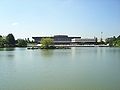 The main hall seen from the lake
 -
 Polytechnique cadets at the Bastille Day Military Parade
 -
 The Polytechnique bicorne hat


See also
[edit]
References
[edit]- ^ a b c d e "Study at École polytechnique". École polytechnique.
- ^ "Applications for the Bachelor program open on November 25th". École polytechnique.
- ^ a b "Arrêté du 25 février 2021 fixant la liste des écoles accréditées à délivrer un titre d'ingénieur diplômé – Légifrance". archive.wikiwix.com. Retrieved 29 May 2022.
- ^ Michel Nusimovici, Les écoles de l'an III, 2010.
- ^ "History - École polytechnique". www.polytechnique.edu. Retrieved 12 February 2024.
- ^ "Les élèves". École polytechnique, école d'ingénieur (in French). Retrieved 13 November 2022.
- ^ "Bachelor of Science". programmes.polytechnique.edu. Retrieved 13 November 2022.
- ^ "Career Paths". programmes.polytechnique.edu. Retrieved 13 November 2022.
- ^ Becquerel, Allais and Tirole.
- ^ Jean-Christophe Yoccoz (1994); Yoccoz was not a student at Polytechnique because he chose to be educated at École Normale Supérieure (1975–1979), but he completed his Ph.D. under Michael Herman in 1985 in the Centre de mathématiques Laurent Schwartz of École polytechnique, a research centre which had been created by another Field medalist and a professor at Polytechnique : Laurent Schwartz.
- ^ Sadi Carnot (who was the nephew of Carnot the physicist and the grandson of Carnot the École founder), Lebrun and Giscard.
- ^ "Présentation de l'École". programmes.polytechnique.edu. Retrieved 13 November 2022.
- ^ Programmes de l'enseignement polytechnique de l'École centrale des travaux publics [Polytechnic Education Programs of the Central School of Public Works]. Paris. 1795.
- ^ a b c d e f g h Grattan-Guinness, Ivor (March 2005). "The "Ecole Polytechnique", 1794–1850: Differences over Educational Purpose and Teaching Practice". The American Mathematical Monthly. 112 (3): 233–250. doi:10.2307/30037440. ISSN 0002-9890. JSTOR 30037440. Archived from the original on 4 November 2020.
- ^ Callot et al., "Le séminaire de la rue Descartes" ["The Seminar on Rue Descartes"].
- ^ Les Français peints par eux-mêmes. L'Armée, les écoles militaires, le garde national [The French Painted by Themselves: The Army, Military Schools, the National Guard]. Paris: Curmer. 1840. View 155.
- ^ "Histoire et patrimoine" [History and Heritage]. École polytechnique.
- ^ Albert Lévy; Gaston Pinet (1894). L'argot de l'X illustré par les X [The Argot of the X Illustrated by the Xs]. Preface by Armand Silvestre. Paris: Émile Testard. OCLC 803689559. BnF 34077236m. Retrieved 6 January 2013.
- ^ Mattatia, Fabrice (2004). Dictionnaire d'argot de l'X: Tout sur le langage des polytechniciens [Dictionary of the Argot of X: Everything about the Language of Polytechnicians]. Illustrated by Laurent Di Cesare and Jérémie Wainstain (2nd ed.). Paris: Lavauzelle. ISBN 2702512305..
- ^ "Admissions and Entrance Exams — International Exchange Program". École polytechnique. Archived from the original on 1 November 2015.
- ^ "Foire aux questions" ["Frequently Asked Questions"]. Polytechnique.org. Archived from the original on 20 February 2013.
- ^ Callot et al., "Évolutions récentes de l'enseignement" ["Recent Developments in Education"].
- ^ Stein, Henri (1889). "Recherches sur les débuts de l'imprimerie à Provins". Bibliothèque de l'école des chartes. 50 (1): 218–228. doi:10.3406/bec.1889.447566. ISSN 0373-6237.
- ^ Langins, Janis (1991). "La préhistoire de l'Ecole polytechnique". Revue d'histoire des sciences. 44 (1): 61–89. doi:10.3406/rhs.1991.4174. ISSN 0151-4105. JSTOR 23632816.
- ^ Capecchi, Danilo; Ruta, Giuseppe (1 January 2014). "European polytechnic schools in nineteenth century and Karlsruhe's exemplary case". Meccanica. 49 (1): 13–21. doi:10.1007/s11012-013-9866-9. ISSN 1572-9648. S2CID 254798029.
- ^ "1794–1804: Revolution and Napoleonic Period". École polytechnique. Retrieved 28 May 2022.
- ^ "Journal de l'École polytechnique". jep.centre-mersenne.org. Retrieved 29 May 2022.
- ^ a b c "19th century: thrust into the upheaval of the times". École polytechnique. Retrieved 28 May 2022.
- ^ a b Chappey, Jean-Luc (1 September 2004). "La Formation d'une technocratie. L'École polytechnique et ses élèves de la Révolution au Second Empire". Annales historiques de la Révolution française (in French) (337): 223–227. doi:10.4000/ahrf.1564. ISSN 0003-4436.
- ^ Organisation de l'Ecole Polytechnique. Ordonnance du 13 novembre 1830, Mon. univ. (15 November 1830) 1465–1466; also in Le globe (18 November 1830) 1085–1086 [with editorial remarks]; also in J. gén. civil 10 (1831) 87–97.
- ^ "20th century: wars lead to new orientations". École polytechnique. Retrieved 31 May 2022.
- ^ a b c d e f "From 1958 to 2018". École polytechnique. Retrieved 28 May 2022.
- ^ "Histoire de l'École polytechnique". enseignementsup-recherche.gouv.fr (in French). Retrieved 28 May 2022.
- ^ École polytechnique – Un cadre unique. Polytechnique.edu. Retrieved on 16 June 2014.
- ^ Code de l'éducation, L675-1
- ^ Arrêté du 12 septembre 2005 relatif à l'exercice de la tutelle du ministre de la défense sur divers organismes publics confiés à la délégation générale pour l'armement, article 1
- ^ Décret n°96-1124 du 20 décembre 1996 relatif à l'organisation et au régime administratif et financier de l'École polytechnique
- ^ Décret n° 2008-960 du 12 septembre 2008 fixant certaines dispositions d'ordre statutaire applicables aux élèves français de l'École polytechnique
- ^ First Period : General Education, web site
- ^ Arrêté du 14 août 2001 relatif à la formation militaire et à la formation à l'exercice des responsabilités des élèves français de l'École polytechnique prévues à l'article 2 du décret n° 2000-900 du 14 septembre 2000 fixant certaines dispositions d'ordre statutaire applicables aux élèves français de l'École polytechnique
- ^ Partners, official web site
- ^ Décret 87-16 du 14 janvier 1987: by exception to the general rule that staff in public establishments of an administrative character are civil servants, the teaching staff of Polytechnique is hired on contracts.
- ^ Décret n°2000-497 du 5 juin 2000 fixant les dispositions applicables aux personnels enseignants de l'École polytechnique
- ^ The French 'Grandes Écoles', École Poytechnique web site
- ^ Until 1988, the number of newly admitted French students was around 300 on a yearly basis; and until 1952, it was between 200 and 250.
- ^ International Exchange Program
- ^ Ingénieur Polytechnicien Program, an English-language page from the school's website, describing the engineering degree.
- ^ a b "Ingenieur Polytechnicien" (PDF). (5.79 MB) p. 74
- ^ "Top 20 des écoles d'ingénieurs qui paient le mieux à la sortie". Les Echos. 16 February 2017. Retrieved 15 September 2019.
- ^ "Admissions Criteria and Procedures".
- ^ MSc X-HEC Entrepreneurs : admission, inscription, prix...
- ^ Admission École polytechnique web site
- ^ Joly, Hervé (2012). "Les dirigeants des grandes entreprises industrielles françaises au 20e siècle". Vingtième Siècle. Revue d'histoire. 2 (114): 16–32. doi:10.3917/vin.114.0016.
- ^ "Ecole polytechnique". nturanking.csti.tw. Retrieved 22 October 2020.
- ^ "URAP – University Ranking by Academic Academic Performance". www.urapcenter.org. Retrieved 22 October 2020.
- ^ The world's best small universities 2016, 25 January 2016
- ^ "QS Top Universities 2021: Ecole polytechnique". QS Top Universities. Retrieved 17 June 2020.
- ^ [1] Archived 18 December 2008 at the Wayback Machine
- ^ Les inégalités sociales d'accès aux grandes écoles – Insee (PDF). INSEE. Retrieved 20 June 2020.
- ^ "Des classes préparatoires et des grandes écoles toujours aussi fermées". Inegalites. Retrieved 20 June 2020.
Bibliography
[edit]- Clark, Burton R. (1993). The Research Foundations of Graduate Education: Germany, Britain, France, United States, Japan. University of California Press. p. 412. ISBN 978-0-520-07997-7.
- Gillispie, Charles C. (2004). Science and Polity in France, the Revolutionary and Napoleonic Years. Princeton Universitv Press. ISBN 978-0-691-11541-2.
- Jean-Pierre Callot; Michel Camus; Bernard Esambert; Jacques Bouttes (23 June 2004). Histoire et Prospective de l'École polytechnique [History and Prospects of the École Polytechnique] (21 cm × 23 cm, hardcover with dust jacket, ill.) (2nd ed.). Paris: Lavauzelle. ISBN 978-2-702-50350-8. OCLC 464063564. BnF 35607251.
- "In France, the Heads No Longer Roll", The New York Times, Sunday, 17 February 2008
External links
[edit]

École polytechnique
View on GrokipediaNomenclature
Official Designations and Usage
The official French designation of the institution is École polytechnique, denoting a school focused on polymathic technical education, with "l'X" serving as the prevalent abbreviation in domestic usage and among alumni networks.[8] This shorthand, derived from the Roman numeral for 10 (symbolizing its prestige as one of France's top grandes écoles), appears in formal alumni associations and internal communications.[6] In English-language contexts, the institution is rendered as Polytechnic School to convey its foundational emphasis on multidisciplinary engineering and sciences, while retaining the original French name to preserve institutional specificity and avoid conflation with unrelated polytechnic entities globally.[8] Official international communications, including admissions and partnerships, consistently employ "École polytechnique" alongside this translation.[12] Since its incorporation as a constituent school in 2019, the Institut Polytechnique de Paris (IP Paris) has encompassed École polytechnique within a federated structure of five engineering grandes écoles, enabling shared doctoral training and research initiatives under the IP Paris umbrella without supplanting the core designation of École polytechnique.[13] This affiliation reflects administrative evolution toward collegiate models in French higher education, yet official documents and branding prioritize the standalone École polytechnique identity for its engineering cycle and legacy programs.[8]Historical Development
Origins and Foundation (1794–1804)
The École Centrale des Travaux Publics was established on March 11, 1794, by decree of the Committee of Public Safety amid the French Revolution's exigencies for national defense and infrastructure reconstruction.[1] This initiative addressed the acute shortage of trained engineers following the disruption of existing fragmented military academies and the demands of ongoing wars, which necessitated centralized preparation of personnel for artillery, fortifications, and public works.[1] Mathematician Gaspard Monge, a key proponent alongside Lazare Carnot, played a pivotal role in its conception, drawing on prior experiences in military engineering education to advocate for a unified institution prioritizing scientific rigor over traditional apprenticeship models.[14] Renamed École Polytechnique on September 1, 1795, the school emphasized foundational education in mathematics, physics, and chemistry to equip students for specialized applications in civil and military engineering.[1] Admission occurred through a rigorous competitive entrance examination (concours) open to candidates across France, ensuring selection based on aptitude in analytical reasoning rather than social privilege.[1] The curriculum centered on mathematical analysis and mechanics as core disciplines, with instruction from luminaries such as Pierre-Simon Laplace and Monge, who designed courses to foster verifiable problem-solving skills applicable to real-world challenges like ballistics and structural design.[15] This foundational approach reflected revolutionary priorities for utilitarian science, positioning the institution as a meritocratic engine for national utility by producing graduates capable of advancing artillery capabilities and civil projects without reliance on pre-revolutionary guilds or dispersed training facilities.[1] Initial classes, housed in repurposed royal buildings like the Palais-Bourbon, began with small cohorts subjected to intensive theoretical training before specialization elsewhere.[1]Militarization and Napoleonic Influence (1805–1815)
In 1804, Napoleon Bonaparte elevated the École Polytechnique to full military status, integrating it into the Empire's defense apparatus and establishing its enduring motto, "Pour la Patrie, les Sciences et la Gloire."[16] This shift imposed comprehensive military discipline, mandating student boarding, uniforms, and hierarchical ranks akin to officer cadets, which instilled a structured rigor that prioritized national service alongside scientific education.[17] The same year, the institution relocated to the premises of the former Collège de Navarre on the Montagne Sainte-Geneviève in Paris's Latin Quarter, accommodating the demands of militarized operations with expanded facilities for barracks and instruction.[16] Napoleon's reforms refocused the school's mission on producing engineers for military applications, channeling most graduates into the artillery and génie (military engineering) corps to address acute shortages in technical expertise during expansionist campaigns.[11] The curriculum, grounded in advanced mathematics, physics, and mechanics, was tailored for defense needs such as trajectory calculations and fortification design, with post-graduation specialization at institutions like the École d'Application de l'Artillerie et du Génie in Metz.[1] This alignment ensured a pipeline of approximately 100–150 annual graduates primed for frontline deployment, enhancing the French army's engineering proficiency amid the Grande Armée's growth to over 600,000 men by 1812.[18] The militarized framework yielded tangible results in Napoleonic engagements from 1805 to 1815, as alumni engineered critical infrastructure like pontoon bridges during the Ulm maneuver and fortified positions in the Russian campaign of 1812.[19] By 1811, a majority of artillery officers hailed from the École Polytechnique, contributing to operational efficiencies in siege warfare and logistics that sustained prolonged conflicts.[18] In March 1814, students directly supported Paris's defenses against the Sixth Coalition, exemplifying the discipline's causal role in elevating graduate effectiveness; Napoleon himself reviewed the school during his Hundred Days return in 1815, affirming its strategic value.[16]19th-Century Evolution and Challenges
Following the Bourbon Restoration in 1815, École Polytechnique underwent significant adjustments amid political shifts, including the dismissal of over 100 students perceived as overly republican in April 1816 and the temporary loss of its military status under Louis XVIII, reflecting efforts to align the institution with monarchical priorities.[16] Despite these changes, the school's rigorous concours entrance examination persisted as the primary merit-based selection mechanism, admitting approximately 200 students annually by the mid-century and ensuring an elite cohort drawn from competitive preparatory classes.[16] The institution regained its military character during the July Monarchy, with students actively participating in the 1830 July Revolution, where around 50 reinforced barricades and one, Louis Vaneau, was killed in combat, underscoring its entanglement with republican upheavals.[16] The mid-19th century saw expansions in scope toward practical engineering, as alumni increasingly applied their training in state corps like the Corps des Ponts et Chaussées, which oversaw infrastructure development including the rapid growth of France's railway network from initial lines in the 1830s to systematic expansion under laws of 1842. Polytechniciens dominated these technical bodies, with a majority of graduates—often exceeding 70% in early cohorts—entering public engineering roles that facilitated projects such as canal systems and early industrial metallurgy, contributing to France's industrial takeoff.[20] These applications demonstrated the school's causal influence on national modernization, though enrollment remained capped until 1871–1872, when annual intake doubled from 140 to 280 students to meet growing demands.[16] Challenges arose from the curriculum's intense focus on pure mathematics, which, while fostering analytical rigor through figures like Siméon Denis Poisson, prompted internal debates on its rigidity and potential lag in integrating emerging applied fields like thermodynamics until reforms under director Urbain Le Verrier (class of 1831) in 1850–1852 shifted emphasis toward practical sciences and laboratory work.[16] [21] Critics, including some faculty, argued for complementary balance between theoretical foundations and industrial relevance, yet evidence of sustained excellence persisted, as polytechniciens advanced applied mechanics and celestial calculations, underpinning verifiable contributions to fields like ballistics and hydraulics without supplanting the mathematical core.[21] This tension reflected broader 19th-century educational realism, prioritizing causal efficacy in training over unadapted abstraction.20th-Century Wars and Reorientations
During World War I, École Polytechnique experienced significant disruptions as its facilities in Paris were repurposed as a military hospital, and normal operations halted until 1919, with no national entrance examination conducted in 1915.[22] Alumni, many of whom had been directed toward the army's technical branches such as artillery and engineering prior to the war, were rapidly mobilized, contributing to over 800 deaths among Polytechniciens, including 260 students from the classes of 1911 to 1918.[22] This wartime integration underscored the school's military orientation, enabling alumni to apply their scientific training directly to frontline engineering needs despite institutional interruptions.[23] In World War II, following the 1940 armistice and German occupation of northern France, the school was relocated to Lyon in the unoccupied zone, where it again lost its military status, and its Paris buildings were allocated to the Red Cross.[22] Operations resumed in Lyon under civilian administration, but the institution returned to Paris in 1943 and was placed under the Ministry of War by September 1944 after liberation.[22] Alumni demonstrated resilience through active participation in the Resistance, with 250 students dying in military campaigns or combat, 60 in deportation, and 33 recognized as Companions of the Liberation for their contributions.[22] The temporary loss of military status highlighted vulnerabilities during foreign occupation but facilitated postwar recovery by preserving core faculty and student cadres. Post-1945, École Polytechnique regained its military status, which supported institutional stability and adaptation to national priorities in nuclear energy and aerospace engineering amid France's industrial reconstruction.[24] Alumni played pivotal roles in the French atomic program, providing technical expertise essential to the Commissariat à l'énergie atomique (CEA) established in 1945.[22] Curriculum and research reorientations emphasized these fields to meet strategic demands, while enrollment expanded—admissions rising from around 200-300 annually prewar to approximately 400 by the 1960s—allowing greater intake without compromising the rigorous mathematical and scientific core.[10] Diversification into economics and management training emerged to address civil sector needs, yet technical disciplines remained predominant, ensuring alumni versatility in industry while prioritizing causal applications in defense and energy sectors.[22] A 1957 decree reformed the Development Council under President Louis Armand, further aligning the school with postwar technological imperatives.[22]Postwar Expansion and Modernization (1945–Present)
In the postwar era, École Polytechnique experienced substantial growth aligned with France's emphasis on scientific and technological reconstruction, including increased enrollment to support national research priorities in nuclear energy and defense.[10] This expansion was facilitated by the 1976 relocation from central Paris to the Palaiseau plateau, which provided larger facilities and strategic proximity to institutions such as the Commissariat à l'énergie atomique (CEA), the Centre national de la recherche scientifique (CNRS), and the University of Paris-Sud, enabling enhanced collaboration on applied sciences.[10] [25] The move accommodated rising student numbers, with the institution adapting to broader higher education reforms that promoted clustering of elite engineering schools around research hubs.[26] The school transitioned to full coeducation in the mid-1980s, following initial female admissions in 1972, which gradually diversified the student body—reaching approximately 13% female enrollment by 2013—without documented disruptions to academic standards or output quality based on available institutional data.[27] This shift supported France's push for inclusive technical education amid evolving societal norms, while maintaining rigorous selection via national concours.[28] By the 2010s, enrollment stabilized around 400-500 in the core ingénieur program annually, reflecting sustained demand and integration into national service obligations.[29] In 2019, École Polytechnique co-founded the Institut Polytechnique de Paris (IP Paris) with ENSTA Paris, ENSAE Paris, Télécom Paris, and Télécom SudParis, forming a collegiate university to foster interdisciplinary research and education in science, technology, and economics.[30] This initiative, endorsed by the French government, included partnerships such as with HEC Paris for multidisciplinary programs and international ties with institutions like ETH Zurich, aimed at elevating global rankings and attracting funding for joint projects in areas like high-energy physics.[31] [32] Recent modernization efforts, detailed in the 2023 annual report, have prioritized expansions in strategic fields including artificial intelligence, cybersecurity, and quantum technologies, with new courses and research centers to address national priorities in digital sovereignty and innovation.[29] This aligns with IP Paris's interdisciplinary centers tackling societal challenges, supported by collaborations with entities like Inria and the French Ministry of Armed Forces.[33] Alumni-founded startups have underscored this trajectory, with seven labeled French Tech120 in 2025—Wandercraft, Exotrail, Pasqal, Ekimetrics, OuiHelp, Veesion, and Voltalis—highlighting success in robotics, space, quantum computing, and energy efficiency, contributing to France's scale-up ecosystem.[34] Additionally, 25 IP Paris-linked scale-ups featured in the 2025 Next40/120 selection, representing a quarter of the cohort and demonstrating robust entrepreneurial output.[35]Institutional Framework
Governance and Legal Status
École Polytechnique operates as a public establishment for higher education and research (établissement public d'enseignement supérieur et de recherche), classified as a grand établissement under the tutelage of the French Ministry of Armed Forces through the Direction Générale de l'Armement.[36] This status, codified in Decree n° 2015-1176 of September 24, 2015, positions the institution as a national asset for scientific and technological advancement, with funding primarily from state budgets allocated via the ministry to support its missions in education, research, and innovation.[36] The arrangement ensures fiscal accountability to the government while permitting operational flexibility, as evidenced by the school's ability to form strategic partnerships without direct ministerial veto on academic decisions.[37] The administrative hierarchy centers on the Conseil d'administration, comprising 15 voting members including the president, director-general, six state representatives, and nine qualified personalities selected for expertise in science, industry, or administration.[36] The president, appointed by decree in the Council of Ministers for a five-year renewable term following a public selection process, chairs the board and defines strategic orientations, prioritizing merit-based input to mitigate undue political influence.[36] The director-general, a general officer appointed similarly by decree—such as Laura Chaubard on October 5, 2022—manages executive functions, including resource allocation and implementation, under the president's oversight.[38] [36] This structure, with its emphasis on external experts, links decision-making to empirical competence and long-term institutional goals rather than transient governmental priorities, fostering resilience in governance.[36] As a founding member of the Institut Polytechnique de Paris (IP Paris) established by Decree n° 2019-549 of May 31, 2019, École Polytechnique integrates into collaborative frameworks like Université Paris-Saclay for joint graduate training and research initiatives, without surrendering its distinct legal autonomy.[39] This affiliation aligns the school with national research ecosystems—evident in shared facilities and funding streams—while the Conseil d'administration retains authority over core operations, enabling independent pursuit of excellence amid broader priorities such as interdisciplinary innovation.[40] The model's causal efficacy lies in leveraging public oversight for resource stability alongside internal meritocracy for adaptive strategy, as demonstrated by sustained high rankings in global science metrics despite evolving national agendas.[36]Military Status and National Service Obligations
French nationals admitted to the École Polytechnique's Ingénieur Polytechnicien program enter as paid officer cadets with military status, receiving remuneration equivalent to that of midshipmen starting in their second year, while international students maintain civilian status.[24][12] This framework, overseen by a general officer, requires French cadets to wear military uniforms, including the distinctive Grand Uniforme with bicorn hat and sword, and fosters values of commitment, self-sacrifice, and prioritization of national interests through structured discipline.[24] Initial military formation for all first-year students includes a compulsory three-week intensive at the La Courtine camp in September, emphasizing command, leadership, and team dynamics, followed by a six-month "human training" period in the armed forces, national gendarmerie, or approved civilian organizations.[24] Upon completion of the four-year program, French graduates are commissioned as second lieutenants or ensigns in the army or gendarmerie, with many initially assigned to the Ministry of Armed Forces, directing talent toward defense-related roles and elite technical corps such as the Corps de l'armement.[24] The national service obligation mandates that French graduates commit to at least ten years of public or civil service within twenty years of graduation to waive any training cost repayment, estimated at €21,000–€31,000 depending on post-graduation choices, with prorated reductions for partial service; failure to comply requires financial reimbursement to the state.[41] This payback mechanism channels alumni into high-caliber positions in civil engineering corps (e.g., Corps des Ponts et Chaussées, Corps des Mines) or military-technical bodies, ensuring a steady supply of technically proficient leaders aligned with French sovereignty and defense needs, as evidenced by over one-third of graduates entering public administration roles upon completion.[24] The structure empirically enhances institutional loyalty and national focus, producing cadres who contribute disproportionately to strategic sectors amid France's emphasis on sovereign technological capabilities.[24]Physical Infrastructure
Early Sites and Relocations
The École Polytechnique was founded on 7 March 1794 as the École Centrale des Travaux Publics and initially housed in the Palais Bourbon in Paris, a site chosen for its availability amid revolutionary upheavals and proximity to government institutions.[42] In September 1795, following its renaming to École Polytechnique, the school relocated to the adjacent Hôtel de Lassay, a former private mansion that provided expanded space for lectures and student quarters while maintaining logistical ties to central administrative centers.[43] These early Paris locations reflected the institution's origins in responding to national engineering needs during wartime scarcity, though they proved temporary due to growing enrollment and evolving military priorities. In 1805, Emperor Napoleon I ordered the school's transfer to the Montagne Sainte-Geneviève in Paris's Latin Quarter, repurposing buildings from suppressed religious colleges into a dedicated campus to align with its new status as a militarized academy.[44] This site, atop a hill overlooking the Seine, was selected for its strategic defensibility, ample space for barracks and laboratories, and central position amid intellectual hubs like the Sorbonne and Collège de France, which enabled direct interactions with scholars and resources essential for interdisciplinary engineering training.[45] The relocation solidified networks with Parisian scientific communities, as evidenced by shared professorial roles and collaborative projects in mathematics and physics that persisted through the 19th century. The Montagne Sainte-Geneviève campus hosted the school continuously from 1805 until 1976, serving as its primary base despite periodic adaptations for urban growth. During World War II, after the June 1940 armistice and German occupation of northern France, the institution was evacuated to Lyon in the Vichy-controlled free zone to evade requisition and ensure operational continuity, with its Paris facilities allocated to the Red Cross and military status suspended.[22] This move, spanning 1940 to 1943, involved significant logistical disruptions including dispersed faculty and interrupted curricula, though it preserved core activities until the school's return to Paris following Allied advances; the period underscored vulnerabilities of urban centrality during conflict, prompting temporary reliance on provincial infrastructure.[22]Palaiseau Campus Establishment and Features
The Palaiseau campus of École Polytechnique was established in 1976 through the relocation of the institution from central Paris to the Plateau de Saclay, approximately 20 kilometers south of the city.[46][25] This move positioned the school adjacent to major research entities such as the Commissariat à l'énergie atomique (CEA) and the Centre national de la recherche scientifique (CNRS), facilitating synergies in scientific endeavors.[10] The site encompasses over 160 hectares, incorporating dedicated laboratory spaces, academic buildings, student residences, and extensive green areas designed to support both pedagogical and investigative activities.[25][47] Central to the campus layout are modular teaching facilities, including approximately 50 classrooms and 15 lecture halls, optimized for scalable educational delivery in engineering and scientific disciplines.[47] Residential infrastructure provides around 1,836 units exclusively for students, enabling on-site living that minimizes commuting and enhances focus on academic pursuits.[48] The design emphasizes functional integration of research laboratories with instructional spaces, promoting efficient knowledge transfer and interdisciplinary collaboration within a compact yet expansive environment.[9] As a core component of the Institut Polytechnique de Paris (IP Paris), the Palaiseau campus benefits from shared infrastructure across the broader 200-hectare IP Paris expanse, which includes adjacent institutions like ENSTA Paris and Télécom Paris.[13] This ecosystem configuration supports advanced research domains while maintaining École Polytechnique's distinct operational footprint, with amenities tailored to sustain high-density scientific output and student capacity of approximately 3,600.[9][13]Recent Infrastructure Projects
In May 2024, École Polytechnique announced the Renov'X project, a comprehensive restructuring of 24,000 m² encompassing its central main building and research laboratories.[49] This initiative, backed by a 130 million euro investment, seeks to overhaul workspaces, teaching environments, and social areas to foster innovation, openness, and sustainability while accommodating evolving pedagogical and scientific demands.[49][46] Site preparation and initial works are underway, with full-scale renovation scheduled to commence in spring 2026.[50] Complementing Renov'X, École Polytechnique unveiled plans in September 2025 for a new dedicated research building on the Palaiseau campus.[50] This facility will consolidate two key laboratories—the Laboratory of Physics of Interfaces and Thin Films (LPICM) and a complementary unit—under one roof to enhance collaboration, streamline operations, and support the institution's expansion in high-impact research domains.[51] The project aligns with the school's broader performance and transformation strategy, addressing capacity constraints amid rising enrollment and interdisciplinary deeptech pursuits.[50] These developments respond to documented needs for upgraded physical infrastructure to sustain competitive edge in fields like advanced computing and materials science, as identified in institutional assessments following the post-2020 campus optimization reviews.[46] Expansion of student housing is also under consideration to accommodate growth linked to the X-UP deeptech incubator, which has scaled to support over 50 startups since its 2018 inception, though specific timelines remain pending.[52]Educational Offerings
École Polytechnique enrolls approximately 3,700 students across its programs, with admissions emphasizing exceptional scientific aptitude, academic excellence, and potential.[53]Ingénieur Polytechnicien Program
The Ingénieur Polytechnicien Program constitutes the cornerstone of École Polytechnique's educational mission, cultivating a cadre of versatile, high-caliber engineers equipped for leadership in science, industry, and public service through a demanding, merit-based curriculum grounded in fundamental sciences. This flagship 4-year post-baccalauréat engineering cycle enrolls approximately 500 to 600 students each year, extremely competitively selected via national and international entrance examinations comprising admissibility and admission phases, primarily for French students from top classes préparatoires or international equivalents under 25, with Morocco as a leading source of international candidates via the CPGE pathway—where, for the 2025 cycle, 497 registered, 63 were admissible, and 24 entered (21% of international entrants), following a trend of 20-40 per year including 29 in 2024, supported by local exam centers and lycées like LYDEX Benguérir, and minimal entries via university pathways—assessing proficiency in mathematics, physics, and related disciplines and leading to Master-level degrees.[54] The core structure unfolds over three years on the Palaiseau campus, yielding the diploma d'ingénieur at the Master's level (equivalent to 120 ECTS credits), with provisions for a fourth year of advanced specialization often pursued abroad or in partner institutions.[55] The inaugural year fuses military discipline with scientific initiation, underscoring the program's alignment with France's defense imperatives. From September to March, cadets complete basic military training, including physical conditioning, leadership exercises, and ethical formation under the Ministry of the Armed Forces, instilling resilience and collective ethos. This phase transitions into academic immersion in core subjects such as advanced mathematics, physics, chemistry, and computer science, delivered through lectures, problem-solving sessions, and laboratory work, with approximately 30 hours of weekly coursework.[56][57] Subsequent years intensify disciplinary depth while preserving breadth. The second year builds on foundational knowledge with specialized modules in applied mathematics, mechanics, economics, and humanities, culminating in a compulsory three-month internship in industry, research, or abroad to bridge theory and practice. Emphasis remains on quantitative rigor, with mathematics and physics comprising over half the curriculum, fostering analytical prowess essential for complex problem-solving. In the third year, students elect a scientific major—options including energy systems, data science, biology, or economics—entailing advanced coursework, projects, and seminars tailored to emergent technological challenges, thereby transitioning from generalist training to domain expertise.[58][59][60] Graduation hinges on cumulative performance, yielding a class ranking that governs placement into prestigious civil or military engineering corps, such as the Corps des Mines or Corps des Ponts, where alumni repay state-subsidized tuition—nominally €13,000 annually but effectively covered by waived fees—through a 10-year service commitment in public administration, defense, or approved private-sector roles aligned with national interests. This mechanism ensures meritocratic allocation of elite positions, with top-ranked graduates accessing high-responsibility postings in policy, R&D, or infrastructure, while reinforcing the program's role in sustaining France's technical sovereignty.[58][61]Undergraduate and Specialized Degrees
The Bachelor of Science program at École Polytechnique is a three-year undergraduate degree, fully taught in English and accredited as equivalent to a French licence, emphasizing foundational training in mathematics, physics, economics, and computer science through a multidisciplinary curriculum totaling 180 ECTS credits.[62][63] Launched to broaden access beyond the traditional French classes préparatoires pathway, it admits approximately 146 students annually as of the 2024–2025 intake from over 1,300 applicants, with enrollment reaching 432 students across cohorts by that year following expansions from an initial 71 students in earlier years; the program features small class sizes and approximately 80% international students from 37+ nationalities.[64][65][62] Admissions require strong high school performance in mathematics and sciences, advanced courses, C1-level English proficiency (e.g., TOEFL iBT 90+ or IELTS 6.5+), an online application including transcripts, CV, personal statement, and references, followed by an interview, with holistic evaluation.[66] Unlike the Ingénieur Polytechnicien program, participants face no military service obligations, enabling direct preparation for master's-level studies or professional entry while attracting a predominantly international cohort oriented toward global scientific careers.[62] Students customize their studies via double majors, such as Mathematics and Physics or Mathematics and Computer Science, with the latter incorporating foundational elements for artificial intelligence through advanced algorithms and data structures.[67] Specialized tracks extend to quantum technologies within physics-oriented paths, integrating quantum mechanics, information theory, and computational modeling to address emerging fields like quantum computing.[62] These options, refined in program updates through 2023, align with institutional priorities in high-impact domains, fostering skills for subsequent graduate pursuits without the extended commitment of the core engineering cycle.[68] The program's selectivity and English-medium delivery support over 40% international enrollment school-wide, with the Bachelor specifically targeting non-French applicants to diversify talent pipelines.[69]Graduate and Doctoral Training
École Polytechnique offers graduate-level master's programs primarily through the Master of Science and Technology (MSc&T), a two-year curriculum designed to provide advanced, multidisciplinary training in fundamental and applied sciences. These programs, delivered in collaboration with the Institut Polytechnique de Paris (IP Paris), span fields including mathematics, computer science, chemistry, economics, energy, mechanics, physics, data science, finance, and biological sciences.[70][71] The majority of courses are taught in English, emphasizing state-of-the-art methodologies and practical applications to equip graduates for roles in research, technology development, and industry leadership.[71] Integration with research activities is a key feature, allowing students to engage in projects that bridge theoretical knowledge and innovative problem-solving, often in partnership with IP Paris laboratories. This structure supports dual-degree options and pathways toward doctoral studies, fostering skills in areas like artificial intelligence and sustainable energy that align with practical technological advancement.[72][73] Doctoral training occurs under the IP Paris Doctoral School, where École Polytechnique supervises PhD candidates in original research across disciplines such as physics, biology, chemistry, mathematics, engineering, computer science, economics, and social sciences. Standard programs last three years, with research conducted in over 30 affiliated laboratories, while a five-year PhD Track accommodates bachelor's graduates by incorporating initial master's-level coursework.[74] These efforts prioritize funded theses supported by sources including the French Ministry of Higher Education (MESR), national research bodies like CNRS and CEA, and industry via CIFRE contracts, which embed doctoral work in company-led innovation projects.[74] The emphasis on strategic domains, such as high-tech engineering and energy technologies with CEA collaborations, ensures doctoral outputs contribute to national priorities including defense and advanced manufacturing.[74] This research-oriented approach promotes causal linkages between academic inquiry and real-world applications, with graduates frequently advancing to positions in academia, government labs, or private sector R&D.[74]Research and Innovation
Organizational Structure of Research
École Polytechnique's research is structured around 23 laboratories, which function as joint research units primarily affiliated with national organizations including the CNRS, INRIA, and INSERM.[75] These laboratories maintain a decentralized organization focused on core disciplines such as mathematics, physics, chemistry, biology, economics, mechanics, and human sciences, enabling specialized investigations while sharing resources and expertise with partner institutions.[75] This setup is embedded within the Institut Polytechnique de Paris (IP Paris), a consortium that coordinates efforts across its member schools, aggregating approximately 30 laboratories into 10 disciplinary departments and 3 interdisciplinary hubs dedicated to energy, artificial intelligence, and defense.[75] The IP Paris framework promotes cross-institutional collaboration, allowing École Polytechnique's units to participate in larger-scale projects without centralizing all operations under a single hierarchy.[76] The laboratories employ over 1,600 staff, encompassing permanent researchers, postdoctoral fellows, and technical personnel, who conduct investigations in a coordinated manner through shared governance with affiliated bodies.[75] Funding derives from a blend of public sources—such as allocations from the CNRS and other state agencies—European Union programs like ERC grants, and industry partnerships that support applied research contracts.[75] [77] This model balances autonomy in discipline-specific units with IP Paris-led interdisciplinary initiatives, facilitating both fundamental advancements and responses to complex challenges requiring multi-unit input.[76]Primary Research Domains and Outputs
École Polytechnique maintains 23 research laboratories staffed by over 1,600 researchers, focusing on disciplines including mathematics, physics, chemistry, biology, and engineering, with emphasis on applied sciences yielding verifiable economic and defense applications.[75] Outputs are quantified through metrics such as Nature Index shares, where chemistry accounts for 27 articles with a 3.55 fractional count and earth & environmental sciences for 47 articles with a 2.44 count, reflecting contributions to foundational technologies like materials and climate modeling.[78] In artificial intelligence, the institution demonstrates leadership via the "AI, Science and Society" conference held February 6-7, 2025, which convened experts to address AI's causal mechanisms in scientific advancement and risk mitigation, prioritizing empirical validation over speculative deployment.[79] Quantum technologies represent another core domain, with laboratories advancing neutral-atom and other architectures that underpin hardware for optimization problems in logistics and cryptography; this has catalyzed startups like Pasqal, co-directed by alumni and leveraging faculty expertise for scalable quantum processors targeting industrial simulations.[80][81] Cybersecurity research integrates with national priorities, as outlined in the 2023 annual report, which details expansions in protective protocols amid rising threats, emphasizing resilient systems for critical infrastructure over theoretical models.[29] Annual outputs include 10 to 20 priority patent filings, directed toward transferable innovations in energy transition and secure computing, ensuring causal links to deployable technologies rather than isolated proofs-of-concept.[82] Translational impact is evident in alumni-founded enterprises, with multiple ventures—such as those co-founded by graduates—selected for the 2025 French Tech Next40/120 cohort, fostering economic value through AI and quantum-derived tools applied in sectors like finance and manufacturing.[35] These firms exemplify the prioritization of measurable productivity gains, with examples including Mistral AI for language models grounded in efficiency benchmarks.[83]Campus Community
Student Demographics and Traditions
The student body of École Polytechnique's Ingénieur Polytechnicien program, the institution's flagship engineering cycle, consists of approximately 500 new entrants annually, selected through a highly competitive national entrance examination following two years of intensive preparatory classes (classes préparatoires). This merit-based admission process ranks candidates solely on performance in mathematics, physics, and related sciences, minimizing direct influence of socioeconomic privilege during final selection, though access to quality preparatory education can favor urban and affluent backgrounds. Around 24% of students in initial education programs are female, a figure reflecting gradual progress since women were first admitted in 1972, with the school targeting 30% female enrollment by 2026. International students comprise about 40% of the overall student population, drawn from over 100 nationalities, enhancing diversity in the predominantly French cohort.[84][85][86] Student traditions at École Polytechnique are deeply rooted in its militarized structure, established under Napoleon in 1804, emphasizing discipline, hierarchy, and national service. Cadets, granted military status upon entry, undergo initial three-week basic training at La Courtine camp and later six months of practical assignments in armed forces or civilian roles, fostering resilience through structured rigor. Ceremonial practices include the annual flag handover presided over by high-ranking officers, where the school's flag—bearing the motto "Pour la Patrie, les Sciences et la Gloire"—is presented to the incoming class, symbolizing continuity and duty. Participation in the Bastille Day military parade on the Champs-Élysées, a tradition since 1887, involves hundreds of students marching in grand uniform (complete with bicorne hat and sword), reinforcing esprit de corps and public visibility of the institution's military ethos.[24][87][88] Daily life balances intense academics—often exceeding 30 hours of classes weekly in early years—with mandatory physical training across 15 disciplines, six hours per week under military instructors, cultivating endurance and teamwork. Social rituals, such as the Bal de l'X featuring traditional quadrilles at the Opéra Garnier, provide outlets for camaraderie amid the demanding schedule, though the hierarchical ranking system from entrance exams continues to influence peer dynamics throughout. These elements collectively instill a culture of excellence and sacrifice, aligned with the school's dual civil-military mission.[24][89]Extracurricular Activities and Sports
Students at École Polytechnique engage in nearly 250 student associations, known as binets, which span cultural, artistic, social, scientific, religious, and sporting domains, with over 75% of students participating to cultivate responsibility and initiative.[90] These clubs facilitate leadership development by involving students in event organization and management, such as through La Kès, established in 1804, which coordinates international student support and association oversight.[90] Debating societies participate in national competitions organized by the French Debating Association, including finals against institutions like Sciences Po, honing analytical and rhetorical skills essential for professional discourse.[91] Entrepreneurship clubs integrate with the school's X-UP incubator at the Drahi-X Novation Center, where students access programs for early-stage deeptech startups, prototyping facilities, and mentorship to translate academic knowledge into ventures.[52] This setup encourages practical innovation, contrasting with peers focused solely on theoretical studies by providing hands-on experience in project leadership and market validation.[92] The CXS (X Sport Club) oversees 16 athletic activities, mandatory at 4-6 hours weekly for engineering students to promote physical health, ethical conduct, and team coordination.[93] Facilities include indoor elements like two pools, an armory with 11 fencing pistes, a dojo, and fitness room, plus outdoor options such as rugby pitches, a 400m track, and equestrian center.[93] Competitive teams contend in university and military championships, the La Défense grandes écoles tournament, and international events, exemplified by the annual Challenge X-Systra fencing competition, which draws over 150 participants from 30 nationalities.[94] These pursuits build resilience and collaborative abilities, equipping students for high-stakes environments beyond classroom rigor.[93]Achievements and Recognition
Notable Alumni Contributions
Graduates of École Polytechnique, known as polytechniciens, have driven empirical advancements in physics, economics, and mathematics, evidenced by multiple Nobel Prizes and a Fields Medal. Henri Becquerel (class of 1872) discovered natural radioactivity in uranium salts in 1896, laying foundational work for nuclear physics and sharing the 1903 Nobel Prize in Physics with Pierre and Marie Curie for this breakthrough, which enabled subsequent developments in radiology and atomic energy.[95] Maurice Allais (1933) earned the 1988 Nobel Prize in Economics for contributions to welfare economics and market efficiency, including the Allais paradox challenging expected utility theory and influencing resource allocation models used in policy analysis.[95] [10] Jean Tirole (1981) received the 2014 Nobel Prize in Economics for his analysis of market power and regulatory mechanisms, providing frameworks adopted in antitrust policies and platform economics that have shaped competition laws in the European Union.[95] In mathematics, Jean-Christophe Yoccoz (1975) was awarded the 1994 Fields Medal for proving stability in Hamiltonian systems, advancing dynamical systems theory with applications to celestial mechanics and chaos prediction in engineering simulations.[96] Alumni have influenced French economic policy through high-level political roles, with three serving as presidents of the Republic, contributing to national modernization. Valéry Giscard d'Estaing (1950), president from 1974 to 1981, oversaw annual GDP growth averaging 3.1% and liberalized markets by abolishing price controls in 1978, fostering industrial expansion amid the oil crises.[96] Emmanuel Macron (1995), president since 2017, implemented the 2017 labor ordinance reforming the code to ease hiring and firing, correlating with a drop in unemployment from 9.4% in mid-2017 to 8.5% by 2018 before external shocks.[97] In industry, polytechniciens have led innovations in manufacturing and defense. André Citroën (1898) founded Automobiles Citroën in 1919, applying Taylorist methods to achieve Europe's first mass-produced automobiles, outputting 100 units daily by 1920 and introducing front-wheel drive in the 1934 Traction Avant model, which boosted French automotive exports.[9] Conrad Schlumberger (1907) co-founded Schlumberger in 1926, pioneering electrical resistivity logging for oil exploration, enabling precise subsurface mapping that increased global petroleum recovery rates from under 30% to over 35% by the mid-20th century.[9] In defense, alumni dominate leadership in firms like Thales Group, with executives from the Corps des Mines corps contributing to radar and avionics systems integral to France's military exports, valued at €11.8 billion in 2023.[97] [98] While these merit-based achievements underscore technical prowess, alumni networks have drawn critique for concentrating influence, potentially limiting diverse inputs in decision-making.[98]Institutional Rankings and Metrics
In global university rankings, the Institut Polytechnique de Paris (IP Paris), of which École Polytechnique is a founding member, placed 41st worldwide and 2nd in France in the QS World University Rankings 2026, reflecting strong performance in academic reputation, employer reputation, and citations per faculty.[99] It ranked 68th globally and 2nd nationally in the Times Higher Education World University Rankings 2026, with subject-specific scores of =96th in engineering and 42nd in computer science.[100] In the Academic Ranking of World Universities (ARWU) 2025, IP Paris rose 99 places to 224th worldwide and 9th in France, driven by indicators such as highly cited researchers and publications in top journals.[101] Subject rankings underscore École Polytechnique's excellence in core disciplines: IP Paris tied for 40th globally in engineering and technology in QS by Subject 2025, positioning it as a leader among French institutions.[102] Domestically, École Polytechnique consistently tops rankings for grandes écoles, scoring 103.5 out of 119 to claim 1st place in L'Étudiant’s 2025 engineering schools assessment, evaluating factors like academic excellence, internationalization, and insertion professionnelle.[103] It also led Le Figaro Étudiant’s 2025 post-prépa engineering rankings with 18.8/20, ahead of peers like ENSTA Paris.[104]| Ranking Organization | Global Position | France Position | Year | Key Metrics Emphasized |
|---|---|---|---|---|
| QS World University | 41 | 2 | 2026 | Employer reputation, citations |
| THE World University | 68 | 2 | 2026 | Research quality, industry income |
| ARWU (Shanghai) | 224 | 9 | 2025 | Publications, Nobel/Fields affiliates |
| QS Engineering & Tech | 40 | 1 | 2025 | H-index, employer survey |