



Community hub
Anson Carter
View on Wikipedia
Anson Horace Carter (born June 6, 1974) is a Canadian former professional ice hockey right winger who played in the National Hockey League (NHL) for eight teams from 1996 to 2007, most notably with the Boston Bruins, Edmonton Oilers and Vancouver Canucks. He was last active as a player with HC Lugano in the Swiss Nationalliga A. After retiring from professional hockey, he joined NBC Sports as an analyst and is now currently an analyst for NHL on TNT and MSG Network.
Key Information


Carter is also the founder of Big Up Entertainment, a record label specializing in hip hop music. He attended high school at Agincourt Collegiate Institute[1] and attended Michigan State University where he played at the college level. He is of Bajan descent.[2]
Early life
[edit]Anson Carter was born on June 6, 1974, in Toronto, Ontario.[3] He is one of three children of Horace and Valma Carter, who emigrated from Barbados.[4] He started playing hockey seriously at the age of eight. Carter received a scholarship to play hockey at Michigan State University (MSU) in 1992.[5]
Playing career
[edit]Carter was drafted by the Quebec Nordiques in the 1992 NHL entry draft in the 10th round, 220th overall, after playing AAA level hockey in the Metro Toronto Hockey League.
After completing his AAA hockey career, Carter played one season in the Metro Junior 'A' Hockey League for the Wexford Raiders, scoring 18 goals and adding 22 assists for 40 points in 42 games,[6] helping the Raiders to a league title as a result of sweeping the Bramalea Blues 4–0 in the championship final. (Incidentally, the Raiders' head coach was Stan Butler, current special advisor to the owner of the Ontario Hockey League's North Bay Battalion).[7]
Carter went on to play four years at Michigan State University, earning himself honours on the CCHA First All-Star Team in 1994 and 1995, Second All-Star Team in 1996, as well as the NCAA West Second All-American Team in 1995.[8]
On April 3, 1996, the Nordiques' successor, the Colorado Avalanche, traded his rights to the Washington Capitals in exchange for a fourth-round pick in the 1996 NHL entry draft.
Carter made his professional debut in 1996–97, splitting his time with the Capitals and their American Hockey League (AHL) affiliate, the Portland Pirates, before being traded to the Boston Bruins on March 1, 1997. As part of a blockbuster deal, Carter was sent with Jason Allison, Jim Carey, a third-round selection in the 1997 draft (63rd overall–Lee Goren) and a conditional second-round pick in the 1998 draft to the Bruins in exchange for Adam Oates, Bill Ranford and Rick Tocchet.[9][10] Both Carter and Tocchet would work together as studio analysts with the NHL on TNT nearly a quarter of a century later beginning in 2021.[11]
After spending several seasons with the Bruins, Carter was traded (along with a conditional pick in the 2003 draft, a first- and a second-round pick in the 2001 draft) to the Edmonton Oilers in exchange for Bill Guerin and a first-round pick in the 2001 draft. In his second season with Edmonton, Carter would record career-highs in assists (32) and points (60). However, on March 11, 2003, he was again traded, to the New York Rangers (along with Aleš Píša) in exchange for Radek Dvořák and Cory Cross.
At the completion of the 2002–03 season, Carter played for Canada in the 2003 World Championships. Over 14 minutes into the first overtime of the gold medal game against Sweden, Carter beat Swedish goaltender Mikael Tellqvist with a wraparound goal. The goal was contested for several minutes before replays confirmed Tellqvist had stopped the puck behind the goal line. It was Canada's first World Championship win in five years.[12]
Lasting half a season with the Rangers, Carter was traded back to the Washington Capitals on January 23, 2004, in exchange for Jaromír Jágr. His second go with the Capitals was even more short-lived than his stint with New York, as he was flipped to the Los Angeles Kings for Jared Aulin just over a month later on March 8, 2004.
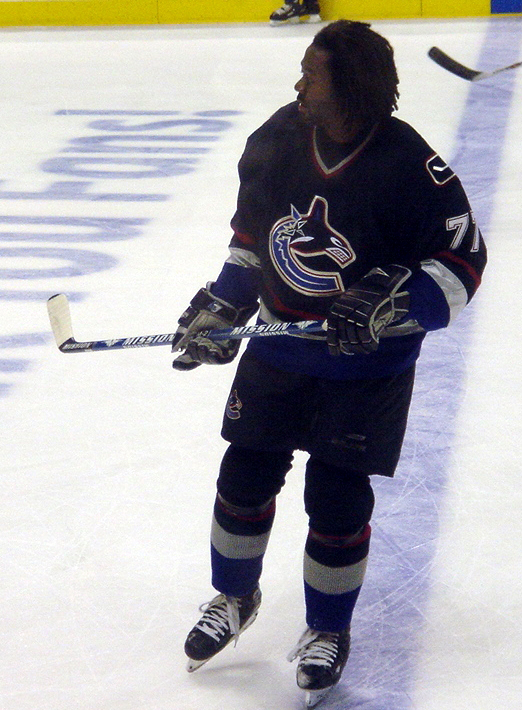
On August 16, 2005, Carter signed a one-year contract with the Vancouver Canucks as an unrestricted free agent.[13] He played in Vancouver on the second offensive line with twins Henrik and Daniel Sedin, where the trio were known colloquially as the "Brothers Line".[14] He set a new career-high in goals with 33, leading the team, and earned the Canucks' Most Exciting Player Award. However, he did not re-sign with the Canucks at the end of the season.
On September 13, 2006, Carter signed a one-year contract with the Columbus Blue Jackets,[15] but was traded once again to the Carolina Hurricanes on February 23, 2007, in exchange for a fifth-round pick in the 2008 NHL draft (Tomas Kubalik).[16]
In September 2007, Carter rejoined the Edmonton Oilers on a try-out basis during their training camp, and played one exhibition game before being released on October 2, 2007.[17] Without an NHL job, on November 5, Carter joined HC Lugano of the Swiss Nationalliga A.
Post-playing career
[edit]After playing in the NHL for 11 seasons, Carter began his post-hockey career in 2013 with the NBC Sports coverage of NHL regular season, and Stanley Cup Playoffs games. Besides covering the professional ranks, Carter provides game analysis for NBCSN's Notre Dame's Fighting Irish college hockey. Additionally, Carter also made his debut as part of the 2018 Olympic coverage of the PyeongChang Winter games.[5][18]
On Canadian television, starting in 2022, Carter was a panelist on Sportsnet's Rogers Monday Night Hockey NHL broadcasts.[19] He continues to be on Sportsnet NHL coverage in 2024.
Carter founded the Big Up Entertainment record label in March 2005. The label's first release was from Richmond, Virginia, natives Main & Merc.[20]
Carter now lives in Atlanta, Georgia. In 2022, Carter become the minority owner of the Atlanta Gladiators of the ECHL.[21] He is currently seeking to bring an NHL expansion team to Atlanta, with his new group Alpharetta Sports & Entertainment, which would be the city’s third team since the departure of the Atlanta Flames in 1980 and the Atlanta Thrashers in 2011.[22]

Career statistics
[edit]Regular season and playoffs
[edit]| Regular season | Playoffs | |||||||||||||
|---|---|---|---|---|---|---|---|---|---|---|---|---|---|---|
| Season | Team | League | GP | G | A | Pts | PIM | GP | G | A | Pts | PIM | ||
| 1991–92 | Wexford Raiders | MetJHL | 42 | 18 | 22 | 40 | 24 | — | — | — | — | — | ||
| 1992–93 | Michigan State University | CCHA | 36 | 19 | 11 | 30 | 20 | — | — | — | — | — | ||
| 1993–94 | Michigan State University | CCHA | 39 | 30 | 24 | 54 | 36 | — | — | — | — | — | ||
| 1994–95 | Michigan State University | CCHA | 39 | 34 | 17 | 51 | 40 | — | — | — | — | — | ||
| 1995–96 | Michigan State University | CCHA | 42 | 23 | 20 | 43 | 36 | — | — | — | — | — | ||
| 1996–97 | Washington Capitals | NHL | 19 | 3 | 2 | 5 | 7 | — | — | — | — | — | ||
| 1996–97 | Portland Pirates | AHL | 27 | 19 | 19 | 38 | 11 | — | — | — | — | — | ||
| 1996–97 | Boston Bruins | NHL | 19 | 8 | 5 | 13 | 2 | — | — | — | — | — | ||
| 1997–98 | Boston Bruins | NHL | 78 | 16 | 27 | 43 | 31 | 6 | 1 | 1 | 2 | 0 | ||
| 1998–99 | Boston Bruins | NHL | 55 | 24 | 16 | 40 | 22 | 12 | 4 | 3 | 7 | 0 | ||
| 1999–00 | Boston Bruins | NHL | 59 | 22 | 25 | 47 | 14 | — | — | — | — | — | ||
| 2000–01 | Edmonton Oilers | NHL | 61 | 16 | 26 | 42 | 23 | 6 | 3 | 1 | 4 | 4 | ||
| 2001–02 | Edmonton Oilers | NHL | 82 | 28 | 32 | 60 | 25 | — | — | — | — | — | ||
| 2002–03 | Edmonton Oilers | NHL | 68 | 25 | 30 | 55 | 20 | — | — | — | — | — | ||
| 2002–03 | New York Rangers | NHL | 11 | 1 | 4 | 5 | 6 | — | — | — | — | — | ||
| 2003–04 | New York Rangers | NHL | 43 | 10 | 7 | 17 | 14 | — | — | — | — | — | ||
| 2003–04 | Washington Capitals | NHL | 19 | 5 | 5 | 10 | 6 | — | — | — | — | — | ||
| 2003–04 | Los Angeles Kings | NHL | 15 | 0 | 1 | 1 | 0 | — | — | — | — | — | ||
| 2005–06 | Vancouver Canucks | NHL | 81 | 33 | 22 | 55 | 41 | — | — | — | — | — | ||
| 2006–07 | Columbus Blue Jackets | NHL | 54 | 10 | 17 | 27 | 16 | — | — | — | — | — | ||
| 2006–07 | Carolina Hurricanes | NHL | 10 | 1 | 0 | 1 | 2 | — | — | — | — | — | ||
| 2007–08 | HC Lugano | NLA | 15 | 3 | 5 | 8 | 22 | — | — | — | — | — | ||
| NHL totals | 674 | 202 | 219 | 421 | 229 | 24 | 8 | 5 | 13 | 4 | ||||
International
[edit]| Medal record | ||
|---|---|---|
Representing  Canada Canada
| ||
| World Championships | ||
 |
1997 Finland | |
|
2003 Finland | |
| World Junior Championships | ||
|
1994 Czech Republic | |
| Year | Team | Event | GP | G | A | Pts | PIM | |
|---|---|---|---|---|---|---|---|---|
| 1994 | Canada | WJC | 7 | 3 | 2 | 5 | 0 | |
| 1997 | Canada | WC | 11 | 4 | 2 | 6 | 4 | |
| 2003 | Canada | WC | 9 | 2 | 1 | 3 | 8 | |
| Junior totals | 7 | 3 | 2 | 5 | 0 | |||
| Senior totals | 20 | 6 | 3 | 9 | 12 | |||
Awards and honours
[edit]| Award | Year |
|---|---|
| All-CCHA First Team | 1993–94 1994–95 |
| AHCA West Second-Team All-American | 1994–95 |
| All-CCHA Second Team | 1995–96 |
| Vancouver Canucks Most Exciting Player Award | 2005–06 |
Transactions
[edit]- June 20, 1992 – Quebec Nordiques' 10th round draft choice, 220th overall, in the 1992 NHL entry draft.
- June 21, 1995 – Rights transferred to the Colorado Avalanche after Quebec Nordiques relocation.
- April 3, 1996 – Traded by the Colorado Avalanche to the Washington Capitals in exchange for Washington's 1996 4th round draft choice.
- March 1, 1997 – Traded by the Washington Capitals, along with Jim Carey, Jason Allison and Washington's 1997 3rd round draft choice to the Boston Bruins in exchange for Bill Ranford, Adam Oates and Rick Tocchet.
- November 15, 2000 – Traded by the Boston Bruins, along with Boston's 2001 1st round draft choice and Boston's 2001 2nd round draft choice to the Edmonton Oilers in exchange for Bill Guerin and future considerations.
- March 11, 2003 – Traded by the Edmonton Oilers, along with Aleš Píša, to the New York Rangers in exchange for Radek Dvořák and Cory Cross.
- January 23, 2004 – Traded by the New York Rangers to the Washington Capitals in exchange for Jaromír Jágr.
- March 8, 2004 – Traded by the Washington Capitals to the Los Angeles Kings in exchange for Jared Aulin.
- August 17, 2005 – Signed a one-year, $1 million contract as a free agent with the Vancouver Canucks.
- September 13, 2006 – Signed a one-year, $2.5 million contract as a free agent with the Columbus Blue Jackets.
- February 23, 2007 – Traded by the Columbus Blue Jackets to the Carolina Hurricanes in exchange for Carolina's 2008 5th round draft choice (Tomáš Kubalík).
See also
[edit]
References
[edit]- Harris, Cecil (2005). Breaking the Ice: The Black Experience in Professional Hockey. Insomniac Press. ISBN 9781894663809.
Notes
[edit]- ^ Brown, Heath (November 27, 2001). "Carter skating toward career season". The Globe and Mail. Toronto: Bell Globemedia. Archived from the original on March 18, 2022. Retrieved March 13, 2024.
- ^ Lapointe, Joe (May 11, 1999). "N.H.L. PLAYOFFS; Boston's Gallery Gods Must Be Smiling". The New York Times. Retrieved January 10, 2013.
- ^ NHL Staff (2024). "Anson Carter". NHL.com. New York: National Hockey League. Archived from the original on December 15, 2023. Retrieved March 13, 2024.
- ^ Kennedy, Kostya. "Looking Good The eye-catching thing about Anson Carter, a Bruins right wing, is that he's a very good hockey player--for a man of any color". Sports Illustrated Vault.
- ^ a b NBC Sports Staff (2014). "Anson Carter Bio". NBC Sports Group. Archived from the original on August 14, 2014. Retrieved March 13, 2024.
- ^ "Anson Carter Stats and Profile". hockeydb.com.
- ^ "Club Directory – North Bay Battalion".
- ^ NHL Staff (2007). "Anson Carter". NHL.com. New York: National Hockey League. Retrieved March 13, 2024.
{{cite web}}: CS1 maint: deprecated archival service (link) - ^ "Bruins deal disgrunted Oates and two others in blockbuster deal," The Associated Press (AP), Saturday, March 1, 1997. Retrieved March 3, 2022.
- ^ 1997 NHL Entry Draft Pick Transactions, June 21 – Pro Sports Transactions. Retrieved March 3, 2022.
- ^ Clarke, Mary (September 30, 2021). "TNT's NHL broadcast is already more fun than NBC's ever was, growing pains and all". For The Win: USA Today Sports. Tysons, Virginia: Gannet. Archived from the original on October 20, 2023. Retrieved March 13, 2024.
- ^ Bulman, Erica (May 11, 2003). "Canada beats Sweden to win world title". USA Today. The Associated Press. Archived from the original on July 23, 2004. Retrieved March 13, 2024.
- ^ "Canucks sign Carter to one-year contract". Associated Press. Retrieved October 27, 2008.
- ^ "Sedins debate pucks, bad habits, Mrs. Tiger Woods". ESPN. November 28, 2006. Retrieved September 25, 2008.
- ^ Allen, Kevin (September 13, 2006). "Blue Jackets, with eye on Zherdev, sign veteran Carter". USA Today. Retrieved October 27, 2008.
- ^ "Hurricanes acquire winger Carter from Blue Jackets". The Hockey News. Archived from the original on October 8, 2008. Retrieved October 27, 2008.
- ^ "Edmonton Oilers Transactions". CNN. Archived from the original on July 15, 2003. Retrieved April 25, 2010.
- ^ NBC Sports Staff (2019). "Anson Carter Bio No. 2". NBC Sports Group. Archived from the original on January 10, 2019. Retrieved March 13, 2024.
- ^ Sportsnet Staff (October 17, 2022). "New SN NOW Stats Central stream to debut alongside Rogers Monday Night Hockey". Sportsnet. Toronto: Rogers Communications. Archived from the original on October 31, 2022. Retrieved March 13, 2024.
- ^ McIntyre, Doug (October 6, 2005). "Life off the Ice". ESPN. Retrieved March 13, 2024.
{{cite news}}: CS1 maint: deprecated archival service (link) - ^ "BOARD OF GOVERNORS APPROVES TRANSFER OF CONTROLLING INTEREST IN ATLANTA" (Press release). ECHL. October 19, 2022.
- ^ Gentille, Sean (March 12, 2024). "Former player Anson Carter, investors formally request NHL expansion to Atlanta". The Athletic. NY Times. Archived from the original on March 13, 2024. Retrieved March 13, 2024.
External links
[edit]- Biographical information and career statistics from NHL.com, or Eliteprospects.com, or Hockey-Reference.com, or The Internet Hockey Database
- Big Up Entertainment official site
Anson Carter
View on GrokipediaEarly life and education
Childhood in Toronto
Anson Carter was born on June 6, 1974, in the Scarborough neighborhood of Toronto, Ontario. He grew up as the middle child of three siblings in a family with Caribbean roots, as his parents, Horace and Valma Carter, had immigrated from Barbados in 1967. Valma worked for the Ontario government, while Horace was employed by Revenue Canada, providing a stable household environment during the 1970s and 1980s.[12][8] Carter's early interest in hockey was shaped by family traditions, including watching Toronto Maple Leafs games on Saturday nights, which exposed him to the sport's excitement and the team's enduring legacy from their 1967 Stanley Cup victory. He also followed local minor hockey action in the Greater Toronto Hockey League (GTHL), a prominent youth circuit in the region. These influences fostered his passion despite hockey's limited presence in his immediate community.[12][13] At age eight, Carter began organized hockey with local teams like the Agincourt Lions, where he initially struggled with skating—often falling and earning the nickname "Zamboni" from his mother—but rapidly progressed to become a leading scorer by the end of his first season. As a Black player in predominantly white leagues, he faced challenges such as teasing from schoolmates who dismissed hockey as a "white sport," yet he persevered with encouragement from his parents, who supported his pursuits by funding equipment costs of around $3,000 to $4,000 annually.[12][3] Carter balanced his growing involvement in hockey with a strong emphasis on academics during early schooling in Scarborough, attending Agincourt Collegiate Institute as an "A" student and earning recognition for his scholastic achievements.[12][14]Junior hockey development
Anson Carter's junior hockey journey commenced at age 16 with his selection by the Detroit Compuware Ambassadors in the 14th round (209th overall) of the 1991 Ontario Hockey League (OHL) Priority Selection, marking his entry into major junior eligibility after excelling in AAA midget hockey with the Don Mills Flyers.[15] Instead of reporting to the OHL club, Carter chose to hone his skills in the Metro Junior A Hockey League (MetJAHL) with the Wexford Raiders for the 1991–92 season, where he emerged as a promising rookie forward, tallying 18 goals and 22 assists for 40 points in 42 games.[16] This performance showcased his scoring potential and physical maturation, as the Toronto native developed into a 6-foot-1, 190-pound winger capable of competing at higher levels.[8] Carter's standout junior A season drew significant scout attention, culminating in his selection by the Quebec Nordiques in the 10th round (220th overall) of the 1992 NHL Entry Draft—one of only a handful of Black players chosen that year amid limited diversity in the league.[17][18] As a late bloomer, he emphasized off-ice development through dedicated training regimens focused on strength, speed, and skill refinement, preparing for the transition to collegiate hockey while balancing academic pursuits.[18] Supported by his family from his Toronto upbringing, which instilled discipline and resilience, Carter's junior phase laid the groundwork for his professional aspirations, highlighting his growth from a local talent to an NHL prospect without assuming leadership roles at that stage.[3]University career at Michigan State
Carter committed to the Michigan State Spartans men's ice hockey program in 1992, joining under head coach Ron Mason and majoring in sociology while balancing academics and athletics.[19][9] In his freshman season of 1992–93, Carter emerged as a key contributor, scoring 19 goals and 30 points in 36 games to earn CCHA Rookie of the Year honors and selection to the CCHA All-Rookie Team.[20][9] During his sophomore year (1993–94), he led the team with 30 goals and 54 points in 39 games, helping the Spartans achieve a 23–13–5 record and third-place finish in the CCHA regular season en route to the conference playoffs and NCAA Tournament appearance.[9][21] As a junior in 1994–95, Carter again topped the Spartans in scoring with 34 goals and 51 points over 39 games, securing CCHA First All-Star Team honors, AHCA West Second-Team All-American status, and a Hobey Baker Award finalist nod while powering the team to a 25–12–3 mark, another third-place CCHA standing, and advancement to the NCAA Tournament.[9][20][22] Carter's senior campaign in 1995–96 marked his pinnacle at Michigan State, where he served as team captain, led with 23 goals and 43 points in 42 games, and garnered All-CCHA Second Team accolades.[9][20] He graduated that spring with a bachelor's degree, capping a collegiate tenure that saw him lead the Spartans in goals three times.[4] Over four seasons, Carter amassed 106 goals and 178 points in 156 games, ranking among Michigan State's all-time leaders in scoring upon his departure.[9] As one of the program's few visible minority players during his era, he broke barriers and positively influenced team culture as a trailblazer and role model for diversity in hockey.[4][18]Professional playing career
Entry into the NHL with Quebec/Colorado
Anson Carter was selected by the Quebec Nordiques in the 10th round, 220th overall, of the 1992 NHL Entry Draft after a standout junior career that showcased his scoring potential.[5] The Nordiques' financial difficulties led to their relocation to Denver, Colorado, in the summer of 1995, where the franchise was rebranded as the Colorado Avalanche under new ownership by COMSAT Entertainment Group.[23] Carter's draft rights transferred with the team, positioning him as part of the Avalanche's emerging prospect pool amid the 1994-95 NHL lockout and the franchise's transition.[5] On April 3, 1996, prior to signing a professional contract, the Avalanche traded Carter's rights to the Washington Capitals in exchange for Washington's fourth-round pick (used to select Ben Storey) in the 1996 NHL Entry Draft.[5] Carter then signed an entry-level contract with the Capitals, marking the start of his professional career. He began the 1996-97 season with the Capitals' American Hockey League (AHL) affiliate, the Portland Pirates, where he quickly adapted to pro hockey by scoring 19 goals and 38 points in just 27 games, earning recognition as an AHL Player of the Week twice during the campaign.[16][24] Carter earned an NHL call-up later that season, making his debut with the Washington Capitals on October 5, 1996, against the Chicago Blackhawks.[8] In 19 games with Washington, he contributed 3 goals and 2 assists for 5 points, serving as a depth forward while adjusting to the NHL's pace and physicality. His collegiate scoring record at Michigan State University, where he tallied over 100 goals, facilitated this relatively smooth transition from amateur to professional ranks.[1] Midway through the season, on March 1, 1997, Carter was involved in a blockbuster seven-player trade that sent him, along with goaltender Jim Carey, center Jason Allison, and draft picks, from the Capitals to the Boston Bruins in exchange for center Adam Oates, goaltender Bill Ranford, and right wing Rick Tocchet.[25] Joining a Bruins team rebuilding around young talent, Carter finished his rookie year with the Bruins by recording 8 goals and 13 points in 19 games, including a shorthanded goal. In the 1997-98 season, he solidified his role as a bottom-six forward, centering the third line at times and using his speed and shot to score 21 goals and 43 points in 78 games, helping Boston reach the playoffs.[16] Carter's early NHL adjustment emphasized learning from veteran linemates and focusing on consistent energy in limited ice time, contributing to the Bruins' offensive depth during a period of transition.[9]Peak years with Edmonton and New York Rangers
Anson Carter's tenure with the Edmonton Oilers began on November 15, 2000, when he was acquired from the Boston Bruins in exchange for Bill Guerin, Boston's 2001 first-round draft pick (which became Aleš Hemský), and a 2001 second-round pick (Doug Lynch).[26] Stepping into Guerin's role on the top line alongside center Doug Weight and left winger Ryan Smyth, Carter quickly adapted, contributing to the Oilers' offensive output in the latter part of the 2000-01 season with 16 goals and 26 assists in 61 games.[27] His early experiences with the Colorado Avalanche had built the physical endurance necessary for such high-intensity line play, allowing him to thrive as a robust right winger in Edmonton's fast-paced system.[16] In the 2001-02 season, Carter established himself as a key scorer for the Oilers, posting career highs of 28 goals and 60 points over 82 games while centering his efforts on net-front presence and quick releases.[1] He maintained consistency the following year, notching 25 goals and 55 points in 68 games before the trade deadline, often relying on his 6-foot-1, 210-pound frame to battle for pucks along the boards and in front of the net.[16] During the 2001 playoffs, Carter added three goals in 11 games as Edmonton reached the second round, showcasing his ability to elevate his game in postseason matchups against physical opponents like the Dallas Stars.[16] On March 3, 2003, the Oilers traded Carter and defenseman Aleš Píša to the New York Rangers for forward Radek Dvořák and defenseman Cory Cross, a move aimed at bolstering Edmonton's depth while giving the Rangers a proven goal scorer to spark their offense.[28] Carter made an immediate contribution in New York, recording one goal and four assists in 11 regular-season games.[16] Over the ensuing months into the 2003-04 season, he solidified his reputation as a power forward, scoring 10 goals in 43 games with the Rangers through a combination of physical forechecking and opportunistic finishing near the crease.[1] His gritty style and scoring touch endeared him to Rangers fans, who appreciated his willingness to engage in the tough areas of the ice during New York's rebuilding push.[29]Later NHL teams and transitions
Carter remained with the Rangers into the 2003–04 season, contributing 10 goals and 7 assists in 43 games before being dealt to the Washington Capitals on January 23, 2004, for star forward Jaromír Jágr. This move highlighted his value as a versatile winger in trade negotiations during a period of team rebuilding.[8] With the Capitals, Carter posted 5 goals and 5 assists in 19 games, aiding their push for a playoff position, but was traded again on March 8, 2004, to the Los Angeles Kings for prospect Jared Aulin. In Los Angeles, he played 15 games without a point as the Kings missed the playoffs, underscoring the challenges of adapting to new systems late in a lockout-shortened season. After sitting out the entire 2004–05 NHL lockout year, Carter signed a one-year, $1 million contract as an unrestricted free agent with the Vancouver Canucks on August 17, 2005, where he thrived on the second line. That season, he led Vancouver with 33 goals and 55 points in 81 games, demonstrating his scoring prowess and chemistry with linemates like the Sedin twins amid the team's competitive environment.[30][1] Declining a contract extension from Vancouver, Carter inked a one-year, $2.5 million deal with the Columbus Blue Jackets on September 13, 2006, seeking a larger role on a rebuilding squad. He recorded 10 goals and 27 points in 54 games before being traded to the Carolina Hurricanes on February 23, 2007, for a 2008 fifth-round draft pick as Columbus cleared cap space. In Carolina, Carter added 1 goal in 10 games during the team's Stanley Cup defense, exemplifying his journeyman adaptability through quick transitions and contributions in short stints despite declining production in his later years.[18][1]Overseas stint in Switzerland
Following his release from the Edmonton Oilers' training camp in September 2007, Anson Carter signed a contract with HC Lugano of Switzerland's National League A (NLA) on November 5, 2007, marking his first professional stint outside North America at age 33.[31] Joining the team midway through the 2007-08 season, Carter adapted to the international rink dimensions and style of play, appearing in 15 regular-season games where he recorded 3 goals and 5 assists for 8 points while accumulating 22 penalty minutes.[16] His contributions helped bolster Lugano's offensive lineup as the team finished ninth in the NLA standings and participated in the relegation play-outs, where they defeated EHC Basel 4–1 in the semifinals but lost the final to SCL Tigers, avoiding relegation.[32] Carter's time in Switzerland provided a contrast to his NHL career, exposing him to a more compact ice surface and an emphasis on puck possession and international rules, though specific personal adaptations were not detailed in contemporary reports.[8] Following the conclusion of the 2007-08 season, Carter retired from professional ice hockey in 2008, concluding a career that spanned over a decade in the NHL and this brief European chapter.[6] In later reflections, he noted the overseas experience broadened his understanding of global hockey dynamics, influencing his post-playing perspectives on the sport.[33]International representation
World Championship appearances
Anson Carter made his international debut for Team Canada at the 1997 IIHF World Championship in Helsinki, Tampere, and Turku, Finland, where he was added to the roster as a promising 22-year-old forward late in the selection process following a strong minor-league season with the Providence Bruins of the American Hockey League.[34] Playing all 11 games, Carter recorded 4 goals and 2 assists for 6 points while accumulating just 4 penalty minutes, contributing offensively to Canada's dominant performance that culminated in a best-of-three final series victory over Sweden 2–1, with Canada winning Game 2 3–1 and Game 3 2–1 after a 3–2 loss in Game 1—Canada's first World Championship title since 1994.[35] His selection balanced his early NHL transition, as the Boston Bruins, to whom he had been traded in March 1997, did not qualify for the Stanley Cup Playoffs, allowing full participation without conflict.[36] Carter returned to the IIHF World Championship in 2003, held in Helsinki, Tampere, and Turku, Finland, after a productive 2002–03 NHL season split between the Edmonton Oilers and New York Rangers, where he tallied 26 goals and 60 points in 79 games, earning a spot on the Team Canada roster.[8] With the Rangers missing the playoffs, Carter faced no scheduling overlap and played in all 9 tournament games, registering 2 goals and 1 assist for 3 points along with 8 penalty minutes.[37] He played a pivotal role in Canada's gold medal run, scoring the game-winning goal 13:49 into overtime of the final against Sweden—a controversial wraparound that required an extended video review but secured a 3–2 victory and Canada's first World Championship gold in six years.[38] Over his two World Championship appearances, Carter amassed 6 goals and 3 assists in 20 games, showcasing his scoring touch and clutch performance for Team Canada during peak years of his NHL career.[16] His selections highlighted Hockey Canada's strategy of integrating established NHL contributors available post-playoffs, leveraging Carter's speed and finishing ability on international ice.[9]Team Canada contributions
Anson Carter also represented Canada at the junior level, participating in the 1994 IIHF World U20 Championship, where he recorded 3 goals and 2 assists in 7 games, contributing to Canada's gold medal win.[39] Anson Carter contributed to Team Canada's preparations for major international competitions by participating in the Olympic orientation camp held in Calgary in September 2001, where he was one of 34 players evaluated for potential selection to the 2002 Winter Olympics roster in Salt Lake City.[40] Although his strong play during the session highlighted his skills as a versatile forward, Carter was ultimately not chosen for the final team.[41] His involvement in such camps underscored his status among Canada's top NHL talents and built on his earlier successes at the World Championships, which had positioned him for Olympic consideration. Beyond direct participation, Carter played a significant role in advancing diversity within Canadian hockey through his national team appearances, becoming one of the prominent Black players to represent Canada internationally during his career. As a visible minority on the global stage, his performances helped challenge stereotypes and encouraged greater inclusion in the sport, particularly for youth from diverse backgrounds.[42] Carter's trailblazing presence as a Black Canadian athlete in high-stakes international contexts paved the way for subsequent generations, demonstrating that players of color could excel and contribute meaningfully to Team Canada's legacy of dominance.[43]Post-retirement activities
Broadcasting roles
Following his retirement from professional hockey in 2008, Anson Carter transitioned into broadcasting, leveraging his NHL experience to provide insightful analysis as a studio analyst. He began with the MSG Network, covering New York Rangers games, before joining NBC Sports in 2013 as an on-air analyst for NHL and college hockey coverage.[44][45][6] Carter's role at NBC Sports expanded to include studio contributions during regular-season games, playoffs, and international events, where his insider perspective from a decade in the league added depth to discussions on strategy and player dynamics. In 2021, he moved to Warner Bros. Discovery Sports as a studio analyst for NHL on TNT, becoming a fixture on the network's coverage from its inaugural season onward, often alongside hosts like Liam McHugh and contributors such as Paul Bissonnette.[46][47] He also continued with the MSG Network, providing analysis for Rangers broadcasts. In October 2025, NBC Olympics announced that Carter would serve as an analyst for hockey coverage at the 2026 Winter Olympics in Milan-Cortina.[48] In Canada, Carter joined Sportsnet in 2022 as a studio analyst and panelist for Rogers Monday Night Hockey NHL broadcasts, contributing to pre- and post-game segments with a focus on game breakdowns and emerging talent.[49] His work has extended to notable playoff assignments, including studio analysis for the Stanley Cup Finals in 2019 with NBC and 2023 with TNT, where he offered commentary on key matchups and team narratives.[50][47] Carter has emphasized diversity in hockey through player interviews and segments, notably leading NBC Sports' "Hockey Culture" digital series in 2020, which explored inclusivity and the experiences of Black players in the sport. By 2025, he remained active as a lead studio analyst for both NHL on TNT and Sportsnet, appearing regularly on national broadcasts and contributing to playoff coverage.[51][24]Business ventures and philanthropy
Following his retirement from professional hockey, Anson Carter ventured into sports ownership and investment groups focused on expanding hockey's presence in the United States. In October 2022, Carter joined as a minority owner of the Atlanta Gladiators, an ECHL team affiliated with the Arizona Coyotes, partnering with majority owner Alex Campbell to acquire the franchise from previous owner P. Daniel Orlich.[52] This move marked his entry into professional team ownership, leveraging his NHL experience to support minor league operations in the Atlanta area, where he has resided since 2009.[6] In 2024, Carter spearheaded the Alpharetta Sports & Entertainment Group, a consortium including investors Aaron Zeigler, Peter Simon, Neil Leibman, and New York Life Real Estate Investors, which formally requested an NHL expansion franchise for the Atlanta region.[53] The group proposed developing a new arena at the site of the former North Point Mall in Alpharetta, Georgia, aiming to revive NHL hockey in the city after previous franchises relocated. By May 2025, Alpharetta city officials approved a feasibility study for the project, highlighting Carter's role in advocating for community-integrated sports infrastructure.[54] Carter's philanthropic efforts center on promoting diversity and inclusion in hockey, particularly for underrepresented youth. Since June 2023, he has co-chaired the NHL Player Inclusion Coalition (NHL PIC) alongside P.K. Subban, a group of current and former players dedicated to advancing equality through education, community engagement, and support for inclusive programs.[55] Under the coalition's initiatives during the 2022-23 season, members including Carter selected organizations like the Atlanta Jr. Thrashers—a girls' hockey program in the South—to receive $5,000 grants for diversity and development efforts.[56] Carter has actively hosted youth clinics through the NHL PIC and partnerships with organizations like Hockey 4 Youth Foundation. In February 2024, he organized an All-Star Overtime Clinic at Scotiabank Arena in Toronto, bringing together about 30 teens from newcomer communities in countries including Afghanistan, Bangladesh, and Somalia for skating and skill-building sessions with NHL alumni. In February 2025, Carter participated in a ball hockey clinic with AHL All-Stars and other NHL PIC members in Laval, Quebec, engaging local youth in inclusive hockey activities. These events emphasize accessibility and inspiration, drawing from Carter's own experiences as one of the few Black players in the NHL during his career. In September 2024, Carter was inducted into the Michigan State University Athletics Hall of Fame, recognizing his collegiate achievements and ongoing contributions to hockey's growth.[20][10][24] Carter resides in the Atlanta area with his wife, Erika—a former athlete from Waterford, Connecticut—and their two daughters, balancing his professional pursuits with family life.[57][58]Career statistics and accomplishments
NHL regular season and playoff stats
Anson Carter played 674 games in the National Hockey League (NHL) over 10 seasons from 1996 to 2007, accumulating 202 goals, 219 assists, and 421 points for an average of 0.62 points per game.[8] His scoring was distributed across eight teams, with consistent production as a right winger known for his shot and power-play contributions.[1] In the playoffs, Carter appeared in 24 games, recording 8 goals, 5 assists, and 13 points, often providing secondary scoring in limited postseason opportunities.[16] Carter's peak scoring season came in 2005–06 with the Vancouver Canucks, where he tallied 33 goals in 81 games, marking his career high and showcasing his ability to thrive on a competitive roster.[8] With the Edmonton Oilers from 2000 to 2003, he scored 69 goals in 211 games, including 28 goals in 2001–02, highlighting a strong trend of goal-scoring during his tenure there.[59] Advanced metrics from his career include a plus/minus rating of -12, reflecting defensive challenges amid frequent team changes, and 72 power-play goals, underscoring his effectiveness on special teams.[60]International and college stats
Carter began his junior hockey career in the 1991-92 season with the Wexford Raiders of the Metro Junior A Hockey League, where he recorded 18 goals and 22 assists for 40 points in 42 games. In college, Carter played four seasons (1992-96) for the Michigan State Spartans in the NCAA's Central Collegiate Hockey Association (CCHA), appearing in 156 games and accumulating 106 goals, 72 assists, and 178 points. His goal-scoring prowess was evident throughout, with season totals of 19 goals in 1992-93, 30 in 1993-94, a league-leading 34 in 1994-95 (earning him CCHA First All-Star Team honors), and 23 in 1995-96.[9][4][61]| Season | Team | GP | G | A | Pts |
|---|---|---|---|---|---|
| 1991-92 | Wexford Raiders (MetJAHL) | 42 | 18 | 22 | 40 |
| 1992-93 | Michigan State (NCAA) | 36 | 19 | 11 | 30 |
| 1993-94 | Michigan State (NCAA) | 39 | 30 | 24 | 54 |
| 1994-95 | Michigan State (NCAA) | 39 | 34 | 17 | 51 |
| 1995-96 | Michigan State (NCAA) | 42 | 23 | 20 | 43 |
| NCAA Totals | 156 | 106 | 72 | 178 |