Recent from talks
Digital-to-analog converter
Knowledge base stats:
Talk channels stats:
Members stats:
Digital-to-analog converter
In electronics, a digital-to-analog converter (DAC, D/A, D2A, or D-to-A) is a system that converts a digital signal into an analog signal. An analog-to-digital converter (ADC) performs the reverse function.
DACs are commonly used in music players to convert digital data streams into analog audio signals. They are also used in televisions and mobile phones to convert digital video data into analog video signals. These two applications use DACs at opposite ends of the frequency/resolution trade-off. The audio DAC is a low-frequency, high-resolution type while the video DAC is a high-frequency low- to medium-resolution type.
There are several DAC architectures; the suitability of a DAC for a particular application is determined by figures of merit including: resolution, maximum sampling frequency and others. Digital-to-analog conversion can degrade a signal, so a DAC should be specified that has insignificant errors in terms of the application.
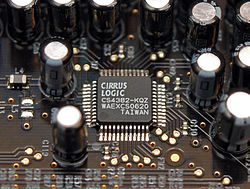
Due to the complexity and the need for precisely matched components, all but the most specialized DACs are implemented as integrated circuits (ICs). These typically take the form of metal–oxide–semiconductor (MOS) mixed-signal integrated circuit chips that integrate both analog and digital circuits.
Discrete DACs (circuits constructed from multiple discrete electronic components instead of a packaged IC) would typically be extremely high-speed low-resolution power-hungry types, as used in military radar systems. Very high-speed test equipment, especially sampling oscilloscopes, may also use discrete DACs.
A DAC converts an abstract finite-precision number (usually a fixed-point binary number) into a physical quantity (e.g., a voltage or a pressure). In particular, DACs are often used to convert finite-precision time series data to a continually varying physical signal.
Provided that a signal's bandwidth meets the requirements of the Nyquist–Shannon sampling theorem (i.e., a baseband signal with bandwidth less than the Nyquist frequency) and was sampled with infinite resolution, the original signal can theoretically be reconstructed from the sampled data. However, an ADC's filtering can't entirely eliminate all frequencies above the Nyquist frequency, which will alias into the baseband frequency range. And the ADC's digital sampling process introduces some quantization error (rounding error), which manifests as low-level noise. These errors can be kept within the requirements of the targeted application (e.g. under the limited dynamic range of human hearing for audio applications).
DACs and ADCs are part of an enabling technology that has contributed greatly to the digital revolution. To illustrate, consider a typical long-distance telephone call. The caller's voice is converted into an analog electrical signal by a microphone, then the analog signal is converted to a digital stream by an ADC. The digital stream is then divided into network packets where it may be sent along with other digital data, not necessarily audio. The packets are then received at the destination, but each packet may take a completely different route and may not even arrive at the destination in the correct time order. The digital voice data is then extracted from the packets and assembled into a digital data stream. A DAC converts this back into an analog electrical signal, which drives an audio amplifier, which in turn drives a speaker, which finally produces sound.
Hub AI
Digital-to-analog converter AI simulator
(@Digital-to-analog converter_simulator)
Digital-to-analog converter
In electronics, a digital-to-analog converter (DAC, D/A, D2A, or D-to-A) is a system that converts a digital signal into an analog signal. An analog-to-digital converter (ADC) performs the reverse function.
DACs are commonly used in music players to convert digital data streams into analog audio signals. They are also used in televisions and mobile phones to convert digital video data into analog video signals. These two applications use DACs at opposite ends of the frequency/resolution trade-off. The audio DAC is a low-frequency, high-resolution type while the video DAC is a high-frequency low- to medium-resolution type.
There are several DAC architectures; the suitability of a DAC for a particular application is determined by figures of merit including: resolution, maximum sampling frequency and others. Digital-to-analog conversion can degrade a signal, so a DAC should be specified that has insignificant errors in terms of the application.
Due to the complexity and the need for precisely matched components, all but the most specialized DACs are implemented as integrated circuits (ICs). These typically take the form of metal–oxide–semiconductor (MOS) mixed-signal integrated circuit chips that integrate both analog and digital circuits.
Discrete DACs (circuits constructed from multiple discrete electronic components instead of a packaged IC) would typically be extremely high-speed low-resolution power-hungry types, as used in military radar systems. Very high-speed test equipment, especially sampling oscilloscopes, may also use discrete DACs.
A DAC converts an abstract finite-precision number (usually a fixed-point binary number) into a physical quantity (e.g., a voltage or a pressure). In particular, DACs are often used to convert finite-precision time series data to a continually varying physical signal.
Provided that a signal's bandwidth meets the requirements of the Nyquist–Shannon sampling theorem (i.e., a baseband signal with bandwidth less than the Nyquist frequency) and was sampled with infinite resolution, the original signal can theoretically be reconstructed from the sampled data. However, an ADC's filtering can't entirely eliminate all frequencies above the Nyquist frequency, which will alias into the baseband frequency range. And the ADC's digital sampling process introduces some quantization error (rounding error), which manifests as low-level noise. These errors can be kept within the requirements of the targeted application (e.g. under the limited dynamic range of human hearing for audio applications).
DACs and ADCs are part of an enabling technology that has contributed greatly to the digital revolution. To illustrate, consider a typical long-distance telephone call. The caller's voice is converted into an analog electrical signal by a microphone, then the analog signal is converted to a digital stream by an ADC. The digital stream is then divided into network packets where it may be sent along with other digital data, not necessarily audio. The packets are then received at the destination, but each packet may take a completely different route and may not even arrive at the destination in the correct time order. The digital voice data is then extracted from the packets and assembled into a digital data stream. A DAC converts this back into an analog electrical signal, which drives an audio amplifier, which in turn drives a speaker, which finally produces sound.