Recent from talks
Erzya language
Knowledge base stats:
Talk channels stats:
Members stats:
Erzya language
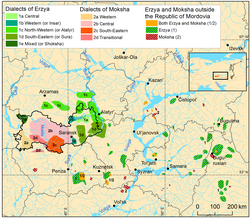
The Erzya language (эрзянь кель, eŕźań keĺ, pronounced [ˈerʲzʲanʲ ˈkʲelʲ]), also Erzian or historically Arisa, is spoken by approximately 300,000 people in the northern, eastern and north-western parts of the Republic of Mordovia and adjacent regions of Nizhny Novgorod, Chuvashia, Penza, Samara, Saratov, Orenburg, Ulyanovsk, Tatarstan and Bashkortostan in Russia. A diaspora can also be found in Armenia and Estonia, as well as in Kazakhstan and other states of Central Asia. Erzya is currently written using Cyrillic with no modifications to the variant used by the Russian language. In Mordovia, Erzya is co-official with Moksha and Russian.
The language belongs to the Mordvinic branch of the Uralic languages. Erzya is a language that is closely related to Moksha but has distinct phonetics, morphology and vocabulary.
The following table lists the consonant phonemes of Erzya together with their Cyrillic equivalents.
Palatalization is widespread in Erzya, but is contrastive only for the alveolar consonants. The labial and velar consonants have palatalized allophones before the front vowels /i/, /e/. The pairs /t/ – /tʲ/, /d/ – /dʲ/ and /n/ – /nʲ/ also often alternate depending on a following or preceding back vs. front vowel. E.g. the 1st person singular possessive suffix has allomorphs such as /-enʲ/ and /-on/. The palatalized consonants can natively occur also in a back vowel environment, e.g. the genitive suffix /-nʲ/, providing minimal pairs such as кудон /kudon/ 'my house' – кудонь /kudonʲ/ '(a) house's'. Non-palatalized /t/, /d/, /n/ in a front vowel environment are limited to recent Russian loans such as кит /kit/ 'whale'.
Note on romanized transcription: in Uralic studies, the members of the palatalized series are usually spelled as ⟨ń⟩, ⟨ť⟩, ⟨ď⟩, ⟨ć⟩, ⟨ś⟩, ⟨ź⟩, ⟨ŕ⟩, ⟨ľ⟩, while the postalveolar sounds are spelled ⟨č⟩, ⟨š⟩, ⟨ž⟩ (see Uralic Phonetic Alphabet).
/f/ and /x/ are loan phonemes from Russian. There is a phonemic contrast between /n/ and /ŋ/, despite that they share the standard spelling ⟨н⟩. Minimal pairs include:
Erzya has a simple five-vowel system.
The front vowels /i/ and /e/ have centralized variants [ï] and [ë] immediately following a plain alveolar consonant, e.g. siń [sïnʲ] "they", seń [sënʲ] "blue".
Hub AI
Erzya language AI simulator
(@Erzya language_simulator)
Erzya language
The Erzya language (эрзянь кель, eŕźań keĺ, pronounced [ˈerʲzʲanʲ ˈkʲelʲ]), also Erzian or historically Arisa, is spoken by approximately 300,000 people in the northern, eastern and north-western parts of the Republic of Mordovia and adjacent regions of Nizhny Novgorod, Chuvashia, Penza, Samara, Saratov, Orenburg, Ulyanovsk, Tatarstan and Bashkortostan in Russia. A diaspora can also be found in Armenia and Estonia, as well as in Kazakhstan and other states of Central Asia. Erzya is currently written using Cyrillic with no modifications to the variant used by the Russian language. In Mordovia, Erzya is co-official with Moksha and Russian.
The language belongs to the Mordvinic branch of the Uralic languages. Erzya is a language that is closely related to Moksha but has distinct phonetics, morphology and vocabulary.
The following table lists the consonant phonemes of Erzya together with their Cyrillic equivalents.
Palatalization is widespread in Erzya, but is contrastive only for the alveolar consonants. The labial and velar consonants have palatalized allophones before the front vowels /i/, /e/. The pairs /t/ – /tʲ/, /d/ – /dʲ/ and /n/ – /nʲ/ also often alternate depending on a following or preceding back vs. front vowel. E.g. the 1st person singular possessive suffix has allomorphs such as /-enʲ/ and /-on/. The palatalized consonants can natively occur also in a back vowel environment, e.g. the genitive suffix /-nʲ/, providing minimal pairs such as кудон /kudon/ 'my house' – кудонь /kudonʲ/ '(a) house's'. Non-palatalized /t/, /d/, /n/ in a front vowel environment are limited to recent Russian loans such as кит /kit/ 'whale'.
Note on romanized transcription: in Uralic studies, the members of the palatalized series are usually spelled as ⟨ń⟩, ⟨ť⟩, ⟨ď⟩, ⟨ć⟩, ⟨ś⟩, ⟨ź⟩, ⟨ŕ⟩, ⟨ľ⟩, while the postalveolar sounds are spelled ⟨č⟩, ⟨š⟩, ⟨ž⟩ (see Uralic Phonetic Alphabet).
/f/ and /x/ are loan phonemes from Russian. There is a phonemic contrast between /n/ and /ŋ/, despite that they share the standard spelling ⟨н⟩. Minimal pairs include:
Erzya has a simple five-vowel system.
The front vowels /i/ and /e/ have centralized variants [ï] and [ë] immediately following a plain alveolar consonant, e.g. siń [sïnʲ] "they", seń [sënʲ] "blue".