Hubbry Logo
search
logo
1191886

Google matrix

logo
Community Hub0 Subscribers
Read side by side
from Wikipedia
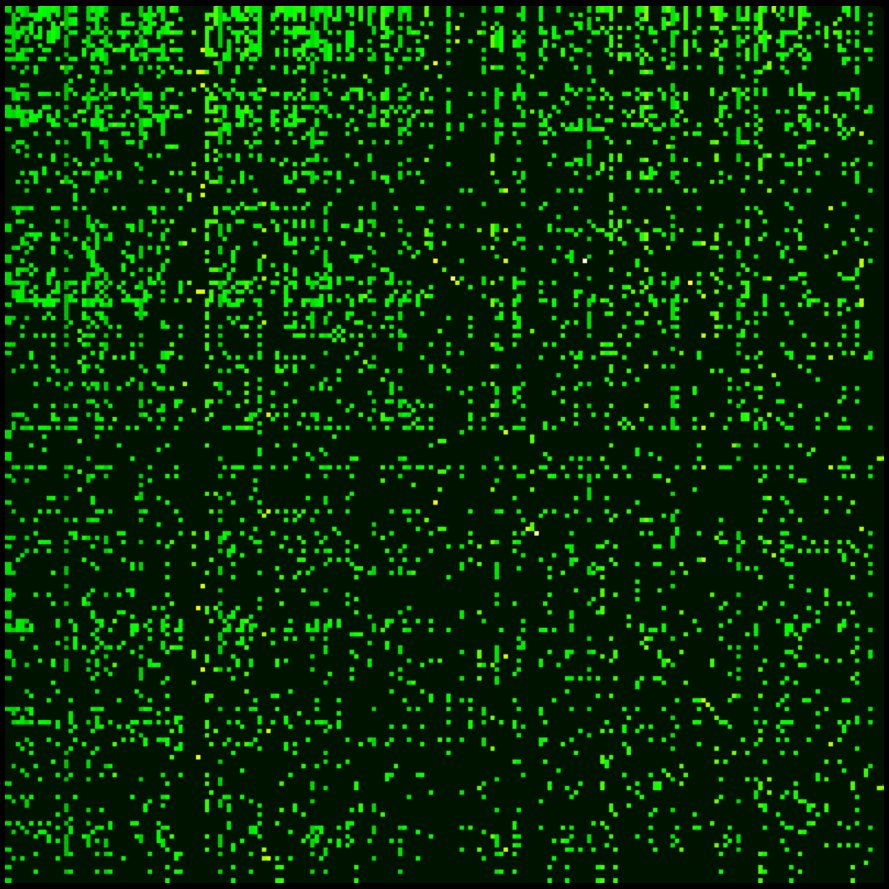
Fig.1. Google matrix of Wikipedia articles network, written in the bases of PageRank index; fragment of top 200 X 200 matrix elements is shown, total size N=3282257 (from [1])

A Google matrix is a particular stochastic matrix that is used by Google's PageRank algorithm. The matrix represents a graph with edges representing links between pages. The PageRank of each page can then be generated iteratively from the Google matrix using the power method. However, in order for the power method to converge, the matrix must be stochastic, irreducible and aperiodic.

Adjacency matrix A and Markov matrix S

[edit]

In order to generate the Google matrix G, we must first generate an adjacency matrix A which represents the relations between pages or nodes.

Assuming there are N pages, we can fill out A by doing the following:

  1. A matrix element is filled with 1 if node has a link to node , and 0 otherwise; this is the adjacency matrix of links.
  2. A related matrix S corresponding to the transitions in a Markov chain of given network is constructed from A by dividing the elements of column "j" by a number of where is the total number of outgoing links from node j to all other nodes. The columns having zero matrix elements, corresponding to dangling nodes, are replaced by a constant value 1/N. Such a procedure adds a link from every sink, dangling state to every other node.
  3. Now by the construction the sum of all elements in any column of matrix S is equal to unity. In this way the matrix S is mathematically well defined and it belongs to the class of Markov chains and the class of Perron-Frobenius operators. That makes S suitable for the PageRank algorithm.

Construction of Google matrix G

[edit]
Fig.2. Google matrix of Cambridge University network (2006), coarse-grained matrix elements are written in the bases of PageRank index, total size N=212710 is shown (from [1])

Then the final Google matrix G can be expressed via S as:

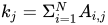
By the construction the sum of all non-negative elements inside each matrix column is equal to unity. The numerical coefficient is known as a damping factor.

Usually S is a sparse matrix and for modern directed networks it has only about ten nonzero elements in a line or column, thus only about 10N multiplications are needed to multiply a vector by matrix G.[2][3]

Examples of Google matrix

[edit]

An example of the matrix construction via Eq.(1) within a simple network is given in the article CheiRank.

For the actual matrix, Google uses a damping factor around 0.85.[2][3][4] The term gives a surfer probability to jump randomly on any page. The matrix belongs to the class of Perron-Frobenius operators of Markov chains.[2] The examples of Google matrix structure are shown in Fig.1 for Wikipedia articles hyperlink network in 2009 at small scale and in Fig.2 for University of Cambridge network in 2006 at large scale.

Spectrum and eigenstates of G matrix

[edit]
Fig3. The spectrum of eigenvalues of the Google matrix of University of Cambridge from Fig.2 at , blue points show eigenvalues of isolated subspaces, red points show eigenvalues of core component (from [5])

For there is only one maximal eigenvalue with the corresponding right eigenvector which has non-negative elements which can be viewed as stationary probability distribution.[2] These probabilities ordered by their decreasing values give the PageRank vector with the PageRank used by Google search to rank webpages. Usually one has for the World Wide Web that with . The number of nodes with a given PageRank value scales as with the exponent .[6][7] The left eigenvector at has constant matrix elements. With all eigenvalues move as except the maximal eigenvalue , which remains unchanged.[2] The PageRank vector varies with but other eigenvectors with remain unchanged due to their orthogonality to the constant left vector at . The gap between and other eigenvalue being gives a rapid convergence of a random initial vector to the PageRank approximately after 50 multiplications on matrix.

Fig4. Distribution of eigenvalues of Google matrices in the complex plane at for dictionary networks: Roget (A, N=1022), ODLIS (B, N=2909) and FOLDOC (C, N=13356); UK university WWW networks: University of Wales (Cardiff) (D, N=2778), Birmingham City University (E, N=10631), Keele University (Staffordshire) (F, N=11437), Nottingham Trent University (G, N=12660), Liverpool John Moores University (H, N=13578)(data for universities are for 2002) (from [8])

At the matrix has generally many degenerate eigenvalues (see e.g. [6][8]). Examples of the eigenvalue spectrum of the Google matrix of various directed networks is shown in Fig.3 from [5] and Fig.4 from.[8]

The Google matrix can be also constructed for the Ulam networks generated by the Ulam method [8] for dynamical maps. The spectral properties of such matrices are discussed in [9,10,11,12,13,15].[5][9] In a number of cases the spectrum is described by the fractal Weyl law [10,12].

Fig5. Distribution of eigenvalues in the complex plane for the Google matrix of the Linux Kernel version 2.6.32 with matrix size at , unit circle is shown by solid curve (from [9])
Fig.6 Coarse-grained probability distribution for the eigenstates of the Google matrix for Linux Kernel version 2.6.32. The horizontal lines show the first 64 eigenvectors ordered vertically by (from [9])

The Google matrix can be constructed also for other directed networks, e.g. for the procedure call network of the Linux Kernel software introduced in [15]. In this case the spectrum of is described by the fractal Weyl law with the fractal dimension (see Fig.5 from [9]). Numerical analysis shows that the eigenstates of matrix are localized (see Fig.6 from [9]). Arnoldi iteration method allows to compute many eigenvalues and eigenvectors for matrices of rather large size [13].[5][9]

Other examples of matrix include the Google matrix of brain [17] and business process management [18], see also.[1] Applications of Google matrix analysis to DNA sequences is described in [20]. Such a Google matrix approach allows also to analyze entanglement of cultures via ranking of multilingual Wikipedia articles abouts persons [21]

Historical notes

[edit]

See also

[edit]

References

[edit]
[edit]
Revisions and contributorsEdit on WikipediaRead on Wikipedia
from Grokipedia
The Google matrix is a primitive, column-stochastic matrix fundamental to the PageRank algorithm, which ranks web pages according to their importance in the World Wide Web's hyperlink structure.[1] Developed as part of Google's search engine by founders Sergey Brin and Larry Page, it models web navigation as a Markov chain where matrix entries represent transition probabilities between pages linked by hyperlinks.[1] The matrix addresses challenges in the web graph, such as dangling nodes (pages with no outgoing links) and potential rank sinks, by incorporating a random teleportation mechanism to ensure reliable convergence.[2] Mathematically, the Google matrix $ G $ is constructed as $ G = \alpha S + (1 - \alpha) \frac{1}{n} \mathbf{e} \mathbf{e}^T $, where $ S $ is a column-stochastic matrix derived from the hyperlink adjacency matrix $ H $ (with columns normalized for out-degree and dangling node columns replaced by uniform distributions), $ \alpha $ (typically 0.85) is the damping factor balancing link-following and random jumps, $ n $ is the total number of modeled web pages, and $ \mathbf{e} $ is the column vector of all ones.[3] This formulation renders $ G $ irreducible, aperiodic, and positive, properties that guarantee the existence of a unique stationary distribution—the PageRank vector—obtainable as the dominant eigenvector corresponding to eigenvalue 1 via the power iteration method.[2] In practice, the PageRank vector assigns a non-negative score to each page proportional to its estimated relevance, aggregating importance from incoming links while mitigating biases from isolated graph components.[1] The algorithm's iterative computation scales to billions of pages through sparse matrix techniques, and its influence extends beyond web search to applications in citation analysis, social networks, and recommendation systems, underscoring the matrix's role in quantifying node centrality in large directed graphs.[2]

Basic Components

Adjacency Matrix

The adjacency matrix $ A $ for a directed graph with $ n $ nodes is defined as an $ n \times n $ matrix where the entry $ A_{ij} = 1 $ if there is a directed link from node $ j $ to node $ i $, and $ A_{ij} = 0 $ otherwise. This representation captures the raw hyperlink structure of networks such as the World Wide Web, treating pages as nodes and links as directed edges. The matrix $ A $ has non-negative entries by construction, with column sums equal to the out-degrees of the nodes (i.e., the number of outgoing links from each node). In large-scale networks like the web, $ A $ is highly sparse, as the number of non-zero entries corresponds to the total number of links, which is typically much smaller than $ n^2 $. To prepare for probabilistic transitions, $ A $ is normalized into a column-stochastic form by dividing each column by its out-degree, ensuring column sums equal 1 where possible; dangling nodes (pages with zero out-degree, resulting in zero-sum columns) require special handling, such as uniform redistribution across all nodes. This normalized version transitions to the stochastic matrix $ S $, which models random walks on the graph. For illustration, consider a simple directed graph with two nodes and mutual links: node 1 links to node 2, and node 2 links to node 1. The adjacency matrix is
A=(0110), A = \begin{pmatrix} 0 & 1 \\ 1 & 0 \end{pmatrix},
where each column sums to 1, reflecting out-degrees of 1 for both nodes.

Stochastic Matrix

The stochastic matrix $ S $ is obtained by normalizing the adjacency matrix of the web graph to form transition probabilities for a random walk. Given an adjacency matrix $ A $ where $ A_{ij} = 1 $ if page $ j $ links to page $ i $ and 0 otherwise, $ S $ is defined as $ S = A D^{-1} $, with $ D $ being the diagonal matrix where each diagonal entry $ D_{jj} $ equals the out-degree of page $ j $, or the number of outgoing links from $ j $.[4] This construction yields $ S_{ij} = \frac{A_{ij}}{D_{jj}} = \frac{1}{\text{out-degree}(j)} $ if page $ j $ links to page $ i $, and 0 otherwise, provided the out-degree is positive.[4] Pages with no outgoing links, termed dangling nodes, result in a column of zeros in $ S $, violating the stochastic property since the column sum is 0 rather than 1. To resolve this, such columns are replaced by a uniform vector with each entry equal to $ \frac{1}{n} $, where $ n $ is the total number of pages, thereby distributing the transition probability equally across all pages and ensuring every column sums to 1.[4] The matrix $ S $ is column-stochastic, with non-negative entries and each column summing to 1, which encodes the probabilities of moving from the current page $ j $ to any linked page $ i $ during a random surf on the web.[5] It serves as the transition matrix for a Markov chain that models unperturbed random surfing behavior, where the surfer follows links uniformly at random.[4] If the underlying directed graph is strongly connected, $ S $ is irreducible, meaning the chain can reach any state from any other state.[6]

Definition and Construction

The Google Matrix Formula

The Google matrix $ G $, central to the PageRank algorithm, is defined by the formula
G=αS+(1α)E, G = \alpha S + (1 - \alpha) E,
where $ S $ is the row-stochastic transition matrix derived from the web's hyperlink structure, $ \alpha $ is the damping factor, and $ E $ is the $ n \times n $ matrix whose every entry is $ 1/n $, with $ n $ denoting the total number of web pages.[1] The matrix $ S $ is obtained by row-normalizing the adjacency matrix to account for outgoing links, with adjustments for pages lacking out-links (dangling nodes) to ensure stochasticity.[7] This formulation interprets the random surfer model: the term $ \alpha S $ captures the probability $ \alpha $ of continuing the walk by following an outgoing hyperlink, while $ (1 - \alpha) E $ models the complementary probability of teleporting uniformly to any page, preventing the walk from becoming trapped in disconnected components or rank sinks within the web graph.[1] In web ranking applications, $ \alpha $ is typically set between 0.85 and 0.99, which balances link-following behavior with random resets and guarantees that $ G $ remains row-stochastic.[8] The row-stochastic property of $ G $ follows directly from those of its components: since the rows of both $ S $ and $ E $ sum to 1, each row sum of $ G $ is $ \alpha \cdot 1 + (1 - \alpha) \cdot 1 = 1 $, maintaining the essential Markov chain structure for convergence to a unique stationary distribution.[7]

Role of the Damping Factor

The damping factor, denoted as α, serves a critical purpose in the Google matrix by regulating the trade-off between link-following behavior, which facilitates exploration along the web's hyperlink structure, and random teleportations to arbitrary pages, which promote global mixing across the entire graph.[9] This balance is essential for preventing the random surfer model from becoming trapped in dense clusters of mutually linking pages or infinite loops, where probability mass could otherwise accumulate indefinitely without dissipation. Historically, α was introduced to emulate realistic user navigation patterns, capturing the empirical observation that web surfers occasionally abandon their current path—estimated at about a 15% probability per step—to jump randomly to another page.[9] In terms of matrix properties, setting α < 1 ensures that the Google matrix G = α S + (1 - α) E, where S is the stochastic link matrix and E is the uniform matrix, becomes primitive, rendering it both irreducible (fully connected via paths) and aperiodic (no cyclic partitioning). This primitivity guarantees the existence of a unique stationary distribution, which corresponds to the PageRank vector, independent of starting conditions. However, as α approaches 1, the matrix's spectral gap narrows, leading to slower convergence in power iteration methods used to compute the stationary distribution, often requiring more iterations for numerical stability.[8] The choice of α is largely empirical, with the original PageRank implementation adopting α = 0.85 to strike an optimal balance between ranking accuracy, which favors higher α for stronger emphasis on link structure, and computational efficiency, as lower α accelerates convergence.[9] Sensitivity analyses reveal that variations in α can significantly affect rank stability, potentially causing rank reversals or shifts in the ordering of pages, particularly in networks with uneven connectivity; for instance, small deviations from 0.85 can cause rank reversals, though rankings in real web graphs tend to exhibit relative stability with a consistent core of top-ranked pages, underscoring the need for careful tuning based on the specific corpus.[10]

Mathematical Properties

Eigenvalues and Spectrum

The Google matrix $ G $, being column-stochastic, possesses a largest eigenvalue $ \lambda_1 = 1 $ with algebraic multiplicity one.[11] This eigenvalue is simple due to the stochastic nature of $ G $, ensuring a unique stationary distribution in the associated Markov chain.[12] For all other eigenvalues $ \lambda_i $ with $ i > 1 $, the condition $ |\lambda_i| < 1 $ holds, guaranteeing convergence of iterative methods like the power iteration used in PageRank computation.[11] These eigenvalues are bounded by the damping factor $ \alpha $, specifically $ |\lambda_i| \leq \alpha $, as $ G $ acts as a contraction mapping in the infinity norm.[11] In non-symmetric directed networks such as the web graph, complex eigenvalues are prevalent, forming intricate patterns in the complex plane within the unit disk.[13] The spectral gap, defined as $ 1 - |\lambda_2| $, where $ \lambda_2 $ is the second-largest eigenvalue in modulus, governs the convergence rate of the power iteration algorithm.[12] In typical web graphs, this gap is small—often on the order of $ 1 - \alpha \approx 0.15 $ for $ \alpha = 0.85 $—leading to slow mixing times and requiring numerous iterations for accurate PageRank computation.[11] The Perron-Frobenius theorem applies to the Google matrix, which is positive due to the uniform damping term, ensuring that the dominant eigenvalue $ \lambda_1 = 1 $ is real, simple, and greater in modulus than all others, with a corresponding strictly positive eigenvector.[12] In large-scale networks with dimension $ n \gg 1 $, the power-law structure and communities inherent to web graphs introduce deviations in the eigenvalue distribution, such as patterns reflecting network modularity.[13]

Eigenvectors and Stationary Distribution

The principal eigenvector of the Google matrix GG corresponds to the eigenvalue λ=1\lambda = 1 and is a left eigenvector vv satisfying vG=vv G = v, normalized such that ivi=1\sum_i v_i = 1. This vector represents the stationary probability distribution of the associated Markov chain, with components viv_i interpreted as PageRank scores indicating the relative importance of nodes in the network.[14][15] The right eigenvector for λ=1\lambda = 1 is the uniform vector consisting of all entries equal to 1/n1/n, where nn is the matrix dimension, reflecting the stochastic nature of GG where each column sums to 1. Secondary eigenvectors, associated with eigenvalues λ<1|\lambda| < 1, can reveal underlying network structures such as communities or cycles; for instance, they often localize on specific subsets of nodes, highlighting groups with strong internal connectivity like academic disciplines or regional clusters in directed networks.[11][15] The principal eigenvector is unique and strictly positive component-wise (vi>0v_i > 0 for all ii), guaranteed by the primitivity of GG (ensured by the damping factor making the matrix irreducible and aperiodic), as per the Perron-Frobenius theorem for nonnegative primitive matrices. It is computed via the power method, iterating v(k+1)=v(k)Gv^{(k+1)} = v^{(k)} G from an initial probability vector v(0)v^{(0)} (often uniform), with convergence to the stationary distribution at a rate determined by the spectral gap 1λ21 - |\lambda_2|, where λ2\lambda_2 is the second-largest eigenvalue modulus.[14][15][11]

Examples and Illustrations

Small-Scale Models

To illustrate the construction of the Google matrix, consider a small 3-node ring graph, where nodes are labeled 1, 2, and 3, with directed links 1 → 2, 2 → 3, and 3 → 1. Each node has out-degree 1, so the column-stochastic matrix SS (obtained by normalizing the adjacency matrix columns) is the permutation matrix
S=(001100010). S = \begin{pmatrix} 0 & 0 & 1 \\ 1 & 0 & 0 \\ 0 & 1 & 0 \end{pmatrix}.
With damping factor α=0.85\alpha = 0.85, the Google matrix is G=αS+(1α)/311TG = \alpha S + (1 - \alpha)/3 \cdot \mathbf{1}\mathbf{1}^T, where 1\mathbf{1} is the all-ones vector, yielding
G=(0.050.050.900.900.050.050.050.900.05). G = \begin{pmatrix} 0.05 & 0.05 & 0.90 \\ 0.90 & 0.05 & 0.05 \\ 0.05 & 0.90 & 0.05 \end{pmatrix}.
The PageRank vector is the principal right eigenvector of GG corresponding to eigenvalue 1, normalized to sum to 1; due to the symmetric cycle structure and damping, it is the uniform distribution [1/3,1/3,1/3]T[1/3, 1/3, 1/3]^T. To compute it via power iteration, start with initial vector r(0)=[0.5,0.3,0.2]Tr^{(0)} = [0.5, 0.3, 0.2]^T and iterate r(k+1)=Gr(k)r^{(k+1)} = G r^{(k)} (the sums remain 1 since GG is column-stochastic). The first three iterations are
r(1)=(0.2200.4750.305),r(2)=(0.3090.2370.454),r(3)=(0.2800.2660.454), r^{(1)} = \begin{pmatrix} 0.220 \\ 0.475 \\ 0.305 \end{pmatrix}, \quad r^{(2)} = \begin{pmatrix} 0.309 \\ 0.237 \\ 0.454 \end{pmatrix}, \quad r^{(3)} = \begin{pmatrix} 0.280 \\ 0.266 \\ 0.454 \end{pmatrix},
approaching [0.333,0.333,0.333]T[0.333, 0.333, 0.333]^T (further iterations confirm convergence within machine precision after ~20 steps for this scale). For the undamped case (α=1\alpha = 1), G=SG = S, and power iteration fails to converge, instead cycling periodically due to the eigenvalues of SS lying on the unit circle (roots of unity for the cycle). Using the same initial r(0)r^{(0)},
r(1)=Sr(0)=(0.2000.5000.300),r(2)=(0.3000.2000.500),r(3)=(0.5000.3000.200)=r(0), r^{(1)} = S r^{(0)} = \begin{pmatrix} 0.200 \\ 0.500 \\ 0.300 \end{pmatrix}, \quad r^{(2)} = \begin{pmatrix} 0.300 \\ 0.200 \\ 0.500 \end{pmatrix}, \quad r^{(3)} = \begin{pmatrix} 0.500 \\ 0.300 \\ 0.200 \end{pmatrix} = r^{(0)},
demonstrating perpetual rotation without damping to ensure aperiodicity and convergence. A dangling node (out-degree 0) requires uniform replacement in SS to maintain stochasticity. Consider a 4-node chain graph with nodes 1 → 2 → 3 → 4, where 4 is the dangling sink (no outgoing links). The column-stochastic SS has column 4 replaced by [0.25,0.25,0.25,0.25]T[0.25, 0.25, 0.25, 0.25]^T:
S=(0000.251000.250100.250010.25). S = \begin{pmatrix} 0 & 0 & 0 & 0.25 \\ 1 & 0 & 0 & 0.25 \\ 0 & 1 & 0 & 0.25 \\ 0 & 0 & 1 & 0.25 \end{pmatrix}.
With α=0.85\alpha = 0.85, G=αS+(1α)/411T=0.85S+0.037511TG = \alpha S + (1 - \alpha)/4 \cdot \mathbf{1}\mathbf{1}^T = 0.85 S + 0.0375 \cdot \mathbf{1}\mathbf{1}^T. Power iteration starting from uniform r(0)=[0.25,0.25,0.25,0.25]Tr^{(0)} = [0.25, 0.25, 0.25, 0.25]^T yields
r(1)(0.0910.3030.3030.303), r^{(1)} \approx \begin{pmatrix} 0.091 \\ 0.303 \\ 0.303 \\ 0.303 \end{pmatrix},
and converges (after ~30 steps) to approximately [0.117,0.215,0.296,0.372]T[0.117, 0.215, 0.296, 0.372]^T. The damping factor α=0.85\alpha = 0.85 ensures convergence while balancing link-following (85% probability) against uniform teleportation (15%), resulting in the sink node 4 receiving elevated rank (~37%) from incoming links and redistributed probability, while earlier nodes gain indirectly via uniform replacement and teleports (node 1 ~12%, reflecting dilution along the chain). Without replacement (raw adjacency for column 4 as zeros), probability mass leaks at the sink, causing total rank sum to decay to 0 over iterations, precluding a stationary distribution.

Large-Scale Network Examples

As observed in a 2000 study by Broder et al., the web graph underlying the Google matrix in PageRank computations exhibits a power-law degree distribution, with in-degree and out-degree probabilities following P(k)kγP(k) \sim k^{-\gamma} where γ2.1\gamma \approx 2.1 for in-degrees and γ2.7\gamma \approx 2.7 for out-degrees, reflecting a scale-free structure dominated by a few high-degree hubs.[16] This graph also displays a bow-tie topology, featuring a strongly connected core (SCC) comprising about 28% of nodes, incoming components (IN) that funnel into the SCC (≈21%), outgoing components (OUT) from the SCC (≈21%), and additional tendrils (≈22%) and disconnected regions (≈8%).[16] Recent studies suggest the global bow-tie structure has evolved, with more emphasis on local bow-tie patterns within components.[17] Such characteristics produce an adjacency matrix that is highly sparse, with modern web graphs encompassing roughly 4×1094 \times 10^9 nodes and average degrees around 10, resulting in edge counts on the order of 101010^{10} far below the theoretical maximum of 101810^{18}.[18] Given the vast scale, exact construction of the dense Google matrix proves impractical; instead, approximations like Monte Carlo methods simulate random surfer walks to estimate the stationary distribution, providing accurate PageRank values for prominent pages with reduced memory demands compared to full matrix operations.[19] Sparse matrix formats, such as compressed sparse row (CSR), enable efficient storage of the transition matrix and iterative computations without densifying the Google matrix. An illustrative early application processed a 1998 Stanford web crawl of 24 million pages using these techniques, demonstrating feasible ranking on period hardware despite the graph's sparsity.[20] In large-scale web graphs, PageRank scores correlate strongly with in-degrees, both adhering to power-law tails with similar exponents, yet the damping factor α\alpha integrates global hyperlink paths and teleportation, highlighting pages with broader structural significance over mere local link counts.[21] Within the giant component, rankings show heightened sensitivity to α\alpha, where shifts from the standard 0.85 value can induce frequent rank reversals, altering perceived page importance.[22] Computational demands include storing the sparse matrix in CSR format, which scales with edge volume—often exceeding 101110^{11} for web-scale graphs—typically via distributed systems. Power iteration for convergence requires hundreds of sparse matrix-vector multiplications to achieve precision, though the spectral gap expedites this to tens of iterations in practice for graphs over 80 million nodes.[23]

Applications and Extensions

Web Ranking with PageRank

The PageRank algorithm employs an iterative process to compute the principal eigenvector $ v $ of the Google matrix, which assigns an importance score to each web page based on the structure of hyperlinks. Higher values of $ v_i $ for a page $ i $ signify greater authority, reflecting the likelihood that a random surfer would visit that page after many steps in a simplified model of web navigation. This eigenvector, representing the stationary distribution of the associated Markov chain, is obtained through repeated matrix-vector multiplications until convergence, typically using the power iteration method. In Google Search, these precomputed PageRank scores are integrated into the ranking of search results by combining them with query-specific relevance measures derived from content analysis. The system evaluates pages not only for their authority via PageRank but also for how well their text matches the user's query, using techniques such as term frequency-inverse document frequency (tf-idf) weighting. The final ranking score for a page is a linear combination of its PageRank and these relevance factors, ensuring that results prioritize both authoritative sources and topical pertinence. This hybrid approach significantly enhances the quality of search outcomes over purely content-based methods.[20] Personalized variants of PageRank adapt the algorithm to individual users by modifying the teleportation component of the Google matrix, biasing the random surfer's jumps toward a user-specific set of pages, such as bookmarks or previously visited sites. This personalization shifts the stationary distribution to emphasize pages more relevant to the user's interests, allowing for tailored search rankings without altering the core link structure analysis. Such adaptations were proposed in the original formulation to accommodate diverse surfing behaviors. Despite its effectiveness, PageRank exhibits vulnerabilities to manipulation through link spam, particularly via link farms—networks of low-quality pages created solely to interlink and artificially inflate scores for targeted sites. These tactics exploit the reliance on incoming links, leading to undeserved high rankings for spammed pages and degrading overall search quality. Subsequent refinements, including trust-based modifications, have mitigated these issues by incorporating additional signals of page credibility.

Analyses in Other Networks

The Google matrix has been extended to biological networks, where it models evolutionary dynamics and interaction flows in systems such as protein interaction graphs and food webs. In protein interaction networks, the reduced Google matrix algorithm analyzes effective interactions between subsets of proteins, accounting for indirect pathways through the larger network; for instance, in the bi-functional SIGNOR database of signaling pathways, it reveals hidden causal relations and ranks protein influence beyond direct links.[24] Similarly, in fibrosis-related protein-protein interaction networks derived from MetaCore data, the reduced Google matrix identifies key regulatory proteins by quantifying their indirect impacts on disease progression.[25] For food webs and ecological systems, the Google matrix assesses stability in mutualism-competition models governed by Lotka-Volterra dynamics, where it decomposes interaction matrices to predict coexistence; a 2016 study on structured ecological networks found that feasibility (positive abundances) is lost before stability as mutualism strength increases, with empirical mutualistic networks (e.g., plant-pollinator webs with connectance q ≈ 0.13) showing alignment to randomized stability thresholds.[26] In social and citation networks, the Google matrix enables ranking of influence while adapting the damping factor α to capture community structures. For citation networks, analysis of the Physical Review articles (over 400,000 papers) using the Google matrix spectrum reveals PageRank vectors that prioritize seminal works, with the distribution in the PageRank-CheiRank plane highlighting bidirectional citation flows and outperforming simple indegree metrics for impact assessment.[27] In social platforms like Twitter, the Google matrix constructed from the 2009 network (41 million users) quantifies user influence via PageRank and CheiRank, where adjusting α (typically 0.85) accounts for sparse community ties and retweet asymmetries, identifying top influencers with eigenvector centralities that reflect real-world virality patterns.[28] For ranking scientists via arXiv links, adaptations of the Google matrix in co-citation graphs adjust α to emphasize disciplinary communities, yielding prestige scores correlated with h-index but enhanced by indirect collaboration paths.[29] Generalizations of the Google matrix extend to directed weighted graphs and time-varying links, preserving key properties like Perron-Frobenius eigenvectors for centrality measures. In directed weighted networks, the matrix incorporates edge weights into the stochastic transition operator, enabling analysis of flow imbalances; a comprehensive review demonstrates its application to economic trade networks, where weighted links represent transaction volumes, and the leading eigenvector approximates eigenvector centrality in undirected projections.[30] Recent extensions leverage the Google matrix in recommender systems and epidemic spreading models, with damping factor α optimized for network diameter to enhance prediction accuracy. In recommender systems, the reduced Google matrix has been explored to infer user-item affinities in sparse graphs by propagating indirect preferences.

Historical Development

Origins and Invention

The development of the Google matrix emerged from early explorations in web graph analysis and link-based ranking. Prior to its invention, the HITS algorithm, proposed by Jon Kleinberg in 1998, represented a foundational link analysis method that employed separate hub and authority matrices to evaluate the importance of web pages based on incoming and outgoing hyperlinks. This approach highlighted the potential of hyperlink structures to infer page authority, influencing later algorithms by shifting focus from content keywords to relational graph properties.[31] In 1996, Stanford University Ph.D. students Larry Page and Sergey Brin launched the BackRub project under the Stanford Digital Library Initiative, with the goal of systematically downloading and indexing the rapidly expanding World Wide Web while prioritizing hyperlinks as indicators of page relevance over textual content alone.[32] Motivated by the limitations of existing search engines, which struggled with spam and low-quality results, they sought to exploit the web's hypertextual structure to generate more accurate rankings.[33] The core idea of the Google matrix was first articulated in Brin and Page's 1998 paper, where they introduced the random surfer model to compute page importance, incorporating a damping mechanism to account for users occasionally abandoning their browsing path and jumping to a random page.[34] This model transformed the web's link graph into a Markov chain, with the damping factor ensuring convergence and mimicking realistic navigation behavior.[34] The invention was protected through U.S. Patent 6,285,999, filed on January 9, 1998, and issued on September 4, 2001, to Lawrence Page, which detailed a method for ranking nodes in linked databases using a modified stochastic matrix derived from hyperlink citations.[35] The patent described the matrix as a combination of the web's adjacency structure and uniform teleportation probabilities, establishing the foundational framework for scalable web ranking.[35]

Key Publications and Evolution

The foundational description of the Google matrix appeared in the 1998 paper "The Anatomy of a Large-Scale Hypertextual Web Search Engine" by Sergey Brin and Lawrence Page, presented at the 7th International World Wide Web Conference. This work introduced the stochastic matrix $ G = \alpha S + (1 - \alpha) E $, where $ S $ is the column-stochastic transition matrix derived from web hyperlinks, $ E $ is the uniform teleportation matrix, and the damping factor $ \alpha = 0.85 $ was selected to balance link-following with random jumps, mimicking typical user navigation patterns.[34] A key follow-up publication, the 1999 Stanford technical report "The PageRank Citation Ranking: Bringing Order to the Web" by Lawrence Page, Sergey Brin, Rajeev Motwani, and Terry Winograd, formalized the computation of the Google matrix's principal eigenvector as the PageRank vector, emphasizing efficient power iteration methods for large-scale implementation.[1] This report solidified the mathematical framework, proving convergence under the matrix's Perron-Frobenius properties and highlighting its superiority over content-based ranking for web-scale data. Subsequent evolutions included the 2002 introduction of personalized PageRank variants, such as topic-sensitive PageRank by Taher H. Haveliwala, which modifies the teleportation vector to incorporate user-specific or topic-based biases, enabling context-aware ranking without altering the core matrix structure.[36] In the 2010s, integrations with machine learning enhanced spam detection; for instance, the 2012 MaxRank algorithm proposed by Olivier Fercoq et al. uses optimization and seed sets to detect link spam and apply PageRank demotion.[37] By 2025, the fundamental Google matrix formulation remained unchanged in core search applications, but hybrid models emerged, fusing it with graph neural networks for AI-driven search, as in the 2022 Personalized PageRank Graph Neural Network (PPRGNN) that extends propagation to infinite depths via neural approximations.[38] The Google matrix's academic impact extends beyond web search, with extensive citations in random matrix theory for analyzing eigenvalue distributions in sparse stochastic systems. In physics, by the 2010s, it inspired extensions to quantum walks and chaotic dynamics, notably through the reduced Google matrix framework for modeling open quantum systems and network flows, as reviewed in the 2015 work by Leonardo Ermann, Klaus M. Frahm, and Dima L. Shepelyansky.[30]

References

User Avatar
No comments yet.