Hubbry Logo
search
logo
1347376

Kaye Webb

logo
Community Hub0 Subscribers
Read side by side
from Wikipedia

Kathleen ("Kaye") Webb MBE (26 January 1914 – 16 January 1996), was a British editor and publisher. She has been called an "enormously influential children's editor" and "brilliant as an innovator of highly successful marketing strategies".[1] She was awarded the Eleanor Farjeon Award in 1970.[1]

Key Information

Early life and education

[edit]

Kathleen Webb was born in Chiswick, London, in 1914, the second of three children of Arthur Webb, a journalist, and Ann (née Stevens), a film and theatre critic.[2][3][4] Her paternal great-great-grandfather was W. G. (William George) Webb, publisher of toy theatres in the Victorian era.[2][3]

Webb was educated first at a dame school, then at Hornsey High School, and then, in 1926, aged twelve, started boarding at Ashburton School, Ashburton, Devon, where her older brother was already a student. Webb herself described her time there as "bullied, miserable, had jaundice", but was inspired and encouraged by the teacher of English, Ben R. Gibbs, author of textbooks about literature and history.[2][3]

She left the school in 1930, and although Gibbs had suggested that she go on to university, she was sent by her parents to stay with a family in Bruges, Belgium, to be "finished".[3]

Career

[edit]

Webb's first job after she left school, aged 16, was as an office girl at The Times.[3] In 1931, after her time in Belgium, she was employed as editor's secretary at Picturegoer, where she was "George the Answerman".[2][3] At some point, she also worked for Mickey Mouse Weekly, where she was paid 2 pence per answer to reply to children's letters.[2][3] She later worked for motor magazines Caravan World and Sports Car. She joined Picture Post as a secretary in 1938; and in 1941 became assistant editor of the magazine Lilliput.[2]

During the Second World War, Webb volunteered as "an ambulance driver, air-raid warden, canteen worker and member of the Fleet Street Women's Rifle Brigade".[5]

She remained at Lilliput until her marriage in 1948, after which she began working freelance, writing features for the News Chronicle and broadcasting on Woman's Hour, among other commissions. In 1955 she was invited by John Grigg, the owner, to edit the children's literary magazine The Young Elizabethan (afterwards retitled The Elizabethan). In 1961, she became editor of Puffin Books, remaining until 1979. In 1967 she founded the Puffin Club, which she ran until 1981 (also editing its magazine, Puffin Post).[2][6]

The publisher Andrew Franklin has described Webb as "the first publisher to turn children’s writers into stars".[7] Nicholas Fisk wrote to her in 1979 that "it was the Kaye Webb 'fluence, permeating the whole field, that was so liberating and encouraging. Whatever the Scene is today, most probably you set it".[1] She had almost complete autonomy over what Puffin published.[1] She ensured that Puffin covers were eye-catching.[1] She preferred publishing texts with complex and sophisticated writing, and emphasised "fantasy and pleasure".[1]

In 1959, she and Searle were invited by the United Nations High Commissioner for Refugees to visit refugee camps in Europe as part of the World Refugee Year of 1959; this resulted in a book, Refugees 1960: A Report in Words and Drawings.[8]

Webb was a castaway on Desert Island Discs in 1993.[7]

Personal life

[edit]
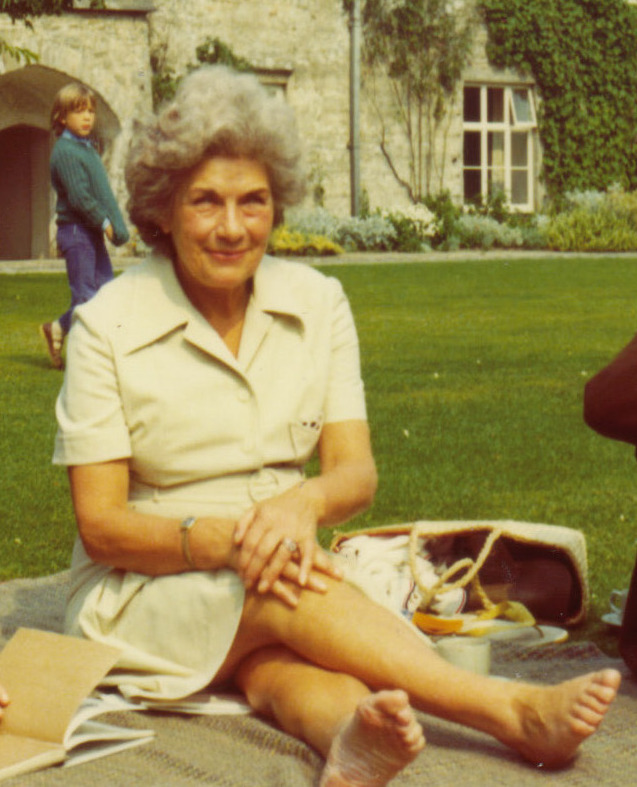
Kaye Webb (centre) with Joan Aiken (left) at Dartington Hall in Devon in 1972

Webb was married three times: each of her marriages ended in divorce. Her third marriage (1948–1967) was to Ronald Searle, who was the father of her son and daughter.[6][7] "They built a colourful and creative kind of domesticity in a house that would be painted in wild colours and filled with all the bizarre objects they collected on their travels".[7]

Webb was cremated at Kensal Green Cemetery.[2]

Archives

[edit]

Webb's archive and working library are held in the Seven Stories centre for children's books collection, based in Newcastle upon Tyne.[1][9]

Books

[edit]
  • Looking at London and People Worth Meeting (1953), News Chronicle, with Ronald Searle
  • Paris Sketchbook (1958), Perpetua Books, with Ronald Searle
  • The St. Trinian's Story: the Whole Ghastly Dossier (ed) (1959), Perpetua Books
  • Refugees 1960: A Report in Words and Drawings (1960), Penguin Books, with Ronald Searle
  • A Book of Goblins (1972), with Alan Garner
  • I Like This Poem (ed) (1979), Puffin
  • Lilliput goes to war (ed) (1985), Hutchinson
  • I Like This Story: a taste of fifty favourites (ed) (1986), Puffin
  • Meet My Friends: Favourite characters and their adventures (ed) (1991), Viking Kestrel
  • Round about six: new stories and poems (ed) (1992), Frances Lincoln
  • Family tree: a collection of favourite poems and stories about all kinds of families (ed) (1994), Hamish Hamilton
  • Let the sun shine: a read aloud collection (ed) (1998), Frances Lincoln

References

[edit]
[edit]
Revisions and contributorsEdit on WikipediaRead on Wikipedia
from Grokipedia
Kaye Webb (26 January 1914 – 16 January 1996) was a British children's book editor and publisher known for her transformative leadership of Puffin Books, Penguin's children's paperback imprint, from 1961 to 1979. [1] During her tenure, she expanded the list to include major authors such as Roald Dahl and Ursula Le Guin, while pioneering innovative marketing and reader engagement strategies that made high-quality children's literature widely accessible and exciting. [2] [3] In 1967 she founded the Puffin Club, a membership scheme that built a vibrant community of young readers through events, a magazine called Puffin Post, and direct interaction with authors, earning her widespread acclaim for revitalizing children's reading culture. [1] [3] She received the MBE in 1974 for services to children's books. [2] Before joining Puffin, Webb worked as a journalist and magazine editor, serving as assistant editor of Lilliput magazine from 1941 to 1947, features writer for the News Chronicle, and editor of the children's magazine Elizabethan from 1955 to 1958. [1] [3] Her blend of editorial vision and commercial acumen helped establish Puffin as the preeminent children's paperback imprint during a golden age of children's publishing in the 1960s and 1970s, influencing generations of readers through a commitment to quality, imagination, and accessibility. [3] After retiring from Puffin in 1979, she remained active in children's literature until her death. [2]

Early life

Birth and family background

Kaye Webb was born Kathleen Webb on 26 January 1914 in Chiswick, London, England.[4][5] She grew up in London, though little is documented about her family background or early childhood beyond her birthplace in the Chiswick area.[5] She later became known professionally as Kaye Webb and acquired the nickname "Fat Puffin," though this moniker originated during her later career rather than in childhood.[5]

Entry into journalism

Kaye Webb entered the world of journalism through a series of junior and secretarial positions in magazine publishing during the 1930s. After spending time in Belgium, she took on the role of editor's secretary at Picturegoer magazine. [6] She also worked on Mickey Mouse Weekly, where she handled responses to children's letters. [6] In 1938, she joined Picture Post as a secretary. [6] She later advanced to assistant editor at Lilliput magazine by 1941. [7] These early roles in journalism and publishing provided her with foundational experience in editorial work leading into the war years.

World War II service

Wartime roles and activities

During the Second World War, Kaye Webb volunteered in multiple civilian support roles on the British home front.[8] She served as an ambulance driver, an air-raid warden, a canteen worker, and a member of the Fleet Street Women's Rifle Brigade.[8][9] These activities complemented her continued professional work as assistant editor of Lilliput magazine throughout the war years.[10]

Post-war journalism career

Magazine and newspaper positions

Kaye Webb continued her journalism career after the war, building on her pre-existing role as Assistant Editor of Lilliput magazine, where she had served from 1941 to 1947—a position that overlapped with her wartime activities.[4] Lilliput, a popular pictorial magazine known for its eclectic mix of articles, photographs, and humor, provided her with experience in editorial oversight during challenging times.[4] In 1947, she shifted focus to theatre journalism, taking up the post of theatre correspondent for the Leader, a role she held until 1949.[4] This position allowed her to cover the post-war London theatre scene and develop her skills in arts reporting.[4] She then joined the News Chronicle as a features writer from 1949 to 1955, contributing articles on a wide range of topics during a period of significant change in British print media.[4] Her work there encompassed freelance features and occasional broadcasting contributions to BBC Radio's Woman's Hour.[11] In 1955, she moved to edit the children's magazine Elizabethan, marking the beginning of her transition toward children's media.[4]

Editing children's magazines

Kaye Webb served as editor of the children's magazine Elizabethan from 1955 to 1958.[4] The magazine targeted a young readership with literary content and interests similar to those later served by Puffin Books.[4] This role represented her focused entry into children's publishing before her appointment as children's editor at Puffin Books in 1961.[4]

Career at Puffin Books

Appointment and editorship tenure

Kaye Webb was appointed Children's Editor of Puffin Books in 1961, marking the beginning of her influential tenure at the children's imprint of Penguin Books. [2] [1] She simultaneously held the position of Publishing Director of the Children's Division at Penguin Books from 1961 until her retirement in 1979. [1] During her eighteen-year editorship, Webb presided over a golden age of children's publishing and the paperback boom of the 1960s and 1970s, establishing Puffin as a leading children's paperback imprint renowned for its quality and appeal. [1] Her enthusiasm and drive elevated the importance of children's books beyond traditional audiences, making the Puffin list irresistible to parents through a combination of high-quality selections and a shrewd recognition that marketing was as essential as content. [1] Webb's instinct and flair for identifying outstanding titles significantly expanded and strengthened the imprint's reputation during this period. [2] Her leadership fostered a child-centred approach that enhanced Puffin's standing in the field, with her influence extending across Penguin and the broader world of children's literature. [1] Webb retired from her roles at Puffin and Penguin in 1979, having left a lasting mark on the imprint's growth and prestige. [2] [1]

Key acquisitions and contributions

Kaye Webb significantly expanded Puffin's list during her editorship by acquiring paperback rights to many of the era's leading children's authors, establishing the imprint's reputation for high-quality literature. [4] These included Philippa Pearce, Rosemary Sutcliff, William Mayne, Alan Garner, C. S. Lewis, Laura Ingalls Wilder, and James Thurber. [4] One of her most notable acquisitions was Clive King's Stig of the Dump, published in Puffin paperback in 1963. [4] Webb's perceptive selection continued into the 1970s, exemplified by the 1973 Puffin edition of Roald Dahl's Charlie and the Chocolate Factory, which reflected her ongoing understanding of children's preferences. [4] Beyond acquisitions, she recognized marketing as essential to success, embracing a distinctive pink branding for the imprint—she often wore pink herself and encouraged staff to do so—and organizing memorable Puffin exhibitions to promote the books and foster enthusiasm among young readers. [4] These efforts complemented her editorial choices, helping Puffin titles reach wide audiences and cementing the imprint's influence in children's publishing. [4]

Founding and operations of the Puffin Club

Kaye Webb founded the Puffin Club in 1967 as her innovative initiative to create a direct relationship between children and books, promising Sir Allen Lane, the founder of Penguin Books, that "It will make children into book readers." [12] Sir Allen Lane became the club's first enthusiastic President, providing crucial support without which the club would not have existed. [12] Unlike a direct book-selling venture, the club focused on encouraging children to visit bookshops through news of new Puffin titles, review requests, and short stories by authors. [12] This approach aimed to give children fresh access to reading and make books a meaningful part of their lives beyond the classroom. [1] Membership grew rapidly, with 16,058 children joining in the first year. [12] New members, known as Puffineers, received an enamel Puffin badge, a welcome letter, a membership book, bookplates, and other items, while founder members later earned a rare Gold Puffin Badge and long-term members (after four years) a Black Badge. [12] The club adopted a playful code and password system suggested by members—"Sniffup" answered with "Spotera" (Puffins are Tops!)—fostering a sense of community and exclusivity. [12] The Puffin Club provided children with direct access to authors and books through various events, including local parties held across the country and national Puffin Exhibitions. [12] The first major exhibition took place in 1969 at the National Union of Teachers in London and proved far more popular than anticipated, leading to larger subsequent events in different London venues that eventually toured other parts of the UK. [12] At these exhibitions, members met favorite authors, obtained autographs, and participated in book-related demonstrations and activities. [12] The club also offered Puffin holidays and other themed experiences to extend engagement with reading. [1] Operations featured creative marketing innovations such as monthly coded messages hidden in 50 new books distributed nationwide, which only members could decode to win prizes. [12] The club organized fundraising efforts, including raising £3,000 in 1972 to buy a mile of Yorkshire coastline as a Puffin sanctuary and collecting funds for a specially adapted minibus for physically handicapped children. [12] These activities, along with competitions judged by Kaye Webb and Puffin authors, emphasized fun, participation, and the importance of marketing children's books as effectively as publishing them. [1]

Launch and editorship of Puffin Post

Puffin Post was launched in 1967 as the official magazine of the Puffin Club, founded and edited by Kaye Webb to strengthen connections between young readers and children's literature. [12] [13] Webb shaped the publication with her characteristic enthusiasm, personally overseeing its content and responding to contributions from members. [14] The magazine featured a lively mix of material designed to engage children, including short stories and articles by Puffin authors, jokes, competitions, quizzes, interviews, coded messages, book news, and puzzles. [12] [13] It encouraged reader participation through members' letters, original writing, drawings, and joke submissions, with Kaye Webb herself judging competitions and providing feedback—sometimes noting when work fell short of standards—to foster creativity and improvement among young contributors. [12] Major children's writers such as Roald Dahl, Joan Aiken, Alan Garner, Leon Garfield, and Spike Milligan contributed pieces and participated in themed activities, creating direct interactions between authors and their audience. [13] Under Webb's editorship from 1967 until 1982, Puffin Post built a distinctive interactive character that helped sustain the Puffin Club's appeal, with some members' writing later appearing in published Puffin collections. [14] [12] The magazine continued in evolved formats after its first discontinuation in 1982, but Webb's personal involvement ended around that time. [13] [14]

Personal life

Marriages and family

Kaye Webb was married three times, with each marriage ending in divorce. Her first husband was Christopher Brierley and her second was Andrew Hunter.[4] Her third marriage was to the artist and cartoonist Ronald Searle, lasting from 1948 to 1967.[7] She had a son, John, and a daughter, Kate.[4]

Later years and health

After retiring from her position as Children's Editor at Puffin Books and Publishing Director of the Children's Division at Penguin Books in 1979, Kaye Webb continued her involvement with children's literature, serving as editor of Puffin Post until 1989.[1][2] She maintained close ties with the Puffin Club and Puffin Books' activities, remaining enthusiastic about books, authors, and children throughout her later years.[1] Webb suffered from severe arthritis, a condition that caused her great pain and had dogged much of her life.[1] Even in considerable discomfort, she refused to withdraw from events, insisting on participating and often being wheeled around by devoted supporters.[1] Kaye Webb died on 16 January 1996, ten days before what would have been her eighty-second birthday.[1]

Awards and legacy

Honours and recognitions

Kaye Webb received notable honours in recognition of her significant contributions to children's literature, particularly through her transformative editorship at Puffin Books. She won the Eleanor Farjeon Award for distinguished services to children's literature in 1970. In 1974, she was appointed Member of the Order of the British Empire (MBE) in the Queen's Honours List for services to children's books. [4] [2] These recognitions underscored her role in expanding access to high-quality children's reading and her broader influence on the publishing industry.

Influence on children's literature

Kaye Webb is widely regarded as an enormously influential children's editor during the 1960s and 1970s, a period often recognized as a golden age for British children's literature. [15] As editor of Puffin Books from 1961 to 1979, she exerted a formative influence on the imprint, expanding the parameters of children's paperback publishing while raising the profile of children's literature overall. [3] Her editorial approach combined a commitment to providing all children with access to high-quality books and a shrewd understanding of promotion and sales, which together transformed Puffin into a dominant force in the field. [3] Webb pioneered innovative marketing strategies that were brilliant in their success, helping to define standards for "the best in children's books" and shaping conceptions of quality children's literature during her era. [15] She turned children's writers into prominent figures and overturned traditional dynamics in children's publishing through heightened sales, enthusiasm, and cultural impact. [16] Central to this was her creation of the Puffin Club in 1967, which fostered direct engagement between authors and children by building a lively reading community that inspired creativity, intellectual curiosity, and reading for pleasure among young members. [2] [3] The Puffin Club, along with its magazine Puffin Post, generated lasting excitement around books, establishing a model for reader involvement that influenced subsequent approaches to children's publishing. [3] Webb's efforts left an enduring mark on the Puffin imprint and on the broader culture of children's reading, helping to instill a love of literature in generations of young people. [3] [16] Her remarkable contributions continue to be recognized as pivotal in the development of modern children's literature. [2]
User Avatar
No comments yet.