Hubbry Logo
search
logo
2255515

M1911 pistol

logo
Community Hub0 Subscribers
Write something...
Be the first to start a discussion here.
See all
M1911 pistol

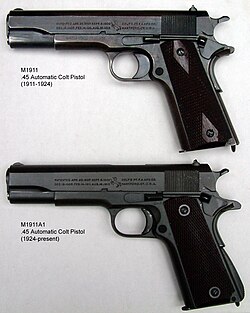
The Colt M1911 (also known as 1911, Colt 1911, Colt .45, or Colt Government in the case of Colt-produced models) is a single-action, recoil-operated, semi-automatic pistol chambered primarily for the .45 ACP cartridge.

The M1911 pistol originated in the late 1890s as the result of a search for a suitable self-loading (or semi-automatic) pistol to replace the variety of revolvers in service at the time. The United States was adopting new firearms at a phenomenal rate; several new pistols and two all-new service rifles (M1892/96/98 Krag and M1895 Navy Lee), as well as a series of revolvers by Colt and Smith & Wesson for the Army and Navy, were adopted just in that decade.

The next decade would see a similar pace, including the adoption of several more revolvers and an intensive search for a self-loading pistol that would culminate in the official adoption of the M1911 after the turn of the decade. Hiram S. Maxim had designed a self-loading rifle in the 1880s, but was preoccupied with machine guns. Nevertheless, the application of his principle of using cartridge energy to reload led to several self-loading pistols in 1896. The designs caught the attention of various militaries, each of which began programs to find a suitable one for their forces. In the U.S., such a program would lead to a formal test at the turn of the 20th century.

During the end of 1899 and into 1900, a test of self-loading pistols was conducted, including entries from Mauser (C96 "Broomhandle"), Mannlicher (Mannlicher M1894), and Colt (Colt M1900). This led to a purchase of 1,000 DWM Luger pistols, chambered in 7.65mm Luger. During field trials, these ran into some problems, especially with stopping power. Other governments had made similar complaints. Consequently, DWM produced an enlarged version of the round, the 9×19mm Parabellum with fifty weapons chambered for it tested by the U.S. Army in 1903.

American units fighting Tausūg guerrillas in the Moro Rebellion in Sulu during the Philippine–American War using the then-standard Colt M1892 revolver, .38 Long Colt, found it to be unsuitable for the rigors of jungle warfare, particularly in terms of stopping power, as the Moros had high battle morale and often used drugs to inhibit the sensation of pain.

The U.S. Army briefly reverted to using the M1873 single-action revolver in .45 Colt caliber, which had been standard during the late 19th century; the heavier bullet was found to be more effective against charging tribesmen. Problems prompted General William Crozier, the Chief of Ordnance, to authorize further testing for a new service pistol.

Following the 1904 Thompson-LaGarde pistol round effectiveness tests, Colonel John T. Thompson stated that the new pistol "should not be of less than .45 caliber" and would preferably be semi-automatic in operation. This led to the 1906 trials of pistols from six firearms manufacturing companies (namely, Colt, Bergmann, Deutsche Waffen- und Munitionsfabriken (DWM), Savage Arms, Knoble, Webley, and White-Merrill).

Of the six designs submitted, three were eliminated early on, leaving only the Savage, Colt, and DWM designs chambered in the new .45 ACP (Automatic Colt Pistol) cartridge. These three still had issues that needed correction, but only Colt and Savage resubmitted their designs.

See all
User Avatar
No comments yet.