
University of Houston
View on Wikipedia | This article needs additional citations for verification. (May 2024) |
The University of Houston (/ˈhjuːstən/ ⓘ; HEW-stən) is a public research university in Houston, Texas, United States. It was established in 1927 as Houston Junior College, a coeducational institution and one of multiple junior colleges formed in the first decades of the 20th century.[7][8] In 1934, HJC was restructured as a four-year degree-granting institution and renamed University of Houston. In 1977, it became the founding member of the University of Houston System. Today, Houston is the fourth-largest university in Texas, awarding 11,350 degrees in 2024.[4] As of 2024, it has a worldwide alumni base of 331,672.[9]
Key Information


The university consists of fifteen colleges and an interdisciplinary honors college offering 310 degree programs and enrolls approximately 37,000 undergraduate and 8,600 graduate students.[10][11][12] The university's campus, which is primarily in southeast Houston, spans 894 acres (3.62 km2), with the inclusion of its two instructional sites located in Sugar Land and Katy.[13] The university is also the founding campus of the University of Houston System.[14]
The university is classified among "R1: Doctoral Universities – Very high research activity"[15][16][17][18] and spends approximately $240 million annually in research. The university operates more than 35 research centers and institutes on campus[19][20] in areas such as superconductivity, space commercialization and exploration, biomedical sciences and engineering, energy and natural resources, and artificial intelligence.
The university has more than 500 student organizations and 17 intercollegiate sports teams.[21] Its varsity athletic teams, known as the Houston Cougars, are members of the Big 12 Conference and compete in the NCAA Division I in all sports. In 2021, the university received and accepted an invitation to join the Big 12 Conference.[22] The football team regularly makes bowl game appearances and the men's basketball team has made 26 appearances in the NCAA Division I men's basketball tournament, including eight Elite Eight and Final Four appearances. The men's golf team has won 16 national championships, the most in NCAA history.[13] In 2022, UH's men's track and field team earned its seventh Indoor Conference Championship title and its swimming and diving team defended its American Athletic Conference title for the sixth straight season.[23][24]
History
[edit]Founding
[edit]The University of Houston began as Houston Junior College (HJC). On March 7, 1927, trustees of the Board of Education of the Houston Independent School District (HISD) unanimously signed a charter founding the junior college. The junior college was operated and administered by HISD.[25][26]
HJC was originally located on the San Jacinto High School campus and offered only night courses to train future teachers.[27]
Its first class began June 5, 1927, with an enrollment of 232 students and 12 faculty recruited from Rice University, the University of Texas and Sam Houston State Teacher's College.[28] The first session accepted no freshman students, and its purpose was to mainly educate future teachers about the college.[28] In the fall semester, HJC opened enrolled to high school students. By then, the college had 230 students and eight faculty members holding evening classes at San Jacinto High School and day classes in area churches.[28]
HJC's first president was Edison Ellsworth Oberholtzer, who was the dominant force in establishing the junior college.[25][29]

University beginnings
[edit]The junior college became eligible to become a university in October 1933 when the governor of Texas, Miriam A. Ferguson, signed House Bill 194 into law. On September 11, 1933, Houston's Board of Education adopted a resolution to make HJC a four-year institution and changing its name to the University of Houston.[30] Unanimously approved by the board, the formal charter of UH was passed April 30, 1934.[28]
UH's first session as a four-year institution began June 4, 1934, at San Jacinto High School with an enrollment of 682. By the fall semester it had 909 students enrolled in classes taught by 39 faculty members in three colleges and schools – College of Arts and Sciences, College of Community Service and General College.[28] In 1934, the first campus of the University of Houston was established at the Second Baptist Church at Milam and McGowen. The next fall, the campus was moved to the South Main Baptist Church on Main Street—between Richmond Avenue and Eagle Street—where it stayed for the next five years.[30] In May 1935, the institution as a university held its first commencement at Miller Outdoor Theatre.[31]

In the mission of finding UH a permanent home, heirs of philanthropists J. J. Settegast and Ben Taub donated 110 acres (0.45 km2) to the university for use as a permanent location in 1936.[32] At this time, there was no road that led to the land tract, but in 1937, the city added Saint Bernard Street, which was later renamed to Cullen Boulevard.[31] It would become a major thoroughfare of the campus. As a project of the National Youth Administration, workers were paid fifty cents an hour to clear the land. In 1938, Hugh Roy Cullen donated $335,000 (equivalent to $5.8 million in 2024) for the first building to be built at the location. The Roy Gustav Cullen Memorial Building was dedicated on June 4, 1939, and opened for classes officially on Wednesday, September 20, 1939.[30] The building was the first air-conditioned college building constructed on a U.S. campus.[28] A year after opening the new campus, the university had over 2,000 students.[28] As World War II approached, enrollment decreased due to the draft and enlistments. The university was one of six colleges selected to train radio technicians in the V-12 Navy College Training Program.[33][34] By the fall of 1943, there were only about 1,100 regular students at UH; thus, the 300 or so servicemen contributed in sustaining the faculty and facilities of the Engineering College. This training at UH continued until March 1945, with a total of 4,178 students.[35]
On March 12, 1945, Senate Bill 207 was signed into law, removing the control of the University of Houston from HISD and placing it into the hands of a board of regents.[30] In 1945, the university—which had grown too large and complex for the Houston school board to administer—became a private university.[36]
.JPG)
In March 1947, the regents authorized creation of a law school at the university. In 1949, the M.D. Anderson Foundation made a $1.5 million gift to UH for the construction of a dedicated library building on the campus. By 1950, the educational plant at UH consisted of 12 permanent buildings. Enrollment was more than 14,000 with a full-time faculty of more than 300.[25] KUHF, the university radio station, signed on in November. By 1951, UH had achieved the feat of being the second-largest university in the state of Texas.[citation needed]
State university
[edit]
In 1953, the university established KUHT—the first educational television station in the nation—after the four yearlong Federal Communications Commission's television licensing freeze ended.[25] During this period, however, the university as a private institution was facing financial troubles. Tuition failed to cover rising costs, and in turn, tuition increases caused a drop in enrollment.[citation needed] That's when it was proposed that UH become a state-funded university.[28]
After a lengthy battle between supporters of the University of Houston, led by school president A.D. Bruce,[37] and forces from state universities, including the University of Texas, geared to block the change, Senate Bill 2 was passed on May 23, 1961, enabling the university to enter the state system in 1963.[25] Beginning roughly during this period, UH became known as "Cougar High" because of its low academic standards, which the university leveraged to its advantage in recruiting athletes.[38]
The University of Houston, initially reserved for white and non-black students, was racially desegregated circa the 1960s as part of the civil rights movements. A group of students called Afro-Americans for Black Liberation (AABL) advocated for desegregation in that period. Robinson Block, a UH undergraduate student writing for Houston History Magazine, stated that as local businesses and student organization remained segregated by race, the first group of black students "had a hard time".[39]
The federal government donated a parcel of coastal prairie to the university in La Marque in Galveston County. Out of this developed the University of Houston Coastal Center (UHCC).[40]
As the University of Houston celebrated its 50th anniversary, the Texas Legislature formally established the University of Houston System in 1977. Philip G. Hoffman resigned from his position as president of UH and became the first chancellor of the University of Houston System. The University of Houston became the oldest and largest member institution in the UH System with nearly 30,000 students.
On April 26, 1983, the university appended its official name to University of Houston–University Park; however, the name was changed back to University of Houston on August 26, 1991.[28][41] This name change was an effort by the UH System to give its flagship institution a distinctive name that would eliminate confusion with the University of Houston–Downtown (UHD), which is a separate and distinct degree-granting institution that is not part of the University of Houston.[28]
Restructuring and growth
[edit]
In 1997, the administrations of the UH System and the University of Houston were combined under a single chief executive officer, with the dual title of chancellor of the UH System and president of the University of Houston. Arthur K. Smith became the first person to hold the combined position. Since 1997, the University of Houston System Administration has been located on campus in the Ezekiel W. Cullen Building.
On October 15, 2007, Renu Khator was selected for the position of UH System chancellor and UH president.[42] On November 5, 2007, Khator was confirmed as the third person to hold the dual title of UH System chancellor and UH president concurrently, and took office in January 2008.[43]
In January 2011, the University of Houston was classified by the Carnegie Foundation for the Advancement of Teaching as a research university with very high research activity.[15][16][17]
Between 2010-2022, undergraduate tuition increased by 47%, significantly outpacing inflation.[44] In 2022, many students reported being incorrectly classified as out-of-state residents, resulting in tuition bills up to $11,000 higher than expected.[45] That same year, students reported that financial aid delays left them at risk of having classes dropped, with the university acknowledging processing backlogs.[46]
Campus safety in 2025
[edit]In early 2025, the university faced widespread criticism for its handling of a series of violent incidents on campus, most notably a sexual assault at knifepoint in the Welcome Center parking garage. The suspect was initially released the same day due to insufficient charges, prompting the Harris County District Attorney's Office to launch a review.[47] The incident was followed within days by two armed robberies, intensifying student outrage.[48] Student leader Aihanuwa Ale-Opinion stated: "Students have a host of concerns regarding their safety, which the UH administration has failed to address for years."[49]
The university fast-tracked an $18 million security upgrade, including increased lighting and patrols.[50] Critics argued these measures came only after years of negligence.[51]
Campus
[edit].JPG)
UH is in southeast Houston, with an official address of 4800 Calhoun Road. It was known as University of Houston–University Park from 1983 to 1991.[28][41] The campus spans 894 acres (3.62 km2) and is roughly bisected by Cullen Boulevard—a thoroughfare that has become synonymous with the university. The Third Ward Redevelopment Council defines the University of Houston as being part of the Third Ward.[52] Melissa Correa of KHOU also stated that the university is in the Third Ward.[53]
The university campus includes numerous green spaces, fountains and sculptures, including a work by famed sculptor Jim Sanborn. Renowned architects César Pelli and Philip Johnson have designed buildings on the UH campus.[54] Recent campus beautification projects have garnered awards from the Keep Houston Beautiful group for improvements made to the Cullen Boulevard corridor.[55]
UH is the flagship institution of the University of Houston System (UH System). It has additional instructional sites located in Sugar Land and Katy. The University of Houston–Clear Lake (UHCL), the University of Houston–Downtown (UHD), and the University of Houston–Victoria (UHV) are separate universities; they are not instructional sites of UH.
Campus layout
[edit]
The University of Houston's campus framework has identified the following five core districts: the Central District, the Arts District, the Professional District, the Residential District, and the Athletics District. In addition, the campus contains several outlying areas not identified among the five districts.
The Central Distinct contains the academic core of the university and consists of the M.D. Anderson Library, the College of Liberal Arts and Social Sciences, the College of Natural Sciences and Mathematics, the College of Technology and the Honors College. The interior of the campus has the original buildings: the Roy G. Cullen Building, the Old Science Building, and the Ezekiel W. Cullen Building. Academic and research facilities include the Cullen Performance Hall, the Science and Engineering Research and Classroom Complex, and Texas Center for Superconductivity and various other science and liberal arts buildings. This area of campus features the reflecting pool at Cullen Family Plaza, the Lynn Eusan Park, and various plazas and green spaces.

The Arts District is located in the northern part of campus and is home to the university's School of Art, the Moores School of Music, the School of Theatre and Dance, the Gerald D. Hines College of Architecture and Design, and the Jack J. Valenti School of Communication. The district also has the Cynthia Woods Mitchell Center for the Performing Arts which houses the Lyndall Finley Wortham Theatre, the main stage of the School of Theatre and Dance, and Moores Opera Center. Other facilities include the Dudley Recital Hall and the Organ Recital Hall in the Fine Arts Building, the Quintero Theatre in the School of Theatre and Dance, and the Moores Opera House and Choral Recital Hall in the Moores School of Music Building.
The Professional District is located northeast and east of the university campus. The district has facilities of the University of Houston Law Center, the Cullen College of Engineering and the C.T. Bauer College of Business. This area of campus is home to Calhoun Lofts, which is an upper-level and graduate housing facility. The East Parking Garage is located on the east end of the district. Adjacent to the district is the University Center (UC), the larger of two student unions on campus.
The Residential District is in the southern portion of the campus, along Wheeler Avenue and east of Martin Luther King Boulevard. This area has undergraduate dormitories, the Conrad N. Hilton College of Hotel and Restaurant Management, now Conrad N. Hilton College of Global Hospitality Leadership, and the College of Optometry. Dormitory facilities include the twin 18-story Moody Towers, Cougar Village, University Lofts, Cougar Place, and the recently demolished Quadrangle which had the following five separate halls: Oberholtzer, Bates, Taub, Settegast, and Law. The Quadrangle was rebuilt in 2020 and renamed The Quad, admitting sophomore level students and up. Adjacent to the Moody Towers and Lynn Eusan Park is the Hilton University of Houston Hotel.
The Athletics District covers the northwest and west part of campus. It includes athletic training facilities for UH sport teams and its stadiums. The western part of the district is home to TDECU Stadium, the football indoor practice facility and the Stadium Parking Garage. Across the parking garage, in the northwestern portion of the district, is the Hofheinz Pavilion. In 2018, the stadium was rebuilt and renamed to the Fertitta Center after UH received a $20 million donation from entrepreneur and UH System Board of Regents chairman Tilman Fertitta. Facilities surrounding the stadium are Carl Lewis International Track & Field Complex, Cougar Field, Softball Stadium, the Alumni Center and the Athletic Center.[56]
Facilities
[edit]
The university's Energy Research Park is a research park specializing in energy research, consisting of 74 acres (0.30 km2) and 19 acres (0.077 km2) of undeveloped land.[57] Much of the physical property was originally developed in 1953 by the oilfield services company Schlumberger as its global headquarters. It was acquired by the university in 2009.[58]
The University of Houston Libraries is the library system of the university. It consists of the M.D. Anderson Library and three branch libraries: the Music Library, William R. Jenkins Architecture, Design & Art Library and the Health Sciences Library. In addition to the libraries administered by the UH Libraries, the university also has the O'Quinn Law Library and the Conrad N. Hilton Library.
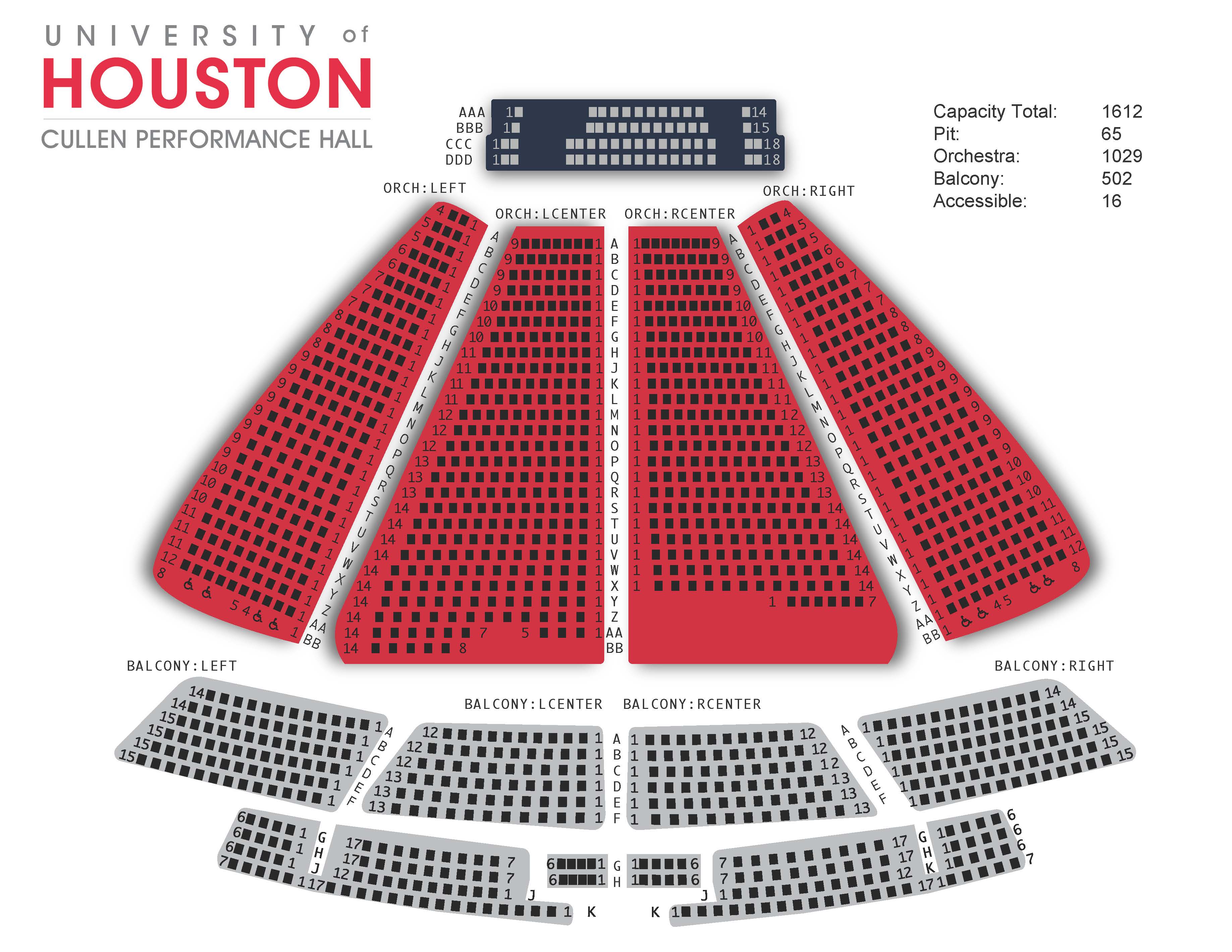
The Cullen Performance Hall is a 1,612 seat proscenium theater which offers a variety of events sponsored by departments and organizations at the university in addition to contemporary music concerts, opera, modern dance, and theatrical performances put on by groups in and outside the Houston area.[59] The Blaffer Art Museum, a contemporary art museum, exhibits the works of both international artists and those of students in the university's School of Art.

The 264,000 square feet (24,500 m2) Campus Recreation and Wellness Center, which is home to the nation's largest collegiate natatorium, was recognized by the National Intramural-Sports Association as an outstanding facility upon its completion in 2004.[60][61]
The LeRoy and Lucile Melcher Center for Public Broadcasting houses the studios and offices of KUHT Houston PBS, the nation's first public television station;[62] KUHF (88.7 FM), Houston's NPR station; the Center for Public Policy Polling; and television studio labs.
The 200,000 sq ft (19,000 m2) Science and Engineering Complex (SEC) was designed by architect César Pelli's firm, Pelli, Clarke & Partners.[63] It houses facilities for many interdisciplinary research programs at UH, including bionanotechnology.
The university has an on-campus Hilton hotel that is part of the Conrad N. Hilton College of Global Hospitality Leadership. This hotel was established with a donation by the founder of Hilton Hotels, Conrad N. Hilton, and is staffed by students in the College of Global Hospitality Leadership.
The University of Houston operates a 250 acres (1.0 km2) branch campus in Sugar Land. The campus was founded in 1995 as a higher education "teaching center" of the University of Houston System. The branch campus has three buildings for exclusive use by the university: the Albert and Mamie George Building, Brazos Hall, and the College of Technology building. Additionally, the University Branch of the Fort Bend County Libraries system is located on the campus for use by students and the Sugar Land community.
Safety concerns have been raised regarding campus facilities. Parking garages were the site of increased crime in 2023, with 12 reported thefts in one semester at the Welcome Center Garage.[64] Students protested a 30% increase in parking permit fees while shuttle services were reduced.[65] Many academic buildings and labs are reportedlt in need of upgrades, particularly in engineering and science facilities.[66]
Institutional structure
[edit]Governance
[edit]The University of Houston (UH) is one of four separate and distinct institutions in the University of Houston System, and was known as University of Houston–University Park from 1983 to 1991.[28][41] UH is the flagship institution of the UH System. It is a multi-campus university with a branch campus located in Sugar Land. The University of Houston–Clear Lake (UHCL), the University of Houston–Downtown (UHD), and the University of Houston–Victoria (UHV) are stand-alone universities; they are not branch campuses of UH.
The organization and control of the UH is vested in the UH System Board of Regents. The board consists of nine members who are appointed by the governor for a six-year term and has all the rights, powers and duties that it has with respect to the organization and control of other institutions in the System; however, UH is maintained as a separate and distinct institution.
Administration
[edit]The president is the chief executive officer (CEO) of the University of Houston, and serves concurrently as chancellor of the UH System. The position is appointed by its board of regents. As of January 2008, Renu Khator has been president of the University of Houston and chancellor of the UH System.
The administrations of UH and the UH System are located on the university campus in the Ezekiel W. Cullen Building. From 1961 until 1977, the Weingarten House in Riverside Terrace housed the president of UH.[67] Currently, the chancellor/president resides in the Wortham House in Broadacres Historic District, provided by the UH System Board of Regents as part of the chancellor/president's employment contract.[68]
Academics
[edit]
| Colleges | Founded |
| Junior College (defunct) | 1927 |
| General College (defunct) | 1933 |
| Graduate School | 1939 |
| Cullen College of Engineering | 1941 |
| College of Technology (defunct) | 1941 |
| College of Arts and Sciences (defunct) | 1942 |
| Bauer College of Business | 1942 |
| Downtown School (defunct) | 1943 |
| College of Education | 1945 |
| College of Pharmacy | 1946 |
| University of Houston Law Center | 1947 |
| College of Nursing (defunct) | 1948 |
| College of Optometry | 1952 |
| Hines College of Architecture and Design | 1956 |
| Graduate College of Social Work | 1967 |
| Hilton College of Global Hospitality Leadership | 1969 |
| College of Continuing Education | 1974 |
| College of Natural Sciences and Mathematics | 1975 |
| College of Social Science (defunct) | 1975 |
| College of Humanities and Fine Arts (defunct) | 1975 |
| Hobby School of Public Affairs | 1981 |
| The Honors College | 1993 |
| College of Liberal Arts and Social Sciences | 2000 |
| Gessner College of Nursing | 2015 |
| Kathrine G. McGovern College of the Arts | 2016 |
| Fertitta Family College of Medicine | 2019 |
| References[69] | |
The university offers over 310-degree programs. With final approval of a PhD in Communication Sciences and Disorders, a Doctorate in Nursing Practice, and a Doctorate in Medicine, university offers 51 doctoral degrees including three professional doctorate degrees in law, optometry, medicine and pharmacy.[20][70][71][72][73]
In 2022, UH System Board of Regents unanimously approved the addition of a new degree program of the Bachelor of Arts in Mexican American and Latino/a Applied Studies. Being located in a city with a large Hispanic/Latino population, the degree aims to focus on the experiences and contributions of the Latino community in the United States.[74]
UH is one of four public universities in Texas with a Phi Beta Kappa chapter.[75][76] The University of Houston's faculty includes National Medal of Science recipient Paul Chu from the Physics Department, and Nobel Peace Prize Laureate Jody Williams.
The College of Liberal Arts and Social Sciences (CLASS) has the Creative Writing Program which includes founders such as alumnus Donald Barthelme and offers degrees in poetry, fiction, and non-fiction. The Gerald D. Hines College of Architecture and Design is one of only 36 schools to have an accreditation from the National Architectural Accrediting Board.[77]
.JPG)
In August 2016, the Texas Higher Education Coordinating Board approved the creation of the Hobby School of Public Affairs.[78] The school, named in honor of former Texas Lt. Gov. Bill Hobby, builds on the existing educational and research programs of the Center for Public Policy, which was founded at UH in 1981. The designation officially moves the Master of Public Policy Degree from the UH College of Liberal Arts and Social Sciences to the Hobby School of Public Affairs and approves the addition of a Master of Public Policy degree as a dual degree with the Graduate College of Social Work's Master of Social Work.
In October 2018, the Texas Higher Education Coordinating Board approved the creation of the College of Medicine.[79] A site has been selected for the college's new building, and the inaugural class entered in 2020.
The UHin4 fixed-tuition program has been criticized for pressuring students into taking 15+ credit semesters, with 40% of participants dropping out due to workload.[80] In 2023, students reported technical issues with class registration systems that locked them out of required courses.[81] And the university has faced criticism for slow responses to residency appeals and credit transfer issues.[45]
Rankings
[edit]| Academic rankings | |
|---|---|
| National | |
| Forbes[82] | 107 |
| U.S. News & World Report[83] | 132 (tie) |
| Washington Monthly[84] | 186 |
| WSJ/College Pulse[85] | 254 |
| Global | |
| ARWU[86] | 201–300 |
| QS[87] | 556 (tie) |
| THE[88] | 401–500 |
| U.S. News & World Report[89] | 416 (tie) |
In the 2026 U.S. News & World Report rankings, UH placed in the top 50 universities for social mobility.[83] That same year, the University of Houston Law Center was ranked tied for 63rd in the nation and 5th in the state of Texas in the graduate school rankings.[90] The undergraduate entrepreneurship studies program at the Bauer College of Business was also ranked 9th in the nation.[83] In the 2025 The Princeton Review and Entrepreneur magazine rankings, the undergraduate entrepreneurship program ranked 1st in the nation.[91]
Critics, including University of Houston faculty members, have alleged that the university's improvement in the U.S. News & World Report rankings was largely due to changes in the ranking methodology which removed key measures of academic excellence, such as the percentage of faculty with the highest degrees, the percentage of students in the top 10 percent of their high school class, and average class size. Those critics have said that these changes gave the appearance of progress without reflecting any meaningful improvement in academic standards and that the university administration's policies aimed at climbing the rankings have actively eroded academic excellence.[92][93]
| National Rankings by Subject (as of 2025)[90] | ||
|---|---|---|
| College | Program | Ranking |
| BAUER | Business | Unranked |
| CLASS | Clinical Psychology | 91 (tie) |
| CLASS | Economics | 68 (tie) |
| CLASS | English | 97 (tie) |
| CLASS | History | 86 (tie) |
| CLASS | Political Science | 58 (tie) |
| CLASS | Psychology | 95 (tie) |
| CLASS | Speech-Language Pathology | 39 (tie) |
| CULLEN | Engineering | 72 (tie) |
| EDU | Education | 81 (tie) |
| HOBBY | Public Affairs | 72 (tie) |
| KGMCA | Fine Arts | 124 (tie) |
| LAW | Law | 63 (tie) |
| MED | Medicine: Primary Care | Unranked |
| MED | Medicine: Research | Unranked |
| NSM | Biological Sciences | 175 (tie) |
| NSM | Chemistry | 81 (tie) |
| NSM | Computer Science | 110 (tie) |
| NSM | Earth Sciences | 70 (tie) |
| NSM | Mathematics | 91 (tie) |
| NSM | Physics | 89 (tie) |
| PHARM | Pharmacy | 41 (tie) |
| SW | Social Work | 67 (tie) |
| Global Rankings by Subject (as of 2025)[94] | |||
|---|---|---|---|
| College | Program | Ranking | |
| BAUER | Economics & Business | 242 | |
| CLASS | Psychiatry/Psychology | 249 (tie) | |
| CLASS | Social Sciences & Public Health | 247 (tie) | |
| CULLEN | Civil Engineering | 194 (tie) | |
| CULLEN | Electrical & Electronic Engineering | 59 | |
| CULLEN | Energy & Fuels | 294 | |
| CULLEN | Engineering | 221 (tie) | |
| CULLEN | Materials Science | 185 (tie) | |
| CULLEN | Nanoscience & Nanotechnology | 274 | |
| CULLEN | Neuroscience & Behavior | 492 | |
| EDU | Public, Environmental & Occupational Health | 454 | |
| MED | Clinical Medicine | 505 (tie) | |
| NSM | Biology & Biochemistry | 655 (tie) | |
| NSM | Chemistry | 354 | |
| NSM | Computer Science | 300 | |
| NSM | Environment/Ecology | 692 (tie) | |
| NSM | Geosciences | 244 (tie) | |
| NSM | Physical Chemistry | 281 (tie) | |
| NSM | Physics | 507 (tie) | |
| School | Founded | 2022 Undergraduate Enrollment[95] | 2022 Graduate Enrollment[95] |
|---|---|---|---|
| University of Houston | 1927 | 37,282 | 9,418 |
| Medicine | 2019 | N/A | 120 |
| Pharmacy | 1946 | N/A | 550 |
| Law | 1947 | N/A | 825 |
| Optometry | 1952 | N/A | 419 |
| Architecture | 1956 | 824 | 89 |
| Business | 1942 | 6,369 | 1,189 |
| Engineering | 1941 | 3,209 | 1,659 |
| Education | 1945 | 2,663 | 850 |
| Public Affairs | 1981 | 47 | 45 |
| Social Work | 1967 | N/A | 544 |
| Arts | 2016 | 1,082 | 247 |
| Liberal arts & Social Sciences | 2000 | 10,621 | 980 |
| Natural Sciences | 1975 | 4,789 | 1,100 |
| Technology | 1941 | 4,704 | 549 |
| Hospitality | 1969 | 633 | 127 |
| Nursing | 2015 | 277 | 102 |
Research
[edit]
The Carnegie Foundation classifies UH as a doctoral degree-granting institution with "highest research activity".[15][16][17] The designation recognizes it as one of only nine universities in Texas with the classification.[15][16][96]
According to the National Science Foundation, UH spent $177 million on research and development in 2018, ranking it 123rd in the nation.[97] It operates more than 40 research centers and institutes on campus,[98][99][100] and through these facilities, UH maintains partnerships with government, health care and private industry.[101] Areas of interdisciplinary research include nanotechnology, superconductivity, space commercialization and exploration, biomedical sciences and engineering, energy and natural resources, and artificial intelligence.[102][103][104][105]
The university has five institutional research thrusts to address several research challenges aimed at economic development and improving the quality of life. The five thrusts include: Cyber and Physical Security, Drug Discovery and Development, Sustainable Communities and Infrastructure, Energy Security and Transition, and Accessible Health Care.[106]
In 2018, UH launched its 50in5 initiative. Led by the Provost Paula Short and Vice President for Research Amr Elnashai, the university is working to increase research by 50 percent in five years. This includes the doubling of UH's national centers from five to 10, thereby improving its position for the Association of American University's membership.[107]
In 2022, UH received $4 million for the expansion of its Center of Economic Inclusion.[108]
Student life
[edit]| Race and ethnicity | Total | ||
|---|---|---|---|
| Hispanic | 38% | ||
| Asian | 24% | ||
| White | 17% | ||
| Black | 11% | ||
| International student | 5% | ||
| Two or more races | 3% | ||
| Unknown | 1% | ||
| Economic diversity | |||
| Low-income[a] | 42% | ||
| Affluent[b] | 58% | ||
The University of Houston is notable for its diverse student body, and U.S. News & World Report ranks the university as the second-most ethnically diverse research university in the United States.[110] UH's Asian and Hispanic student population is among the highest in the state. Due to the high percentage of Hispanic students on campus, UH has been deemed a Hispanic-serving institution. Its international student population is primarily from Asia.
Art, music and theatre
[edit].JPG)
Located in the Fine Arts Building, Blaffer Art Museum is a contemporary art museum dedicated to emerging, mid-career, and underrepresented artists and bodies of work through exhibitions, publications, and public programs. Its educational programs include public lectures, artists' talks, docent tours, audio guides, and youth programs such as Studio Saturday, Summer Arts, and the Young Artist Apprenticeship Program.
The Cullen Performance Hall is a 1,612 seat proscenium theater located near Entrance 1. The hall offers a variety of events sponsored by departments and organizations at the university in addition to contemporary music concerts, opera, modern dance, and theatrical performances put on by groups in and outside the Houston area.[111]
The Moores School of Music presents concerts in various campus venues: Dudley Recital Hall and the Organ Recital Hall in the Fine Arts Building, and in the Moores Opera House and Choral Recital Hall in the music building. Musical events range from opera to jazz with performers including students, faculty, and guest artists.
The School of Theatre and Dance offers a subscription series of five plays each year. Works by classical and modern dramatists, as well as new musical collaborators, are seen in full productions or "gypsy runthroughs".
The School of Art exhibits young artists several times a year, including the Master of Fine Arts exhibition held traditionally near the end of the spring semester in the Blaffer Art Museum. The School of Art also hosts presentations by numerous visiting artists and art historians throughout the academic year.
Housing
[edit]
UH has several on campus dormitories: Moody Towers, The Quad, Cougar Village I & II, Cougar Place, University Lofts, Bayou Oaks, Cullen Oaks, and Cambridge Oaks.
Moody Towers, frequently just called "Moody", is one of the tallest complexes on campus and the largest area of residence halls. Each of the two towers consists of eighteen stories and together house 1,100 students. The Towers feature a newly renovated dining hall. The rooms in Moody were renovated during the summer of 2011.
The Quad is the newest dorm on campus, having been completed in the Fall of 2020. Named after the former dorms, "The Quadrangle", there are laundry facilities on each floor, as well as a recreational facility, computer lab, and an outdoor courtyard. An extension of The Quad, the Townhouses are single-student dorms right across from The Quad. In total, The Quad and Townhouses combine for 7 buildings that house almost 1,200 students.

In August 2009, University Lofts—a university-owned and operated residential facility aimed at graduate and professional students—opened and includes retail stores, lecture halls, and recreation facilities.
Cougar Village I & II are a freshman, including first year Honors students, dorm which opened in August 2010 and August 2013, respectively. The dormitory features themed floors with kitchens and lounges, a tutoring center, computer labs, multi-purpose rooms, study areas, a convenience store, a laundry facility, and a fitness center. Cougar Village I & II are exclusive only to freshman and Honors College students.[112]
In addition to traditional dormitories, Cougar Place was an apartment-style housing complex consisting of 400 units. Cougar Place has since been demolished as of 2013[update] and has been replaced with a new on-campus housing complex for sophomores.[113] The university has privately owned apartment complexes on campus: Cullen Oaks, Bayou Oaks, and Cambridge Oaks.
In June 2017, a divided panel of the United States Court of Appeals for the Fifth Circuit found that the university did not violate the Constitution's Due Process Clause or Title IX when it expelled both a student for committing a campus sexual assault in a dorm room then abandoning the nude victim in a dorm elevator, as well as his girlfriend, who had recorded the assault and shared the video on social media.[114][115]
Media
[edit]The official student newspaper is The Cougar, formerly The Daily Cougar, and has been published since 1927.[30] Students also produce the Houstonian magazine, which is for graduating students; Cooglife, a monthly lifestyle magazine; and Transitions, a magazine for incoming students.
CoogTV is a live student-run TV network that appears on the University of Houston cable network.
CoogRadio, UH's student-run college radio station, made its debut on August 29, 2011.[116]
Traditions
[edit]
The seal of the University of Houston, officially adopted in 1938, is a stylized version of the coat-of-arms of General Sam Houston. The first official version was placed on the floor of the Roy Gustav Cullen Building.[117]
UH's official colors are scarlet red and albino white. These were the colors of Sam Houston's ancestor, Sir Hugh de Paduinan, and were adopted by UH at the same time as the official seal. Scarlet red symbolizes courage or inner strength to face the unknown, and white symbolizes the goodness and purity of spirit embodied in helping one's fellow man.[118]
Cougar Red Friday is part of the ongoing Keep Houston Red initiative at the University of Houston. Students and staff are encouraged to wear red shirts on Friday to show pride for the university.[119]

The school's official mascot is a cougar, which was adopted in 1947 and later named Shasta.[120] The university owned a series of female cougars, but this tradition ceased in 1989, upon the death of Shasta V. When a cougar cub was orphaned in Washington State and moved to the Houston Zoo in 2011, the university adopted it as its first live male cougar mascot and he was named Shasta VI.[121][122] Shasta VI died in August 2022 from a progressive spinal disease. In November of the same year, the Houston Zoo received two orphaned male cubs from Washington State Fish & Wildlife Services and decided the cubs would carry the long-standing tradition of representing the University of Houston as Shasta VII and Louie.[122]
The Frontiersmen—initially exclusive to members of the Sigma Chi fraternity, but later opened membership to the entire student body—is a group of students who participate in university events to drive school spirit. At football games, the Frontiersmen—donning cowboy hats, jeans and dusters for attire—run across the field with the university's flag and the Texas flag after each score.
The BLAZE is an oil field warning siren, operated by the Frontiersmen, that was chosen to represent the university's ties to the petroleum industry. The purchase of the siren was completed in 1991. The Sigma Chi Fraternity has overseen the siren and gave it the name "The BLAZE" in honor of its fallen brother, David Blazek.[28]
Frontier Fiesta—a re-creation of a 19th-century Western town, with music, food and historical exhibits—is a major event on campus each spring semester. The student-led festival is a part of a long-standing tradition dating back to the 1940s established by Gan Bey which later became the Sigma Chi Fraternity's Epsilon Xi chapter at UH.[123] Frontier Fiesta attained widespread notoriety when the Sigma Chi variety show performance known as "Bella Union" garnered national attention on the cover of Life magazine as "The Greatest College Show on Earth" and soon-after drew crowds numbered in the tens of thousands from all across the country to participate in the festivities.
Cougar First Impressions—a program headed by the UH Staff Council—takes place every year on the first two days of classes, when faculty and staff turn out to welcome new and returning students.[124]
Weeks of Welcome is another program welcoming students to the university. Over the span of two weeks, departments and student organizations help students learn more about the university with a variety of events.[125]
The Cougar Paw
[edit]
The Cougar Paw is a popular hand sign used by University of Houston students, faculty, alumni, and athletics fans to represent camaraderie and support. The Cougar Paw tradition was adopted through several athletics events between the University of Houston and the University of Texas.
The University of Houston and the University of Texas played their first football game against one another in 1953. Since this was their first meeting, members of Alpha Phi Omega—the service fraternity in charge of taking care of Shasta I, the university's mascot—brought her to the game. During the trip, Shasta's front paw was caught in the car door and one toe was cut off. At the game, several Longhorn players saw what had happened and began taunting UH players by holding up their hands with the ring finger bent, suggesting the Cougars were invalids. Texas went on to win this game 28–7. UH students had been using the victory sign as a hand signal up to that time but they began using the bent-finger sign as a reminder that they would remember the taunts.[28]
The Cougars did not play the Longhorns again until 1968. With UH fans holding up the new sign of Cougar pride, UH played UT to a 20–20 tie. They didn't meet again until 1976, the first year UH was a member of the Southwest Conference. In front of a record crowd at Texas' Memorial Stadium, UH defeated UT 30–0, a rout that signaled the beginning of the end for legendary Texas coach Darrell Royal. This solidified the use of the Cougar Paw as a tradition.[117]
Athletics
[edit]
UH's 17-sport intercollegiate program is a member of the Big 12 Conference. Houston was previously a member of Conference USA, of which it was a member from the time the conference was formed in 1995 until 2013, when they joined the American Athletic Conference. During that time span, the Cougars won 33 C-USA titles. Prior to 1995, Houston was a member of the Southwest Conference.
After more than 75 years of athletics at UH, other notable achievements include 16 national titles in men's golf, one national title in cross country, seven NCAA Men's Basketball Final Four appearances, and two College World Series appearances. More than 75 Olympic athletes have attended UH, bringing home 41 medals, including 20 gold.[126][127]
UH has many recreational sport clubs, including rugby, NCWA wrestling, soccer, tennis, water polo, kendo, esports and gymnastics.
In addition to varsity sports, the University of Houston offers a variety of intramural sports programs.
Varsity sports
[edit]
The university has an intercollegiate sports program that competes in the National Collegiate Athletic Association (NCAA). The NCAA's Division I sports at the University of Houston include baseball, basketball, cross country, American football, golf, and track and field for men; basketball, cross country, soccer, softball, swimming and diving, tennis, and track and field for women.
The Houston Cougars football team has made 27 post-season bowl appearances and has to its credit several Southwest Conference championships and Cotton Bowl Classic appearances, as well as the 2006 Conference USA Championship[128] and the 2015 American Athletic Conference championship. The 1989 Heisman Trophy winner, Andre Ware, was a Cougar.
The men's basketball team has made 26 NCAA Tournament appearances, with seven trips to the Final Four. See also Phi Slama Jama, the Cougars teams of the early 1980s that featured future NBA legends Clyde Drexler and Hakeem Olajuwon.
Houston competes with other notable sports teams, such as the baseball team, which has made 21 NCAA Tournament appearances with two trips to the College World Series; the men's golf team, which has won 16 NCAA National Championships; the women's soccer team, which was rated as the top first-year women's program in the country in 1998; the swimming and diving teams, which have spawned multiple Olympians and All-Americans; the track and field team, which perennially ranks in the top 10 as an NCAA team; and the volleyball team, which had a streak of ten consecutive trips to the NCAA Tournament.
Notable people
[edit]- Notable University of Houston alumni include:
-
 Fred Couples, professional golfer
 -
 Clyde Drexler, Basketball Hall of Fame member
 -
 Bonnie J. Dunbar, former NASA astronaut
 -
 Elvin Hayes, 12-time NBA All-Star
 -
 Lizzo, Grammy Award-winning singer
 -
 Case Keenum, NFL Quarterback
 -
 Hakeem Olajuwon, 1994 NBA MVP
 -
 Jim Parsons, Emmy Award-winning actor
 -
 Wade Phillips, NFL Coach
 -
 Jack Valenti, former president of the Motion Picture Association
 -
 Elizabeth Warren, U.S. Senator from Massachusetts
.jpg)


_(cropped).jpg)

.jpg)


Jack Valenti, long-time president of the Motion Picture Association of America, creator of the MPAA film rating system, and a special assistant in the Lyndon B. Johnson administration, received his B.B.A. from UH. Artist and filmmaker Julian Schnabel is also an alumnus.
Alice Sebold, a novelist known for Lucky and The Lovely Bones, and Matt Mullenweg, creator of WordPress (the most popular, open-source blogging platform), also attended the university.
Notable athletes within the list include NFL players Wilson Whitley, Glenn Montgomery, Alfred Oglesby, Craig Veasey, Donnie Avery, David Klingler, Kevin Kolb, Billy Milner, Sebastian Vollmer, Case Keenum, and Heisman Trophy winner Andre Ware; baseball stars Doug Drabek, Michael Bourn, and Brad Lincoln; golfers Fred Couples, Billy Ray Brown, Steve Elkington, and Fuzzy Zoeller; track and field legends Carl Lewis and Leroy Burrell; NBA basketball players Hakeem "The Dream" Olajuwon, Clyde "The Glide" Drexler and "The Big E" Elvin Hayes as well as Bo Outlaw, Don Chaney, Michael Young, Damon Jones, Carl Herrera and Otis Birdsong; and legendary Dallas Cowboys coach Tom Landry. The owner of the San Diego Padres and noted philanthropist John Moores holds both undergraduate and law degrees. Wade Phillips, a former head coach of the Denver Broncos, Buffalo Bills, and Dallas Cowboys, is a UH alumnus as well.
Notable Texas politicians who are graduates of the UH Political Science program include Alfred H. Bennett, U.S. District Judge of the U.S. District Court for the Southern District of Texas;[129] Carol Alvarado, Texas State senator for District 6;[130] and James White, State Representative Texas House District 19.[131] Other politicians who attended UH include Gene Green, a retired Democratic U.S. congressman from the state of Texas representing its 29th congressional district, which includes most of eastern Houston, along with large portions of Houston's eastern suburbs; and Ted Poe, a Republican politician formerly representing Texas's 2nd congressional district in the United States House of Representatives. Elizabeth Warren, a U.S. senator from Massachusetts and formerly a University of Houston Law Center faculty member received her B.S. from UH in 1970. Tom DeLay, a former member and majority leader of the U.S. House of Representatives, who represented Texas's 22nd congressional district from 1984 until 2006, also attended the University of Houston. Jasmine Crockett, U.S. representative from Texas's 30th congressional district since January 2023, attended the University of Houston Law Center, graduating in 2006 with a Juris Doctor.
Crystle Stewart, Miss USA 2008 is a former student at the university, last attending in 2007. Jason Alkire, an artist and fashion designer, is a graduate as well.[132] Other alumni include Jim Parsons, star of the television series The Big Bang Theory, Brent Spiner of Star Trek: The Next Generation, actors Robert Wuhl, Loretta Devine, Dennis Quaid, Randy Quaid, Brett Cullen, comedian Bill Hicks and attorney and talk show host Star Jones, Project Runway contestants Chloe Dao and Laura Bennett, sportscasters Jim Nantz and Robert Flores, YouTuber Liza Koshy, South Asian American singer Shahzeb Tejani, singer and rapper Lizzo, and country music stars Larry Gatlin and Kenny Rogers. Dwayne Michael Carter Jr., aka Lil Wayne, is a hip-hop artist from New Orleans. He enrolled in 2005 but dropped out shortly after.
References
[edit]- ^ a b As of August 31, 2024. "Independent Auditor's Report and Financial Statements: August 31, 2024 and 2023". University of Houston System. January 31, 2025. Retrieved February 18, 2025.
- ^ "Fiscal Year 2025 Plan and Budget" (PDF). University of Houston System. May 15, 2024. Archived (PDF) from the original on February 18, 2025. Retrieved February 18, 2025.
- ^ University of Houston. "SVP for Academic Affairs and Provost Diane Z. Chase". University of Houston: Office of the Provost. University of Houston. Retrieved July 24, 2023.
- ^ a b c d e f "University of Houston: Fall 2024 Facts" (PDF). University of Houston. Retrieved May 13, 2025.
- ^ "IPEDS-University of Houston". Archived from the original on November 5, 2021. Retrieved November 5, 2021.
- ^ "University of Houston Brand Style Guide". Archived from the original on August 27, 2022. Retrieved August 27, 2022.
- ^ Richard L. Drury. "Community Colleges in America: A Historical Perspective" (PDF). Inquiry, Volume 8, Number 1, Spring 2003.
- ^ "Community Colleges – The History of Community Colleges, The junior college and the research university., The Community College Mission". education.stateuniversity.com.
- ^ University of Houston. "2024 Annual Report". University of Houston Advancement. University of Houston. Archived from the original on July 31, 2024. Retrieved July 31, 2024.
- ^ "Undergraduate Admissions – Majors". University of Houston. Retrieved May 16, 2023.
- ^ "Graduate School – Programs and Colleges". University of Houston. Retrieved May 16, 2023.
- ^ University of Houston. "University of Houston: Fall 2022 Facts" (PDF). University of Houston. Retrieved May 16, 2023.
- ^ a b University of Houston. "University of Houston: Fall 2021 Facts" (PDF). University of Houston. Archived (PDF) from the original on October 8, 2022. Retrieved September 27, 2022.
- ^ "University of Houston Administrator's Statement". University of Houston System. Archived from the original on February 2, 2011. Retrieved May 30, 2011.
- ^ a b c d Bonnin, Richard. "Carnegie Foundation Gives University of Houston its Highest Classification for Research Success, Elevating U of H to Tier One Status". University of Houston. Archived from the original on September 20, 2012. Retrieved February 8, 2011.
- ^ a b c d "UH achieves Tier One status in research". Houston Business Journal. January 21, 2011. Archived from the original on November 2, 2012. Retrieved July 6, 2011.
- ^ a b c "UH takes big step up to Tier One status". Houston Chronicle. January 18, 2011. Archived from the original on October 21, 2012. Retrieved July 6, 2011.
- ^ Watkins, Matthew (February 2, 2016). "Four Texas Colleges Reach Carnegie "Tier One" Status". The Texas Tribune.
- ^ University of Houston. "University of Houston: Research". University of Houston. Archived from the original on February 3, 2022. Retrieved February 3, 2022.
- ^ a b University of Houston. "University of Houston: About". University of Houston. Archived from the original on February 3, 2022. Retrieved February 3, 2022.
- ^ "UH at a Glance". University of Houston. Archived from the original on August 14, 2012. Retrieved June 1, 2011.
- ^ Mueller, James (September 10, 2021). "Long-awaited dream: UH accepts invite to join Big 12". The Cougar. Archived from the original on September 27, 2022. Retrieved September 27, 2022.
- ^ Garrett, Tyler (February 20, 2022). "UH swimming and diving wins sixth straight AAC title". The Cougar. Archived from the original on September 27, 2022. Retrieved September 27, 2022.
- ^ Thomas, Sean (June 12, 2022). "UH track and field earns seven All-American honors at NCAA Championship". The Cougar. Archived from the original on September 27, 2022. Retrieved September 27, 2022.
- ^ a b c d e "University of Houston–University Park". Hand book of Texas. Texas State Historical Association. Archived from the original on November 30, 2010. Retrieved October 16, 2007.
- ^ "UH Timeline". University of Houston. Archived from the original on December 18, 2007. Retrieved October 16, 2007.
- ^ "UH Through Time: Events". University of Houston Libraries. Archived from the original on September 14, 2012. Retrieved October 16, 2007.
- ^ a b c d e f g h i j k l m n Adair, Wendy; Gutierrez, Oscar (2001). The University of Houston: Our Time: Celebrating 75 Years of Learning and Leading. Virginia Beach, VA: Donning Co. Publishers. ISBN 1578641438.
- ^ "Oberholtzer, Edison, Ellsworth". Handbook of Texas. Texas State Historical Association. Archived from the original on July 15, 2011. Retrieved April 6, 2008.
- ^ a b c d e "Discover UH's Heritage & History". UH Alumni Organization. Archived from the original on November 7, 2007. Retrieved October 16, 2007.
- ^ a b Johnston, Marguerite (1991). Houston: The Unknown City: 1836–1946. College Station, Texas: Texas A&M University Press. p. 309. ISBN 0-89096-476-9.
- ^ "Group of average students sparks UH creation". Houston Chronicle. April 8, 2001. Archived from the original on October 24, 2012. Retrieved April 6, 2008.
- ^ Test and Research Staff, Bureau of Naval Personnel; "Psychological test construction and research in the Bureau of Naval Personnel. Part V. Navy radio technician training program"; American Psychologist, vol 1(3), Mar. 1946, pp 80–90
- ^ Commandant, Eighth Naval District (1946). United States Naval Administration in World War II: History of the Eighth Naval District. New Orleans, Louisiana: United States Navy. p. 271. Archived from the original on January 12, 2012. Retrieved May 10, 2019.
- ^ Watson, Raymond C., Jr.; Solving the Naval Radar Crisis, Trafford Publishing, 2007, pp. 207–208, ISBN 978-1-4251-6173-6
- ^ Scott, Bethany. ""University of Houston Integration Records: A Difficult Path to Desegregation"" (PDF). Houston History Magazine. University of Houston Center for Public History. Retrieved July 31, 2024.
- ^ "A.D. Bruce Speeches Collection, 1954–1961". Texas Archival Resources Online (TARO). University of Texas Libraries. Archived from the original on April 21, 2007. Retrieved June 25, 2007.
- ^ Pennington, Richard, and Denton A. Cooley. Longhorn Hoops: The History of Texas Basketball. University of Texas Press, 1998.
- ^ Block, p. 24.
- ^ "Texas Institute for Coastal Prairie Research & Education". UH Coastal Center. Retrieved September 28, 2025.
- ^ a b c "72(R) History for Senate Bill 755". Texas Legislature Online History. Texas Legislature. Archived from the original on May 26, 2024. Retrieved March 28, 2010.
- ^ "Scholar and Administrator Selected as Sole Nominee". UH News Release. Archived from the original on May 11, 2012. Retrieved May 11, 2007.
- ^ Gerber, Eric. "Renu Khator Confirmed as New University of Houston & UH System Leader". University of Houston. Archived from the original on December 18, 2007. Retrieved November 27, 2007.
- ^ "UH tuition rises 4% as Texas lawmakers freeze state funding". Houston Chronicle. May 15, 2023.
- ^ a b "Texas students struggle with residency proof". Texas Tribune. August 3, 2021.
- ^ "Financial aid delays leave students scrambling". Daily Cougar. September 8, 2022.
- ^ Downen, Robert (February 24, 2025). "Harris County DA reviewing release of University of Houston sexual assault suspect". Houston Chronicle.
- ^ "UH students demand increased security after string of campus violence". Houston Chronicle. February 13, 2025.
- ^ Downen, Robert (February 25, 2025). "University of Houston students voice fears after campus crimes". Houston Chronicle.
- ^ "University of Houston fast-tracks $18 million security project following crime spike". Houston Public Media. February 25, 2025.
- ^ "UH students demand action after series of incidents spark safety concerns". Click2Houston. February 13, 2025.
- ^ Witcher, T.R. (July 20, 1995). "Third Ward Rising". Houston Press. Archived from the original on February 17, 2015. Retrieved March 18, 2020.
To the east, across Cullen, is UH, and then the Houston Belt & Terminal railroad right of way, which the council uses as the community's eastern boundary. [In other words the council defines UH as part of the Third Ward]
- ^ Correa, Melissa (December 30, 2019). "Innovation vs. gentrification: Third Ward residents want to grow with neighborhood, not be replaced". KHOU. Archived from the original on March 18, 2020. Retrieved March 18, 2020.
That's one piece of a very rich history of the Third Ward, home to the University of Houston and Texas Southern University.
- ^ Vasquez, Leticia. "Art that Speaks for Itself Enlightens New Sculpture". UH Today. University of Houston. Archived from the original on August 25, 2012. Retrieved October 12, 2007.
- ^ Parker, Francine. "UH Keeps Houston Beautiful". UH Today. University of Houston. Archived from the original on February 5, 2012. Retrieved October 12, 2007.
- ^ Stipes, Chris (2018). "Tilman Fertitta to be Honored at Fertitta Center Private Opening Celebration". www.uh.edu. University of Houston. Archived from the original on May 12, 2019. Retrieved September 27, 2022.
- ^ Bonnin, Richard (2009). "New Energy Research Park Energizes March to Tier One". The University of Houston Magazine. Archived from the original on February 12, 2013. Retrieved January 31, 2013.
- ^ Kever, Jeannie (September 7, 2012). "Energy players team up in UH research park". Houston Chronicle. Archived from the original on November 2, 2012. Retrieved January 31, 2013.
- ^ "University of Houston: Cullen Performance Hall". University of Houston. The Cougar. Archived from the original on September 27, 2022. Retrieved September 27, 2022.
- ^ "NIRSA Awards". National Intramural-Recreational Sports Association. Archived from the original on June 17, 2004. Retrieved October 12, 2007.
- ^ Kastendieck, Todd. "CRWC wins national award". The Daily Cougar. Retrieved March 18, 2008.[dead link]
- ^ "Appreciation for KUHT, Houston Public Television". Resolution of the Board of Directors, Corporation for Public Broadcasting. May 24, 1993. Archived from the original on February 18, 2012. Retrieved April 8, 2009.
- ^ Pelli Clarke Pelli Projects Archived October 16, 2007, at the Wayback Machine. Pelli Clarke Pelli Architects official site. Retrieved October 12, 2007.
- ^ "Crime reports spike near UH parking garages". Houston Chronicle. November 3, 2022.
- ^ "UH students protest parking fees after 30% hike". KHOU 11. February 9, 2023.
- ^ "Deferred maintenance plagues aging campus buildings". Daily Cougar. March 15, 2023.
- ^ "Exterior view of the former President's residence, Weingarten House". University of Houston. Archived from the original on October 25, 2019. Retrieved July 25, 2019.
- ^ "Wortham House". UH Through Time. University of Houston Libraries. Archived from the original on September 3, 2006. Retrieved June 26, 2008.
- ^ "Colleges, Schools & Departments". University of Houston. Retrieved July 31, 2024.
- ^ "Inventory of Degree Programs: Bachelor Degrees" (PDF). University of Houston. Archived (PDF) from the original on November 25, 2015. Retrieved November 24, 2015.
- ^ "Inventory of Degree Programs: Master Degrees" (PDF). University of Houston. Archived (PDF) from the original on November 26, 2015. Retrieved November 24, 2015.
- ^ "Inventory of Degree Programs: Doctoral Degrees" (PDF). University of Houston. Archived (PDF) from the original on November 25, 2015. Retrieved November 24, 2015.
- ^ "Inventory of Degree Programs: Special Professional Degrees" (PDF). University of Houston. Archived (PDF) from the original on November 25, 2015. Retrieved November 24, 2015.
- ^ Stipes, Chris (2022). "UH to Add New Degree Program on Latino/a Experience and Contributions". www.uh.edu. University of Houston. Archived from the original on September 27, 2022. Retrieved September 27, 2022.
- ^ "Phi Beta Kappa, Nation's Most Prestigious Honor Society, Establishes Chapter at UH". University of Houston. Archived from the original on April 4, 2016. Retrieved March 30, 2016.
- ^ "PBK Chapter Directory". Phi Beta Kappa. Archived from the original on August 4, 2017. Retrieved March 30, 2016.
- ^ "Accredited and Candidate Programs in Architecture" (PDF). National Architectural Accrediting Board. Archived from the original (PDF) on October 26, 2007. Retrieved October 12, 2007.
- ^ "UH Hobby School of Public Affairs Gains Official Approval". University of Houston. August 9, 2016. Archived from the original on August 15, 2016. Retrieved August 22, 2016.
- ^ Tribune, The Texas; Najmabadi, Shannon (October 25, 2018). "Texas higher education board approves medical schools for University of Houston and UNT Health Science Center". The Texas Tribune. Archived from the original on January 29, 2019. Retrieved January 29, 2019.
- ^ "Is UHin4 worth it? Students say it leads to burnout". Houston Chronicle. April 28, 2022.
- ^ "Waitlist failures leave students locked out of classes". Daily Cougar. January 18, 2023.
- ^ "America's Top Colleges 2025". Forbes. September 6, 2025. Retrieved October 3, 2025.
- ^ a b c "2025-2026 Best National Universities Rankings". U.S. News & World Report. September 23, 2025. Retrieved October 3, 2025.
- ^ "2024 National University Rankings". Washington Monthly. August 25, 2024. Retrieved August 29, 2024.
- ^ "2025 Best Colleges in the U.S." The Wall Street Journal/College Pulse. September 4, 2025. Retrieved October 3, 2025.
- ^ "2024 Academic Ranking of World Universities". ShanghaiRanking Consultancy. August 15, 2024. Retrieved August 21, 2024.
- ^ "QS World University Rankings 2026". Quacquarelli Symonds. June 19, 2025. Retrieved June 19, 2025.
- ^ "World University Rankings 2025". Times Higher Education. October 9, 2024. Retrieved June 19, 2025.
- ^ "2025-2026 Best Global Universities Rankings". U.S. News & World Report. June 17, 2025. Retrieved June 17, 2025.
- ^ a b "University of Houston - Overall Rankings". U.S. News & World Report. September 23, 2025. Retrieved October 11, 2025.
- ^ "Top 50 Entrepreneurship: Ugrad". The Princeton Review. November 12, 2024. Retrieved October 11, 2025.
- ^ "Why the New U.S. News Rankings Are Flawed (Opinion)". Inside Higher Ed. Inside Higher Ed. October 9, 2023. Retrieved September 8, 2024.
- ^ "Humanities on the Cutting-Room Floor". The Chronicle of Higher Education. The Chronicle of Higher Education. Retrieved September 8, 2024.
- ^ "University of Houston in United States - US News Best Global Universities". U.S. News & World Report. June 17, 2025. Retrieved June 19, 2025.
- ^ a b "University of Houston Institutional Research". uh.edu. Archived from the original on March 9, 2023. Retrieved March 9, 2023.
- ^ "Four Texas Colleges Reach Carnegie "Tier One" Status". The Texas Tribune. February 2, 2016. Archived from the original on July 6, 2017. Retrieved November 24, 2016.
- ^ "Table 20. Higher education R&D expenditures, ranked by FY 2018 R&D expenditures: FYs 2009–18". ncsesdata.nsf.gov. National Science Foundation. Archived from the original on June 11, 2020. Retrieved July 25, 2020.
- ^ "University of Houston Progress Card" (PDF). University of Houston System. Archived (PDF) from the original on October 25, 2016. Retrieved October 24, 2016.
- ^ "Research Centers & Institutes". University of Houston. Archived from the original on December 13, 2007. Retrieved March 23, 2008.
- ^ "UH DOR Centers". UH Division of Research. Archived from the original on May 10, 2012. Retrieved April 26, 2012.
- ^ "Methodist Neurological Institute, University of Houston combine 'brain power'". Focus on ALS. Archived from the original on December 6, 2008. Retrieved April 1, 2009.
- ^ "UH Nanofabrication Facility". Archived from the original on April 20, 2012. Retrieved April 26, 2012.
- ^ "Center for Advanced Materials". CAM. Archived from the original on April 17, 2012. Retrieved April 26, 2012.
- ^ "Integrated Bio and Nano Systems". IBNS. Archived from the original on February 17, 2013. Retrieved April 26, 2012.
- ^ "TiiMS". UH Engineering. Archived from the original on May 23, 2012. Retrieved April 26, 2012.
- ^ "University of Houston: Research Clusters". University of Houston. Archived from the original on June 21, 2011. Retrieved June 20, 2011.
- ^ "50-in-5: University of Houston". University of Houston. Archived from the original on September 27, 2022. Retrieved September 27, 2022.
- ^ Ketterer, Samantha (July 25, 2022). "Prominent local family's $4M donation renames and expands UH's new Center for Economic Inclusion". Houston Chronicle. Archived from the original on March 14, 2023. Retrieved July 26, 2022.
- ^ "College Scorecard: University of Houston". College Scorecard. United States Department of Education. Retrieved July 2, 2025.
- ^ "Best Colleges: Racial Diversity: National Universities". U.S. News & World Report. Archived from the original on April 12, 2010. Retrieved March 27, 2010.
- ^ "University of Houston: Cullen Performance Hall". University of Houston. Archived from the original on September 27, 2022. Retrieved September 27, 2022.
- ^ "Student Lofts". UH Division of Student Affairs. Archived from the original on October 16, 2007. Retrieved October 1, 2007.
- ^ "Housing Areas". UH Residential Life & Housing. Archived from the original on September 8, 2007. Retrieved October 1, 2007.
- ^ {{{first}}} Note, Fifth Circuit Holds that Due Process Standards May Be Lowered in the Presence of "Overwhelming" Video and Photographic Evidence of Guilt, 131 Harv. L. Rev. 634 (2017).
- ^ Plummer v. University of Houston, 860 F.3d 767 (5th Cir. 2017).
- ^ Valdez, Tiffany. "Student-run radio at the University of Houston". Coog Radio. Archived from the original on August 19, 2014. Retrieved August 15, 2014.
- ^ a b "University of Houston Traditions". UH Athletics. Archived from the original on October 27, 2007. Retrieved October 16, 2007.
- ^ "University of Houston: UH Traditions". University of Houston. Archived from the original on March 24, 2014. Retrieved March 23, 2014.
- ^ ""Cougar Red Friday"". Archived from the original on May 18, 2013.
- ^ "Our History & Traditions". ssl.uh.edu. Archived from the original on October 25, 2019. Retrieved December 31, 2018.
- ^ Stanton, Robert (March 20, 2012). "UH Cougar pride takes center stage with new mascot". Houston Chronicle. Archived from the original on March 22, 2012. Retrieved March 23, 2014.
- ^ a b University of Houston. "Introducing Shasta VII". stories.uh.edu. University of Houston. Archived from the original on January 4, 2023. Retrieved January 4, 2023.
- ^ Allison Smith (March 26, 2009). "Fiesta fun in full swing". The Daily Cougar. Retrieved April 8, 2009.[permanent dead link]
- ^ "Cougar First Impressions". UH Staff Council. Archived from the original on August 20, 2007. Retrieved October 16, 2007.
- ^ Khan, Nabihah (September 8, 2020). "Weeks of Welcome, opening events go virtual for Fall 2020". The Cougar. Archived from the original on September 27, 2022. Retrieved September 27, 2022.
- ^ "University of Houston: Points of Pride". University of Houston. Archived from the original on November 5, 2011. Retrieved November 18, 2011.
- ^ Olympics. The University of Houston. Retrieved 2025-01-07.
- ^ "Cougars Bowl Game Trivia". UH Athletics. Archived from the original on October 16, 2007. Retrieved October 12, 2007.
- ^ "Judge Alfred H. Bennett's Biography". U.S. District & Bankruptcy Court-Southern District of Texas. Archived from the original on February 25, 2022. Retrieved February 24, 2022.
- ^ "Texas Directory". Texas Scorecard. Archived from the original on February 25, 2022. Retrieved February 24, 2022.
- ^ "BallotPedia – James White (Texas)". BallotPedia. Archived from the original on February 25, 2022. Retrieved February 24, 2022.
- ^ "Official CFDA Website". CFDA. May 25, 2016. Archived from the original on September 20, 2016. Retrieved September 19, 2016.
Notes
[edit]- ^ The percentage of students who received an income-based federal Pell grant intended for low-income students.
- ^ The percentage of students who are a part of the American middle class at the bare minimum.
Further reading
[edit]- Adair, Wendy & Gutiérrez, Oscar (2001). The University of Houston: Our Time: Celebrating 75 Years of Learning and Leading. The Donning Company Publishers. ISBN 1-57864-143-8.
- Nicholson, Patrick J (1977). In Time: An Anecdotal History of the First Fifty Years of the University of Houston. Pacesetter Press. ISBN 0-88415-371-1.
External links
[edit]

 Media related to University of Houston at Wikimedia Commons


| Academics |
|  | ||||||
|---|---|---|---|---|---|---|---|---|
| Athletics |
| |||||||
| Broadcasting | ||||||||
| Campus |
| |||||||
| Student life | ||||||||
| Traditions | ||||||||
| ||||||||
| International | |
|---|---|
| National | |
| Geographic | |
| Academics | |
| Artists | |
| People | |
| Other | |
University of Houston
View on GrokipediaHistory
Founding and Early Development (1927–1940s)
The University of Houston traces its origins to 1927, when it was founded as Houston Junior College, a two-year coeducational institution under the auspices of the Houston Independent School District (HISD).[1] The initiative responded to growing demand for accessible higher education in Houston, amid rapid population expansion that saw the city become Texas's most populous by 1930.[12] Initial evening classes commenced on September 19, 1927, at San Jacinto High School, enrolling 232 students under eight faculty members, with a primary emphasis on teacher training.[13] [14] HISD Superintendent Edison E. Oberholtzer, who concurrently served as the college's first president until 1934, drove the establishment as part of broader efforts to erect new high schools and junior colleges, including a segregated counterpart for Black students.[15] [12] In 1934, Houston Junior College transitioned to a four-year institution renamed the University of Houston, operating as a private entity governed by HISD while granting bachelor's degrees.[13] [16] This restructuring enabled daytime classes, initially hosted at Second Baptist Church, boosting enrollment to 909 students by the mid-1930s despite the Great Depression's constraints on growth.[16] The period marked initial academic expansion, including the introduction of liberal arts and vocational programs tailored to Houston's industrial economy.[17] Development accelerated in the late 1930s with the acquisition of 134 acres south of downtown Houston for a permanent campus in 1936.[1] Oil magnate Hugh Roy Cullen's philanthropy funded the inaugural building, the Roy G. Cullen Building, dedicated on June 4, 1939, symbolizing the shift from temporary facilities to dedicated infrastructure.[18] That year also saw the inaugural Frontier Fiesta, an annual student-led event fostering campus culture.[1] The early 1940s were shaped by World War II, which stagnated civilian enrollment but prompted the campus's use for military training programs, sustaining faculty and facilities amid wartime resource shortages.[19] By 1947, the university adopted the cougar as its mascot, later named Shasta, reflecting emerging athletic traditions.[1] These years laid foundational administrative and physical groundwork, positioning the institution for post-war expansion under continued HISD oversight until the late 1940s.[20]Transition to Four-Year Institution and World War II Era (1940s–1950s)
In the early 1940s, the University of Houston faced significant disruptions due to World War II, with enrollment declining from 2,494 students in fall 1941 to 1,015 by spring 1944 as many male students enlisted or were drafted.[21] To adapt, the university hosted military training programs, including the Navy Reserve Vocational School in 1941 and the Navy Electricity and Radio Material School in a new recreation building in 1942, accommodating three Navy units and a small Army Air Corps detachment.[20] The first veterans enrolled under the G.I. Bill in 1944, foreshadowing post-war expansion.[20] A pivotal transition occurred in 1945 when Texas Senate Bill 207 severed the university's ties with the Houston Independent School District, establishing it as an independent private institution with a new 15-member Board of Regents chaired by philanthropist Hugh Roy Cullen; E.E. Oberholtzer continued as president.[20] Post-war, the G.I. Bill fueled rapid growth, with enrollment surging to 10,028 by 1946, including over 6,000 veterans housed in Trailer Village (320 trailers) and Veteran's Village (350 apartments).[20] The university joined the Lone Star Conference that year, playing its first football game on September 21, 1946 (a 13-7 loss at Public School Stadium), and founded the Ex-Students’ Association.[20] Traditions emerged, including the introduction of live mascot Shasta, a 75-pound puma, in 1947, and the organization of the Frontiersmen group and Army ROTC with the Cullen Rifles in 1948.[20]  The 1950s marked further institutional maturation amid booming enrollment, reaching 14,129 students by 1950 with 352 full-time and 273 part-time faculty.[22] Key infrastructure included the opening of the Ezekiel W. Cullen Building in 1950–1951, featuring 46 classrooms, $40,000 in pianos, and a 1,680-seat auditorium, alongside the relocation of the library to the M.D. Anderson Memorial Library.[23] Academic milestones encompassed the launch of KUHF-FM radio on November 6, 1950, and KUHT-TV on May 25, 1953, the nation's first non-commercial educational television station.[23] Athletic achievements included the football team's first bowl victory in the 1952 Salad Bowl (26–21 over Dayton), the golf team's national championship in 1956, and swimmer Carin Cone's world records, earning a Sports Illustrated cover.[23] The Friends of the Library expanded holdings from 12,000 to 56,000 volumes by 1950–1951, supporting scholarly growth.[23]Integration into State System and Expansion (1960s–1980s)
In 1963, the University of Houston transitioned from a private institution to a state-supported public university following the passage of a legislative bill by a 107-35 margin in the Texas House of Representatives.[24] This integration into the Texas state higher education system drastically reduced annual tuition from approximately $700 to $100, prompting a 28 percent enrollment surge to 17,430 students in the fall semester.[24] Fall enrollment had stood at 13,587 in 1962–63, rising to 15,805 by 1963–64, reflecting broader accessibility amid Houston's postwar economic expansion.[25] The shift also facilitated desegregation efforts, with the first African American undergraduate, Charles P. Rhinehart, enrolling in 1962, and athletic integration advancing through recruits like Warren McVea and Elvin Hayes.[24] The state affiliation catalyzed a decade-long building boom, with 25 new structures erected between 1963 and the early 1970s to accommodate surging student numbers and academic programs.[24] Notable additions included the University Center, dedicated on March 11, 1967, as a central hub for student activities described as the campus's "living room."[24] An art acquisition initiative launched in 1966–67 installed works like Orbit I in 1968, contributing to a collection that grew to nearly 300 pieces.[24] Enrollment continued climbing, reaching 24,829 by fall 1970–71, supported by Houston's population influx.[25] By 1977, the Texas Legislature established the University of Houston System, incorporating the main campus with emerging components like UH–Clear Lake, UH–Downtown, and UH–Victoria under centralized governance for academic and fiscal coordination.[1][26] The 1970s oil boom provided additional state funding, enabling over 30 new buildings amid economic prosperity that drew migrants and bolstered enrollment diversity.[19] Infrastructure milestones included the M.D. Anderson Library acquiring its one-millionth volume in 1977 and the purchase of Jeppesen Stadium (later Robertson Stadium) in 1970 for athletic use.[26] Into the 1980s, research advancements, such as Paul Chu's 1987 breakthrough in high-temperature superconductivity at 93K, underscored expanding scientific capacity, though enrollment stabilization reflected maturing state support.[27]Restructuring, Growth, and Tier-One Aspirations (1990s–Present)
In the 1990s, the University of Houston underwent significant administrative restructuring, including leadership transitions and the consolidation of the University of Houston System and the main campus under a single chief executive officer holding the dual title of Chancellor of the UH System and President of UH, effective in 1997 with the appointment of Arthur K. Smith.[28] This merger aimed to streamline governance amid prior instability, such as a 1995 shakeup involving the resignation of the chancellor and multiple campus presidents.[29] Enrollment during this decade hovered around 30,000 to 35,000 students, with efforts focused on stabilizing operations following earlier expansions.[30] The 2000s marked accelerated growth, driven by increased state funding and urban development in Houston, leading to expanded facilities like the first major Texas university building dedicated to accessibility for disabled students.[31] By 2002, UH had conferred its 200,000th degree, with research expenditures rising to support emerging programs in energy and engineering.[32] Enrollment began climbing steadily, reflecting demographic shifts and economic booms in the region, setting the stage for ambitious strategic initiatives. Under Chancellor and President Renu Khator, appointed in 2008 as the first woman and Indian immigrant in such roles at a Texas public university, UH pursued explicit Tier One research university aspirations through a strategic plan emphasizing research intensification in areas like energy, health, and data sciences.[33][34] This culminated in 2011 with Carnegie Classification as an R1 institution—"Doctoral Universities: Very High Research Activity"—after surpassing thresholds of $50 million in annual research expenditures and 70 research doctorates awarded, elevating UH to one of only three public Tier One universities in Texas at the time.[35] Khator's tenure saw further milestones, including the 2015 establishment of a Phi Beta Kappa chapter, the opening of the Tilman J. Fertitta College of Medicine in 2020, and a $1 billion fundraising campaign concluded in 2019.[36] Subsequent infrastructure investments, such as the $125 million TDECU Stadium opened in 2014, supported athletic prominence and campus vitality, while research expenditures grew to approximately $240 million annually by the 2020s.[37] Enrollment expanded dramatically under these efforts, reaching 46,676 in fall 2023 and a record 48,972 in fall 2025, driven by the largest incoming freshman class in UH history and a focus on retention.[4] In 2023, Texas legislation created a permanent endowment providing $3.9 billion for UH and other emerging research universities, bolstering long-term aspirations despite federal funding fluctuations.[38] Recent Carnegie reevaluations in 2025 reaffirmed UH's R1 status alongside high undergraduate teaching engagement, positioning it among 21 elite U.S. institutions.[39]Campus and Infrastructure
Main Campus Layout and Key Facilities
The main campus of the University of Houston is situated in southeast Houston, Texas, encompassing 667 acres of urban landscape featuring greenery, fountains, and sculptures.[2] The campus layout follows a framework dividing it into five primary districts: the Art District, Professional District, Undergraduate District, Core Academic District, and Stadium District, designed to integrate academic, residential, and recreational functions while supporting expansion.[2] Central to the Core Academic District is the Roy G. Cullen Building, a key administrative structure housing classrooms and offices, originally constructed as one of the early permanent buildings on campus by the 1950s.[40] The M.D. Anderson Library serves as the primary research facility, spanning 250,000 square feet and recently renovated with floors 7 and 8 reopening in July 2025 to enhance study spaces and collections access.[41] In the Stadium District, TDECU Stadium anchors athletic facilities, supporting university sports programs.[42] Student life facilities include the Recreation and Wellness Center, providing fitness and aquatic amenities, and residential options like Cougar Village for on-campus housing.[43] Specialized buildings such as the University of Houston Science Center support engineering and research activities, while the Rebecca and John J. Moores School of Music offers performance venues in the Art District.[44] These facilities collectively enable the campus's role as a hub for over 300 degree programs amid ongoing infrastructure developments.[2]Satellite Campuses and Extensions
The University of Houston maintains several regional instructional sites as extensions of its main campus, primarily to expand access to undergraduate and graduate programs in growing suburban areas around Houston. These sites, developed under the University of Houston System, focus on high-demand fields such as engineering, business, and technology, allowing students to complete degrees without commuting to the central campus. They emphasize partnerships with local community colleges and feature dedicated facilities for classrooms, labs, and faculty offices.[45] UH at Katy, located at the intersection of Interstate 10 and the Grand Parkway, serves as a key extension for west Houston. The site originated from the system's acquisition of 46 acres in 2016, following the sale of the prior Cinco Ranch satellite campus that had operated since 1989. A 80,000-square-foot academic building opened in 2019, housing programs from the Cullen College of Engineering, including undergraduate degrees in computer engineering and analytics, as well as construction management. Ongoing expansions include plans for additional faculty hires and student services to support Bauer College of Business programs, with state funding allocated in 2025 for program growth despite limited capital outlay.[46][47][48] UH at Sugar Land, situated in Fort Bend County, provides engineering and technology-focused instruction as another suburban extension. The campus features a three-story, 75,000-square-foot Academic Building 2, unveiled in September 2025, which accommodates classrooms, labs, and offices for the Cullen College of Engineering-Technology Division. A separate $65 million engineering building opened in October 2025, enhancing capacity for programs like those in electrical and computer engineering. These facilities support the system's goal of serving local workforce needs, with courses and degrees offered directly by UH faculty.[49][50] UH Northwest operates through a partnership with Lone Star College, offering a 2+2 pathway where students complete associate degrees locally before transitioning to UH bachelor's programs. Located at the college's northwest campus, it provides upper-level courses in fields aligned with regional industries, such as energy and manufacturing. This extension facilitates credit transfer and serves commuter students in northwest Harris County, emphasizing accessible pathways to UH degrees without full relocation to the main campus.[51][52]Infrastructure Developments and Safety Challenges
The University of Houston has pursued multiple capital improvement projects to address aging infrastructure and support campus growth on its main Third Ward location. A flagship initiative is the $40 million Centennial Project, initiated on June 1, 2025, which reconfigures University Drive west of Martin Luther King Jr. Boulevard to enhance pedestrian flow, introduce art installations, dining options, and tree canopies, culminating in a central Centennial Plaza ahead of the institution's 1927 founding centennial in 2027.[53][54] Other Board of Regents-approved efforts include the Agnes Arnold Hall renovation for improved academic spaces, Student Center North expansion to accommodate growing enrollment, and upgrades to fire alarm systems across multiple buildings, alongside the Houston Science Center's fire panel and pump replacements.[55] These developments reflect a $100 million allocation for core campus retrofits, prioritizing functionality amid rising student numbers exceeding 46,000.[56] Campus safety has presented ongoing challenges, exacerbated by the urban Houston environment and reflected in Clery Act-compliant statistics showing escalation in reported incidents. Total crimes on the main campus increased from 86 in 2022 to 198 in 2023 and 226 in 2024, with property crimes—primarily burglaries (rising from 34 to 106) and motor vehicle thefts (peaking at 91 in 2023)—driving much of the uptick, while violent crimes stabilized at 49 annually in 2023 and 2024, encompassing rapes (16-19), aggravated assaults (9-14), and lesser numbers of robberies and fondling.[57] Despite this raw increase, the university's violent crime rate stood at 7.3 per 10,000 students in 2023, lower than peers like Texas A&M (with 90 violent crimes that year), attributable to proactive policing by the UH Police Department rather than inherent institutional factors.[58] A cluster of violent events in early 2025 intensified scrutiny, including a February 7 sexual assault, subsequent armed robbery, and assaults in parking areas over four days, sparking student protests for enhanced measures beyond additional patrols.[59][60] In response, UH augmented security with more officers, formed a task force emphasizing prevention over reactive policing, and expanded crime prevention education, though critics noted limitations in deterring opportunistic urban intrusions without broader environmental redesigns integrated into infrastructure plans.[61][62] These episodes underscore causal links between proximity to high-crime neighborhoods and campus vulnerability, prompting calls for fortified perimeters alongside facility upgrades.Governance and Administration
Board of Regents and Oversight
The Board of Regents of the University of Houston System governs the University of Houston and its component institutions, comprising nine members appointed by the Governor of Texas with the advice and consent of the state Senate.[63] These members serve staggered six-year terms, with three appointments occurring every two years to maintain continuity.[64] A non-voting Student Regent, appointed annually by the Governor for a one-year term commencing June 1, participates in deliberations but does not count toward quorum or hold voting privileges.[65] The Board's responsibilities encompass ultimate authority over institutional oversight, including the appointment and removal of the chancellor and university presidents, faculty and staff management, budget approval, property acquisition and disposition, contract execution, and enactment of bylaws for operational control.[63] It formulates policies to preserve institutional independence, clarify mission objectives, foster community relations, and direct strategic development, as delineated in Texas Education Code Section 51.352.[64] The Board convenes regular meetings with public access, elects annual officers including a chair and vice chair, and delegates functions through standing committees such as those for finance, administration, academics, and audit to scrutinize performance in budgeting, policy compliance, and risk management.[66][67] State-level oversight integrates with the Texas Higher Education Coordinating Board (THECB), which coordinates public higher education, approves degree programs, and monitors institutional scope and standards, requiring Board certification of compliance.[63] Legislative reforms, including Senate Bill 37 effective in 2025, have augmented regental powers by mandating oversight of curriculum content, faculty workload policies, and adherence to state directives on academic freedom and viewpoint diversity, with annual THECB affirmations to enforce accountability.[68] These measures address prior gaps in institutional self-governance, ensuring alignment with statutory mandates amid expanded state scrutiny via positions like the Director of Institutional Policy and Oversight.[69]Presidential Leadership and Key Administrators
The presidency of the University of Houston originated with the institution's elevation to four-year status in 1934, building on leadership from its Houston Junior College phase (1927–1934). Edison E. Oberholtzer, the founding president, guided the university through its early expansion until 1950, establishing foundational academic programs and infrastructure amid limited resources.[28] Subsequent administrations featured frequent acting and interim leaders during transitions, including Walter W. Kemmerer (acting 1950–1952, president 1953) and Charles F. McElhinney (acting 1953–1954). From 1954 to 1961, the university experimented with separate president and chancellor roles, with A. D. Bruce serving as president (1954–1956) before becoming chancellor (1956–1961), an arrangement not repeated thereafter. Clanton W. Williams held the presidency briefly from 1956 to 1960 amid this shift. Philip G. Hoffman, president from 1961 to 1977, secured affiliation with the Texas state university system in 1963, enabling racial integration, doctoral program growth, and major enrollment increases from under 20,000 to over 30,000 students, alongside facility expansions funded by state support.[28] [70] [71] Later presidents included Barry Munitz (1977–1983), with interim Hugh Walker (1982–1983); Richard L. Van Horn (1983–1989); interim George E. Magner (1989–1990); Marguerite Ross Barnett (1990–1992); James H. Pickering (interim/1992–1995); and Glenn A. Goerke (1995–1997). Since 1997, the roles of UH president and UH System chancellor have been combined, starting with Arthur K. Smith (1997–2003), followed by Jay Gogue (2003–2007), interim John Rudley (2007), and Renu Khator (2008–present). Under Khator, the university attained Tier One research classification from the Carnegie Foundation in 2011—the fastest such ascent among Texas public institutions—while launching four new colleges (including the Hobby School of Public Affairs and Tilman J. Fertitta Family College of Medicine), raising over $1 billion in funds, and boosting enrollment beyond 46,000 students with enhanced research expenditures exceeding $200 million annually.[28] [72] [73] [74] Key administrators in Khator's cabinet support these priorities across operations. Diane Z. Chase, Senior Vice President for Academic Affairs and Provost since 2023, directs faculty hiring, curriculum development, and student success initiatives, including enrollment management for over 46,000 students. Claudia Neuhauser, Vice President for Research, manages research strategy and funding, contributing to the Tier One designation through heightened grant pursuits. Raymond S. Bartlett, Senior Vice President for Administration and Finance, oversees a $1.5 billion budget, infrastructure projects, and fiscal sustainability. Other cabinet roles include Vice President for Intercollegiate Athletics Eddie Nuñez, who leads athletic programs post-Big 12 Conference entry in 2023, and Vice President for Energy and Innovation Ramanan Krishnamoorti, focusing on industry partnerships in Houston's energy sector.[75] [76] [77]| President/Chancellor | Term | Notable Contribution |
|---|---|---|
| Edison E. Oberholtzer | 1934–1950 | Founded UH as four-year institution |
| Philip G. Hoffman | 1961–1977 | State system integration (1963), enrollment/facility growth |
| Renu Khator | 2008–present | Tier One status (2011), new colleges, $1B+ fundraising |