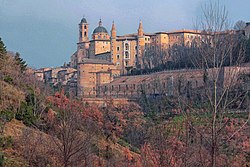
Urbino
Urbino
Main page
2207976

Urbino

logo
Community Hub0 subscribers
What are your thoughts?
Be the first to start a discussion here.
Urbino

Urbino (UK: /ɜːrˈbn/ ur-BEE-noh, Italian: [urˈbiːno] ; Romagnol: Urbìn) is a comune (municipality) in the Italian region of Marche, southwest of Pesaro, a World Heritage Site notable for a remarkable historical legacy of independent Renaissance culture, especially under the patronage of Federico da Montefeltro, duke of Urbino from 1444 to 1482.

The town, nestled on a high sloping hillside, retains much of its picturesque medieval aspect. It hosts the University of Urbino, founded in 1506, and is the seat of the Archbishop of Urbino. Its best-known architectural piece is the Palazzo Ducale, rebuilt by Luciano Laurana.

The city lies in a hilly region, at the foothills of the Northern Apennines and the Tuscan-Romagnolo Apennines. It is within the southern area of Montefeltro, an area classified as medium-high seismic risk. Nearly 65 seismic events have affected the town of Urbino between 1511 and 1998. They include 24 April 1741, when the shocks were stronger than VIII on the Mercalli intensity scale, with an epicenter in Fabriano (where it reached 6.08 on the moment magnitude scale).

The originally modest Roman town of Urbinum Mataurense ("the little city on the river Mataurus") became an important strategic stronghold during the Gothic Wars of the 6th century. In 538, it was captured from the Ostrogoths by the Byzantine general Belisarius, and is frequently mentioned by the historian Procopius.

Pepin the Short (King of the Franks) presented Urbino to the Papacy in 754–56. Its commune later had some independence until around 1200, when it came into the possession of the House of Montefeltro. These noblemen had no direct authority over the commune; however, they could pressure it to elect them to the position of podestà. Bonconte di Montefeltro obtained this title in 1213: Urbino's population rebelled and formed an alliance with the independent commune of Rimini (1228), finally regaining independence in 1234. Eventually, though, the Montefeltro noblemen took control once more, and held it until 1508. In the struggles between the Guelphs and Ghibellines, when factions supported either the Papacy or the Holy Roman Empire respectively, the 13th and 14th century Montefeltro lords of Urbino were leaders of the Ghibellines of the Marche and in the Romagna region.

The most famous member of the Montefeltro family, Federico da Montefeltro, ruled as Duke of Urbino from 1444 to 1482. He was a very successful condottiere, a skillful diplomat and an enthusiastic patron of art and literature. He rose to power in 1444 as the son of Guidantonio, after a conspiracy and the murder of the legitimate heir Oddantonio, hated for his "unbridled lust" and excessive taxes.

Federico began a reorganization of the state, which also included a restructuring of the city according to a modern conception - comfortable, efficient and beautiful.

At his court, Piero della Francesca wrote on the science of perspective, Francesco di Giorgio Martini wrote his Trattato di architettura (Treatise on Architecture) and Raphael's father, Giovanni Santi, wrote his poetical account of the chief artists of his time. Federico's brilliant court, according to the descriptions in Baldassare Castiglione's Il Cortegiano (The Book of the Courtier, published in 1528), set standards of what would characterize a modern European "gentleman" for centuries to come.

See all
User Avatar
No comments yet.