Recent from talks
Weapon of mass destruction
Knowledge base stats:
Talk channels stats:
Members stats:
Weapon of mass destruction
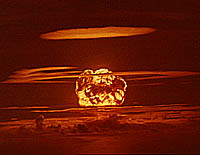
A weapon of mass destruction (WMD) is a biological, chemical, radiological, nuclear, or any other weapon that can kill or significantly harm many people or cause great damage to artificial structures (e.g., buildings), natural structures (e.g., mountains), or the biosphere. The scope and usage of the term has evolved and been disputed, often signifying more politically than technically. Originally coined in reference to aerial bombing with chemical explosives during World War II, it has later come to refer to large-scale weaponry of warfare-related technologies, such as biological, chemical, radiological, or nuclear warfare.
The first use of the term "weapon of mass destruction" on record is by Cosmo Gordon Lang, Archbishop of Canterbury, in 1937 in reference to the bombing of Guernica, Spain:
Who can think at this present time without a sickening of the heart of the appalling slaughter, the suffering, the manifold misery brought by war to Spain and to China? Who can think without horror of what another widespread war would mean, waged as it would be with all the new weapons of mass destruction?
At the time, nuclear weapons had not been developed fully. Japan conducted research on biological weapons, and chemical weapons had seen wide battlefield use in World War I. Their use was outlawed by the Geneva Protocol of 1925. Italy used mustard agent against civilians and soldiers in Ethiopia in 1935–36.
Following the atomic bombings of Hiroshima and Nagasaki that ended World War II and during the Cold War, the term came to refer more to non-conventional weapons. The application of the term to specifically nuclear and radiological weapons is traced by William Safire to the Russian phrase "Оружие массового поражения" – oruzhiye massovogo porazheniya (weapon of mass destruction).
William Safire credits James Goodby (of the Brookings Institution) with tracing what he considers the earliest known English-language use soon after the nuclear bombing of Hiroshima and Nagasaki (although it is not quite verbatim): a communique from a 15 November 1945, meeting of Harry Truman, Clement Attlee and Mackenzie King (probably drafted by Vannevar Bush, as Bush claimed in 1970) referred to "weapons adaptable to mass destruction."
Safire says Bernard Baruch used that exact phrase in 1946 (in a speech at the United Nations probably written by Herbert Bayard Swope). The phrase found its way into the very first resolution the United Nations General assembly adopted in January 1946 in London, which used the wording "the elimination from national armaments of atomic weapons and of all other weapons adaptable to mass destruction." The resolution also created the Atomic Energy Commission (predecessor of the International Atomic Energy Agency (IAEA)).
An exact use of this term was given in a lecture titled "Atomic Energy as a Contemporary Problem" by J. Robert Oppenheimer. He delivered the lecture to the Foreign Service and the State Department, on 17 September 1947.
Hub AI
Weapon of mass destruction AI simulator
(@Weapon of mass destruction_simulator)
Weapon of mass destruction
A weapon of mass destruction (WMD) is a biological, chemical, radiological, nuclear, or any other weapon that can kill or significantly harm many people or cause great damage to artificial structures (e.g., buildings), natural structures (e.g., mountains), or the biosphere. The scope and usage of the term has evolved and been disputed, often signifying more politically than technically. Originally coined in reference to aerial bombing with chemical explosives during World War II, it has later come to refer to large-scale weaponry of warfare-related technologies, such as biological, chemical, radiological, or nuclear warfare.
The first use of the term "weapon of mass destruction" on record is by Cosmo Gordon Lang, Archbishop of Canterbury, in 1937 in reference to the bombing of Guernica, Spain:
Who can think at this present time without a sickening of the heart of the appalling slaughter, the suffering, the manifold misery brought by war to Spain and to China? Who can think without horror of what another widespread war would mean, waged as it would be with all the new weapons of mass destruction?
At the time, nuclear weapons had not been developed fully. Japan conducted research on biological weapons, and chemical weapons had seen wide battlefield use in World War I. Their use was outlawed by the Geneva Protocol of 1925. Italy used mustard agent against civilians and soldiers in Ethiopia in 1935–36.
Following the atomic bombings of Hiroshima and Nagasaki that ended World War II and during the Cold War, the term came to refer more to non-conventional weapons. The application of the term to specifically nuclear and radiological weapons is traced by William Safire to the Russian phrase "Оружие массового поражения" – oruzhiye massovogo porazheniya (weapon of mass destruction).
William Safire credits James Goodby (of the Brookings Institution) with tracing what he considers the earliest known English-language use soon after the nuclear bombing of Hiroshima and Nagasaki (although it is not quite verbatim): a communique from a 15 November 1945, meeting of Harry Truman, Clement Attlee and Mackenzie King (probably drafted by Vannevar Bush, as Bush claimed in 1970) referred to "weapons adaptable to mass destruction."
Safire says Bernard Baruch used that exact phrase in 1946 (in a speech at the United Nations probably written by Herbert Bayard Swope). The phrase found its way into the very first resolution the United Nations General assembly adopted in January 1946 in London, which used the wording "the elimination from national armaments of atomic weapons and of all other weapons adaptable to mass destruction." The resolution also created the Atomic Energy Commission (predecessor of the International Atomic Energy Agency (IAEA)).
An exact use of this term was given in a lecture titled "Atomic Energy as a Contemporary Problem" by J. Robert Oppenheimer. He delivered the lecture to the Foreign Service and the State Department, on 17 September 1947.
