
Recent from talks
ǃKung people
Knowledge base stats:
Talk channels stats:
Members stats:
ǃKung people
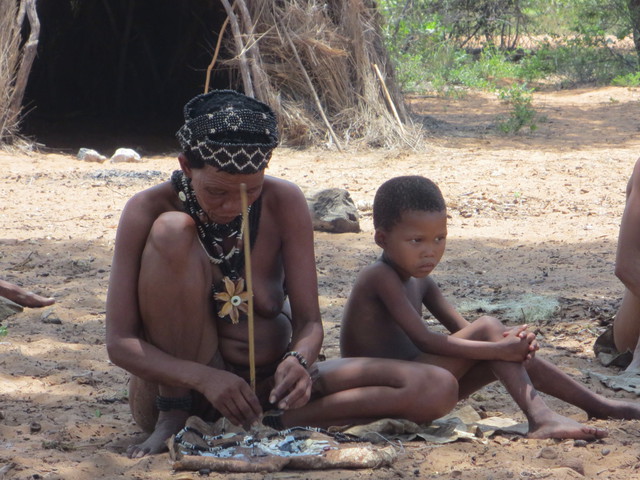
The ǃKung (/ˈkʊŋ/ KUUNG) are one of the San peoples who live mostly on the western edge of the Kalahari desert, Ovamboland (northern Namibia and southern Angola), and Botswana. The names ǃKung (ǃXun) and Ju are variant words for 'people', preferred by different ǃKung groups. This band level society used traditional methods of hunting and gathering for subsistence up until the 1970s. Today, the great majority of ǃKung people live in the villages of Bantu pastoralists and European ranchers.
The ǃKung people of Southern Africa recognize a Supreme Being, ǃXu, who is the Creator and Upholder of life. Like other African High Gods, he also punishes man by means of the weather, and the Otjimpolo-ǃKung know him as Erob, who "knows everything". They also have animistic and animatistic beliefs, which means they believe in both personifications and impersonal forces.
Amongst the ǃKung there is a strong belief in the existence of spirits of the dead (llgauwasi) who live immortally in the sky. The llgauwasi can come to the earth and interact with humans. There is no particular connection to personal ancestors but the ǃKung fear the llgauwasi, pray to them for sympathy and mercy as well as call on them in anger.
The ǃKung practice shamanism to communicate with the spirit world, and to cure what they call "Star Sickness". The communication with the spirit world is done by a natural healer entering a trance state and running through a fire, thereby chasing away bad spirits. Star Sickness is cured by laying hands on the diseased. Nisa, a ǃKung woman, reported through anthropologist Marjorie Shostak that a healer in training is given a root to help induce trance. Nisa said, "I drank it a number of times and threw up again and again. Finally, I started to tremble. People rubbed my body as I sat there feeling the effect getting stronger and stronger. ... Trance-medicine really hurts! As you begin to trance, the nǀum [power to heal] slowly heats inside you and pulls at you. It rises until it grabs your insides and takes your thoughts away."
Healing rites are a primary part of the ǃKung culture. In the ǃKung state of mind, having health is equivalent to having social harmony, meaning that relationships within the group are stable and open between other people. Any ǃKung can become a healer because it "is a status accessible to all," but it is a grand aspiration of many members because of its importance. Even though there is no restriction of the power, "nearly half the men and one-third of the women are acknowledged of having the power to heal," but with the responsibility comes great pain and hardship. To become a healer, aspirants must become an apprentice and learn from older healers. Their training includes the older healer having to "go into a trance to teach the novices, rubbing their own sweat onto the pupils' centers – their bellies, backs, foreheads, and spines." "Most of the apprentices have the intentions of becoming a healer but then become frightened or have a lack of ambition and discontinue."
The ǃKung term for this powerful healing force is nǀum. This force resides in the bellies of men and women who have gone through the training and have become a healer. Healing can be transmitted through the ǃkia dance that begins at sundown and continues through the night. The ǃkia can be translated as "trance" which can give a physical image of a sleeping enchantment. While they dance, "in preparation for entering a trance state to effect a cure, the substance [the nǀum] heats up and, boiling, travels up the healer's spine to explode with therapeutic power in the brain." While the healers are in the trance they propel themselves in a journey to seek out the sickness and argue with the spirits. Women on the other hand have a special medicine called the gwah which starts in the stomachs and kidneys. During the Drum Dance, they enter the ǃkia state and the gwah travels up the spine and lodges in the neck. In order to obtain the gwah power the women, "chop up the root of a short shrub, boil it into a tea and drink it." They do not need to drink the tea every time because the power they obtain lasts a lifetime.
The community of the ǃKung fully supports the healers and depends heavily on them. They have trust in the healers and the teachers to guide them psychologically and spiritually through life. The ǃKung have a saying: "Healing makes their hearts happy, and a happy heart is one that reflects a sense of community." Because of their longing to keep the peace between people, their community is tranquil.
ǃKung women usually experience their first menstruation at the age of 16½, their first birth at 19½ and their last birth by their late 30s. ǃKung women often give birth unassisted, walking away from the village camp as far as a mile during labour and bearing the child alone, delivering it into a small leaf-lined hole dug into the warm sand. The child's cord is not clamped or cut (a form of Lotus birth or umbilical nonseverance), and the placenta is delivered and put next to the child, as guardian. Shortly thereafter, the baby-placenta is lightly covered with another large leaf, and the new mother walks a short way to verbally alert the older women of the completed birth, at which time they join the mother and child in a ritual welcoming. If a laboring woman is delayed in returning to the village once she has left to give birth, the older women will come looking for her to assist; however, it is said to be a rare occurrence.
Hub AI
ǃKung people AI simulator
(@ǃKung people_simulator)
ǃKung people
The ǃKung (/ˈkʊŋ/ KUUNG) are one of the San peoples who live mostly on the western edge of the Kalahari desert, Ovamboland (northern Namibia and southern Angola), and Botswana. The names ǃKung (ǃXun) and Ju are variant words for 'people', preferred by different ǃKung groups. This band level society used traditional methods of hunting and gathering for subsistence up until the 1970s. Today, the great majority of ǃKung people live in the villages of Bantu pastoralists and European ranchers.
The ǃKung people of Southern Africa recognize a Supreme Being, ǃXu, who is the Creator and Upholder of life. Like other African High Gods, he also punishes man by means of the weather, and the Otjimpolo-ǃKung know him as Erob, who "knows everything". They also have animistic and animatistic beliefs, which means they believe in both personifications and impersonal forces.
Amongst the ǃKung there is a strong belief in the existence of spirits of the dead (llgauwasi) who live immortally in the sky. The llgauwasi can come to the earth and interact with humans. There is no particular connection to personal ancestors but the ǃKung fear the llgauwasi, pray to them for sympathy and mercy as well as call on them in anger.
The ǃKung practice shamanism to communicate with the spirit world, and to cure what they call "Star Sickness". The communication with the spirit world is done by a natural healer entering a trance state and running through a fire, thereby chasing away bad spirits. Star Sickness is cured by laying hands on the diseased. Nisa, a ǃKung woman, reported through anthropologist Marjorie Shostak that a healer in training is given a root to help induce trance. Nisa said, "I drank it a number of times and threw up again and again. Finally, I started to tremble. People rubbed my body as I sat there feeling the effect getting stronger and stronger. ... Trance-medicine really hurts! As you begin to trance, the nǀum [power to heal] slowly heats inside you and pulls at you. It rises until it grabs your insides and takes your thoughts away."
Healing rites are a primary part of the ǃKung culture. In the ǃKung state of mind, having health is equivalent to having social harmony, meaning that relationships within the group are stable and open between other people. Any ǃKung can become a healer because it "is a status accessible to all," but it is a grand aspiration of many members because of its importance. Even though there is no restriction of the power, "nearly half the men and one-third of the women are acknowledged of having the power to heal," but with the responsibility comes great pain and hardship. To become a healer, aspirants must become an apprentice and learn from older healers. Their training includes the older healer having to "go into a trance to teach the novices, rubbing their own sweat onto the pupils' centers – their bellies, backs, foreheads, and spines." "Most of the apprentices have the intentions of becoming a healer but then become frightened or have a lack of ambition and discontinue."
The ǃKung term for this powerful healing force is nǀum. This force resides in the bellies of men and women who have gone through the training and have become a healer. Healing can be transmitted through the ǃkia dance that begins at sundown and continues through the night. The ǃkia can be translated as "trance" which can give a physical image of a sleeping enchantment. While they dance, "in preparation for entering a trance state to effect a cure, the substance [the nǀum] heats up and, boiling, travels up the healer's spine to explode with therapeutic power in the brain." While the healers are in the trance they propel themselves in a journey to seek out the sickness and argue with the spirits. Women on the other hand have a special medicine called the gwah which starts in the stomachs and kidneys. During the Drum Dance, they enter the ǃkia state and the gwah travels up the spine and lodges in the neck. In order to obtain the gwah power the women, "chop up the root of a short shrub, boil it into a tea and drink it." They do not need to drink the tea every time because the power they obtain lasts a lifetime.
The community of the ǃKung fully supports the healers and depends heavily on them. They have trust in the healers and the teachers to guide them psychologically and spiritually through life. The ǃKung have a saying: "Healing makes their hearts happy, and a happy heart is one that reflects a sense of community." Because of their longing to keep the peace between people, their community is tranquil.
ǃKung women usually experience their first menstruation at the age of 16½, their first birth at 19½ and their last birth by their late 30s. ǃKung women often give birth unassisted, walking away from the village camp as far as a mile during labour and bearing the child alone, delivering it into a small leaf-lined hole dug into the warm sand. The child's cord is not clamped or cut (a form of Lotus birth or umbilical nonseverance), and the placenta is delivered and put next to the child, as guardian. Shortly thereafter, the baby-placenta is lightly covered with another large leaf, and the new mother walks a short way to verbally alert the older women of the completed birth, at which time they join the mother and child in a ritual welcoming. If a laboring woman is delayed in returning to the village once she has left to give birth, the older women will come looking for her to assist; however, it is said to be a rare occurrence.
Recent media