
Recent from talks
100 metres
Knowledge base stats:
Talk channels stats:
Members stats:
100 metres
The 100 metres, or 100-meter dash, is a sprint race in track and field competitions. The shortest common outdoor running distance, the 100-metre (109.36 yd) dash is one of the most popular and prestigious events in the sport of athletics. It has been contested at the Summer Olympics since 1896 for men and since 1928 for women. The inaugural World Championships were in 1983.
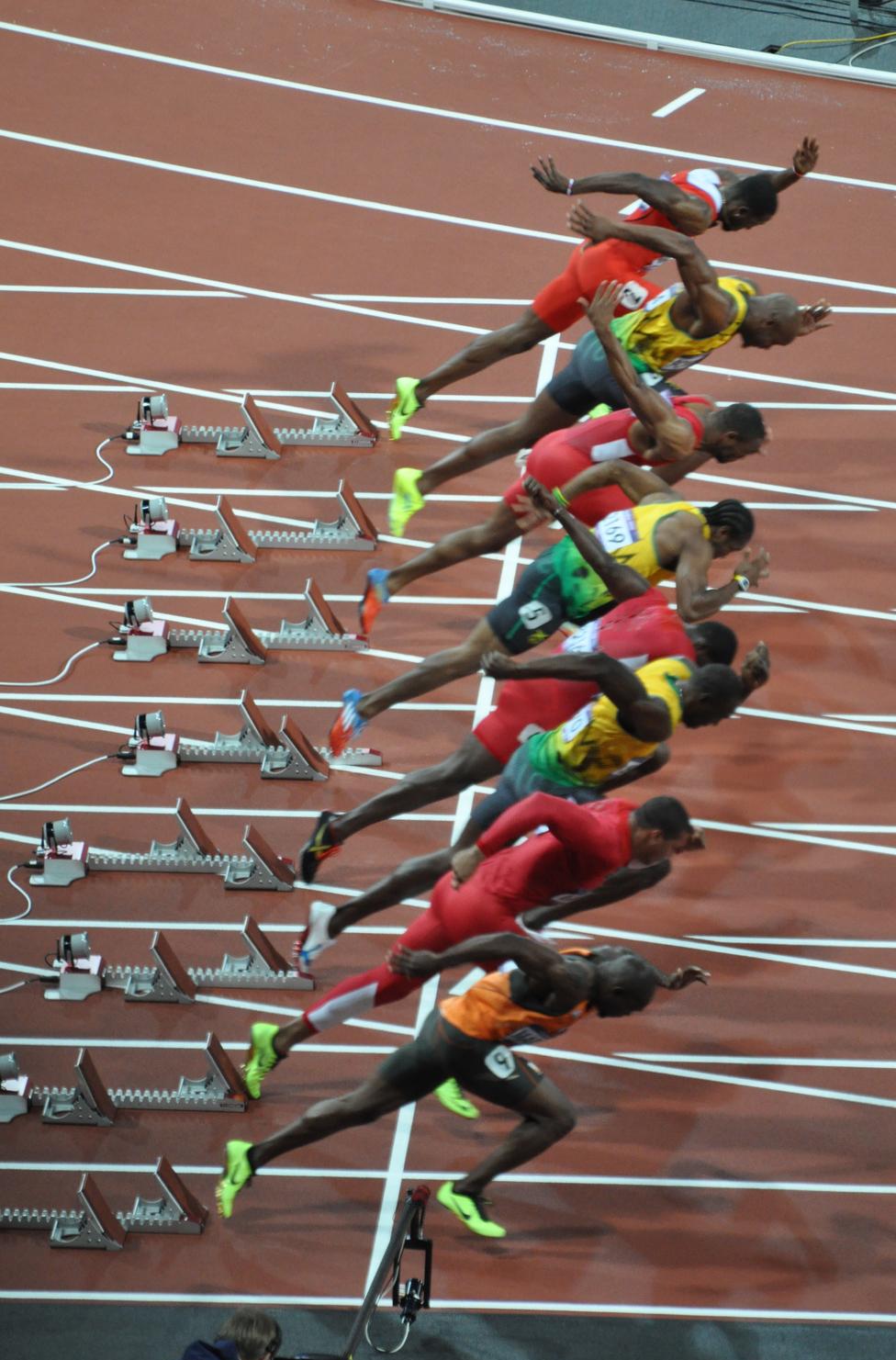
On an outdoor 400-metre running track, the 100 m is held on the home straight, with the start usually being set on an extension to make it a straight-line race. There are three instructions given to the runners immediately before and at the beginning of the race: "on your marks", "set", and the firing of the starter's pistol. The runners move to the starting blocks when they hear the "on your marks" instruction. The following instruction, to adopt the "set" position, allows them to adopt a more efficient starting posture and isometrically preload their muscles: this will help them to start faster. A race-official then fires the starter's pistol to signal the race beginning and the sprinters stride forwards from the blocks. Sprinters typically reach top speed after somewhere between 50 and 60 m. Their speed then slows towards the finish line.
The 10-second barrier has historically been a barometer of fast men's performances, while the best female sprinters take eleven seconds or less to complete the race. The men's world record is 9.58 seconds, set by Jamaica's Usain Bolt in 2009, while the women's world record is 10.49 seconds, set by American Florence Griffith-Joyner in 1988.
The 100 metres is considered one of the blue ribbon events of the Olympics and is among the highest profile competitions at the games. It is the most prestigious 100 metres race at an elite level and is the shortest sprinting competition at the Olympics – a position it has held at every edition except for a brief period between 1900 and 1904, when a men's 60 metres was contested. The unofficial "world's fastest man or woman" title typically goes to the Olympic or world 100 metres champion. The 200 metre time almost always yields a "faster" average speed than a 100-metre race time, since the initial slow speed at the start is spread out over the longer distance. The current men's Olympic champion is Noah Lyles, while the current world champion is Oblique Seville. The current women's Olympic champion is Julien Alfred, and the world champion is Melissa Jefferson-Wooden.
The women's 100 Meter race features the top athletes from around the world. This event is constantly evolving with new technology, training methods, and global participation. Early competitions were mainly focused on North American and European athletes, but recent improvements to facility access and international investment in women's athletics has shown a drastic spread of the sport. By the late 20th century, sprinters from the Caribbean, United States, and all across Africa, began setting record after record in the 100 Meter sprint.
Throughout the evolution of this race, several athletes from around the globe have been dominant. For example, Wilma Rudolph and Florence Griffith-Joyner are two prominent American sprinters. Rudolph was a triple gold medalist in 1960, and Florence set the 100 meter record in 1988 and still holds the female record. Jamaican sprinters also change the landscape for females in this event. Shelly-Ann Fraser-Pryce and Elaine Thompson-Herah have been at the lead of the Jamaican sprinters in the modern era. Other runners such as Marie-José Pérec of France, and Blessing Okagbare of Nigeria have helped spread awareness to this race across Europe and Africa. All of these sprinters have helped grown the 100 meter race internationally, helping the sport become more accessible to diverse regions around the globe.
The men's 100 meter race is also known as the premier racing event in the world, determining the world's fastest man. Over the years the race has constantly evolved with new technology, training gear, and number of runners. Similar to the female race, the early known sprinters were from North America and Europe. This included United State athletes Jesse Owens and Carl Owens. The domination in these regions soon spread to the whole world. With the new advancements in technology, countries like the Caribbean, Africa, and Jamaica would soon add to the competition.
Throughout history, many sprinters have made a long lasting mark on the 100 meter race. First of all, Jesse Owens, from Cleveland Ohio, captured attention in 1936 for winning the Olympic Gold medal for the United States. In the modern era, Usain Bolt from Jamaica still holds the Olympic record for the 100 meter race that he set back in 2009. Other sprinters, including Akani Simbine of South Africa and Linford Christie of Great Britain have helped spread the sport around other regions of world. All of these athletes have both helped push each other to new records, and pushed the sport to become more accessible to all genders, ages, ethnicities, and more.
Hub AI
100 metres AI simulator
(@100 metres_simulator)
100 metres
The 100 metres, or 100-meter dash, is a sprint race in track and field competitions. The shortest common outdoor running distance, the 100-metre (109.36 yd) dash is one of the most popular and prestigious events in the sport of athletics. It has been contested at the Summer Olympics since 1896 for men and since 1928 for women. The inaugural World Championships were in 1983.
On an outdoor 400-metre running track, the 100 m is held on the home straight, with the start usually being set on an extension to make it a straight-line race. There are three instructions given to the runners immediately before and at the beginning of the race: "on your marks", "set", and the firing of the starter's pistol. The runners move to the starting blocks when they hear the "on your marks" instruction. The following instruction, to adopt the "set" position, allows them to adopt a more efficient starting posture and isometrically preload their muscles: this will help them to start faster. A race-official then fires the starter's pistol to signal the race beginning and the sprinters stride forwards from the blocks. Sprinters typically reach top speed after somewhere between 50 and 60 m. Their speed then slows towards the finish line.
The 10-second barrier has historically been a barometer of fast men's performances, while the best female sprinters take eleven seconds or less to complete the race. The men's world record is 9.58 seconds, set by Jamaica's Usain Bolt in 2009, while the women's world record is 10.49 seconds, set by American Florence Griffith-Joyner in 1988.
The 100 metres is considered one of the blue ribbon events of the Olympics and is among the highest profile competitions at the games. It is the most prestigious 100 metres race at an elite level and is the shortest sprinting competition at the Olympics – a position it has held at every edition except for a brief period between 1900 and 1904, when a men's 60 metres was contested. The unofficial "world's fastest man or woman" title typically goes to the Olympic or world 100 metres champion. The 200 metre time almost always yields a "faster" average speed than a 100-metre race time, since the initial slow speed at the start is spread out over the longer distance. The current men's Olympic champion is Noah Lyles, while the current world champion is Oblique Seville. The current women's Olympic champion is Julien Alfred, and the world champion is Melissa Jefferson-Wooden.
The women's 100 Meter race features the top athletes from around the world. This event is constantly evolving with new technology, training methods, and global participation. Early competitions were mainly focused on North American and European athletes, but recent improvements to facility access and international investment in women's athletics has shown a drastic spread of the sport. By the late 20th century, sprinters from the Caribbean, United States, and all across Africa, began setting record after record in the 100 Meter sprint.
Throughout the evolution of this race, several athletes from around the globe have been dominant. For example, Wilma Rudolph and Florence Griffith-Joyner are two prominent American sprinters. Rudolph was a triple gold medalist in 1960, and Florence set the 100 meter record in 1988 and still holds the female record. Jamaican sprinters also change the landscape for females in this event. Shelly-Ann Fraser-Pryce and Elaine Thompson-Herah have been at the lead of the Jamaican sprinters in the modern era. Other runners such as Marie-José Pérec of France, and Blessing Okagbare of Nigeria have helped spread awareness to this race across Europe and Africa. All of these sprinters have helped grown the 100 meter race internationally, helping the sport become more accessible to diverse regions around the globe.
The men's 100 meter race is also known as the premier racing event in the world, determining the world's fastest man. Over the years the race has constantly evolved with new technology, training gear, and number of runners. Similar to the female race, the early known sprinters were from North America and Europe. This included United State athletes Jesse Owens and Carl Owens. The domination in these regions soon spread to the whole world. With the new advancements in technology, countries like the Caribbean, Africa, and Jamaica would soon add to the competition.
Throughout history, many sprinters have made a long lasting mark on the 100 meter race. First of all, Jesse Owens, from Cleveland Ohio, captured attention in 1936 for winning the Olympic Gold medal for the United States. In the modern era, Usain Bolt from Jamaica still holds the Olympic record for the 100 meter race that he set back in 2009. Other sprinters, including Akani Simbine of South Africa and Linford Christie of Great Britain have helped spread the sport around other regions of world. All of these athletes have both helped push each other to new records, and pushed the sport to become more accessible to all genders, ages, ethnicities, and more.
Recent media