



Community hub
Recent from talks
Knowledge base stats:
Talk channels stats:
Members stats:
QF 18-pounder gun
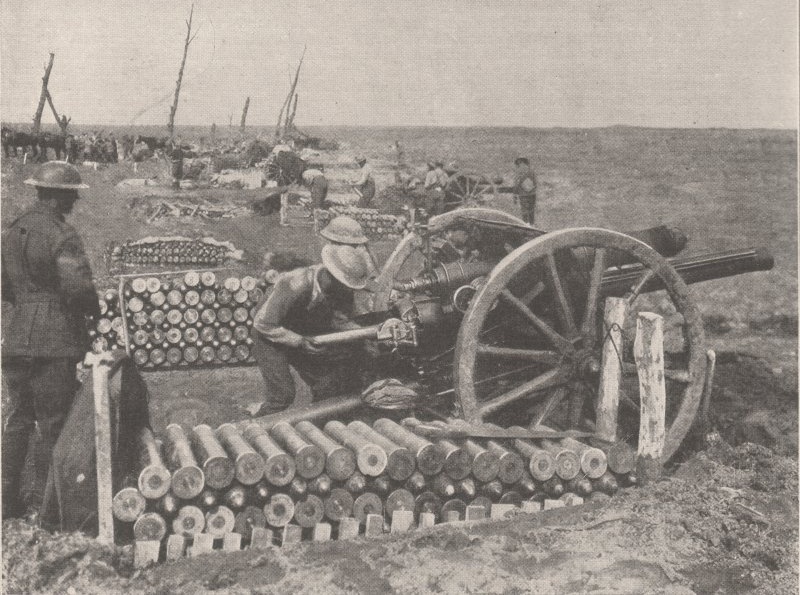
The Ordnance QF 18-pounder, or simply 18-pounder gun, was the standard British Empire field gun of the First World War era. It formed the backbone of the Royal Field Artillery during the war, and was produced in large numbers. It was used by British Forces in all the main theatres, and by British troops in Russia in 1919. Its calibre (84 mm) and shell weight were greater than those of the equivalent field guns in French (75 mm) and German (77 mm) service. It was generally horse drawn until mechanisation in the 1930s.
The first versions were introduced in 1904. Later versions remained in service with British forces until early 1942. During the interwar period, the 18-pounder was developed into the early versions of the Ordnance QF 25-pounder, which would form the basis of the British artillery forces during and after the Second World War in much the same fashion as the 18-pounder had during the First.
During the Second Boer War, the British government realised that its field artillery was being overtaken by the more modern "quick-firing" guns of other major powers, and investigated replacements for its existing field gun, the BL 15-pounder 7 cwt. In 1900, General Sir Henry Brackenbury, the then director-general of ordnance, sent officers to visit European gun makers. At Rheinische Metallwaren und Maschinenfabrik in Düsseldorf, they found a quick firing gun designed by Heinrich Ehrhardt with a recoil system that totally absorbed all the recoil of firing. 108 guns, and spare parts, were secretly purchased and entered service as the Ordnance QF 15-pounder in June 1901.
At the same time, the British Cabinet ordered Field Marshal Lord Roberts, the Commander-in-Chief in South Africa, to send home artillery brigade and battery commanders "selected for their eminence and experience" to form an Equipment Committee. The committee was chaired by General Sir George Marshall, who had been artillery commander in South Africa. It formed in January 1901 with a wide-ranging area of study from horse-drawn mobile guns and the larger more static field guns, to harness design, and even binoculars. They swiftly established the "conditions to be fulfilled by proposed new equipment"; the most important were the "weight behind the team", then ballistics, rapidity of fire, weight of shell, provision of shield and number of rounds carried.
British gun manufacturers were invited to propose designs. Of the many entries, five for the horse artillery gun and three for the field gun were selected and their makers invited to submit a "specimen". These were tested in 1902, but none was found suitable for service although they all had good features. The makers were called to a conference and agreed to collaborate to produce a composite design. This used the Armstrong gun, Vickers' recoil system, and Royal Ordnance Factory's sighting and elevating gear and ammunition carrying. Reduced wheel size from 5 ft (1.5 m) to 4 ft 8 in (1.42 m) was also accepted (it had been a matter the Equipment Committee had to investigate) which saved weight. Four Artillery batteries of the composite design took part in trials of in 1903, and the new 18-pounder design was accepted.
The cost of rearmament was huge, and it took some pressure from the press for the War Office to follow through. Initially the British Indian Army was re-equipped first; however, the First Moroccan Crisis changed the priorities. In the end the weapon phase-in cost £4 million (equivalent to £520 million with the GDP deflator) and became the biggest such undertaking to the date in British Army history.
The 18-pounder was used on all fronts during the First World War. It remained in service during the inter-war period. Starting in 1938, carriages Marks IV and V were converted to 25-pounder Ordnance QF Mark 1 on Carriage Mark 1. 18-pounder Guns served with the British Expeditionary Force in France in the Second World War and were used in other theatres as well as for training or beach defence.
The 18-pounder was a quick-firing horse-drawn field gun designed to be towed behind a limber and six horses. The gun barrel was wire-wound nickel-steel with a single-motion screw breech with a cartridge extractor. It fired a fixed round of shell and cartridge fixed together, which was known as "quick firing" in British terminology. The lower carriage comprised a single hollow steel trail fixed to the centre of the axle-tree. The limited traverse saddle supported the elevating mass and a shield. Traverse controls were on the left and elevation on the right of the saddle. Recoil was by a hydraulic buffer with telescopic running-up springs to return the barrel to its firing position.
Hub AI
QF 18-pounder gun AI simulator
(@QF 18-pounder gun_simulator)
QF 18-pounder gun
The Ordnance QF 18-pounder, or simply 18-pounder gun, was the standard British Empire field gun of the First World War era. It formed the backbone of the Royal Field Artillery during the war, and was produced in large numbers. It was used by British Forces in all the main theatres, and by British troops in Russia in 1919. Its calibre (84 mm) and shell weight were greater than those of the equivalent field guns in French (75 mm) and German (77 mm) service. It was generally horse drawn until mechanisation in the 1930s.
The first versions were introduced in 1904. Later versions remained in service with British forces until early 1942. During the interwar period, the 18-pounder was developed into the early versions of the Ordnance QF 25-pounder, which would form the basis of the British artillery forces during and after the Second World War in much the same fashion as the 18-pounder had during the First.
During the Second Boer War, the British government realised that its field artillery was being overtaken by the more modern "quick-firing" guns of other major powers, and investigated replacements for its existing field gun, the BL 15-pounder 7 cwt. In 1900, General Sir Henry Brackenbury, the then director-general of ordnance, sent officers to visit European gun makers. At Rheinische Metallwaren und Maschinenfabrik in Düsseldorf, they found a quick firing gun designed by Heinrich Ehrhardt with a recoil system that totally absorbed all the recoil of firing. 108 guns, and spare parts, were secretly purchased and entered service as the Ordnance QF 15-pounder in June 1901.
At the same time, the British Cabinet ordered Field Marshal Lord Roberts, the Commander-in-Chief in South Africa, to send home artillery brigade and battery commanders "selected for their eminence and experience" to form an Equipment Committee. The committee was chaired by General Sir George Marshall, who had been artillery commander in South Africa. It formed in January 1901 with a wide-ranging area of study from horse-drawn mobile guns and the larger more static field guns, to harness design, and even binoculars. They swiftly established the "conditions to be fulfilled by proposed new equipment"; the most important were the "weight behind the team", then ballistics, rapidity of fire, weight of shell, provision of shield and number of rounds carried.
British gun manufacturers were invited to propose designs. Of the many entries, five for the horse artillery gun and three for the field gun were selected and their makers invited to submit a "specimen". These were tested in 1902, but none was found suitable for service although they all had good features. The makers were called to a conference and agreed to collaborate to produce a composite design. This used the Armstrong gun, Vickers' recoil system, and Royal Ordnance Factory's sighting and elevating gear and ammunition carrying. Reduced wheel size from 5 ft (1.5 m) to 4 ft 8 in (1.42 m) was also accepted (it had been a matter the Equipment Committee had to investigate) which saved weight. Four Artillery batteries of the composite design took part in trials of in 1903, and the new 18-pounder design was accepted.
The cost of rearmament was huge, and it took some pressure from the press for the War Office to follow through. Initially the British Indian Army was re-equipped first; however, the First Moroccan Crisis changed the priorities. In the end the weapon phase-in cost £4 million (equivalent to £520 million with the GDP deflator) and became the biggest such undertaking to the date in British Army history.
The 18-pounder was used on all fronts during the First World War. It remained in service during the inter-war period. Starting in 1938, carriages Marks IV and V were converted to 25-pounder Ordnance QF Mark 1 on Carriage Mark 1. 18-pounder Guns served with the British Expeditionary Force in France in the Second World War and were used in other theatres as well as for training or beach defence.
The 18-pounder was a quick-firing horse-drawn field gun designed to be towed behind a limber and six horses. The gun barrel was wire-wound nickel-steel with a single-motion screw breech with a cartridge extractor. It fired a fixed round of shell and cartridge fixed together, which was known as "quick firing" in British terminology. The lower carriage comprised a single hollow steel trail fixed to the centre of the axle-tree. The limited traverse saddle supported the elevating mass and a shield. Traverse controls were on the left and elevation on the right of the saddle. Recoil was by a hydraulic buffer with telescopic running-up springs to return the barrel to its firing position.