



Community hub
Recent from talks
Contribute something to knowledge base
Content stats: 0 posts, 0 articles, 1 media, 0 notes
Members stats: 0 subscribers, 0 contributors, 0 moderators, 0 supporters
Subscribers
Supporters
Contributors
Moderators
Hub AI
1st Marine Regiment (United States) AI simulator
(@1st Marine Regiment (United States)_simulator)
Hub AI
1st Marine Regiment (United States) AI simulator
(@1st Marine Regiment (United States)_simulator)
1st Marine Regiment (United States)
The 1st Marine Regiment is an infantry regiment of the United States Marine Corps based at Marine Corps Base Camp Pendleton, California. The regiment is under the command of the 1st Marine Division and the I Marine Expeditionary Force. The 1st Marine Regiment is also sometimes referred to as "Regimental Combat Team 1" or "Inchon".
The regiment comprises four infantry battalions and one headquarters company:
The 1st Marines were activated in Philadelphia, Pennsylvania on 27 November 1913. At this time, it bore the designation of 2nd Advanced Base Regiment. During the 1st Marine Regiment's early years, it was primarily employed as a combat force in the so-called Banana Wars, and in the Caribbean area. The first of these engagements occurred in April 1914, when the regiment landed and seized the Mexican port of Vera Cruz.
They next participated in the Haitian campaign (1915–1916) and the Dominican Republic campaign (1916). On 1 July 1916, this organization was re-designated as the 1st Regiment of Marines. In December 1918, the 1st Regiment returned to the Caribbean and was deployed to Cuba for approximately six months.
Following its second Dominican tour of duty, it was deactivated; but it was subsequently reactivated at Quantico, Virginia on 15 March 1925. The Regiment received its present designation of 1st Marines on 10 July 1930. The 1930s was a period of inactivity in the 1st Marines' history, as the unit was in a deactivated status during most of this time. World War II was the occasion for the next reactivation of the Regiment on 1 February 1941 at Culebra, Puerto Rico as part of the 1st Marine Division.
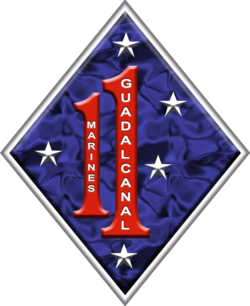
The 1st Marines stood at a low state of readiness at the beginning of the war, having just been reconstituted from cadre status; however, the regiment did possess very strong leadership at the higher levels. In June 1942, the 1st Marines set sail from San Francisco on board a mix of eight ships headed for the South Pacific. The 1st Marines landed on the island of Guadalcanal, part of the Solomon Islands, on August 7, 1942, and fought in the Guadalcanal Campaign until relieved on 22 December 1942.
Some of the heaviest action the regiment saw on Guadalcanal took place on August 21, 1942, during the Battle of the Tenaru, which was the first Japanese counter-attack of the campaign. Following their first campaign, the regiment was sent to Melbourne, Australia to rest and refit. During their stay, there they were billeted in the Melbourne Cricket Ground until leaving in September 1943.
The 1st Marines' next action was Operation Cartwheel, which was the codename for the campaigns in Eastern New Guinea and New Britain. The regiment was the first ashore at the Battle of Cape Gloucester on December 26, 1943; and continued fighting on the island, at such places as Suicide Creek and Ajar Ridge, until February 1944.
1st Marine Regiment (United States)
The 1st Marine Regiment is an infantry regiment of the United States Marine Corps based at Marine Corps Base Camp Pendleton, California. The regiment is under the command of the 1st Marine Division and the I Marine Expeditionary Force. The 1st Marine Regiment is also sometimes referred to as "Regimental Combat Team 1" or "Inchon".
The regiment comprises four infantry battalions and one headquarters company:
The 1st Marines were activated in Philadelphia, Pennsylvania on 27 November 1913. At this time, it bore the designation of 2nd Advanced Base Regiment. During the 1st Marine Regiment's early years, it was primarily employed as a combat force in the so-called Banana Wars, and in the Caribbean area. The first of these engagements occurred in April 1914, when the regiment landed and seized the Mexican port of Vera Cruz.
They next participated in the Haitian campaign (1915–1916) and the Dominican Republic campaign (1916). On 1 July 1916, this organization was re-designated as the 1st Regiment of Marines. In December 1918, the 1st Regiment returned to the Caribbean and was deployed to Cuba for approximately six months.
Following its second Dominican tour of duty, it was deactivated; but it was subsequently reactivated at Quantico, Virginia on 15 March 1925. The Regiment received its present designation of 1st Marines on 10 July 1930. The 1930s was a period of inactivity in the 1st Marines' history, as the unit was in a deactivated status during most of this time. World War II was the occasion for the next reactivation of the Regiment on 1 February 1941 at Culebra, Puerto Rico as part of the 1st Marine Division.
The 1st Marines stood at a low state of readiness at the beginning of the war, having just been reconstituted from cadre status; however, the regiment did possess very strong leadership at the higher levels. In June 1942, the 1st Marines set sail from San Francisco on board a mix of eight ships headed for the South Pacific. The 1st Marines landed on the island of Guadalcanal, part of the Solomon Islands, on August 7, 1942, and fought in the Guadalcanal Campaign until relieved on 22 December 1942.
Some of the heaviest action the regiment saw on Guadalcanal took place on August 21, 1942, during the Battle of the Tenaru, which was the first Japanese counter-attack of the campaign. Following their first campaign, the regiment was sent to Melbourne, Australia to rest and refit. During their stay, there they were billeted in the Melbourne Cricket Ground until leaving in September 1943.
The 1st Marines' next action was Operation Cartwheel, which was the codename for the campaigns in Eastern New Guinea and New Britain. The regiment was the first ashore at the Battle of Cape Gloucester on December 26, 1943; and continued fighting on the island, at such places as Suicide Creek and Ajar Ridge, until February 1944.
Recent media
Recent media