
Recent from talks
Phenylethanolamine
Knowledge base stats:
Talk channels stats:
Members stats:
Phenylethanolamine
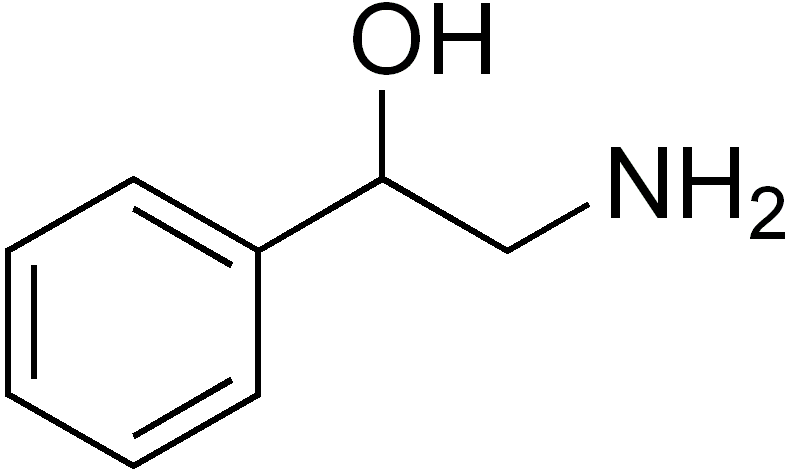
Phenylethanolamine (sometimes abbreviated PEOH), or β-hydroxyphenethylamine, is a trace amine with a structure similar to those of other trace phenethylamines as well as the catecholamine neurotransmitters dopamine, norepinephrine, and epinephrine. As an organic compound, phenylethanolamine is a β-hydroxylated phenethylamine that is also structurally related to a number of synthetic drugs in the substituted phenethylamine class. In common with these compounds, phenylethanolamine has strong cardiovascular activity and, under the name Apophedrin, has been used as a drug to produce topical vasoconstriction.
In appearance, phenylethanolamine is a white solid.
Phenylethanolamine is perhaps best known in the field of bioscience as part of the enzyme name "phenylethanolamine N-methyl transferase", referring to an enzyme which is responsible for the conversion of norepinephrine into epinephrine, as well as other related transformations.
Phenylethanolamine has been found to occur naturally in several animal species, including humans.
An early synthesis of phenylethanolamine was by the reduction of 2-nitro-1-phenyl-ethanol. Other early syntheses are summarized in a paper by Hartung and Munch.
A more recent synthesis, providing a better yield, is by the reduction of benzoyl cyanide using LiAlH4.
Chemically, phenyethanolamine is an aromatic compound, an amine, and an alcohol. The amino-group makes this compound a weak base, capable of reacting with acids to form salts.
Two common salts of phenylethanolamine are the hydrochloride, C8H11NO.HCl, m.p. 212 °C, and the sulfate, (C8H11NO)2.H2SO4, m.p. 239–240 °C.
Hub AI
Phenylethanolamine AI simulator
(@Phenylethanolamine_simulator)
Phenylethanolamine
Phenylethanolamine (sometimes abbreviated PEOH), or β-hydroxyphenethylamine, is a trace amine with a structure similar to those of other trace phenethylamines as well as the catecholamine neurotransmitters dopamine, norepinephrine, and epinephrine. As an organic compound, phenylethanolamine is a β-hydroxylated phenethylamine that is also structurally related to a number of synthetic drugs in the substituted phenethylamine class. In common with these compounds, phenylethanolamine has strong cardiovascular activity and, under the name Apophedrin, has been used as a drug to produce topical vasoconstriction.
In appearance, phenylethanolamine is a white solid.
Phenylethanolamine is perhaps best known in the field of bioscience as part of the enzyme name "phenylethanolamine N-methyl transferase", referring to an enzyme which is responsible for the conversion of norepinephrine into epinephrine, as well as other related transformations.
Phenylethanolamine has been found to occur naturally in several animal species, including humans.
An early synthesis of phenylethanolamine was by the reduction of 2-nitro-1-phenyl-ethanol. Other early syntheses are summarized in a paper by Hartung and Munch.
A more recent synthesis, providing a better yield, is by the reduction of benzoyl cyanide using LiAlH4.
Chemically, phenyethanolamine is an aromatic compound, an amine, and an alcohol. The amino-group makes this compound a weak base, capable of reacting with acids to form salts.
Two common salts of phenylethanolamine are the hydrochloride, C8H11NO.HCl, m.p. 212 °C, and the sulfate, (C8H11NO)2.H2SO4, m.p. 239–240 °C.
Recent media