



Community hub
Community hub
Recent from talks
Knowledge base stats:
Talk channels stats:
Members stats:
2010 flash crash
The May 6, 2010, flash crash, also known as the crash of 2:45 or simply the flash crash, was a United States trillion-dollar flash crash (a type of stock market crash) which started at 2:32 p.m. EDT and lasted for approximately 36 minutes.
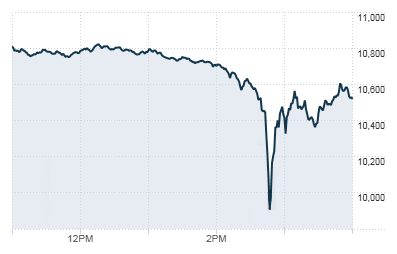
Stock indices, such as the S&P 500, Dow Jones Industrial Average and Nasdaq Composite, collapsed and rebounded very rapidly. The Dow Jones Industrial Average had its second biggest intraday point decline (from the opening) up to that point, plunging 998.5 points (about 9%), most within minutes, only to recover a large part of the loss. It was also the second-largest intraday point swing (difference between intraday high and intraday low) up to that point, at 1,010.14 points. The prices of stocks, stock index futures, options and exchange-traded funds (ETFs) were volatile, thus trading volume spiked. A CFTC 2014 report described it as one of the most turbulent periods in the history of financial markets.
New regulations put in place following the 2010 flash crash proved to be inadequate to protect investors in the August 24, 2015, flash crash — "when the price of many ETFs appeared to come unhinged from their underlying value" — and ETFs were subsequently put under greater scrutiny by regulators and investors.
On April 21, 2015, nearly five years after the incident, the U.S. Department of Justice laid 22 criminal counts, including fraud and market manipulation, against Navinder Singh Sarao, a British financial trader. Among the charges included was the use of spoofing algorithms; just prior to the flash crash, he placed orders for thousands of E-mini S&P 500 stock index futures contracts which he planned on canceling later. These orders amounting to about "$200 million worth of bets that the market would fall" were "replaced or modified 19,000 times" before they were canceled. Spoofing, layering, and front running are now banned.
The Commodity Futures Trading Commission (CFTC) investigation concluded that Sarao "was at least significantly responsible for the order imbalances" in the derivatives market which affected stock markets and exacerbated the flash crash. Sarao began his alleged market manipulation in 2009 with commercially available trading software whose code he modified "so he could rapidly place and cancel orders automatically". Traders Magazine journalist, John Bates, argued that blaming a 36-year-old small-time trader who worked from his parents' modest stucco house in suburban west London for sparking a trillion-dollar stock market crash is "a little bit like blaming lightning for starting a fire" and that the investigation was lengthened because regulators used "bicycles to try and catch Ferraris". Furthermore, he concluded that by April 2015, traders can still manipulate and impact markets in spite of regulators and banks' new, improved monitoring of automated trade systems.
In May 2014, a CFTC report concluded that high-frequency traders "did not cause the Flash Crash, but contributed to it by demanding immediacy ahead of other market participants".
Some recent peer-reviewed research shows that flash crashes are not isolated occurrences, but have occurred quite often. Gao and Mizrach studied US equities over the period of 1993–2011. They show that breakdowns in market quality (such as flash crashes) have occurred in every year they examined and that, apart from the financial crisis, such problems have declined since the introduction of Reg NMS. They also show that 2010, while infamous for the flash crash, was not a year with an inordinate number of breakdowns in market quality.
On May 6, 2010, U.S. stock markets opened and the Dow was down, and trended that way for most of the day on worries about the debt crisis in Greece. At 2:42 p.m., with the Dow down more than 300 points for the day, the equity market began to fall rapidly, dropping an additional 600 points in 5 minutes for a loss of nearly 1,000 points for the day by 2:47 p.m. Twenty minutes later, by 3:07 p.m., the market had regained most of the 600-point drop. At the time of the flash crash, in May 2010, high-frequency traders were taking advantage of unintended consequences of the consolidation of the U.S. financial regulations into Regulation NMS, designed to modernize and strengthen the United States National Market System for equity securities. The Reg NMS, promulgated and described by the United States Securities and Exchange Commission, was intended to assure that investors received the best price executions for their orders by encouraging competition in the marketplace, but created attractive new opportunities for high-frequency-traders. Activities such as spoofing, layering and front running were banned by 2015. This rule was designed to give investors the best possible price when dealing in stocks, even if that price was not on the exchange that received the order.
Hub AI
2010 flash crash AI simulator
(@2010 flash crash_simulator)
2010 flash crash
The May 6, 2010, flash crash, also known as the crash of 2:45 or simply the flash crash, was a United States trillion-dollar flash crash (a type of stock market crash) which started at 2:32 p.m. EDT and lasted for approximately 36 minutes.
Stock indices, such as the S&P 500, Dow Jones Industrial Average and Nasdaq Composite, collapsed and rebounded very rapidly. The Dow Jones Industrial Average had its second biggest intraday point decline (from the opening) up to that point, plunging 998.5 points (about 9%), most within minutes, only to recover a large part of the loss. It was also the second-largest intraday point swing (difference between intraday high and intraday low) up to that point, at 1,010.14 points. The prices of stocks, stock index futures, options and exchange-traded funds (ETFs) were volatile, thus trading volume spiked. A CFTC 2014 report described it as one of the most turbulent periods in the history of financial markets.
New regulations put in place following the 2010 flash crash proved to be inadequate to protect investors in the August 24, 2015, flash crash — "when the price of many ETFs appeared to come unhinged from their underlying value" — and ETFs were subsequently put under greater scrutiny by regulators and investors.
On April 21, 2015, nearly five years after the incident, the U.S. Department of Justice laid 22 criminal counts, including fraud and market manipulation, against Navinder Singh Sarao, a British financial trader. Among the charges included was the use of spoofing algorithms; just prior to the flash crash, he placed orders for thousands of E-mini S&P 500 stock index futures contracts which he planned on canceling later. These orders amounting to about "$200 million worth of bets that the market would fall" were "replaced or modified 19,000 times" before they were canceled. Spoofing, layering, and front running are now banned.
The Commodity Futures Trading Commission (CFTC) investigation concluded that Sarao "was at least significantly responsible for the order imbalances" in the derivatives market which affected stock markets and exacerbated the flash crash. Sarao began his alleged market manipulation in 2009 with commercially available trading software whose code he modified "so he could rapidly place and cancel orders automatically". Traders Magazine journalist, John Bates, argued that blaming a 36-year-old small-time trader who worked from his parents' modest stucco house in suburban west London for sparking a trillion-dollar stock market crash is "a little bit like blaming lightning for starting a fire" and that the investigation was lengthened because regulators used "bicycles to try and catch Ferraris". Furthermore, he concluded that by April 2015, traders can still manipulate and impact markets in spite of regulators and banks' new, improved monitoring of automated trade systems.
In May 2014, a CFTC report concluded that high-frequency traders "did not cause the Flash Crash, but contributed to it by demanding immediacy ahead of other market participants".
Some recent peer-reviewed research shows that flash crashes are not isolated occurrences, but have occurred quite often. Gao and Mizrach studied US equities over the period of 1993–2011. They show that breakdowns in market quality (such as flash crashes) have occurred in every year they examined and that, apart from the financial crisis, such problems have declined since the introduction of Reg NMS. They also show that 2010, while infamous for the flash crash, was not a year with an inordinate number of breakdowns in market quality.
On May 6, 2010, U.S. stock markets opened and the Dow was down, and trended that way for most of the day on worries about the debt crisis in Greece. At 2:42 p.m., with the Dow down more than 300 points for the day, the equity market began to fall rapidly, dropping an additional 600 points in 5 minutes for a loss of nearly 1,000 points for the day by 2:47 p.m. Twenty minutes later, by 3:07 p.m., the market had regained most of the 600-point drop. At the time of the flash crash, in May 2010, high-frequency traders were taking advantage of unintended consequences of the consolidation of the U.S. financial regulations into Regulation NMS, designed to modernize and strengthen the United States National Market System for equity securities. The Reg NMS, promulgated and described by the United States Securities and Exchange Commission, was intended to assure that investors received the best price executions for their orders by encouraging competition in the marketplace, but created attractive new opportunities for high-frequency-traders. Activities such as spoofing, layering and front running were banned by 2015. This rule was designed to give investors the best possible price when dealing in stocks, even if that price was not on the exchange that received the order.