



Community hub
Recent from talks
Knowledge base stats:
Talk channels stats:
Members stats:
2018–2019 Gaza border protests
The 2018–2019 Gaza border protests, also known as the Great March of Return (Arabic: مسیرة العودة الكبرى, romanized: Masīra al-ʿawda al-kubrā), were a series of demonstrations held each Friday in Gaza near the Gaza-Israel border from 30 March 2018 until 27 December 2019, in which Israel killed a total of 223 Palestinians. The demonstrators demanded that the Palestinian refugees must be allowed to return to lands they were displaced from in what is now Israel. They protested against Israel's land, air and sea blockade of Gaza and the United States recognition of Jerusalem as capital of Israel.
The first demonstrations were organized by independent activists, but the initiative was soon endorsed by Hamas, the governing party of Gaza, as well as other major factions in Gaza. The activists who planned the Great March of Return intended it to last only from 30 March 2018 (Land Day) to 15 May (Nakba Day) but the demonstrations continued for almost 18 months until Hamas announced on 27 December 2019 that they would be postponed. Thirty thousand Palestinians participated in the first demonstration on 30 March. Larger protests took place on the following Fridays, 6 April, 13 April, 20 April, 27 April, 4 May, and 11 May — each of which involved at least 10,000 demonstrators — while smaller numbers attended activities during the week.
Most of the demonstrators demonstrated peacefully far from the border fence. Peter Cammack, a fellow with the Middle East Program at the Carnegie Endowment for International Peace, argued that the march indicated a new trend in Palestinian society and Hamas, with a shift away from violence towards non-violent forms of protest. Nevertheless, smaller groups attempted to breach the fence, rolling tires, and throwing stones and molotov cocktails. Israeli officials said the demonstrations were used by Hamas as cover for launching attacks against Israel.
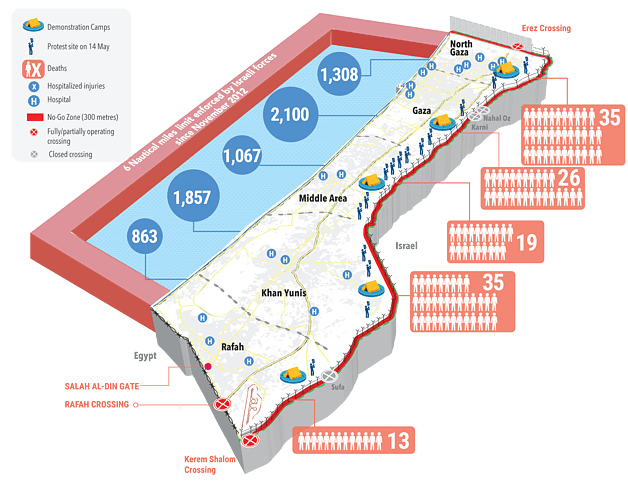
At least 189 Palestinians were killed between 30 March and 31 December 2018. An independent United Nations commission said that at least 29 out of the 189 killed were militants. Israeli soldiers fired tear gas and live ammunition. According to Robert Mardini, head of Middle East for the International Committee of the Red Cross (ICRC), more than 13,000 Palestinians were wounded as of 19 June 2018. The majority were wounded severely, with some 1,400 struck by three to five bullets. No Israelis were physically harmed from 30 March to 12 May, until one Israeli soldier was reported as slightly wounded on 14 May, the day the protests peaked. The same day, 59 or 60 Palestinians were shot dead at twelve clash points along the border fence. Hamas claimed 50 of them as its militants, and Islamic Jihad claimed 3 of the 62 killed as members of its military wing. Some 35,000 Palestinians protested that day, with thousands approaching the fence.
Israel's use of deadly force was condemned on 13 June 2018 in a United Nations General Assembly resolution. Condemnations also came from human rights organizations, including Human Rights Watch, B'Tselem, and Amnesty International, and by United Nations officials. Kuwait proposed two United Nations Security Council statements, both blocked by the United States, which called for investigations into Israel's killing of Palestinian protesters. The Israeli government praised Israeli troops for protecting the border fence. Media coverage of the demonstrations, and what has been termed the "PR battle", has been the object of analysis and controversy. In late February 2019, a United Nations Human Rights Council's independent commission found that of the 489 cases of Palestinian deaths or injuries analyzed, only two were possibly justified as responses to danger by Israeli security forces. The commission deemed the rest of the cases illegal, and concluded with a recommendation calling on Israel to examine whether war crimes or crimes against humanity had been committed, and if so, to bring those responsible to trial.
In 2005, Israel withdrew its forces from Gaza and allowed the Palestinian authority to take control. Despite the withdrawal, Israel still maintains direct external control over everyday life in Gaza, such as the territory's air and maritime space, most of its land crossings, electricity and water supply and other utilities. According to Human Rights Watch (HRW), Palestinians in Gaza still remain protected persons under the articles of the Geneva Conventions.
Following the 2006 Palestinian election and the subsequent Battle of Gaza in 2007, Hamas took full control over Gaza and expelled its rival and then-ruler of the West Bank, Fatah. The takeover by Hamas led Israel and Egypt to impose a land, air and sea blockade on Gaza. Gaza's economy has shriveled as a result, and many people in the territory do not have access to basic necessities. Hamas has also been accused of frequently diverting portions of the international aid Gaza receives to its wars against Israel rather than the civilian population.
As a result of numerous wars between Hamas and Israel, particularly the 2014 Gaza war, the humanitarian situation in Gaza worsened. The new leadership under Yahya Sinwar hoped to get the Fatah-led Palestinian Authority to take control of Gaza's civilian affairs through the 2017 Fatah–Hamas Agreement, which was ultimately unsuccessful. According to Israeli journalist Amos Harel, Hamas, which failed to lift the blockade for years, sought to use the demonstrations as a means to get out its strategic crisis, as it found armed conflict with Israel to be ineffective.
Hub AI
2018–2019 Gaza border protests AI simulator
(@2018–2019 Gaza border protests_simulator)
2018–2019 Gaza border protests
The 2018–2019 Gaza border protests, also known as the Great March of Return (Arabic: مسیرة العودة الكبرى, romanized: Masīra al-ʿawda al-kubrā), were a series of demonstrations held each Friday in Gaza near the Gaza-Israel border from 30 March 2018 until 27 December 2019, in which Israel killed a total of 223 Palestinians. The demonstrators demanded that the Palestinian refugees must be allowed to return to lands they were displaced from in what is now Israel. They protested against Israel's land, air and sea blockade of Gaza and the United States recognition of Jerusalem as capital of Israel.
The first demonstrations were organized by independent activists, but the initiative was soon endorsed by Hamas, the governing party of Gaza, as well as other major factions in Gaza. The activists who planned the Great March of Return intended it to last only from 30 March 2018 (Land Day) to 15 May (Nakba Day) but the demonstrations continued for almost 18 months until Hamas announced on 27 December 2019 that they would be postponed. Thirty thousand Palestinians participated in the first demonstration on 30 March. Larger protests took place on the following Fridays, 6 April, 13 April, 20 April, 27 April, 4 May, and 11 May — each of which involved at least 10,000 demonstrators — while smaller numbers attended activities during the week.
Most of the demonstrators demonstrated peacefully far from the border fence. Peter Cammack, a fellow with the Middle East Program at the Carnegie Endowment for International Peace, argued that the march indicated a new trend in Palestinian society and Hamas, with a shift away from violence towards non-violent forms of protest. Nevertheless, smaller groups attempted to breach the fence, rolling tires, and throwing stones and molotov cocktails. Israeli officials said the demonstrations were used by Hamas as cover for launching attacks against Israel.
At least 189 Palestinians were killed between 30 March and 31 December 2018. An independent United Nations commission said that at least 29 out of the 189 killed were militants. Israeli soldiers fired tear gas and live ammunition. According to Robert Mardini, head of Middle East for the International Committee of the Red Cross (ICRC), more than 13,000 Palestinians were wounded as of 19 June 2018. The majority were wounded severely, with some 1,400 struck by three to five bullets. No Israelis were physically harmed from 30 March to 12 May, until one Israeli soldier was reported as slightly wounded on 14 May, the day the protests peaked. The same day, 59 or 60 Palestinians were shot dead at twelve clash points along the border fence. Hamas claimed 50 of them as its militants, and Islamic Jihad claimed 3 of the 62 killed as members of its military wing. Some 35,000 Palestinians protested that day, with thousands approaching the fence.
Israel's use of deadly force was condemned on 13 June 2018 in a United Nations General Assembly resolution. Condemnations also came from human rights organizations, including Human Rights Watch, B'Tselem, and Amnesty International, and by United Nations officials. Kuwait proposed two United Nations Security Council statements, both blocked by the United States, which called for investigations into Israel's killing of Palestinian protesters. The Israeli government praised Israeli troops for protecting the border fence. Media coverage of the demonstrations, and what has been termed the "PR battle", has been the object of analysis and controversy. In late February 2019, a United Nations Human Rights Council's independent commission found that of the 489 cases of Palestinian deaths or injuries analyzed, only two were possibly justified as responses to danger by Israeli security forces. The commission deemed the rest of the cases illegal, and concluded with a recommendation calling on Israel to examine whether war crimes or crimes against humanity had been committed, and if so, to bring those responsible to trial.
In 2005, Israel withdrew its forces from Gaza and allowed the Palestinian authority to take control. Despite the withdrawal, Israel still maintains direct external control over everyday life in Gaza, such as the territory's air and maritime space, most of its land crossings, electricity and water supply and other utilities. According to Human Rights Watch (HRW), Palestinians in Gaza still remain protected persons under the articles of the Geneva Conventions.
Following the 2006 Palestinian election and the subsequent Battle of Gaza in 2007, Hamas took full control over Gaza and expelled its rival and then-ruler of the West Bank, Fatah. The takeover by Hamas led Israel and Egypt to impose a land, air and sea blockade on Gaza. Gaza's economy has shriveled as a result, and many people in the territory do not have access to basic necessities. Hamas has also been accused of frequently diverting portions of the international aid Gaza receives to its wars against Israel rather than the civilian population.
As a result of numerous wars between Hamas and Israel, particularly the 2014 Gaza war, the humanitarian situation in Gaza worsened. The new leadership under Yahya Sinwar hoped to get the Fatah-led Palestinian Authority to take control of Gaza's civilian affairs through the 2017 Fatah–Hamas Agreement, which was ultimately unsuccessful. According to Israeli journalist Amos Harel, Hamas, which failed to lift the blockade for years, sought to use the demonstrations as a means to get out its strategic crisis, as it found armed conflict with Israel to be ineffective.