
Recent from talks
22nd Air Refueling Wing
Knowledge base stats:
Talk channels stats:
Members stats:
22nd Air Refueling Wing
The 22d Air Refueling Wing is a United States Air Force unit assigned to the Air Mobility Command's Eighteenth Air Force. It is stationed at McConnell Air Force Base, Kansas and also functions as the host wing for McConnell.
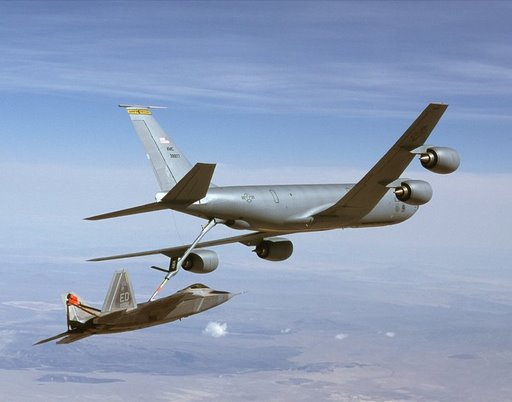
Its primary mission is to provide global reach by conducting air refueling and airlift where and when needed. It is one of only three "supertanker" wings in the Air Force, with four Regular Air Force air refueling squadrons, and 47 Boeing KC-135R Stratotanker and Boeing KC-46 Pegasus aircraft.[citation needed]
Its origins date to 1940 as the 22d Bombardment Group. The group was one of the first United States Army Air Forces units to be deployed into the Pacific Theater after the Pearl Harbor Attack with the Martin B-26 Marauder medium bomber. The 22d Operations Group carries the lineage and history of its highly decorated World War II predecessor unit. Active for over 60 years, the 22 Air Refueling Wing and its earlier designation as the 22d Bombardment Wing, was a component wing of Strategic Air Command's deterrent force during the Cold War.
The 22d Air Refueling Wing is commanded by Colonel Richard Tanner. Its Vice Commander is Colonel Mark Baran. The Wing's Command Chief Master Sergeant is Chief Master Sergeant Melissa Royster.
Established as 22d Bombardment Wing, Medium, on 28 July 1948. Activated on 1 August 1948. The new wing was assigned to March Air Force Base, California on 10 May 1949. It was not operational, so it shared a commander with the 1st Fighter Wing. The 22d Bomb became operational on 1 July 1949. The 1st Fighter Wing was attached to it and both wings shared the same commanding officer.
Detached from the wing, the 22d Bombardment Group deployed its B-29s in early July 1950 to Kadena Air Base, Okinawa, where it came under control of Far Ease Air Forces Bomber Command (Provisional). On 13 July, the group flew its first mission, against the marshaling yards and oil refinery at Wonsan, North Korea. By 21 October, it had amassed fifty-seven missions against the enemy, attacking bridges, factories, industrial targets, troop concentrations, airfields, marshalling yards, communications centers, and port facilities. During four months of combat, the group flew 335 sorties with only fourteen aborts and dropped over 6,500 tons of bombs. It redeployed to the United States in late October and November 1950.
Following the return of the Bombardment Group the wing re-equipped the propeller-driven B-29s with new B-47E Stratojet swept-wing bomber medium bombers in 1953, capable of flying at high subsonic speeds and primarily designed for penetrating the airspace of the Soviet Union. It trained for proficiency in global strategic bombardment, adding air refueling to its mission in 1952. The wing deployed at RAF Mildenhall, England, September–December 1951, and at RAF Upper Heyford, England, December 1953 – March 1954. From April to July 1957, it deployed to Andersen Air Force Base, Guam. SAC began phasing the B-47 out of the inventory beginning in 1962, sending the last of the wing's aircraft to Davis-Monthan Air Force Base, Arizona in 1963.
The wing was not tactically operational 11 March 1963 – 15 September 1963, while converting to B-52D bombers and KC-135A tankers. The wing supported Fifteenth Air Force's post-attack command and control system with EC-135s from, September 1964 – March 1970.
Hub AI
22nd Air Refueling Wing AI simulator
(@22nd Air Refueling Wing_simulator)
22nd Air Refueling Wing
The 22d Air Refueling Wing is a United States Air Force unit assigned to the Air Mobility Command's Eighteenth Air Force. It is stationed at McConnell Air Force Base, Kansas and also functions as the host wing for McConnell.
Its primary mission is to provide global reach by conducting air refueling and airlift where and when needed. It is one of only three "supertanker" wings in the Air Force, with four Regular Air Force air refueling squadrons, and 47 Boeing KC-135R Stratotanker and Boeing KC-46 Pegasus aircraft.[citation needed]
Its origins date to 1940 as the 22d Bombardment Group. The group was one of the first United States Army Air Forces units to be deployed into the Pacific Theater after the Pearl Harbor Attack with the Martin B-26 Marauder medium bomber. The 22d Operations Group carries the lineage and history of its highly decorated World War II predecessor unit. Active for over 60 years, the 22 Air Refueling Wing and its earlier designation as the 22d Bombardment Wing, was a component wing of Strategic Air Command's deterrent force during the Cold War.
The 22d Air Refueling Wing is commanded by Colonel Richard Tanner. Its Vice Commander is Colonel Mark Baran. The Wing's Command Chief Master Sergeant is Chief Master Sergeant Melissa Royster.
Established as 22d Bombardment Wing, Medium, on 28 July 1948. Activated on 1 August 1948. The new wing was assigned to March Air Force Base, California on 10 May 1949. It was not operational, so it shared a commander with the 1st Fighter Wing. The 22d Bomb became operational on 1 July 1949. The 1st Fighter Wing was attached to it and both wings shared the same commanding officer.
Detached from the wing, the 22d Bombardment Group deployed its B-29s in early July 1950 to Kadena Air Base, Okinawa, where it came under control of Far Ease Air Forces Bomber Command (Provisional). On 13 July, the group flew its first mission, against the marshaling yards and oil refinery at Wonsan, North Korea. By 21 October, it had amassed fifty-seven missions against the enemy, attacking bridges, factories, industrial targets, troop concentrations, airfields, marshalling yards, communications centers, and port facilities. During four months of combat, the group flew 335 sorties with only fourteen aborts and dropped over 6,500 tons of bombs. It redeployed to the United States in late October and November 1950.
Following the return of the Bombardment Group the wing re-equipped the propeller-driven B-29s with new B-47E Stratojet swept-wing bomber medium bombers in 1953, capable of flying at high subsonic speeds and primarily designed for penetrating the airspace of the Soviet Union. It trained for proficiency in global strategic bombardment, adding air refueling to its mission in 1952. The wing deployed at RAF Mildenhall, England, September–December 1951, and at RAF Upper Heyford, England, December 1953 – March 1954. From April to July 1957, it deployed to Andersen Air Force Base, Guam. SAC began phasing the B-47 out of the inventory beginning in 1962, sending the last of the wing's aircraft to Davis-Monthan Air Force Base, Arizona in 1963.
The wing was not tactically operational 11 March 1963 – 15 September 1963, while converting to B-52D bombers and KC-135A tankers. The wing supported Fifteenth Air Force's post-attack command and control system with EC-135s from, September 1964 – March 1970.
Recent media