
Recent from talks
3D tic-tac-toe
Knowledge base stats:
Talk channels stats:
Members stats:
3D tic-tac-toe
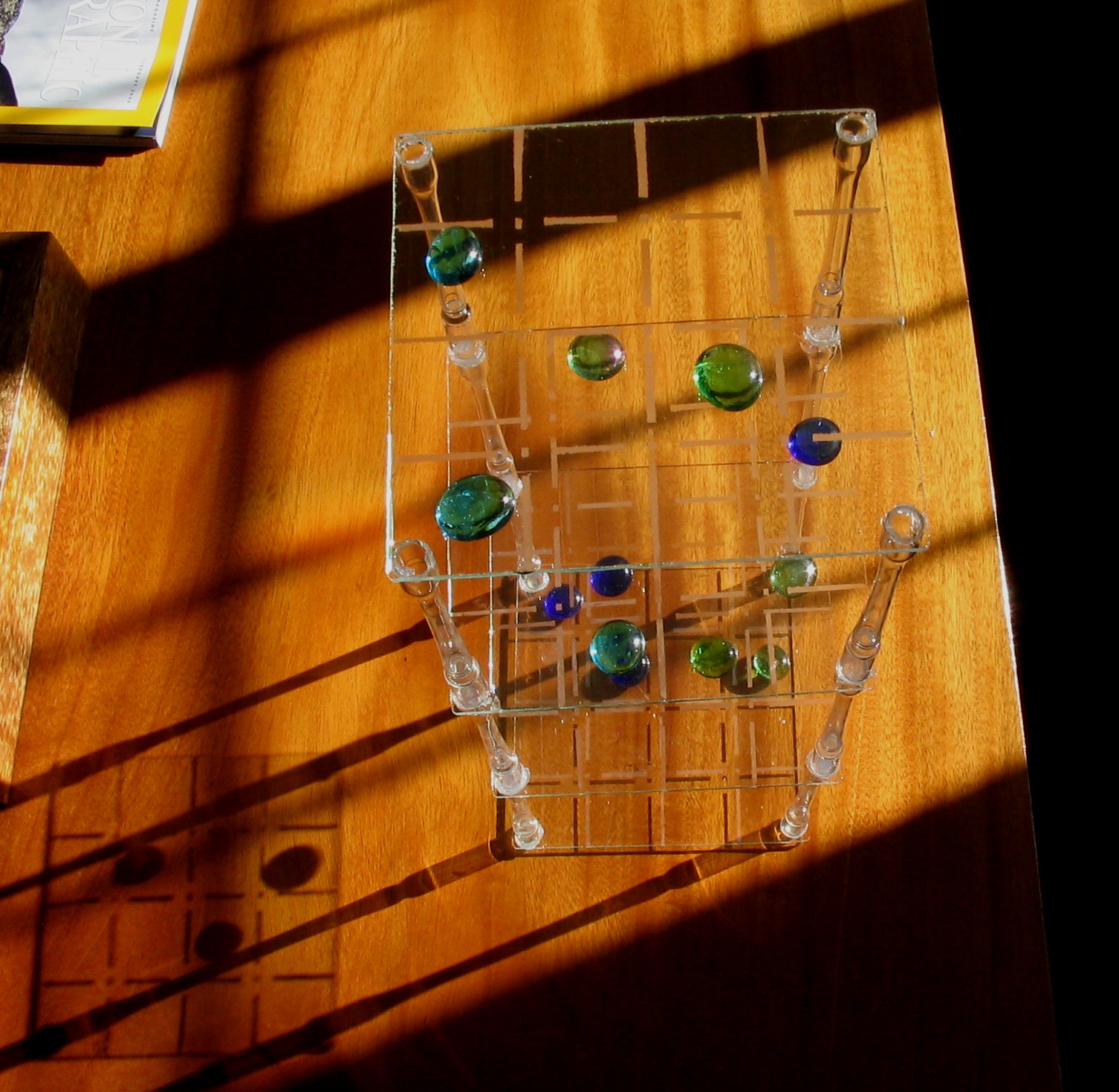
3D tic-tac-toe, also known by the trade name Qubic, is an abstract strategy board game, generally for two players. It is similar in concept to traditional tic-tac-toe but is played in a cubical array of cells, usually 4×4×4. Players take turns placing their markers in blank cells in the array. The first player to achieve four of their own markers in a row wins. The winning row can be horizontal, vertical, or diagonal on a single board as in regular tic-tac-toe, or vertically in a column, or a diagonal line through four boards.
As with traditional tic-tac-toe, several commercial sets of apparatus have been sold for the game, and it may also be played with pencil and paper with a hand-drawn board.
The game has been analyzed mathematically and a first-player-win strategy was developed and published. However, the strategy is too complicated for most human players to memorize and apply.
Like traditional 3×3 tic-tac-toe, the game may be played with pencil and paper. A game board can easily be drawn by hand, with players using the usual "naughts and crosses" to mark their moves.
In the 1970s, 3M Games (a division of 3M Corporation) sold a series of "Paper Games", including "3 Dimensional Tic Tac Toe". Buyers received a pad of 50 sheets with preprinted game boards.
Gobblets Gobbler and Otrio, use marker sizes (small, medium, large) as the replacement of the third element. Players can 'steal' the opponent spot by placing larger marker at the top of the opponent smaller marker or just simply competing with overlapping spot.
"Qubic" is the brand name of equipment for the 4×4×4 game that was manufactured and marketed by Parker Brothers, starting in 1964. It was reissued in 1972 with a more modern design. Both versions described the game as "Parker Brothers 3D Tic Tac Toe Game".
In the original issue, the bottom level board was opaque plastic, and the upper three clear, all of simple square design. The 1972 reissue used four clear plastic boards with rounded corners. Whereas pencil and paper play almost always involves just two players, Parker Brothers' rules said that up to three players could play. The circular playing pieces resembled small poker chips in red, blue, and yellow.
Hub AI
3D tic-tac-toe AI simulator
(@3D tic-tac-toe_simulator)
3D tic-tac-toe
3D tic-tac-toe, also known by the trade name Qubic, is an abstract strategy board game, generally for two players. It is similar in concept to traditional tic-tac-toe but is played in a cubical array of cells, usually 4×4×4. Players take turns placing their markers in blank cells in the array. The first player to achieve four of their own markers in a row wins. The winning row can be horizontal, vertical, or diagonal on a single board as in regular tic-tac-toe, or vertically in a column, or a diagonal line through four boards.
As with traditional tic-tac-toe, several commercial sets of apparatus have been sold for the game, and it may also be played with pencil and paper with a hand-drawn board.
The game has been analyzed mathematically and a first-player-win strategy was developed and published. However, the strategy is too complicated for most human players to memorize and apply.
Like traditional 3×3 tic-tac-toe, the game may be played with pencil and paper. A game board can easily be drawn by hand, with players using the usual "naughts and crosses" to mark their moves.
In the 1970s, 3M Games (a division of 3M Corporation) sold a series of "Paper Games", including "3 Dimensional Tic Tac Toe". Buyers received a pad of 50 sheets with preprinted game boards.
Gobblets Gobbler and Otrio, use marker sizes (small, medium, large) as the replacement of the third element. Players can 'steal' the opponent spot by placing larger marker at the top of the opponent smaller marker or just simply competing with overlapping spot.
"Qubic" is the brand name of equipment for the 4×4×4 game that was manufactured and marketed by Parker Brothers, starting in 1964. It was reissued in 1972 with a more modern design. Both versions described the game as "Parker Brothers 3D Tic Tac Toe Game".
In the original issue, the bottom level board was opaque plastic, and the upper three clear, all of simple square design. The 1972 reissue used four clear plastic boards with rounded corners. Whereas pencil and paper play almost always involves just two players, Parker Brothers' rules said that up to three players could play. The circular playing pieces resembled small poker chips in red, blue, and yellow.
Recent media