
Recent from talks
416th Air Expeditionary Wing
Knowledge base stats:
Talk channels stats:
Members stats:
416th Air Expeditionary Wing
The 416th Air Expeditionary Wing (AEW) is a provisional unit assigned to the Air Combat Command of the United States Air Force to activate or inactivate as needed.
The wing began life in World War II as the 416th Bombardment Group (BG). The group was a Douglas A-20 Havoc light bomb group assigned to Ninth Air Force in Western Europe. It was awarded a Distinguished Unit Citation for its actions in France when, in spite of intense resistance, the group bombed bridges, railways, rolling stock, and a radar station to disrupt the German retreat through the Falaise-Argentan gap. It converted to Douglas A-26 Invaders while engaged in combat and continued to support ground forces through the end of the war.
The group's heritage was continued by the 416th Bombardment Wing (BW), a Strategic Air Command B-52 Stratofortress wing that conducted strategic bombardment training and air refueling operations on a global scale based at Griffiss Air Force Base in New York. 416th BW crews and aircraft deployed to the Pacific during the Vietnam War era to support SAC operations during the conflict. In 1984, the wing and group were consolidated and became a single unit. In 1991, wing tanker crews and KC-135R aircraft participated in the war in Southwest Asia. The 416th was inactivated as part of the Post-Cold War drawdown of United States strategic forces in 1995 (BRAC 1993) and the closure of Griffiss AFB.
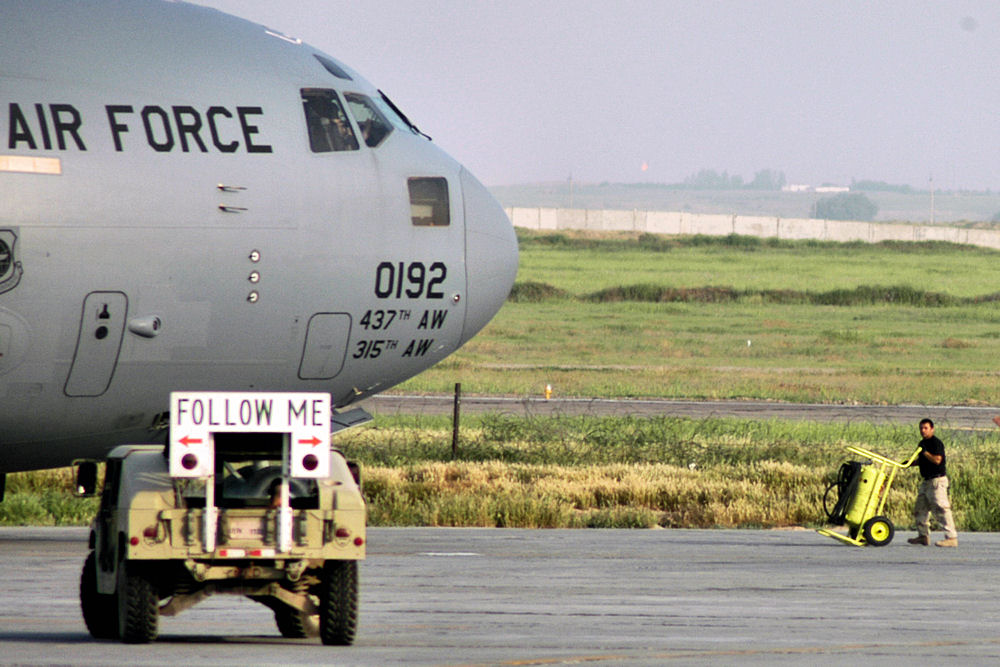
In 2002 the wing was converted to provisional status as the 416th Air Expeditionary Group It served as the host unit at Karshi-Khanabad Air Base (K2), in Qarshi, Uzbekistan, from 2002 to 2005, where it supported operations against the Taliban and al-Qaeda in Afghanistan. It was redesignated as the 416th Air Expeditionary Wing in 2010, but the current status of this unit is not publicly known.
 Media related to 416th Bombardment Group (United States Army Air Forces) at Wikimedia Commons
The wing was first activated on 5 February 1943 without personnel, at Will Rogers Field, Oklahoma as the 416th Bombardment Group (Light) (BG). The original squadrons of the group were the 668th, 669th, 670th, and 671st Bombardment Squadrons
Fifty-one officers and two hundred and forty-one (241) enlisted men were transferred to the group on 15 February 1943. The source of the cadre was the 46th Bombardment Group and units from Will Rogers Field; Blythe AAF, California; Barksdale Field, Louisiana and a number of men with considerable overseas experience from the Third Air Force Replacement Center, Plant Park, Florida. On that date, the 46th BG moved to the North side of Will Rogers Field, leaving the South side to the 416th BG.[citation needed]
The group originally operated as an Operational Training Unit under the III Air Support Command, providing a portion of the initial cadre of the 417th Bombardment Group. The group fell back on the 46th BG for assistance with its training. Pilots were attached to the 46th BG for transition flying during the first three months of its existence. On 11 May, the first eight (8) planes were assigned to the 416th Group. One North American B-25C Mitchell and one Douglas A-20B Havoc was given to each of the 668th and 669th Squadrons. Two A-20B's were assigned to each of the 670th and 671st Squadrons. Classes in all the military occupational specialties were conducted by the 46th until 1 June 1943. The Pilots attended Ground School, for five hours a day, in the following subjects: code, link trainer, aircraft recognition, operation and maintenance of the A-20 and B-25, air navigation, radio, instrument procedure, etc. The Intelligence personnel attended classes for one hour a day.[citation needed]
Hub AI
416th Air Expeditionary Wing AI simulator
(@416th Air Expeditionary Wing_simulator)
416th Air Expeditionary Wing
The 416th Air Expeditionary Wing (AEW) is a provisional unit assigned to the Air Combat Command of the United States Air Force to activate or inactivate as needed.
The wing began life in World War II as the 416th Bombardment Group (BG). The group was a Douglas A-20 Havoc light bomb group assigned to Ninth Air Force in Western Europe. It was awarded a Distinguished Unit Citation for its actions in France when, in spite of intense resistance, the group bombed bridges, railways, rolling stock, and a radar station to disrupt the German retreat through the Falaise-Argentan gap. It converted to Douglas A-26 Invaders while engaged in combat and continued to support ground forces through the end of the war.
The group's heritage was continued by the 416th Bombardment Wing (BW), a Strategic Air Command B-52 Stratofortress wing that conducted strategic bombardment training and air refueling operations on a global scale based at Griffiss Air Force Base in New York. 416th BW crews and aircraft deployed to the Pacific during the Vietnam War era to support SAC operations during the conflict. In 1984, the wing and group were consolidated and became a single unit. In 1991, wing tanker crews and KC-135R aircraft participated in the war in Southwest Asia. The 416th was inactivated as part of the Post-Cold War drawdown of United States strategic forces in 1995 (BRAC 1993) and the closure of Griffiss AFB.
In 2002 the wing was converted to provisional status as the 416th Air Expeditionary Group It served as the host unit at Karshi-Khanabad Air Base (K2), in Qarshi, Uzbekistan, from 2002 to 2005, where it supported operations against the Taliban and al-Qaeda in Afghanistan. It was redesignated as the 416th Air Expeditionary Wing in 2010, but the current status of this unit is not publicly known.
Media related to 416th Bombardment Group (United States Army Air Forces) at Wikimedia Commons
The wing was first activated on 5 February 1943 without personnel, at Will Rogers Field, Oklahoma as the 416th Bombardment Group (Light) (BG). The original squadrons of the group were the 668th, 669th, 670th, and 671st Bombardment Squadrons
Fifty-one officers and two hundred and forty-one (241) enlisted men were transferred to the group on 15 February 1943. The source of the cadre was the 46th Bombardment Group and units from Will Rogers Field; Blythe AAF, California; Barksdale Field, Louisiana and a number of men with considerable overseas experience from the Third Air Force Replacement Center, Plant Park, Florida. On that date, the 46th BG moved to the North side of Will Rogers Field, leaving the South side to the 416th BG.[citation needed]
The group originally operated as an Operational Training Unit under the III Air Support Command, providing a portion of the initial cadre of the 417th Bombardment Group. The group fell back on the 46th BG for assistance with its training. Pilots were attached to the 46th BG for transition flying during the first three months of its existence. On 11 May, the first eight (8) planes were assigned to the 416th Group. One North American B-25C Mitchell and one Douglas A-20B Havoc was given to each of the 668th and 669th Squadrons. Two A-20B's were assigned to each of the 670th and 671st Squadrons. Classes in all the military occupational specialties were conducted by the 46th until 1 June 1943. The Pilots attended Ground School, for five hours a day, in the following subjects: code, link trainer, aircraft recognition, operation and maintenance of the A-20 and B-25, air navigation, radio, instrument procedure, etc. The Intelligence personnel attended classes for one hour a day.[citation needed]
Recent media