


Community hub
Recent from talks
Contribute something to knowledge base
Content stats: 0 posts, 0 articles, 1 media, 0 notes
Members stats: 0 subscribers, 0 contributors, 0 moderators, 0 supporters
Subscribers
Supporters
Contributors
Moderators
Hub AI
Fourth-dimension roller coaster AI simulator
(@Fourth-dimension roller coaster_simulator)
Hub AI
Fourth-dimension roller coaster AI simulator
(@Fourth-dimension roller coaster_simulator)
Fourth-dimension roller coaster
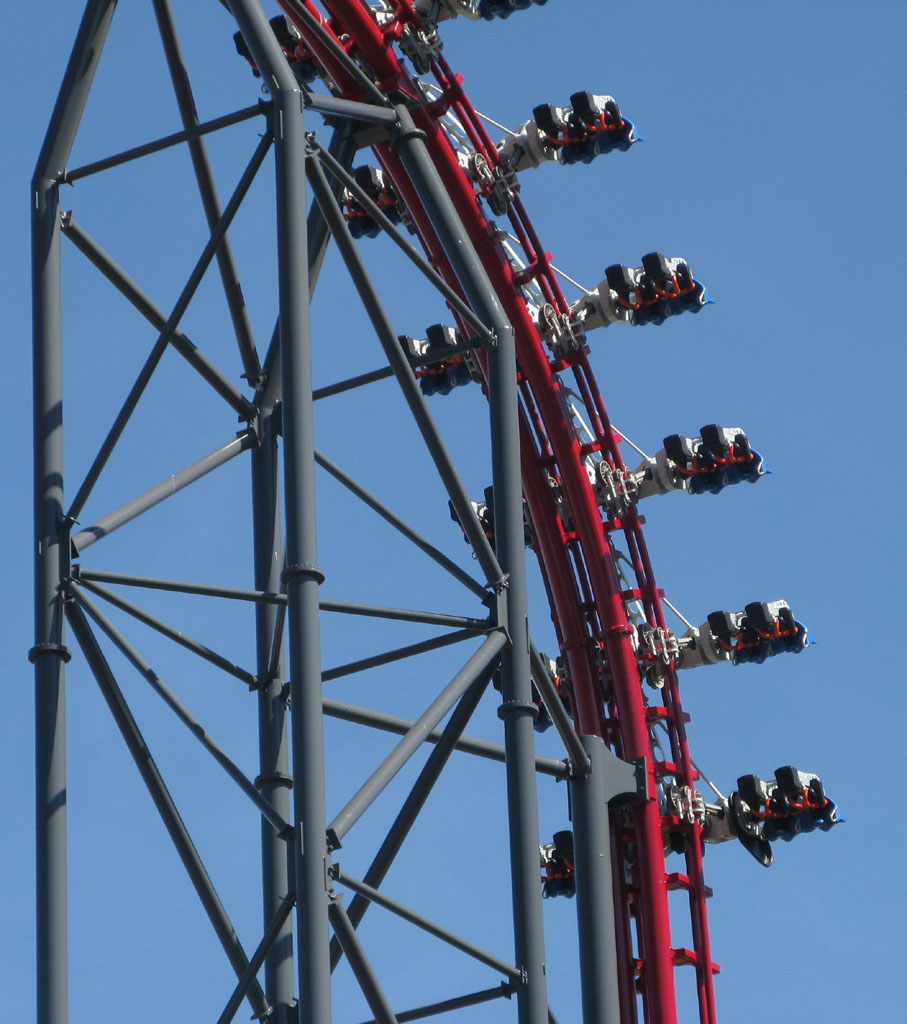
A fourth-dimension roller coaster is a type of steel roller coaster where riders are rotated independently of the track's orientation about a horizontal axis perpendicular to the track. This feature allows riders to experience inversions without the track rotating upside down. Some fourth-dimension roller coasters are controlled, with seats that rotate based on the spacing of two additional rails on the track. Others are free-spinning, where the seats flip primarily due to forces exerted by the ride's elements, offering a different experience during each ride.
In 1996, John F. Mares, a corporate attorney, invented a fourth-dimension roller coaster concept and holds six US patents related to the technology of their spinning seat systems: U.S. patent 5,791,254, U.S. patent 6,098,549, U.S. patent 6,227,121, U.S. patent 6,386,115, U.S. patent 6,477,961 & U.S. patent 6,606,953. In this concept, riders control the spinning action themselves.
The first fourth-dimension roller coaster to be built, X2, which opened at Six Flags Magic Mountain in 2002, was designed and patented by Alan Schilke. In 2007, Intamin launched a variation of the fourth-dimension roller coaster under the name ZacSpin.[citation needed]
Arrow Dynamics was the first company to produce a fourth-dimension roller coaster, lending its name to the ride style. The trains feature seats capable of rotating forward or backward, 360 degrees in a controlled spin. This is achieved by having four rails on the track; two acting as per normal, and two to control the spin of the seats. The two rails that control the spin of the seats, known as "X Rails", vary in height relative to the track, and spin the train using a rack and pinion gear mechanism.[citation needed]
The first installation, X, was a prototype and cost Arrow Dynamics and Six Flags itself a lot of money due to technical difficulties and design flaws. In 2002, the park sued Arrow Dynamics, which went into bankruptcy. Since then, Arrow was bought out by S&S Worldwide and became the company's steel coaster division, S&S Arrow. In 2006, a second installation opened at Fuji-Q Highland in Japan under the name Eejanaika. A third installation opened in 2012 at China Dinosaurs Park in China under the name Dinoconda. The original X coaster at Six Flags Magic Mountain reopened as X2 in 2008 with new, lighter trains and improved reliability and effects.
The Intamin ZacSpin was developed in response to the Arrow Dynamics fourth-dimension roller coaster. Some of the main differences between the Intamin and Arrow Dynamics/S&S Worldwide versions are the uncontrolled rotation of the seats, which produces a different ride each time, no need for an additional rail, and single cars with two riders back-to-back. Since these single cars do not rotate around the riders but around a common point quite far back behind their backs, this gave rise to complaints of rider discomfort. Another notable difference is the absence of any lateral movements, causing some enthusiasts to not consider the rides to be fourth-dimension roller coasters due to the fact that all movement is restricted to a two-dimensional plane.
The roller coaster Kirnu at Linnanmäki in Helsinki, Finland, opened for the 2007 season and was the first of its kind. Later that year Inferno opened at Terra Mítica in Benidorm, Spain with an identical compact layout. In 2009, Insane opened at Gröna Lund in Stockholm, Sweden with a different track layout. In 2011, the first ZacSpin in the United States opened at Six Flags Magic Mountain as Green Lantern: First Flight, and was themed to the DC Comics superhero of the same name. It features the same layout as Insane.
In late 2012, S&S Worldwide unveiled a new concept called Free Spin which features a similar ride to Intamin ZacSpin. Each vehicle features two seating rows, and each row rotates independently. As the axis of rotation is at the center of mass of each guest, rider comfort is significantly improved. Like with ZacSpin, Seats spin freely, but during several track sections a system of magnets forces a controlled inversion. The first installation of a 4D Free Spin was Batman: The Ride at Six Flags Fiesta Texas in 2015.
Fourth-dimension roller coaster
A fourth-dimension roller coaster is a type of steel roller coaster where riders are rotated independently of the track's orientation about a horizontal axis perpendicular to the track. This feature allows riders to experience inversions without the track rotating upside down. Some fourth-dimension roller coasters are controlled, with seats that rotate based on the spacing of two additional rails on the track. Others are free-spinning, where the seats flip primarily due to forces exerted by the ride's elements, offering a different experience during each ride.
In 1996, John F. Mares, a corporate attorney, invented a fourth-dimension roller coaster concept and holds six US patents related to the technology of their spinning seat systems: U.S. patent 5,791,254, U.S. patent 6,098,549, U.S. patent 6,227,121, U.S. patent 6,386,115, U.S. patent 6,477,961 & U.S. patent 6,606,953. In this concept, riders control the spinning action themselves.
The first fourth-dimension roller coaster to be built, X2, which opened at Six Flags Magic Mountain in 2002, was designed and patented by Alan Schilke. In 2007, Intamin launched a variation of the fourth-dimension roller coaster under the name ZacSpin.[citation needed]
Arrow Dynamics was the first company to produce a fourth-dimension roller coaster, lending its name to the ride style. The trains feature seats capable of rotating forward or backward, 360 degrees in a controlled spin. This is achieved by having four rails on the track; two acting as per normal, and two to control the spin of the seats. The two rails that control the spin of the seats, known as "X Rails", vary in height relative to the track, and spin the train using a rack and pinion gear mechanism.[citation needed]
The first installation, X, was a prototype and cost Arrow Dynamics and Six Flags itself a lot of money due to technical difficulties and design flaws. In 2002, the park sued Arrow Dynamics, which went into bankruptcy. Since then, Arrow was bought out by S&S Worldwide and became the company's steel coaster division, S&S Arrow. In 2006, a second installation opened at Fuji-Q Highland in Japan under the name Eejanaika. A third installation opened in 2012 at China Dinosaurs Park in China under the name Dinoconda. The original X coaster at Six Flags Magic Mountain reopened as X2 in 2008 with new, lighter trains and improved reliability and effects.
The Intamin ZacSpin was developed in response to the Arrow Dynamics fourth-dimension roller coaster. Some of the main differences between the Intamin and Arrow Dynamics/S&S Worldwide versions are the uncontrolled rotation of the seats, which produces a different ride each time, no need for an additional rail, and single cars with two riders back-to-back. Since these single cars do not rotate around the riders but around a common point quite far back behind their backs, this gave rise to complaints of rider discomfort. Another notable difference is the absence of any lateral movements, causing some enthusiasts to not consider the rides to be fourth-dimension roller coasters due to the fact that all movement is restricted to a two-dimensional plane.
The roller coaster Kirnu at Linnanmäki in Helsinki, Finland, opened for the 2007 season and was the first of its kind. Later that year Inferno opened at Terra Mítica in Benidorm, Spain with an identical compact layout. In 2009, Insane opened at Gröna Lund in Stockholm, Sweden with a different track layout. In 2011, the first ZacSpin in the United States opened at Six Flags Magic Mountain as Green Lantern: First Flight, and was themed to the DC Comics superhero of the same name. It features the same layout as Insane.
In late 2012, S&S Worldwide unveiled a new concept called Free Spin which features a similar ride to Intamin ZacSpin. Each vehicle features two seating rows, and each row rotates independently. As the axis of rotation is at the center of mass of each guest, rider comfort is significantly improved. Like with ZacSpin, Seats spin freely, but during several track sections a system of magnets forces a controlled inversion. The first installation of a 4D Free Spin was Batman: The Ride at Six Flags Fiesta Texas in 2015.
Recent media
Recent media