


Community hub
Recent from talks
Contribute something to knowledge base
Content stats: 0 posts, 0 articles, 1 media, 0 notes
Members stats: 0 subscribers, 0 contributors, 0 moderators, 0 supporters
Subscribers
Supporters
Contributors
Moderators
Hub AI
5.56×45mm NATO AI simulator
(@5.56×45mm NATO_simulator)
Hub AI
5.56×45mm NATO AI simulator
(@5.56×45mm NATO_simulator)
5.56×45mm NATO
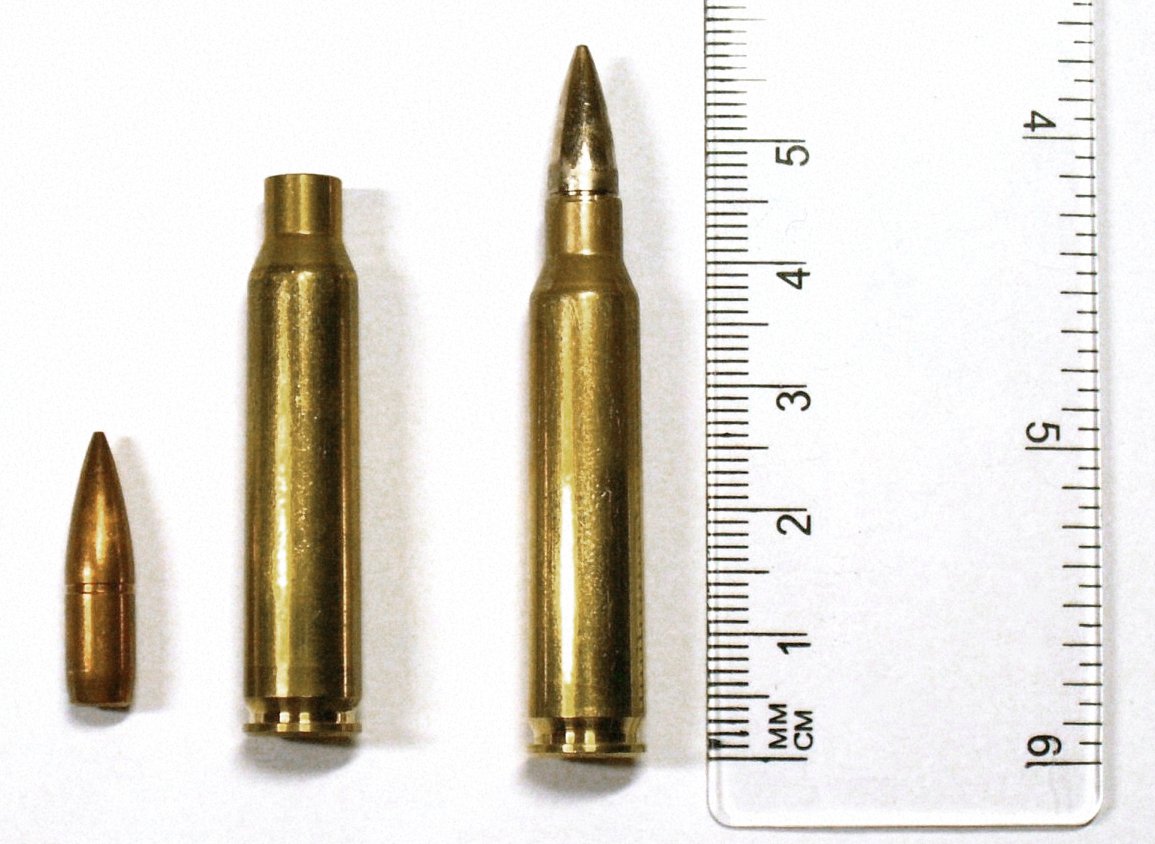
The 5.56×45mm NATO (official NATO nomenclature 5.56 NATO, commonly pronounced "five-five-six") is a rimless bottlenecked centerfire intermediate cartridge family developed in the late 1970s in Belgium by FN Herstal. It consists of the SS109, L110, and SS111 cartridges. On 28 October 1980, under STANAG 4172, it was standardized as the second standard service rifle cartridge for NATO forces as well as many non-NATO countries. Though they are not identical, the 5.56×45mm NATO cartridge family was derived from the .223 Remington cartridge designed by Remington Arms in the early 1960s, which has a near-identical case. However, firing chamber dimensions differ slightly between rifles manufactured for the designated cartridges. The differences may cause unsafe chamber pressures when firing 5.56 NATO in rifles designed for .223 Remington. Therefore, this combination is not recommended.
In 1954, the larger 7.62×51mm NATO rifle cartridge was selected as the first standard NATO rifle cartridge. At the time of selection there had been criticism that the recoil power of the 7.62×51mm NATO, when fired from a handheld lightweight modern service rifle in full automatic mode, did not allow for sufficient control, so the automatic follow-on shots would not hit the intended target but scatter around it.
The British had extensive evidence through their own experimentation with intermediate cartridges since 1945, and were on the point of adopting the .280 (7 mm × 43mm) cartridge when the selection of 7.62×51mm (.308) as the NATO standard was made. The FN company had also been involved in the development of the .280 round, including developing a version of the FN FAL in .280. Concerns about the recoil and overall effectiveness of 7.62 mm were overruled by the US, and the other NATO nations accepted that standardization was more important than the selection of a cartridge that was otherwise ideal.
The development of the cartridge that eventually became the .223 Remington (from which 5.56mm NATO would eventually be developed) would be intrinsically linked to the development of a new lightweight combat rifle. The cartridge and rifle were developed as one unit by Fairchild Industries, Remington Arms, and several engineers working toward a goal developed by U.S. Continental Army Command (CONARC). Early development work began in 1957. A project to create a small-calibre, high-velocity (SCHV) firearm was created. Eugene Stoner of Armalite was invited to scale down the AR-10 (7.62mm) design. Winchester was also invited to participate. The parameters that were requested by CONARC:
Springfield Armory's Earle Harvey lengthened the .222 Remington cartridge case to meet the requirements. It was then known as the .224 Springfield. Concurrently with the SCHV project, Springfield Armory was developing a 7.62mm rifle. Harvey was ordered to cease all work on the SCHV to avoid any competition for resources.
Eugene Stoner of Armalite (a division of Fairchild Industries) had been advised to produce a scaled-down version of the 7.62mm AR-10 design. In May 1957, Stoner gave a live-fire demonstration of the prototype of the AR-15 for General Willard G. Wyman, Commander-in-Chief of CONARC. As a result, CONARC ordered rifles to test. Stoner and Sierra Bullet's Frank Snow began work on the .222 Remington cartridge. Using a ballistic calculator, they determined that a 55-grain bullet would have to be fired at 3,300 ft/s (1,006 m/s) to achieve the 500-yard performance necessary.
Robert Hutton (technical editor of Guns & Ammo magazine[clarification needed]) started development of a powder load to reach the 3,300 ft/s (1,006 m/s) goal. He used DuPont IMR4198, IMR3031, and an Olin powder to work up loads. Testing was done with a Remington 722 rifle with a 22-inch Apex barrel. During a public demonstration, the round successfully penetrated the U.S. steel helmet as required. But testing showed chamber pressures to be excessively high.
Stoner contacted both Winchester and Remington about increasing the case capacity. Remington created a larger cartridge called the ".222 Special", which was loaded with DuPont IMR4475 powder. During parallel testing of the T44E4 (future M14) and the AR-15 in 1958, the T44E4 experienced 16 failures per 1,000 rounds fired compared to 6.1 for the AR-15.
5.56×45mm NATO
The 5.56×45mm NATO (official NATO nomenclature 5.56 NATO, commonly pronounced "five-five-six") is a rimless bottlenecked centerfire intermediate cartridge family developed in the late 1970s in Belgium by FN Herstal. It consists of the SS109, L110, and SS111 cartridges. On 28 October 1980, under STANAG 4172, it was standardized as the second standard service rifle cartridge for NATO forces as well as many non-NATO countries. Though they are not identical, the 5.56×45mm NATO cartridge family was derived from the .223 Remington cartridge designed by Remington Arms in the early 1960s, which has a near-identical case. However, firing chamber dimensions differ slightly between rifles manufactured for the designated cartridges. The differences may cause unsafe chamber pressures when firing 5.56 NATO in rifles designed for .223 Remington. Therefore, this combination is not recommended.
In 1954, the larger 7.62×51mm NATO rifle cartridge was selected as the first standard NATO rifle cartridge. At the time of selection there had been criticism that the recoil power of the 7.62×51mm NATO, when fired from a handheld lightweight modern service rifle in full automatic mode, did not allow for sufficient control, so the automatic follow-on shots would not hit the intended target but scatter around it.
The British had extensive evidence through their own experimentation with intermediate cartridges since 1945, and were on the point of adopting the .280 (7 mm × 43mm) cartridge when the selection of 7.62×51mm (.308) as the NATO standard was made. The FN company had also been involved in the development of the .280 round, including developing a version of the FN FAL in .280. Concerns about the recoil and overall effectiveness of 7.62 mm were overruled by the US, and the other NATO nations accepted that standardization was more important than the selection of a cartridge that was otherwise ideal.
The development of the cartridge that eventually became the .223 Remington (from which 5.56mm NATO would eventually be developed) would be intrinsically linked to the development of a new lightweight combat rifle. The cartridge and rifle were developed as one unit by Fairchild Industries, Remington Arms, and several engineers working toward a goal developed by U.S. Continental Army Command (CONARC). Early development work began in 1957. A project to create a small-calibre, high-velocity (SCHV) firearm was created. Eugene Stoner of Armalite was invited to scale down the AR-10 (7.62mm) design. Winchester was also invited to participate. The parameters that were requested by CONARC:
Springfield Armory's Earle Harvey lengthened the .222 Remington cartridge case to meet the requirements. It was then known as the .224 Springfield. Concurrently with the SCHV project, Springfield Armory was developing a 7.62mm rifle. Harvey was ordered to cease all work on the SCHV to avoid any competition for resources.
Eugene Stoner of Armalite (a division of Fairchild Industries) had been advised to produce a scaled-down version of the 7.62mm AR-10 design. In May 1957, Stoner gave a live-fire demonstration of the prototype of the AR-15 for General Willard G. Wyman, Commander-in-Chief of CONARC. As a result, CONARC ordered rifles to test. Stoner and Sierra Bullet's Frank Snow began work on the .222 Remington cartridge. Using a ballistic calculator, they determined that a 55-grain bullet would have to be fired at 3,300 ft/s (1,006 m/s) to achieve the 500-yard performance necessary.
Robert Hutton (technical editor of Guns & Ammo magazine[clarification needed]) started development of a powder load to reach the 3,300 ft/s (1,006 m/s) goal. He used DuPont IMR4198, IMR3031, and an Olin powder to work up loads. Testing was done with a Remington 722 rifle with a 22-inch Apex barrel. During a public demonstration, the round successfully penetrated the U.S. steel helmet as required. But testing showed chamber pressures to be excessively high.
Stoner contacted both Winchester and Remington about increasing the case capacity. Remington created a larger cartridge called the ".222 Special", which was loaded with DuPont IMR4475 powder. During parallel testing of the T44E4 (future M14) and the AR-15 in 1958, the T44E4 experienced 16 failures per 1,000 rounds fired compared to 6.1 for the AR-15.
Recent media
Recent media