
Recent from talks
94th Airlift Wing
Knowledge base stats:
Talk channels stats:
Members stats:
94th Airlift Wing
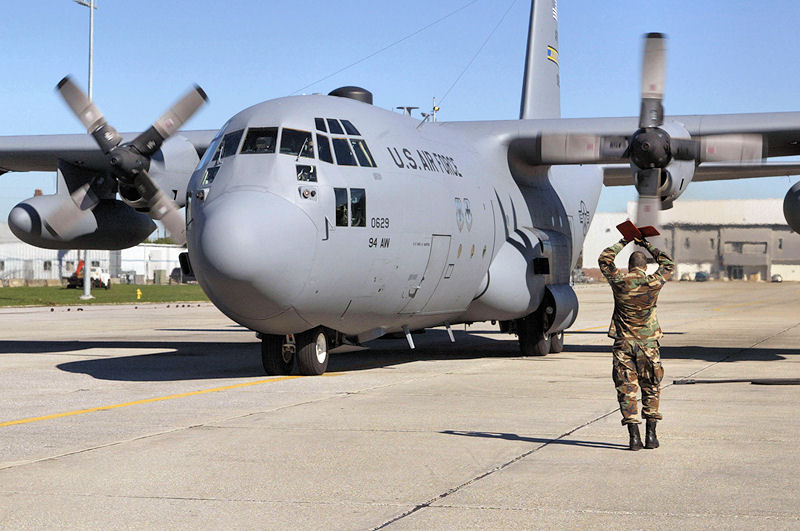
The 94th Airlift Wing is a reserve unit of the United States Air Force. It is assigned to the Twenty-Second Air Force of the Air Force Reserve Command (AFRC) and is stationed at Dobbins Air Reserve Base, Georgia. When mobilized, most of the wing would be presented to US Transportation Command, while a smaller proportion would be retained by AFRC.
The 94th Wing is the host organization at Dobbins ARB and is responsible for providing security, civil engineering, fire protection, air traffic control, airfield maintenance, and numerous other services the base and to tenant organizations assigned to the base.
The original 94th Bombardment Group was activated in mid-1942 and bombed Germany from the United Kingdom for three years.
First activated in June 1949 at Marietta Air Force Base as the 94th Bombardment Wing, the wing trained in the reserve as a light bomber wing until March 1951, when it was called to active service on 10 March 1951 during the Korean War. By 20 March all wing personnel had been transferred to other USAF organizations and the wing was inactivated on 1 April. The wing's aircraft were also distributed to other organizations
The wing was reactivated in the reserves in June 1952 at what was now called Dobbins Air Force Base as the 94th Tactical Reconnaissance Wing, replacing the 902d Reserve Training Wing. The reserve mobilization for the Korean war had left the reserve without aircraft, and the unit did not receive aircraft until July. Once it received aircraft, it began to train for the reconnaissance mission with a variety of aircraft.
The Air Force desired that all reserve units be designed to augment the regular forces in the event of a national emergency. The reserves, however, had six pilot training wings with no mobilization mission. On 18 May 1955, they were discontinued. In the resulting reorganization of reserve wings, the 94th Wing transferred its mission, personnel and equipment at Dobbins to the 482d Fighter-Bomber Wing and moved on paper to Scott Air Force Base, Illinois, where it absorbed the resources of the 8711th Pilot Training Wing and returned to its original role as a light bombardment unit.
It flew its Douglas B-26 Invaders for only two years at Scott. The Joint Chiefs of Staff were pressuring the Air Force to provide more wartime airlift. At the same time, about 150 Fairchild C-119 Flying Boxcars became available from the active force. Consequently, in November 1956 the Air Force directed Continental Air Command to convert three reserve fighter bomber wings to the troop carrier mission by 1957. Cuts in the budget in 1957 also led to a reduction in the number of reserve wings from 24 to 15. As a result, reserve flying operations at Scott were reduced to a single squadron (the 73d Troop Carrier Squadron), and the wing moved on paper to Laurence G. Hanscom Field, Massachusetts in November 1957. On arrival at Hanscom, it absorbed the resources of the inactivating 89th Fighter-Bomber Wing and began conversion to Flying Boxcars. By 1958, wing personnel began taking part in regular airlift missions and exercises, both in the United States and overseas
In April 1959, the wing reorganized under the Dual Deputy system. Its 94th Troop Carrier Group was inactivated and the 731st and 732d Troop Carrier Squadrons were assigned directly to the wing. Although the 731st was located with the wing at Hanscom, the 732d was stationed at Grenier Field, New Hampshire under he Detached Squadron Concept, a program designed to lessen community impact and facilitate recruiting and manning by locating reserve squadron sized units in smaller population centers, rather than concentrating an entire wing in one location.
Hub AI
94th Airlift Wing AI simulator
(@94th Airlift Wing_simulator)
94th Airlift Wing
The 94th Airlift Wing is a reserve unit of the United States Air Force. It is assigned to the Twenty-Second Air Force of the Air Force Reserve Command (AFRC) and is stationed at Dobbins Air Reserve Base, Georgia. When mobilized, most of the wing would be presented to US Transportation Command, while a smaller proportion would be retained by AFRC.
The 94th Wing is the host organization at Dobbins ARB and is responsible for providing security, civil engineering, fire protection, air traffic control, airfield maintenance, and numerous other services the base and to tenant organizations assigned to the base.
The original 94th Bombardment Group was activated in mid-1942 and bombed Germany from the United Kingdom for three years.
First activated in June 1949 at Marietta Air Force Base as the 94th Bombardment Wing, the wing trained in the reserve as a light bomber wing until March 1951, when it was called to active service on 10 March 1951 during the Korean War. By 20 March all wing personnel had been transferred to other USAF organizations and the wing was inactivated on 1 April. The wing's aircraft were also distributed to other organizations
The wing was reactivated in the reserves in June 1952 at what was now called Dobbins Air Force Base as the 94th Tactical Reconnaissance Wing, replacing the 902d Reserve Training Wing. The reserve mobilization for the Korean war had left the reserve without aircraft, and the unit did not receive aircraft until July. Once it received aircraft, it began to train for the reconnaissance mission with a variety of aircraft.
The Air Force desired that all reserve units be designed to augment the regular forces in the event of a national emergency. The reserves, however, had six pilot training wings with no mobilization mission. On 18 May 1955, they were discontinued. In the resulting reorganization of reserve wings, the 94th Wing transferred its mission, personnel and equipment at Dobbins to the 482d Fighter-Bomber Wing and moved on paper to Scott Air Force Base, Illinois, where it absorbed the resources of the 8711th Pilot Training Wing and returned to its original role as a light bombardment unit.
It flew its Douglas B-26 Invaders for only two years at Scott. The Joint Chiefs of Staff were pressuring the Air Force to provide more wartime airlift. At the same time, about 150 Fairchild C-119 Flying Boxcars became available from the active force. Consequently, in November 1956 the Air Force directed Continental Air Command to convert three reserve fighter bomber wings to the troop carrier mission by 1957. Cuts in the budget in 1957 also led to a reduction in the number of reserve wings from 24 to 15. As a result, reserve flying operations at Scott were reduced to a single squadron (the 73d Troop Carrier Squadron), and the wing moved on paper to Laurence G. Hanscom Field, Massachusetts in November 1957. On arrival at Hanscom, it absorbed the resources of the inactivating 89th Fighter-Bomber Wing and began conversion to Flying Boxcars. By 1958, wing personnel began taking part in regular airlift missions and exercises, both in the United States and overseas
In April 1959, the wing reorganized under the Dual Deputy system. Its 94th Troop Carrier Group was inactivated and the 731st and 732d Troop Carrier Squadrons were assigned directly to the wing. Although the 731st was located with the wing at Hanscom, the 732d was stationed at Grenier Field, New Hampshire under he Detached Squadron Concept, a program designed to lessen community impact and facilitate recruiting and manning by locating reserve squadron sized units in smaller population centers, rather than concentrating an entire wing in one location.
Recent media