



Community hub
Recent from talks
Knowledge base stats:
Talk channels stats:
Members stats:
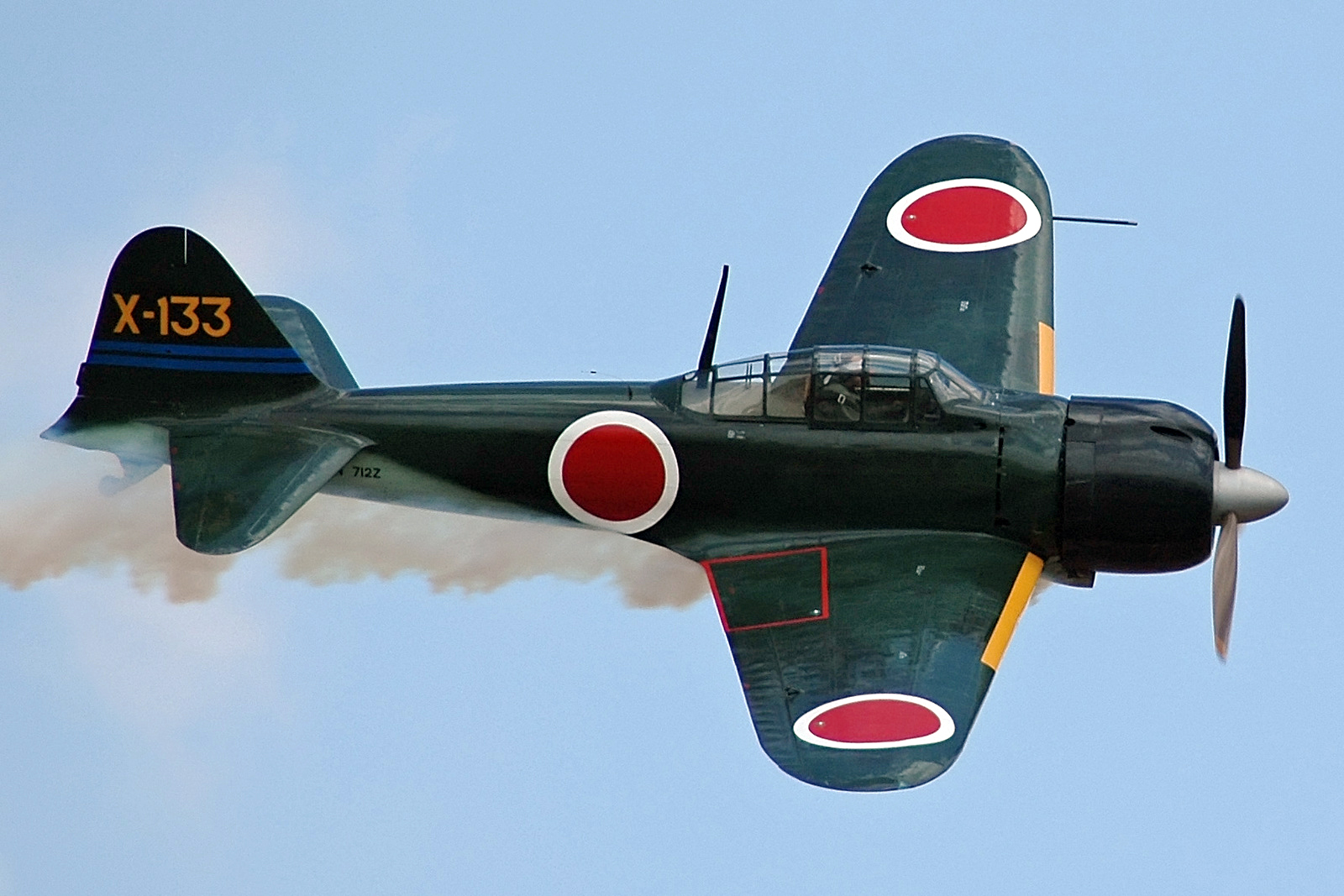
Mitsubishi A6M Zero
The Mitsubishi A6M "Zero" is a long-range carrier-capable fighter aircraft that was manufactured by Mitsubishi Aircraft Company, which was part of Mitsubishi Heavy Industries. It was operated by the Imperial Japanese Navy (IJN) from 1940 to 1945. The A6M was designated as the Mitsubishi Navy Type 0 carrier fighter (零式艦上戦闘機, rei-shiki-kanjō-sentōki), or the Mitsubishi A6M Rei-sen. The A6M was usually referred to by its pilots as the Reisen (零戦, zero fighter), "0" being the last digit of the imperial year 2600 (1940) when it entered service with the IJN. The official Allied reporting name was "Zeke", although the name "Zero" was used more commonly.
The Zero is considered to have been the most capable carrier-based fighter in the world when it was introduced early in World War II, combining excellent maneuverability, high airspeed, strong firepower and very long range. The Imperial Japanese Navy Air Service also frequently used it as a land-based fighter.
In early combat operations, the Zero gained a reputation as a dogfighter, achieving an outstanding kill ratio of 12 to 1, but by mid-1942 a combination of new tactics and the introduction of better equipment enabled Allied pilots to engage the Zero on generally equal terms. By the middle months of 1943 the deterioration of fighter pilot training in the IJNAS contributed to making the Zero less effective against newer Allied fighters. The Zero lacked hydraulic boosting for its ailerons and rudder, rendering it difficult to maneuver at high speeds. Lack of self-sealing fuel tanks also made it more vulnerable than its contemporaries.
By 1944, the A6M had fallen behind Allied fighters in speed and was regarded as outdated but still capable if operated by trained pilots. As design delays and production difficulties hampered the introduction of newer Japanese aircraft models, the Zero continued to serve in a front-line role until the end of the war in the Pacific. During the final phases, it was adapted for use in kamikaze operations. Japan produced more Zeros than any other model of combat aircraft during the war.
The Mitsubishi A5M fighter was just entering service in early 1937, when the Imperial Japanese Navy started looking for its eventual replacement. On 5 October 1937, it issued "Planning Requirements for the Prototype 12-shi Carrier-based Fighter", sending them to Nakajima and Mitsubishi. Both firms started preliminary design work while awaiting more definitive requirements a few months later.
Based on the experiences of the A5M in China, the IJN sent out updated requirements in October, calling for a speed of 270 kn (310 mph; 500 km/h) at 4,000 m (13,000 ft) and a climb to 3,000 m (9,800 ft) in 9.5 minutes. With drop tanks, the IJN wanted an endurance of two hours at normal power, or six to eight hours at economical cruising speed. Armament was to consist of two 20 mm cannons, two 7.7 mm (.303 in) machine guns and two 60 kg (130 lb) bombs. A complete radio set was to be mounted in all aircraft, along with a radio direction finder for long-range navigation. The maneuverability was to be at least equal to that of the A5M, while the wingspan had to be less than 12 m (39 ft) to allow for use on aircraft carriers.
Nakajima's team considered the new requirements unachievable and pulled out of the competition in January. Mitsubishi's chief designer, Jiro Horikoshi, thought that the requirements could be met, but only if the aircraft were made as light as possible. Every possible weight-saving measure was incorporated into the design. Most of the aircraft was built of a new top-secret aluminium alloy developed by Sumitomo Metal Industries in 1936. Called "extra super duralumin", it was lighter, stronger and more ductile than other alloys used at the time but was prone to corrosive attack, which made it brittle.
This detrimental effect was countered with a zinc chromate anti-corrosion coating applied after fabrication. No armour protection was provided for the pilot, engine or other critical points of the aircraft, and self-sealing fuel tanks, which were becoming common among other combatants, were not used. This made the Zero lighter, more maneuverable, and one of the longest-ranged single-engine fighters of World War II, which made it capable of searching out an enemy hundreds of kilometres away, bringing it to battle, then returning to its base or aircraft carrier. However, that tradeoff in weight and construction also made it prone to catching fire and exploding when struck by enemy fire.
Hub AI
Mitsubishi A6M Zero AI simulator
(@Mitsubishi A6M Zero_simulator)
Mitsubishi A6M Zero
The Mitsubishi A6M "Zero" is a long-range carrier-capable fighter aircraft that was manufactured by Mitsubishi Aircraft Company, which was part of Mitsubishi Heavy Industries. It was operated by the Imperial Japanese Navy (IJN) from 1940 to 1945. The A6M was designated as the Mitsubishi Navy Type 0 carrier fighter (零式艦上戦闘機, rei-shiki-kanjō-sentōki), or the Mitsubishi A6M Rei-sen. The A6M was usually referred to by its pilots as the Reisen (零戦, zero fighter), "0" being the last digit of the imperial year 2600 (1940) when it entered service with the IJN. The official Allied reporting name was "Zeke", although the name "Zero" was used more commonly.
The Zero is considered to have been the most capable carrier-based fighter in the world when it was introduced early in World War II, combining excellent maneuverability, high airspeed, strong firepower and very long range. The Imperial Japanese Navy Air Service also frequently used it as a land-based fighter.
In early combat operations, the Zero gained a reputation as a dogfighter, achieving an outstanding kill ratio of 12 to 1, but by mid-1942 a combination of new tactics and the introduction of better equipment enabled Allied pilots to engage the Zero on generally equal terms. By the middle months of 1943 the deterioration of fighter pilot training in the IJNAS contributed to making the Zero less effective against newer Allied fighters. The Zero lacked hydraulic boosting for its ailerons and rudder, rendering it difficult to maneuver at high speeds. Lack of self-sealing fuel tanks also made it more vulnerable than its contemporaries.
By 1944, the A6M had fallen behind Allied fighters in speed and was regarded as outdated but still capable if operated by trained pilots. As design delays and production difficulties hampered the introduction of newer Japanese aircraft models, the Zero continued to serve in a front-line role until the end of the war in the Pacific. During the final phases, it was adapted for use in kamikaze operations. Japan produced more Zeros than any other model of combat aircraft during the war.
The Mitsubishi A5M fighter was just entering service in early 1937, when the Imperial Japanese Navy started looking for its eventual replacement. On 5 October 1937, it issued "Planning Requirements for the Prototype 12-shi Carrier-based Fighter", sending them to Nakajima and Mitsubishi. Both firms started preliminary design work while awaiting more definitive requirements a few months later.
Based on the experiences of the A5M in China, the IJN sent out updated requirements in October, calling for a speed of 270 kn (310 mph; 500 km/h) at 4,000 m (13,000 ft) and a climb to 3,000 m (9,800 ft) in 9.5 minutes. With drop tanks, the IJN wanted an endurance of two hours at normal power, or six to eight hours at economical cruising speed. Armament was to consist of two 20 mm cannons, two 7.7 mm (.303 in) machine guns and two 60 kg (130 lb) bombs. A complete radio set was to be mounted in all aircraft, along with a radio direction finder for long-range navigation. The maneuverability was to be at least equal to that of the A5M, while the wingspan had to be less than 12 m (39 ft) to allow for use on aircraft carriers.
Nakajima's team considered the new requirements unachievable and pulled out of the competition in January. Mitsubishi's chief designer, Jiro Horikoshi, thought that the requirements could be met, but only if the aircraft were made as light as possible. Every possible weight-saving measure was incorporated into the design. Most of the aircraft was built of a new top-secret aluminium alloy developed by Sumitomo Metal Industries in 1936. Called "extra super duralumin", it was lighter, stronger and more ductile than other alloys used at the time but was prone to corrosive attack, which made it brittle.
This detrimental effect was countered with a zinc chromate anti-corrosion coating applied after fabrication. No armour protection was provided for the pilot, engine or other critical points of the aircraft, and self-sealing fuel tanks, which were becoming common among other combatants, were not used. This made the Zero lighter, more maneuverable, and one of the longest-ranged single-engine fighters of World War II, which made it capable of searching out an enemy hundreds of kilometres away, bringing it to battle, then returning to its base or aircraft carrier. However, that tradeoff in weight and construction also made it prone to catching fire and exploding when struck by enemy fire.