



Community hub
Recent from talks
Contribute something to knowledge base
Content stats: 0 posts, 0 articles, 1 media, 0 notes
Members stats: 0 subscribers, 0 contributors, 0 moderators, 0 supporters
Subscribers
Supporters
Contributors
Moderators
Hub AI
API oil–water separator AI simulator
(@API oil–water separator_simulator)
Hub AI
API oil–water separator AI simulator
(@API oil–water separator_simulator)
API oil–water separator
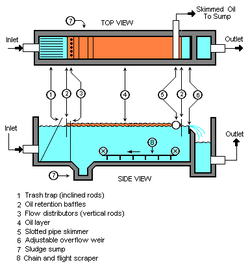
An API oil–water separator is a device designed to separate gross amounts of oil and suspended solids from industrial wastewater produced at oil refineries, petrochemical plants, chemical plants, natural gas processing plants and other industrial oily water sources. The API separator is a gravity separation device designed by using Stokes Law to define the rise velocity of oil droplets based on their density and size. The design is based on the specific gravity difference between the oil and the wastewater because that difference is much smaller than the specific gravity difference between the suspended solids and water. The suspended solids settles to the bottom of the separator as a sediment layer, the oil rises to top of the separator and the cleansed wastewater is the middle layer between the oil layer and the solids.
The name is derived from the fact that such separators are designed according to standards published by the American Petroleum Institute (API).
The API separator is a gravity separation device designed using Stokes' law principles that define the rise velocity of oil droplets based on their density, size and water properties. The design of the separator is based on the specific gravity difference between the oil and the wastewater because that difference is much smaller than the specific gravity difference between the suspended solids and water. Based on that design criterion, most of the suspended solids will settle to the bottom of the separator as a sediment layer, the oil will rise to top of the separator, and the wastewater will be the middle layer between the oil on top and the solids on the bottom. The API Design Standards, when correctly applied, make adjustments to the geometry, design and size of the separator beyond simple Stokes Law principles. This includes allowances for water flow entrance and exit turbulence losses as well as other factors. API Specification 421 requires a minimum length to width ratio of 5:1 and minimum depth-to-width ratio of 0.3:0.5.
Typically, the oil layer is skimmed off and subsequently re-processed or disposed of, and the bottom sediment layer is removed by a chain and flight scraper (or similar device) and a sludge pump. The water layer is sent to further treatment for additional removal of any residual oil and then to some type of biological treatment unit for removal of undesirable dissolved chemical compounds.[citation needed]
Many oils can be recovered from open water surfaces by skimming devices. Considered a dependable and cheap way to remove oil, grease and other hydrocarbons from water, oil skimmers can sometimes achieve the desired level of water purity. At other times, skimming is also a cost-efficient method to remove most of the oil before using membrane filters and chemical processes. Skimmers will prevent filters from blinding prematurely and keep chemical costs down because there is less oil to process.[citation needed]
Because grease skimming involves higher viscosity hydrocarbons, skimmers must be equipped with heaters powerful enough to keep grease fluid for discharge. If floating grease forms into solid clumps or mats, a spray bar, aerator or mechanical apparatus can be used to facilitate removal.
However, hydraulic oils and the majority of oils that have degraded to any extent will also have a soluble or emulsified component that will require further treatment to eliminate. Dissolving or emulsifying oil using surfactants or solvents usually exacerbates the problem rather than solving it, producing wastewater that is more difficult to treat.
API design separators, and similar gravity tanks, are not intended to be effective when any of the following conditions apply to the feed conditions:[citation needed]
API oil–water separator
An API oil–water separator is a device designed to separate gross amounts of oil and suspended solids from industrial wastewater produced at oil refineries, petrochemical plants, chemical plants, natural gas processing plants and other industrial oily water sources. The API separator is a gravity separation device designed by using Stokes Law to define the rise velocity of oil droplets based on their density and size. The design is based on the specific gravity difference between the oil and the wastewater because that difference is much smaller than the specific gravity difference between the suspended solids and water. The suspended solids settles to the bottom of the separator as a sediment layer, the oil rises to top of the separator and the cleansed wastewater is the middle layer between the oil layer and the solids.
The name is derived from the fact that such separators are designed according to standards published by the American Petroleum Institute (API).
The API separator is a gravity separation device designed using Stokes' law principles that define the rise velocity of oil droplets based on their density, size and water properties. The design of the separator is based on the specific gravity difference between the oil and the wastewater because that difference is much smaller than the specific gravity difference between the suspended solids and water. Based on that design criterion, most of the suspended solids will settle to the bottom of the separator as a sediment layer, the oil will rise to top of the separator, and the wastewater will be the middle layer between the oil on top and the solids on the bottom. The API Design Standards, when correctly applied, make adjustments to the geometry, design and size of the separator beyond simple Stokes Law principles. This includes allowances for water flow entrance and exit turbulence losses as well as other factors. API Specification 421 requires a minimum length to width ratio of 5:1 and minimum depth-to-width ratio of 0.3:0.5.
Typically, the oil layer is skimmed off and subsequently re-processed or disposed of, and the bottom sediment layer is removed by a chain and flight scraper (or similar device) and a sludge pump. The water layer is sent to further treatment for additional removal of any residual oil and then to some type of biological treatment unit for removal of undesirable dissolved chemical compounds.[citation needed]
Many oils can be recovered from open water surfaces by skimming devices. Considered a dependable and cheap way to remove oil, grease and other hydrocarbons from water, oil skimmers can sometimes achieve the desired level of water purity. At other times, skimming is also a cost-efficient method to remove most of the oil before using membrane filters and chemical processes. Skimmers will prevent filters from blinding prematurely and keep chemical costs down because there is less oil to process.[citation needed]
Because grease skimming involves higher viscosity hydrocarbons, skimmers must be equipped with heaters powerful enough to keep grease fluid for discharge. If floating grease forms into solid clumps or mats, a spray bar, aerator or mechanical apparatus can be used to facilitate removal.
However, hydraulic oils and the majority of oils that have degraded to any extent will also have a soluble or emulsified component that will require further treatment to eliminate. Dissolving or emulsifying oil using surfactants or solvents usually exacerbates the problem rather than solving it, producing wastewater that is more difficult to treat.
API design separators, and similar gravity tanks, are not intended to be effective when any of the following conditions apply to the feed conditions:[citation needed]
Recent media
Recent media