



Community hub
Community hub
Recent from talks
Knowledge base stats:
Talk channels stats:
Members stats:
A Doll's House
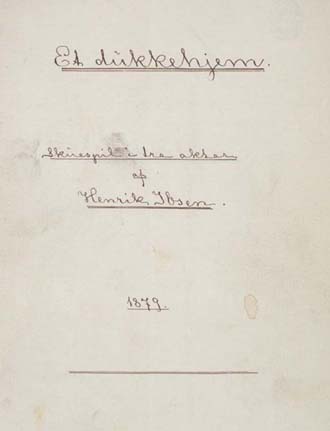
A Doll's House (Danish and Bokmål: Et dukkehjem; also translated as A Doll House) is a three-act play written by Norwegian playwright Henrik Ibsen. It premiered at the Royal Danish Theatre in Copenhagen, Denmark, on 21 December 1879, having been published earlier that month. The play is set in a Norwegian town c. 1879.
The play concerns the fate of a married woman, who, at the time in Norway, lacked reasonable opportunities for self-fulfillment in a male-dominated world. Despite the fact that Ibsen denied it was his intent to write a feminist play, it was a great sensation at the time and caused a "storm of outraged controversy" that went beyond the theater to the world of newspapers and society.
In 2006, the centennial of Ibsen's death, A Doll's House held the distinction of being the world's most-performed play that year. UNESCO has inscribed Ibsen's autographed manuscripts of A Doll's House on the Memory of the World Register in 2001, in recognition of their historical value.
The title of the play is most commonly translated as A Doll's House, though some scholars use A Doll House. John Simon says that A Doll's House is "the British term for what [Americans] call a 'dollhouse'". Egil Törnqvist says of the alternative title: "Rather than being superior to the traditional rendering, it simply sounds more idiomatic to Americans."
(The character's name in Michael Meyer's 1965 translation is Peter Rank.)
(Some English translations localize the spelling of the name Kristine to Christine.)
The play opens around Christmas time as Nora Helmer enters her home carrying many packages and presents. Nora's husband, Torvald, is working in his study when she arrives. He playfully rebukes her for spending so much money on Christmas gifts, calling her his "little squirrel". He teases her about how, the previous year, she had spent weeks making gifts and ornaments by hand because money was scarce. This year, Torvald is due a promotion at the bank where he works, so Nora feels that they can let themselves go a little. The maid announces two visitors: Mrs. Kristine Linde, an old friend of Nora's, who has come seeking employment; and Dr. Rank, a close friend of the family, who is let into the study. Kristine has had a difficult few years, ever since her husband died leaving her with no money or children. Nora says that things have not been easy for them either: Torvald became sick, and they had to travel to Italy so he could recover. Kristine explains that, when her mother was ill, she had to take care of her brothers, but, now that they are grown, she feels her life is "unspeakably empty". Nora promises to talk to Torvald about finding her a job. Kristine gently tells Nora that she is like a child. Nora is offended, so she tells her that she got money from "some admirer" so they could travel to Italy to improve Torvald's health. She told Torvald that her father gave her the money, but, in fact, she illegally borrowed it without his knowledge (women were forbidden from conducting financial activities such as signing checks without a man's endorsement). Since then, she has been secretly working and saving up to pay off the loan.
Krogstad, a low level employee at Torvald's bank, arrives and goes into the study. Nora is clearly uneasy when she sees him. Dr. Rank leaves the study and mentions that he feels wretched, though like everyone he wants to go on living. In contrast to his physical illness, he says that the man in the study, Krogstad, is "morally diseased".
Hub AI
A Doll's House AI simulator
(@A Doll's House_simulator)
A Doll's House
A Doll's House (Danish and Bokmål: Et dukkehjem; also translated as A Doll House) is a three-act play written by Norwegian playwright Henrik Ibsen. It premiered at the Royal Danish Theatre in Copenhagen, Denmark, on 21 December 1879, having been published earlier that month. The play is set in a Norwegian town c. 1879.
The play concerns the fate of a married woman, who, at the time in Norway, lacked reasonable opportunities for self-fulfillment in a male-dominated world. Despite the fact that Ibsen denied it was his intent to write a feminist play, it was a great sensation at the time and caused a "storm of outraged controversy" that went beyond the theater to the world of newspapers and society.
In 2006, the centennial of Ibsen's death, A Doll's House held the distinction of being the world's most-performed play that year. UNESCO has inscribed Ibsen's autographed manuscripts of A Doll's House on the Memory of the World Register in 2001, in recognition of their historical value.
The title of the play is most commonly translated as A Doll's House, though some scholars use A Doll House. John Simon says that A Doll's House is "the British term for what [Americans] call a 'dollhouse'". Egil Törnqvist says of the alternative title: "Rather than being superior to the traditional rendering, it simply sounds more idiomatic to Americans."
(The character's name in Michael Meyer's 1965 translation is Peter Rank.)
(Some English translations localize the spelling of the name Kristine to Christine.)
The play opens around Christmas time as Nora Helmer enters her home carrying many packages and presents. Nora's husband, Torvald, is working in his study when she arrives. He playfully rebukes her for spending so much money on Christmas gifts, calling her his "little squirrel". He teases her about how, the previous year, she had spent weeks making gifts and ornaments by hand because money was scarce. This year, Torvald is due a promotion at the bank where he works, so Nora feels that they can let themselves go a little. The maid announces two visitors: Mrs. Kristine Linde, an old friend of Nora's, who has come seeking employment; and Dr. Rank, a close friend of the family, who is let into the study. Kristine has had a difficult few years, ever since her husband died leaving her with no money or children. Nora says that things have not been easy for them either: Torvald became sick, and they had to travel to Italy so he could recover. Kristine explains that, when her mother was ill, she had to take care of her brothers, but, now that they are grown, she feels her life is "unspeakably empty". Nora promises to talk to Torvald about finding her a job. Kristine gently tells Nora that she is like a child. Nora is offended, so she tells her that she got money from "some admirer" so they could travel to Italy to improve Torvald's health. She told Torvald that her father gave her the money, but, in fact, she illegally borrowed it without his knowledge (women were forbidden from conducting financial activities such as signing checks without a man's endorsement). Since then, she has been secretly working and saving up to pay off the loan.
Krogstad, a low level employee at Torvald's bank, arrives and goes into the study. Nora is clearly uneasy when she sees him. Dr. Rank leaves the study and mentions that he feels wretched, though like everyone he wants to go on living. In contrast to his physical illness, he says that the man in the study, Krogstad, is "morally diseased".